
Spatiotemporal Assessment of Physicochemical Water Quality in the Al-Aziziyah–Al-Hafariya Water Treatment System, Wasit, Iraq
Article Sidebar
Main Article Content
Abstract
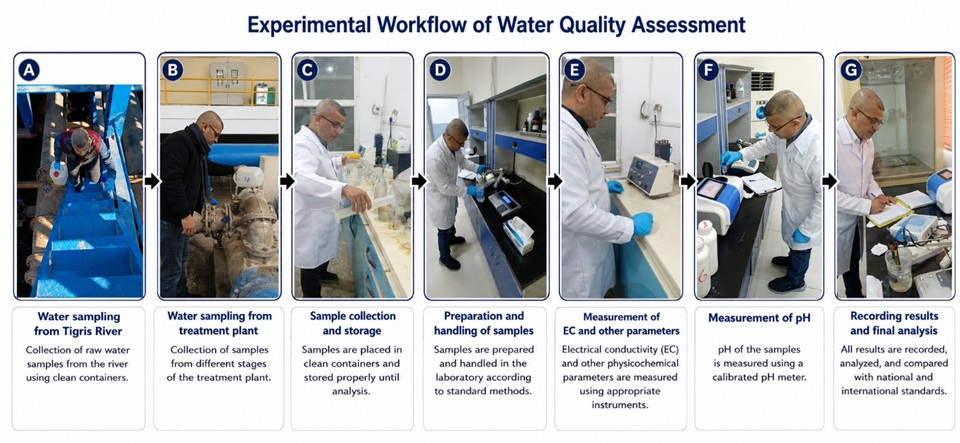
This study aimed to evaluate the physicochemical characteristics of water within the Al-Aziziyah–Al-Hafariya unified water treatment and distribution system in Wasit Governorate, Iraq. Water samples were collected monthly from six locations representing the raw water source, treatment stages, and the distribution network from September 2025 to February 2026. Key parameters were analyzed, including temperature, turbidity, total suspended solids (TSS), total dissolved solids (TDS), electrical conductivity (EC), salinity, pH, dissolved oxygen (DO), biological oxygen demand (BOD), alkalinity, hardness, residual chlorine, sulfate, nitrate, and phosphate. The results showed significant temporal variations (P ≤ 0.05) in most parameters, while spatial variations were generally insignificant across all sampling sites. Temperature, TDS, EC, salinity, and hardness were higher during autumn and decreased in winter. In contrast, dissolved oxygen and nutrient concentrations increased during colder months. Turbidity and TSS exhibited seasonal fluctuations. Critically, residual chlorine fell to zero at all six sampling sites during January and February, well below the WHO minimum recommendation of ≥0.2 mg/L at the point of delivery, representing a serious public health concern regarding microbiological safety. Statistically significant spatial variation (P ≤ 0.05) was observed in phosphate concentrations, with elevated levels at distribution-network endpoints (S4–S6, mean 0.238–0.257 mg/L) compared to raw and treated water sites (S1–S2, mean 0.174–0.177 mg/L), suggesting localized contamination within the distribution network. In conclusion, seasonal factors play a dominant role in influencing water quality, while the treatment and distribution system ensures relatively uniform water characteristics across the study area. These findings emphasize the importance of continuous monitoring and optimization of treatment and disinfection processes to ensure safe drinking water quality.
Downloads
Article Details

This work is licensed under a Creative Commons Attribution-NonCommercial-NoDerivatives 4.0 International License.
References
Cain, N. L.; Gleick, P. H. The Global Water Crisis. Issues Sci. Technol. 2005, 21, 79–82.
Gleick, P. H.; Cooley, H. Freshwater Scarcity. Annu. Rev. Environ. Resour. 2021, 46, 319–348. https://doi.org/10.1146/annurev-environ-012220-101319
American Public Health Association (APHA). Standard Methods for the Examination of Water and Wastewater, 23rd ed.; American Public Health Association: Washington, DC, 2017
Boyd, C. E. Water Quality: An Introduction; Springer: New York, 2000. https://doi.org/10.1007/978-1-4615-4485-2
Al Yousif, M. A.; Chabuk, A. Assessment Water Quality Indices of Surface Water for Drinking and Irrigation Applications—A Comparison Review. J. Ecol. Eng. 2023, 24, 40–55. https://doi.org/10.12911/22998993/161194
Farhan, A. F.; Al-Ahmady, K. K.; Al-Masry, N. A. A. Assessment of Tigris River Water Quality in Mosul for Drinking and Domestic Use by Applying CCME Water Quality Index. IOP Conf. Ser.: Mater. Sci. Eng. 2020, 737, 012204. https://doi.org/10.1088/1757-899X/737/1/012204
Alsaadoon, D. W. K.; Hassan, F. M.; Mahdi, W. M. Assessment of Water Quality of Diyala River Using Overall Index of Pollution (OIP) in Iraq. Iraqi J. Agric. Sci. 2023, 54, 682–690. https://doi.org/10.36103/ijas.v54i3.1748
Mohammed, N. Y.; Abdulrazzaq, K. A. Evaluation of Drinking Water Quality in Al Wahda Treatment Plant in Baghdad City—Iraq. J. Eng. 2021, 27, 38–50. https://doi.org/10.31026/j.eng.2021.09.04
Al-Mayah, W. T. Chemical and Microbial Health Risk Assessment of Drinking Water Treatment Plants in Kut City, Iraq. Mater. Today: Proc. 2021, 42, 3062–3067. https://doi.org/10.1016/j.matpr.2020.12.920
Radhi, I.; Abduljaleel, H.; Mohmmed, Z.; Abdulhassan, A.; Jazaa, B. Assessment of Al-Wahda Water Treatment Plant within Baghdad City. AIP Conf. Proc. 2024, 020070. https://doi.org/10.1063/5.0236870
Hamaamin, Y. A. Performance Evaluation of Conventional Water Treatment Plants Using Turbidity and Disinfection Parameters. Zanco J. Pure Appl. Sci. 2026, 38, 177–188. https://doi.org/10.21271/ZJPAS.38.1.14
Abbas, S. H.; Khudair, B. H.; Jaafar, M. S. River Water Salinity Impact on Drinking Water Treatment Plant Performance Using Artificial Neural Network. J. Eng. 2019, 25, 149–159. https://doi.org/10.31026/j.eng.2019.08.10
Al-Mohammed, F. M.; Al-Saadi, R. J. M.; Al-Fawzy, A. M.; Mohammed-Ali, S. H.; Mutasher, A. A.; Hommadi, A. H. The Analysis of Water Quality Using Canadian Water Quality Index: Green Belt Project/Kerbala-Iraq. Int. J. Des. Nat. Ecodyn. 2021, 16, 91–98. https://doi.org/10.18280/ijdne.160112
Abbas, H. A. Revisited Iraqi Drinking Water Quality Standards (IQS 417/2009). Tikrit J. Eng. Sci. 2025, 32, 23. https://doi.org/10.25130/tjes.32.1.23
Dhanabal, G.; Chellaiah, G. Enhancing Residual Chlorine Stability in Water Distribution Systems: Challenges, Modeling Approaches, and Advanced Optimization Strategies. Next Chem. Eng. 2025, 1, 100005. https://doi.org/10.1016/j.nxcen.2025.100005
Alegbeleye, O. O.; Singleton, I.; Sant'Ana, A. S. Sources and Contamination Routes of Microbial Pathogens to Fresh Produce during Field Cultivation: A Review. Food Microbiol. 2018, 73, 177–208. https://doi.org/10.1016/j.fm.2018.01.003
World Health Organization. Guidelines for Drinking-Water Quality, 4th ed.; World Health Organization: Geneva, 2017.
U.S. Environmental Protection Agency. Drinking Water Regulations and Contaminants; U.S. Environmental Protection Agency: Washington, DC, 2020.
Al-Mayah, W. T. Evaluation of Efficiency of Drinking Water Treatment Plant in Al-Aziziyah City, Iraq. Sci. Res. J. Agric. Life Sci. 2022, 2, 1–7. https://doi.org/10.47310/srjals.2022.v02i02.001
Strickland, J. D. H.; Parsons, T. R. A Practical Handbook of Seawater Analysis; Fisheries Research Board of Canada: Ottawa, 1972.
Khader, B.; Owaied, Y. H.; Jalal, R. Physical and Chemical Analysis of Water Quality at Al-Dur Water Treatment Plant. J. Primeasia 2024, 5, 1–9. https://doi.org/10.25163/primeasia.519766
Hamza, A.; Hama, B. H.; Karim, M. M.; Ahmed, K. Water Quality Assessment for Qaladze Water Treatment Plant, Sulaymaniyah Governorate, Kurdistan Region, Iraq. Adv. Civ. Eng. Environ. Sci. 2024, 1, 15–24.
Mesfun, N. M.; Derib, S. D. Performance Evaluation and Factors Influencing a Drinking Water Treatment Plant, Shire Indassilassie, Ethiopia. Water-Energy Nexus 2024, 7, 235–242. https://doi.org/10.1016/j.wen.2024.08.001
Mendez-Ruiz, J. I.; Barcia-Carreño, M. B.; Mejía-Bustamante, L. J.; Cornejo-Pozo, Á. K.; Salas-Vázquez, C. A.; Valverde-Armas, P. E. Assessment of the Performance of a Water Treatment Plant in Ecuador: Hydraulic Resizing of the Treatment Units. Sustainability 2023, 15, 1235. https://doi.org/10.3390/su15021235
Nasier, M.; Abdulrazzaq, K. A. Performance Evaluation of the Turbidity Removal Efficiency of Al-Muthana Water Treatment Plant. J. Eng. 2022, 28, 1–13. https://doi.org/10.31026/j.eng.2022.03.01
Hamaamin, Y. A.; Abdullah, J. B. Temporal Variation of Drinking Water Quality Parameters for Sulaimani City, Kurdistan Region, Iraq. UHD J. Sci. Technol. 2020, 4, 99–106. https://doi.org/10.21928/uhdjst.v4n2y2020.pp99-106
Hussein, M. A.; Muhsun, S. S.; Abudi, Z. N. Groundwater Quality Assessment for the Wells System in Zurbatiyah, Iraq, for Civil and Irrigation Uses by Two Water Quality Index Approaches. J. Ecol. Eng. 2025, 26, 389–402. https://doi.org/10.12911/22998993/207193
Kumar, P. Water Quality Assessments for Urban Water Environment. Water 2021, 13, 1686. https://doi.org/10.3390/w13121686
Bwapwa, J. K.; Mkhize, N.; Seyam, M. Evaluation of Operational Efficiency and Performance for a Water Treatment Plant. S. Afr. J. Chem. Eng. 2024, 49, 11–34. https://doi.org/10.1016/j.sajce.2024.04.003
Jumaa, M. W.; Abdulqader, R. S. Evaluation of Drinking Water Quality Index in Kirkuk City, Iraq. Cent. Asian J. Med. Nat. Sci. 2024, 5, 815–823.
Elsherif, S. M.; Kazma, M. H.; Taha, A. F. Quality-Aware Hydraulic Control in Drinking Water Networks via Controllability Proxies. arXiv 2024, arXiv:2401.12214
Abdul-Kareem, N.; Al-Baidhani, J. H. Assessing the Influence of Climate Change on Water Treatment Efficiency in Baghdad, Iraq. J. Wildl. Biodivers. 2023, 7, 713–729
Choudhury, S.; Saha, A. K. Prediction of Operation Efficiency of Water Treatment Plant with the Help of Multi-Criteria Decision-Making. Water Conserv. Sci. Eng. 2018, 3, 79–90. https://doi.org/10.1007/s41101-017-0034-2
Silva, G. M. E.; Campos, D. F.; Brasil, J. A. T.; Tremblay, M.; Mendiondo, E. M.; Ghiglieno, F. Advances in Technological Research for Online and In Situ Water Quality Monitoring—A Review. Sustainability 2022, 14, 5059. https://doi.org/10.3390/su14095059
Ethaib, S.; Fahs, M.; Mishbak, H.; Fares, M. N.; Makki, J. S.; Alhello, A.; Bitar, A. A. Water Resources in South of Iraq: Current State, Future Evolutions, Challenges, and Potential Solutions. Hydrology 2026, 13, 87. https://doi.org/10.3390/hydrology13030087
Ali, B. H.; Abojassim, A. A. Heavy Metals in Healthy Water Samples Used by Newborn in Al-Najaf Governorate, Iraq. Al-Bahir J. Eng. Pure Sci. 2025, 6, 7. https://doi.org/10.55810/2313-0083.1097
