
Reducing GHG Emissions in Frozen Fruit Processing by Solar Optimization and Waste Management Strategies
Article Sidebar
Main Article Content
Abstract
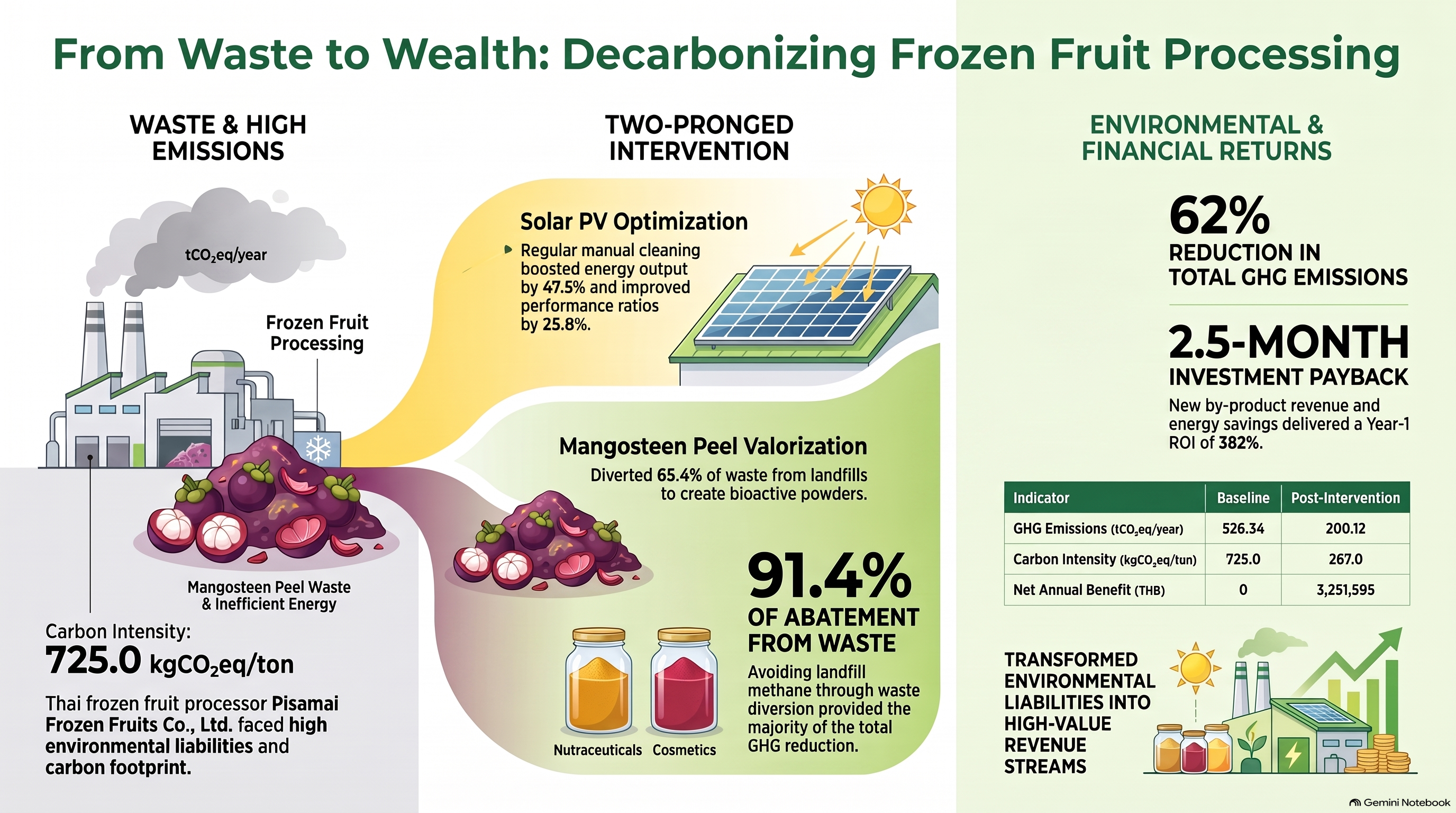
This study quantifies the combined environmental and economic effects of two parallel interventions, solar-panel cleaning and mangosteen peel valorization, at a Thai frozen-fruit processing facility, with emissions calculated using the Thailand Greenhouse Gas Management Organization (TGO) methodology for July–December 2023. Aggregate greenhouse-gas (GHG) emissions fell from 526.34 to 200.12 tCO₂eq/year, a reduction of 326.22 tCO₂eq/year (−62.0%). Waste valorization accounted for 91.4% of the reduction (298.15 tCO₂eq), and solar optimization accounted for the remaining 8.6% (28.07 tCO₂eq). Carbon intensity of production declined from 725.0 to 267.0 kgCO₂eq per tonne of finished product (−63.2%), and the facility BCG (Bio-Circular-Green) composite index rose from 0.42 to 0.78. Solar cleaning increased annual generation from 70,000 to 146,000 kWh and improved the system performance ratio from 0.62 to 0.78 (+25.8%). Peel diversion reached 65.4% (283,120 of 433,120 kg/year), yielding 42,468 kg/year of dried by-products. In economics, capital expenditure totaled 675,000 THB. Annual operating savings reached 549,872 THB (380,000 THB in electricity, 169,872 THB in waste disposal), and by-product sales added 2,831,723 THB/year. Net annual benefit after maintenance was 3,251,595 THB, giving a payback of 2.5 months, a Year-1 ROI of 382%, and a Year-3 ROI of 1,346%. The findings support a phased adoption pathway, solar optimization first, then waste valorization, anchored to source-segregation protocols and seasonal capacity-sharing arrangements among co-located processors.
Downloads
Article Details

This work is licensed under a Creative Commons Attribution-NonCommercial-NoDerivatives 4.0 International License.
References
Iamchamnan, P.; Saithanoo, S.; Putsukee, T.; Intasuwan, S. Assessment of Carbon Footprint for Organization in Frozen Processed Seafood Factory and Strategies for Greenhouse Gas Emission Reduction. Processes 2025, 13, 1990. https://doi.org/10.3390/pr13071990
IPCC. Climate Change 2014: Synthesis Report. Contribution of Working Groups I, II, and III to the Fifth Assessment Report of the Intergovernmental Panel on Climate Change; Core Writing Team, Pachauri, R. K., Meyer, L. A., Eds.; Intergovernmental Panel on Climate Change: Geneva, Switzerland, 2014.
Siribrahmanakul, J.; Ngarmpornprasert, S. A Comprehensive Literature Review on Greenhouse Gas Mitigation in Thailand's Building and Industrial Sectors: Technical, Economic, and Policy Insights from Recent Studies. ASEAN J. Sci. Technol. Rep. 2026, 29(3), 261277. https://doi.org/10.55164/ajstr.v29i3.261277
Okonogi, S.; Duangrat, C.; Anuchpreeda, S.; Tachakittirungrod, S.; Chowwanapoonpohn, S. Comparison of Antioxidant Capacities and Cytotoxicities of Certain Fruit Peels. Food Chem. 2007, 103(3), 839–846. https://doi.org/10.1016/j.foodchem.2006.09.034
Lim, S. L.; Wu, T. Y.; Clarke, C. Treatment and Biotransformation of Highly Polluted Agro-industrial Wastewater from a Palm Oil Mill into Vermicompost Using Earthworms. J. Agric. Food Chem. 2014, 62(3), 691–698. https://doi.org/10.1021/jf404265f
Tangprasert, P.; Krasaechol, N.; Weerasai, K. Valorization of food processing by-products in Thailand's emerging bioactive ingredient market. ASEAN J. Sci. Technol. Dev. 2021, 38(2), 79–87. https://doi.org/10.29037/ajstd.668
Fielding, M.; Aung, M. T. Bioeconomy in Thailand: A Case Study; Working Paper; Stockholm Environment Institute: Stockholm, Sweden, 2018. https://www.sei.org/wp-content/uploads/2018/04/sei-wp-2018-bioeconomy-thailand.pdf (accessed June 8, 2026).
Khawkomol, S.; Vongphet, J. Investor-Centric Policy Prioritization for Biomass Energy in Thailand: An Analytic Hierarchy Process Decision-Support Model. Sustainability 2026, 18, 2224. https://doi.org/10.3390/su18052224
Duangsong, J.; Theerathammakorn, S. Evaluation and Reduction of the Carbon Footprints Associated with Steviol Glycoside Production. ASEAN J. Sci. Technol. Rep. 2024, 27(3), e252464. https://doi.org/10.55164/ajstr.v27i3.252464
Department of Business Development, Ministry of Commerce, Thailand. Company Registration Certificate: Pitsamai Frozen Fruits Company Limited (Registration No. 0705561001403). https://encert.dbd.go.th/encert-inter/public/en/checkbyref (accessed June 8, 2026).
Pitsamai Frozen Fruits Co., Ltd. Frozen Fruit Manufacturing — OEM/ODM Export Standards (Mango, Durian, Mangosteen). https://www.pitsamai-pff.com/ (accessed June 8, 2026).
IEC. Photovoltaic System Performance-Part 1: Monitoring; IEC 61724-1:2017; International Electrotechnical Commission: Geneva, Switzerland, 2017.
Thailand Greenhouse Gas Management Organization (TGO). Carbon Footprint for Organization (CFO). https://thaicarbonlabel.tgo.or.th/index.php (accessed June 8, 2026).
ISO. Greenhouse Gases — Part 1: Specification with Guidance at the Organization Level for Quantification and Reporting of Greenhouse Gas Emissions and Removals; ISO 14064-1:2018; International Organization for Standardization: Geneva, Switzerland, 2018.
Maghami, M.R.; Hizam, H.; Gomes, C.; Radzi, M.A.; Rezadad, M.I.; Hajighorbani, S. Power loss due to soiling on solar panel: A review. Renew. Sustain. Energy Rev. 2016, 59, 1307–1316. https://doi.org/10.1016/j.rser.2016.01.044
Lakshmi, K. R. C.; Ramadas, G. Dust Deposition's Effect on Solar Photovoltaic Module Performance: An Experimental Study in India's Tropical Region. J. Renewable Mater. 2022, 10(8), 2133–2153. https://doi.org/10.32604/jrm.2022.019649
Office of the Energy Regulatory Commission (OERC). Annual Report 2023; Energy Regulatory Commission and Office of the Energy Regulatory Commission: Bangkok, Thailand, 2024.
Tanesab, J.; Parlevliet, D.; Whale, J.; Urmee, T. Seasonal Effect of Dust on the Degradation of PV Modules Performance Deployed in Different Climate Areas. Renew. Energy 2017, 111, 105–115. https://doi.org/10.1016/j.renene.2017.03.091
Said, S. A.; Walwil, H. M. Fundamental Studies on Dust Fouling Effects on PV Module Performance. Sol. Energy 2014, 107, 328–337. https://doi.org/10.1016/j.solener.2014.05.048
Saidan, M.; Albaali, A. G.; Alasis, E.; Kaldellis, J. K. Experimental Study on the Effect of Dust Deposition on Solar Photovoltaic Panels in Desert Environment. Renew. Energy 2016, 92, 499–505. https://doi.org/10.1016/j.renene.2016.02.031
Rout, S.; Srivastav, P. P.; Mishra, S. Valorization of Mango Peels Toward Sustainability and Circular Economy by Combining Pretreatment and Drying with Ultrasound Assisted Extraction. J. Food Process Eng. 2025. https://doi.org/10.1111/jfpe.70079
Sutthasil, N.; Chiemchaisri, C.; Chiemchaisri, W.; Wangyao, K.; Towprayoon, S.; Endo, K.; Yamada, M. Life Cycle Greenhouse Gas Emissions of Emerging Municipal Solid Waste Management Options: A Case Study in Thailand. J. Mater. Cycles Waste Manage. 2023, 25, 662–673. https://doi.org/10.1007/s10163-022-01584-6
Amornwattahcharoenchai, P.; Jantapoon, K. Marginal Abatement Cost Curves for Carbon-Neutral Transition in Thailand’s Agri-Food Processing Industry: Quantitative Pathways toward Bio-Circular-Green Economy Alignment. Front. Sustain. Food Syst. 2026, 10, 1842024. https://doi.org/10.3389/fsufs.2026.1842024
Department of Industrial Works (DIW), Ministry of Industry, Thailand. Industrial Factory Database and SME Benchmarking Statistics. https://www.diw.go.th (accessed June 8, 2026).
Thai Frozen Foods Association (TFFA). Industry Standards and Sustainability Information. https://www.thai-frozen.or.th (accessed June 8, 2026).
Mungkung, R.; Pengthamkeerati, P.; Chaichana, R.; Watcharothai, S.; Kitpakornsanti, K.; Tapananont, S. Life Cycle Assessment of Thai Organic Hom Mali Rice to Evaluate the Climate Change, Water Use and Biodiversity Impacts. J. Clean. Prod. 2019, 211, 687–694. https://doi.org/10.1016/j.jclepro.2018.11.197
Ministry of Higher Education, Science, Research and Innovation (MHESI). Bio-Circular-Green Economy Model: BCG Strategic Action Plan 2021–2027; MHESI: Bangkok, Thailand, 2021.
Yoomak, S.; Patcharoen, T.; Ngaopitakkul, A. Performance and Economic Evaluation of Solar Rooftop Systems in Different Regions of Thailand. Sustainability 2019, 11, 6647. https://doi.org/10.3390/su11236647
Board of Investment of Thailand (BOI). Investment Promotion Act and Category List (Activity 7.1: Production of Electricity from Renewable Energy). https://www.boi.go.th (accessed June 8, 2026).
Krungsri Research. Rooftop Solar: Suitable Business and Investment Models for Thailand; Bank of Ayudhya (Krungsri): Bangkok, Thailand, 2025. https://www.krungsri.com/en/research (accessed June 8, 2026).
Usubharatana, P.; Phungrassami, H. Evaluation of Opportunities to Reduce the Carbon Footprint of Fresh and Canned Pineapple Processing in Central Thailand. Pol. J. Environ. Stud. 2017, 26 (4), 1725–1735. https://doi.org/10.15244/pjoes/69442
Hasanbeigi, A.; Menke, C.; du Pont, P. Barriers to Energy Efficiency Improvement and Decision-Making Behavior in Thai Industry. Energy Effic. 2010, 3, 33–52. https://doi.org/10.1007/s12053-009-9056-8
Chanthawong, A.; Dhakal, S. Stakeholders’ Perceptions on Challenges and Opportunities for Biodiesel and Bioethanol Policy Development in Thailand. Energy Policy 2016, 91, 189–206. https://doi.org/10.1016/j.enpol.2016.01.008
