
Tourists’ Responses to Immersive Technology in Community-Based Tourism: A Stimulus–Organism–Response Model
Article Sidebar
Main Article Content
Abstract
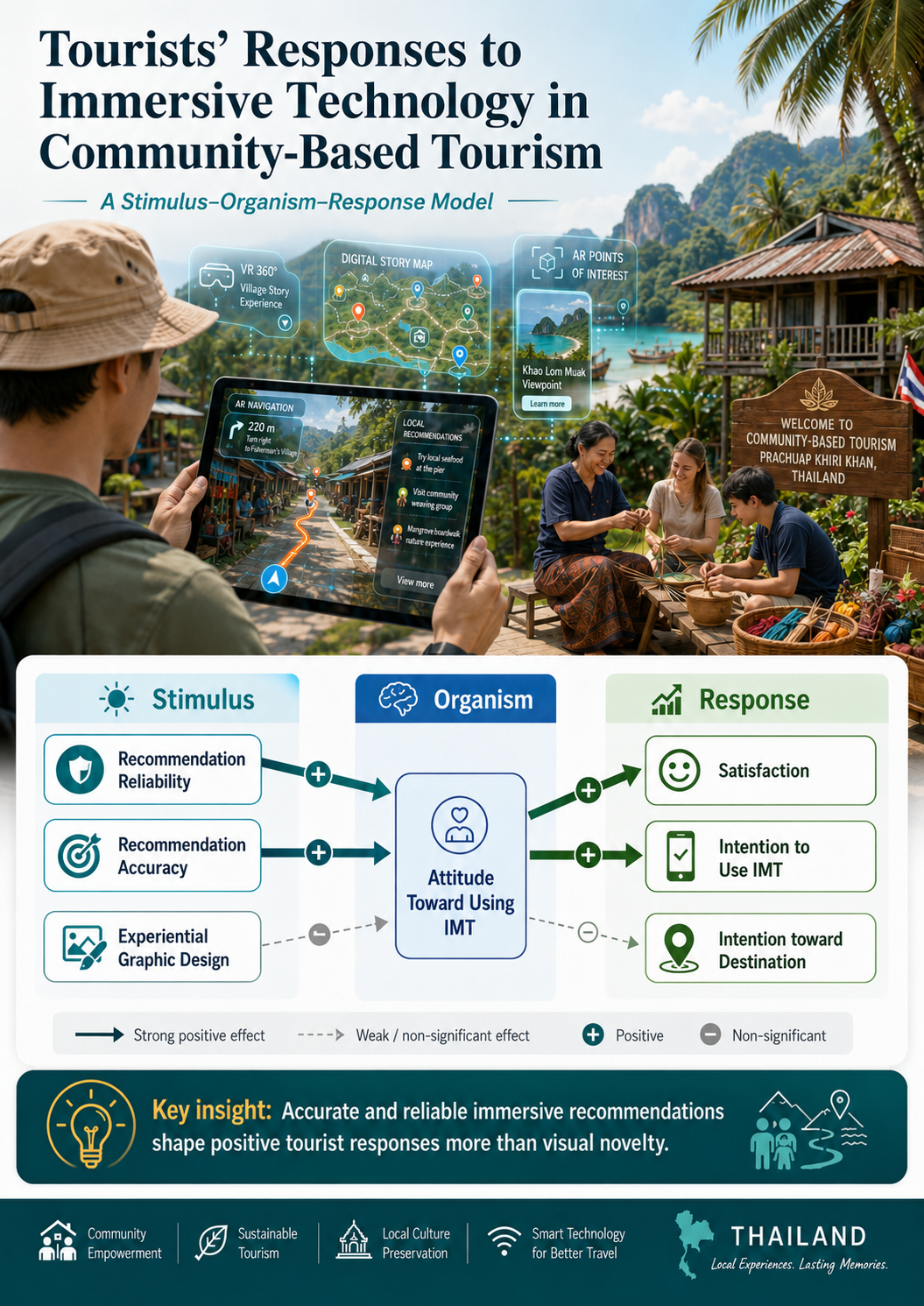
Community-based tourism (CBT) has been recognized as an important approach for promoting sustainable tourism, local participation, and community development. However, the role of immersive technology (IMT) in enhancing CBT experiences remains underexplored, particularly how tourists evaluate technology-driven recommendations and respond behaviorally. This study examines the factors influencing tourists’ attitudes and responses to the use of IMT in CBT through the stimulus–organism–response (SOR) model. A cross-sectional survey was conducted in April 2026 with 400 tourists who had experience using IMT within the previous three months. Data were analyzed using partial least squares structural equation modeling (PLS-SEM) with SmartPLS. The results show that recommendation reliability and recommendation accuracy significantly and positively influence tourists’ attitudes toward using IMT, with recommendation accuracy having the strongest effect. In contrast, experiential graphic design does not significantly affect attitude. Furthermore, attitude toward using IMT significantly influences tourist satisfaction and intention to use IMT, but it does not significantly affect intention toward the destination. These findings confirm attitude as an internal psychological mechanism linking technology-related stimuli with tourists’ behavioral responses. The study contributes to the literature by extending the SOR framework to the IMT-based CBT context. It suggests that IMT development for CBT should prioritize accurate, reliable, and useful information rather than focusing only on visual design or technological novelty.
Downloads
Article Details

This work is licensed under a Creative Commons Attribution-NonCommercial-NoDerivatives 4.0 International License.
References
Jackson, L. A. Community-based tourism: A catalyst for achieving the United Nations sustainable development goals one and eight. Tour. Hosp. 2025, 6, 29. https://doi.org/10.3390/tourhosp6010029
d. Abreu, L. A.; d. C. Walkowski, M.; Perinotto, A. R. C.; d. Fonseca, J. F. Community-based tourism and best practices with the sustainable development goals. Adm. Sci. 2024, 14, 36. https://doi.org/10.3390/admsci14020036
Dangi, T. B.; Jamal, T. An integrated approach to sustainable community-based tourism. Sustainability 2016, 8, 475. https://doi.org/10.3390/su8050475
Scheyvens, R. Ecotourism and the empowerment of local communities. Tour. Manage. 1999, 20, 245–249. https://doi.org/10.1016/S0261-5177(98)00069-7
Bramwell, B.; Lane, B. Tourism Collaboration and Partnerships: Politics, Practice and Sustainability; Channel View Publications, 2003.
Kwangsawad, A.; Nusawat, P.; Jattamart, A. Immersive storytelling content and innovation resistance in agritourism marketing context: Impact on traveler post-experience behavior. J. Theor. Appl. Electron. Commer. Res. 2025, 20, 165. https://doi.org/10.3390/jtaer20030165
Sigala, M. Tourism and COVID-19: Impacts and implications for advancing and resetting industry and research. J. Bus. Res. 2020, 117, 312–321. https://doi.org/10.1016/j.jbusres.2020.06.015
Gretzel, U.; et al. e-Tourism beyond COVID-19: A call for transformative research. Inf. Technol. Tour. 2020, 22, 187–203. https://doi.org/10.1007/s40558-020-00181-3
Durrah, O.; Salem, I. E.; Fathy, E. A.; Fouad, A. M.; Elbaz, A. M.; Hannawi, S. The role of digital technologies in enhancing sustainable community-based tourism: A systematic review of opportunities and challenges. J. Hosp. Tour. Insights 2026, 1–21. https://doi.org/10.1108/JHTI-11-2025-1371
Koo, I.; Zaman, U.; Ha, H.; Nawaz, S. Assessing the interplay of trust dynamics, personalization, ethical AI practices, and tourist behavior in the adoption of AI-driven smart tourism technologies. J. Open Innov. Technol. Mark. Complex. 2025, 11, 100455. https://doi.org/10.1016/j.joitmc.2024.100455
Abou-Shouk, M.; Zouair, N.; Abdelhakim, A.; Roshdy, H.; Abdel-Jalil, M. The effect of immersive technologies on tourist satisfaction and loyalty: The mediating role of customer engagement and customer perceived value. Int. J. Contemp. Hosp. Manag. 2024, 36, 3587–3606. https://doi.org/10.1108/IJCHM-09-2023-1496
Escandon-Barbosa, D.; Salas-Paramo, J. Technology adoption intention of virtual reality in tourism: Tourist and tourism agencies perspective. J. Qual. Assur. Hosp. Tour. 2024, 25, 1028–1042. https://doi.org/10.1080/1528008X.2022.2144981
Samaddar, K.; Mondal, S. AR and VR-based travel: A responsible practice towards sustainable tourism. Int. J. Tour. Cities 2024, 10, 105–128. https://doi.org/10.1108/IJTC-05-2022-0135
Kwangsawad, A.; Nusawat, P.; Jattamart, A. Conceptual model of innovation decision process and hesitation to adopt augmented reality in tourism industry. Int. J. Hum.–Comput. Interact. 2025, 41, 10569–10594. https://doi.org/10.1080/10447318.2024.2434963
Jalil, M. F.; Ali, A.; Meiping, W. Augmented reality adoption and the digital transformation of eco-smart tourism ventures: Exploring the mediating role of tourist engagement. Sci. Rep. 2026. https://doi.org/10.1038/s41598-026-53572-7
Hanafiah, M. H.; Zamzuri, N. H.; Sharif, T. I. S. T.; Chartrungruang, B.-o. Reframing indigenous tourism entrepreneurial personality, experience, sense of community and challenges in community-based tourism-related business. J. Enterprising Communities: People Places Global Econ. 2024, 18, 327–346. https://doi.org/10.1108/JEC-09-2022-0131
Mtapuri, O.; Camilleri, M. A.; Dłużewska, A. Advancing community-based tourism approaches for the sustainable development of destinations. Sustainable Development 2022, 30, 423–432. https://doi.org/10.1002/sd.2257
Tan, N. Q.; Ubukata, F.; Dinh, N. C.; Ha, V. H. Rethinking community-based tourism initiatives through community development lens: A case study in Vietnam. Community Dev. 2024, 55, 754–774. https://doi.org/10.1080/15575330.2024.2344218
Milgram, P.; Kishino, F. A taxonomy of mixed reality visual displays. IEICE Trans. Inf. Syst. 1994, 77, 1321–1329.
Slater, M.; Wilbur, S. A framework for immersive virtual environments (FIVE): Speculations on the role of presence in virtual environments. Presence: Teleoperators Virtual Environ. 1997, 6, 603–616. https://doi.org/10.1162/pres.1997.6.6.603
Hsiao, K.-F.; Chen, N.-S.; Huang, S.-Y. Learning while exercising for science education in augmented reality among adolescents. Interact. Learn. Environ. 2012, 20, 331–349. https://doi.org/10.1080/10494820.2010.486682
Ambika, A.; Shin, H.; Jain, V. Immersive technologies and consumer behavior: A systematic review of two decades of research. Aust. J. Manage. 2025, 50, 55–79. https://doi.org/10.1177/03128962231181429
Mehrabian, A.; Russell, J. A. An Approach to Environmental Psychology; MIT Press: Cambridge, MA, 1974.
Cheng, W.; Tsai, H.; Chuang, H.; Lin, P.; Ho, T. How can emerging event sustainably develop in the tourism industry? From the perspective of the SOR model on a two-year empirical study. Sustainability 2020, 12, 10075. https://doi.org/10.3390/su122310075
Kim, M. J.; Lee, C.-K.; Jung, T. Exploring consumer behavior in virtual reality tourism using an extended stimulus-organism-response model. J. Travel Res. 2020, 59, 69–89. https://doi.org/10.1177/0047287518818915
Kim, J.-H.; Ritchie, J. B.; McCormick, B. Development of a scale to measure memorable tourism experiences. J. Travel Res. 2012, 51, 12–25. https://doi.org/10.1177/0047287510385467
Lemon, K. N.; Verhoef, P. C. Understanding customer experience throughout the customer journey. J. Mark. 2016, 80, 69–96. https://doi.org/10.1509/jm.15.0420
Flavián, C.; Ibáñez-Sánchez, S.; Orús, C. The impact of virtual, augmented and mixed reality technologies on the customer experience. J. Bus. Res. 2019, 100, 547–560. https://doi.org/10.1016/j.jbusres.2018.10.050
DeLone, W. H.; McLean, E. R. The DeLone and McLean model of information systems success: A ten-year update. J. Manage. Inf. Syst. 2003, 19, 9–30. https://doi.org/10.1080/07421222.2003.11045748
Wang, R. Y.; Strong, D. M. Beyond accuracy: What data quality means to data consumers. J. Manage. Inf. Syst. 1996, 12, 5–33. https://doi.org/10.1080/07421222.1996.11518099
Dwivedi, Y. K.; et al. Metaverse beyond the hype: Multidisciplinary perspectives on emerging challenges, opportunities, and agenda for research, practice and policy. Int. J. Inf. Manage. 2022, 66, 102542. https://doi.org/10.1016/j.ijinfomgt.2022.102542
Kim, S.; Huh, I.; Lee, S. No movie to watch: A design strategy for enhancing content diversity through social recommendation in the subscription-video-on-demand service. Appl. Sci. 2022, 13, 279. https://doi.org/10.3390/app13010279
Zheng, L.; Guo, Y.; Peeta, S.; Wu, B. Impacts of information from various sources on the evacuation decision-making process during no-notice evacuations in campus environment. J. Transp. Saf. Secur. 2020, 12, 892–923. https://doi.org/10.1080/19439962.2018.1549643
Arif, Y. M.; et al. Game-based personalized learning in the metaverse computer virtual laboratory: Improving user experience with a learning material recommender system. Int. J. Hum.–Comput. Interact. 2025, 41, 12095–12112. https://doi.org/10.1080/10447318.2025.2452215
Wei, L.; et al. Recommendation systems for the metaverse. Blockchains 2023, 1, 19–33. https://doi.org/10.3390/blockchains1010003
Gupta, A.; Khan, H. U.; Nazir, S.; Shafiq, M.; Shabaz, M. Metaverse security: Issues, challenges and a viable ZTA model. Electronics 2023, 12, 391. https://doi.org/10.3390/electronics12020391
Wang, J.; Kim, J. U.; Kim, H.-M. Purchase intention in TikTok streaming commerce: The role of recommendation accuracy, streamer's attractiveness, and consumer-to-consumer interactions. Rev. Manag. Sci. 2025, 19, 2255–2278. https://doi.org/10.1007/s11846-024-00810-9
Solano-Barliza, A.; et al. Recommender systems applied to the tourism industry: A literature review. Cogent Bus. Manage. 2024, 11, 2367088. https://doi.org/10.1080/23311975.2024.2367088
Petković, G.; Pasanec Preprotić, S.; Kozjan Cindrić, A. Experiential graphic design: Informing, inspiring, and integrating people in physical spaces—A review. Buildings 2025, 15, 1862. https://doi.org/10.3390/buildings15111862
Zhang, J.; Liu, X.; Feng, Z.; Feng, X. Research on the influencing factors of art intervention in the environmental graphics of rural cultural tourism space. Land 2024, 13, 1680. https://doi.org/10.3390/land13101680
Boucherit, S.; Maffei, L.; Masullo, M.; Berkouk, D.; Bouzir, T. A. K. Assessment of sighted and visually impaired users to the physical and perceptual dimensions of an oasis settlement urban park. Sustainability 2023, 15, 7014. https://doi.org/10.3390/su15087014
Lloyd-Esenkaya, T.; Lloyd-Esenkaya, V.; O'Neill, E.; Proulx, M. J. Multisensory inclusive design with sensory substitution. Cogn. Res.: Princ. Implic. 2020, 5, 37. https://doi.org/10.1186/s41235-020-00240-7
Davis, F. D. Perceived usefulness, perceived ease of use, and user acceptance of information technology. MIS Q. 1989, 13, 319–340. https://doi.org/10.2307/249008
Liu, Q.; Sutunyarak, C. The impact of immersive technology in museums on visitors' behavioral intention. Sustainability 2024, 16, 9714. https://doi.org/10.3390/su16229714
Sujood; Pancy. Travelling with open eyes! A study to measure consumers' intention towards experiencing immersive technologies at tourism destinations by using an integrated model of TPB, TAM captured through the lens of SOR. Int. J. Contemp. Hosp. Manag. 2024, 36, 3906–3929. https://doi.org/10.1108/IJCHM-11-2023-1771
Faul, F.; Erdfelder, E.; Lang, A.-G.; Buchner, A. G*Power 3: A flexible statistical power analysis program for the social, behavioral, and biomedical sciences. Behav. Res. Methods 2007, 39, 175–191. https://doi.org/10.3758/BF03193146
Ball, H. L. Conducting online surveys. J. Hum. Lact. 2019, 35, 413–417. https://doi.org/10.1177/0890334419848734
Ringle, C. M. Partial least squares structural equation modelling (PLS-SEM) using SmartPLS 3. In Computational Data Analysis and Numerical Methods VII WCDANM; Portugal, 2015.
Dash, G.; Paul, J. CB-SEM vs PLS-SEM methods for research in social sciences and technology forecasting. Technol. Forecast. Soc. Change 2021, 173, 121092. https://doi.org/10.1016/j.techfore.2021.121092
Hair, J. F., Jr.; Hult, G. T. M.; Ringle, C. M.; Sarstedt, M.; Danks, N. P.; Ray, S. An introduction to structural equation modeling. In Partial Least Squares Structural Equation Modeling (PLS-SEM) Using R: A Workbook; Springer, 2021; pp 1–29. https://doi.org/10.1007/978-3-030-80519-7_1
Fornell, C.; Larcker, D. F. Evaluating structural equation models with unobservable variables and measurement error. J. Mark. Res. 1981, 18, 39–50. https://doi.org/10.1177/002224378101800104
Henseler, J.; Hubona, G.; Ray, P. A. Using PLS path modeling in new technology research: Updated guidelines. Ind. Manage. Data Syst. 2016, 116, 2–20. https://doi.org/10.1108/IMDS-09-2015-0382
