
Evaluation of the Role of Silymarin on Certain Biochemical and Histological Parameters in Male Albino Rats Treated with Monosodium Glutamate
Article Sidebar
Main Article Content
Abstract
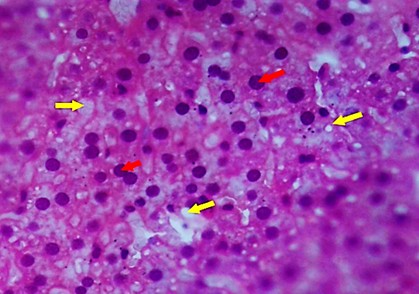
Monosodium glutamate (MSG), a widely used flavor enhancer, can induce hepatic and renal toxicity through oxidative stress, whereas silymarin from Silybum marianum has antioxidant and hepatoprotective properties. This study evaluated the protective effect of silymarin against MSG-induced hepatic biochemical and histological alterations, with renal involvement assessed through serum biochemical markers, in male albino rats. Thirty male rats (3–4 months) were randomly assigned to three groups (n = 10) and treated for 30 days: T1 (control, 0.9% saline), T2 (MSG, 15 mg/kg body weight), and T3 (MSG 15 mg/kg + silymarin 8 mg/kg). Serum liver enzymes (AST, ALT, ALP), urea, creatinine, and total protein were measured colorimetrically or enzymatically, and liver tissue was processed for histology. MSG significantly (P < 0.05) elevated AST, ALT, ALP, urea, and creatinine, and lowered total protein compared with control; for example, AST rose from 135.2 ± 46.7 to 209.5 ± 64.7 U/L, and creatinine from 1.18 ± 0.37 to 2.67 ± 0.23 µmol/L. Co-treatment with silymarin significantly reversed these changes (AST 152.4 ± 74.5 U/L; creatinine 1.58 ± 0.16 µmol/L; total protein restored toward control), although several values remained different from control. Histologically, MSG caused hepatocyte degeneration, necrosis, and cytoplasmic vacuolation, with loss of the normal radial architecture, whereas silymarin co-treatment largely restored hepatic structure, reducing necrosis and inflammation. These findings indicate that silymarin at 8 mg/kg exerts a meaningful protective effect against MSG-induced hepatorenal toxicity, consistent with its antioxidant and membrane-stabilizing actions.
Downloads
Article Details

This work is licensed under a Creative Commons Attribution-NonCommercial-NoDerivatives 4.0 International License.
References
Onyesife, C. O.; et al. Nephroprotective Effects of Piper nigrum Extracts against Monosodium Glutamate-Induced Renal Toxicity in Rats. Sci. Afr. 2023, 19, e01453. https://doi.org/10.1016/j.sciaf.2022.e01453
Chakraborty, S. P. Patho-Physiological and Toxicological Aspects of Monosodium Glutamate. Toxicol. Mech. Methods 2019, 29(6), 389–396. https://doi.org/10.1080/15376516.2018.1528649
Hassama, P.; Htwe, N. M. P. S.; Rattanaphan, T.; Ruangrak, E.; Promwee, A. Effect of Monosodium Glutamate on the Growth and Quality of Sunflower Microgreens. ASEAN J. Sci. Technol. Rep. 2025, 28(2), e255735. https://doi.org/10.55164/ajstr.v28i2.255735
Tarda, A. A. K. Determining Monosodium Glutamate in Cafeteria Foods at the Eastern Mediterranean University; M.Sc. Thesis, Eastern Mediterranean University: Famagusta, 2017.
National Center for Biotechnology Information. PubChem Compound Summary; NCBI: Bethesda, MD, USA, 2021.
Walker, R.; Lupien, J. R. The Safety Evaluation of Monosodium Glutamate. J. Nutr. 2000, 130(4), 1049S–1052S. https://doi.org/10.1093/jn/130.4.1049S
Hossain, M.; et al. Monosodium Glutamate Level in Kid's Food and Its Dietary Effects on Liver and Kidney Functions in Adult Rats. Am. J. Food Nutr. 2020, 8, 32–36.
Panda, S.; et al. Ameliorative Effect of Aloe Gel against L-T4-Induced Hyperthyroidism via Suppression of Thyrotropin Receptors, Inflammation and Oxidative Stress. Mol. Biol. Rep. 2020, 47(4), 2801–2810. https://doi.org/10.1007/s11033-020-05405-7
Essawy, A. E.; et al. The Protective Efficacy of Omega-3 Polyunsaturated Fatty Acids on Oxidative Stress, Inflammation, Neurotransmitter Perturbations, and Apoptosis Induced by Monosodium Glutamate in the Brain of Male Rats. Metab. Brain Dis. 2025, 40(1), 114. https://doi.org/10.1007/s11011-025-01539-4
Jawad, Z. H.; Salman, H. A. Gastroprotective Effects of Purslane (Portulaca oleracea L.) Ethanolic Extract against Aspirin-Induced Gastric Ulcer: Modulation of Oxidative Stress, Inflammatory Mediators, and EGFR Signaling in Rats. ASEAN J. Sci. Technol. Rep. 2026, 29(5), e263937. https://doi.org/10.55164/ajstr.v29i5.263937
Oluwole, D. T.; et al. Disruptive Consequences of Monosodium Glutamate on Male Reproductive Function: A Review. Curr. Res. Toxicol. 2024, 6, 100148. https://doi.org/10.1016/j.crtox.2024.100148
Hussin, A. M.; et al. The Adverse Effect of Long-Term Intake of Monosodium Glutamate on Kidney Performance. IOP Conf. Ser. Earth Environ. Sci. 2021, 880(1), 012056. https://doi.org/10.1088/1755-1315/880/1/012056
Shaalan, J. A.; Kadhem, W. M. Therapeutic Effects of Marjoram (Origanum majorana L.) Extract and Nano-Formulation on Hormonal Parameters and Ovarian Histology in Letrozole-Induced Polycystic Ovary Syndrome in Rats. ASEAN J. Sci. Technol. Rep. 2026, 29(6), e263936. https://doi.org/10.55164/ajstr.v29i6.263936
Zahwar, A. T.; Sabour, A. N. Berberine Ameliorates Methionine-Induced Hyperhomocysteinemia and Biochemical Alterations in Male Rats. ASEAN J. Sci. Technol. Rep. 2026, 29(3), e262094. https://doi.org/10.55164/ajstr.v29i3.262094
Majhwol, E. M. Chia Seed Extract Attenuates Streptozotocin-Induced Pancreatic Beta-Cell Dysfunction in Diabetic Rats: Evidence from Functional and Oxidative Stress Biomarkers. ASEAN J. Sci. Technol. Rep. 2026, 29(5), e263641. https://doi.org/10.55164/ajstr.v29i5.263641
MacDonald-Ramos, K.; et al. Silymarin Is an Ally against Insulin Resistance: A Review. Ann. Hepatol. 2021, 23, 100255. https://doi.org/10.1016/j.aohep.2020.08.072
Murphy, J. M.; Caban, M.; Kemper, K. Milk Thistle (Silybum marianum). Longwood Herbal Task Force, 2000.
Gillessen, A.; Schmidt, H. H.-J. Silymarin as Supportive Treatment in Liver Diseases: A Narrative Review. Adv. Ther. 2020, 37(4), 1279–1301. https://doi.org/10.1007/s12325-020-01251-y
Tighe, S. P.; et al. Chronic Liver Disease and Silymarin: A Biochemical and Clinical Review. J. Clin. Transl. Hepatol. 2020, 8(4), 454. https://doi.org/10.14218/JCTH.2020.00012
Adetuyi, B. O.; et al. Pharmacological, Biochemical and Therapeutic Potential of Milk Thistle (Silymarin): A Review. World News Nat. Sci. 2021, 37, 75–91.
Dumludag, B.; et al. Role of Silymarin (Silybum marianum) in the Prevention of Colistin-Induced Acute Nephrotoxicity in Rats. Drug Chem. Toxicol. 2022, 45(2), 568–575. https://doi.org/10.1080/01480545.2020.1733003
Reitman, S.; Frankel, S. A Colorimetric Method for the Determination of Serum Glutamic Oxaloacetic and Glutamic Pyruvic Transaminases. Am. J. Clin. Pathol. 1957, 28(1), 56–63. https://doi.org/10.1093/ajcp/28.1.56
Humason, G.; Presnell, J.; Schreibman, M. Humason's Animal Tissue Techniques; Johns Hopkins University Press: Baltimore, MD, 1997.
Schefler, W. C. Statistics for the Biological Sciences, 2nd ed.; Addison-Wesley: Reading, MA, 1980.
Eltayef, E. M.; Farhood, Z. H.; Madlool, Z. S. The Role of Shilajit in Reducing the Toxicity of Monosodium Glutamate on Liver Enzyme and Kidney Functions in Albino Mice. Kidneys 2025, 14(3), 199–206. https://doi.org/10.22141/2307-1257.14.3.2025.534
Sahin, B.; et al. The Effects of Apocynin on Monosodium Glutamate-Induced Liver Damage of Rats. Heliyon 2023, 9(7), e17327. https://doi.org/10.1016/j.heliyon.2023.e17327
Ogunmokunwa, A. E.; Ibitoye, B. O. Monosodium Glutamate (MSG) Exposure Induced Oxidative Stress and Disrupted Testicular Hormonal Regulation, Exacerbating Reproductive Dysfunction in Male Wistar Rats. Endocr. Metab. Sci. 2025, 17, 100226. https://doi.org/10.1016/j.endmts.2025.100226
Dabdoub, B. R.; Mohammed, R. H.; Abdulhadi, H. L. Ganoderma lucidum Attenuates and Prevents CCl4-Induced Hepatic and Renal Damage in Sprague-Dawley Rats. Syst. Rev. Pharm. 2020, 11, 1704–1709.
Ebong, N. O.; Adikwu, E.; Julius, E. Protective Effect of Silymarin on Monosodium Glutamate-Induced Liver Toxicity in Rats. Biol. Biomed. J. 2025, 3(1), 62–69. https://doi.org/10.21608/bbj.2024.300220.1031
Mohammed, M. G.; et al. Effects of Monosodium Glutamate Administration on Metabolic Parameters, Hepatic and Renal Functions in Adult and Neonate Male Rats. Bull. Egypt. Soc. Physiol. Sci. 2022, 42(1), 74–89. https://doi.org/10.21608/besps.2021.84778.1105
Mirzakhani, N.; et al. Comparison of the Effects of Hydroalcoholic Extract of Capparis spinosa Fruit, Quercetin and Vitamin E on Monosodium Glutamate-Induced Toxicity in Rats. Vet. Res. Forum 2020.
Anuforo, P. C.; Egbuonu, A. C. C.; Egu, E. U. Terminalia catappa Flour Extract Mitigated Monosodium Glutamate-Intoxicated Rats' Kidney Biofunction and Histology. J. Phytopharmacol. 2020, 9(3), 164–168. https://doi.org/10.31254/phyto.2020.9302
Okediran, B.; et al. Alterations in the Lipid Profile and Liver Enzymes of Rats Treated with Monosodium Glutamate. Sokoto J. Vet. Sci. 2014, 12(3), 42–46. https://doi.org/10.4314/sokjvs.v12i3.8
Ghonaim, A. H.; et al. Hepatoprotective and Renoprotective Effects of Silymarin against Salinomycin-Induced Toxicity in Adult Rabbits. Vet. World 2022, 15(9), 2244–2252. https://doi.org/10.14202/vetworld.2022.2244-2252
Al Hasnawi, M. B.; Alnahi, A. Silymarin Attenuates Oxidative Stress and Nephrotoxicity Induced by 5-Fluorouracil in Rats. BIO Web Conf. 2024, 139, 06015. https://doi.org/10.1051/bioconf/202413906015
Schümann, J.; et al. Silibinin Protects Mice from T Cell-Dependent Liver Injury. J. Hepatol. 2003, 39(3), 333–340. https://doi.org/10.1016/S0168-8278(03)00239-3
Eweka, A.; Igbigbi, P.; Ucheya, R. Histochemical Studies of the Effects of Monosodium Glutamate on the Liver of Adult Wistar Rats. Ann. Med. Health Sci. Res. 2011, 1(1), 21–30. https://doi.org/10.4314/abs.v9i1.66569
Ortiz, G. G.; et al. Monosodium Glutamate-Induced Damage in Liver and Kidney: A Morphological and Biochemical Approach. Biomed. Pharmacother. 2006, 60(2), 86–91. https://doi.org/10.1016/j.biopha.2005.07.012
Zhang, W. L.; Zhu, L.; Jiang, J. G. Active Ingredients from Natural Botanicals in the Treatment of Obesity. Obes. Rev. 2014, 15(12), 957–967. https://doi.org/10.1111/obr.12228
Abdel Hameed, T. Light and Electron Microscopic Studies on the Effect of Orally Administered Formalin on Liver and Kidney of Guinea Pig. J. Egypt. Ger. Soc. Zool. 2004, 45(C), 203–224.
Aghemo, A.; et al. Role of Silymarin as Antioxidant in Clinical Management of Chronic Liver Diseases: A Narrative Review. Ann. Med. 2022, 54(1), 1548–1560. https://doi.org/10.1080/07853890.2022.2069854
Ghosh, S.; et al. Silymarin Protects Mouse Liver and Kidney from Thioacetamide-Induced Toxicity by Scavenging Reactive Oxygen Species and Activating the PI3K-Akt Pathway. Front. Pharmacol. 2016, 7, 481. https://doi.org/10.3389/fphar.2016.00481
