
การจำแนกปัจจัยเฉพาะในการปลูกหญ้าแฝกในประเทศไทย
Article Sidebar
Main Article Content
บทคัดย่อ
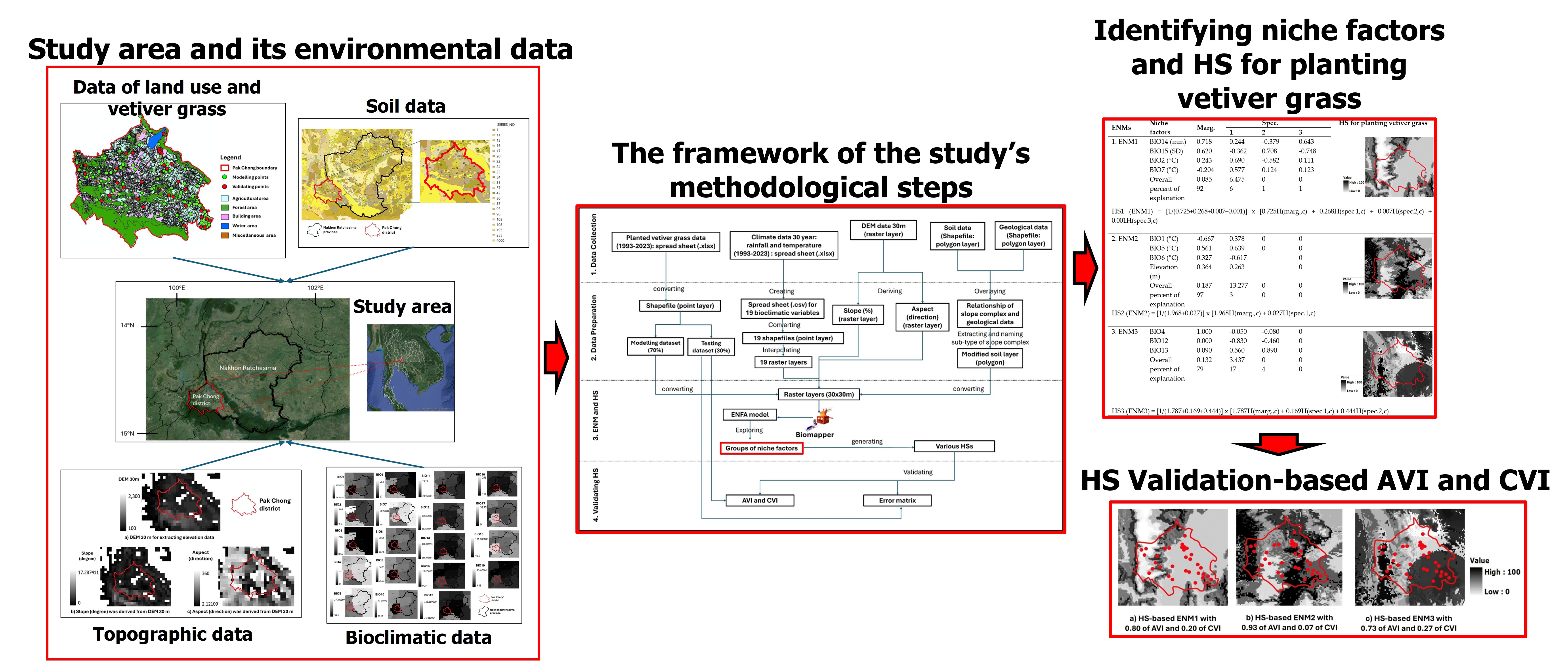
This study aims to identify niche factors to use in mapping potential areas of vetiver grass planting in Thailand. Pak Chong district of Nakhon Ratchasima province is selected as a case study. There were 4 used datasets: existing planted vetiver data, 3 topographical data (DEM, slope, and aspect), bioclimatic data, and the modified soil data. These datasets were transformed into GIS data with WGS 1984 and Zone 48N and were processed by ecological niche factor analysis (ENFA) in BIOMAPPER. ENFA produced the habitat suitability (HS) index for planting vetiver grass and provided understanding of spatial dispersion ability and tolerance of vetiver grass ecology to the current environment. The analyzed results showed that HS-based ENM2 has the highest possibility for planting vetiver grass, with AVI 0.93 and CVI 0.07. The ENM2 included 97% marginality (the ability for spatial distribution in the study area) and 3% specialization (durability in the study area). Moreover, this ENM2 explicitly indicates the existing vetiver grasses have more highly spatial distribution than durability in the study area with niche factors such as BIO1: the mean annual temperature (25-31°C), BIO5: mean monthly maximum temperature (30-38°C), BIO6: mean monthly minimum temperature (17-27°C) and elevation (600-1,300 m), respectively. The obtained niche factor (e.g., BIO1, BIO5, BIO6, and elevation) will be implemented to map potential areas of vetiver grass in the Center for Promoting the Utilization of Vetiver Grass under the Royal Initiative Project (CPUVGRIP) of Forest Royal Department (FRD) in Nakhon Ratchasima, Thailand further.
Article Details

อนุญาตภายใต้เงื่อนไข Creative Commons Attribution-NonCommercial-NoDerivatives 4.0 International License.
เอกสารอ้างอิง
The Office of the Royal Development Projects Board (ORDPB). “The Seventh International Vetiver Conference (ICV7) May 29-June 1 2023”. Available from: https://www.vetiver.org/network-services/conference-proceedings/ [Accessed 4 November 2024].
The Committee on Master Plan for Development and Campaign for the use of vetiver, “The Master Plan of the Royal Project to Develop and Promote the Development and Use of Vetiver No.6 (2017-2021)”. Available from: http://agkb.lib.ku.ac.th/faek/search_detail/result/215032. [Accessed 9 April 2024].
The Committee on Master Plan for Development and Campaign for the use of vetiver, “The Master Plan of the Royal Project to Develop and Promote the Development and Use of Vetiver No.4 (2007-2011)”. Available from: http://thvn.rdpb.go.th/Files/Plan/1-ilovepdf-compressed%20(1).pdf. [Accessed 9 April 2024].
Leknoi, U.; Likitlersuang, S. Good practice and lesson learned in promoting vetiver as solution for slope stabilization and erosion control in Thailand. Land Use Policy. 2020, 99, 105008. https://doi.org/10.1016/j.landusepol.2020.105008
Chen, S.; Xiao, Y.; Xiao, Z.; Ma, D.; Li, J.; Herrera-Ulloa, A. Prediction of suitable habitat shifts and assessment of ecological niche overlaps for three Tridentiger species with intertidal and subtidal characteristics under future climate changes. Marine Pollution Bulletin. 2024, 198, 115827. https://doi.org/10.1016/j.marpolbul.2023.115827
Mathur, M.; Mathur, P.; Purohit, H. Ecological niche modelling of a critically endangered species Commiphora wightii (Arn.) Bhandari using bioclimatic and non-bioclimatic variables. Ecological Process. 2024, 12(8). https://doi.org/10.1186/s13717-023-00423-2
Peterson, A. T.; Soberon, J.; Pearson, R. G.; Anderson, R. P.; Martinez-Meyer, E.; Nakamura, M.; Araujo, M. B. Ecological Niches and Geographic Distributions. Oxfordshire, the United Kingdom: Princeton University Press 2011, 23-48. https://doi.org/10.23943/princeton/9780691136868.003.0003
Sillero, N.; Arenas-Castro, S.; Enriquez-Urzelai, U.; Vale, C. G.; Sousa-Guedes, D.; Martinez-Freiria, F.; Real, R.; Barbosa, A. M. Want to model a species niche? A step-by-step guideline on correlative ecological niche modelling. Ecological Modelling, 2021, 456, 109671. https://doi.org/10.1016/j.ecolmodel.2021.109671
National Geographic, “Niche”. Available from: https://www.nationalgeographic.org/encyclopedia/niche/. [Accessed 12 April 2024].
Dotson, J. D. “Ecological Niche: Definition, Types, Importance & Examples”. Available from: https://sciencing.com/ecological-niche-definition-types-importance-examples-13719219.html. [Accessed 12 April 2024].
Phillips, S.J.; Anderson, R.P.; Dudík, M.; Schapire, R.E.; Blair, M.E. Opening the black box: an opensource release of maxent. Ecography. 2017, 40, 887–893. https://doi.org/10.1111/ecog.03049
Hirzel, A. H.; Hausser, J.; Perrin, N. Biomapper 1.0-4.0. Available from: https://www2.unil.ch
/biomapper/products.html. [Accessed 13 April 2024].
Guo, Q.; Liu, Y. ModEco: an integrated software package for ecological niche modeling. Ecography. 2010, 33(4), 637-642. https://doi.org/10.1111/j.1600-0587.2010.06416.x
Enrique, M.; Mu˜noz, D. S.; Giovanni, R.; De, Siqueira, M. F.; De, Sutton, T.; Brewer, P. Open Modeller: a generic approach to species’ potential distribution modelling. Geoinformatics. 2009, 15, 111–135. https://doi.org/10.1007/s10707-009-0090-7
R Core Team, “R: A Language and Environment for Statistical Computing. Vienna, Austria”. Available from: https://www.R-project.org/ [Accessed 13 April 2024].
Costa, H.; Medeiros, V.; Azevedo, E. B.; Silva, L. Evaluating ecological-niche factor analysis as a modelling tool for environmental weed management in island systems. Weed Research. 2013, 53(3), 221-230. https://doi.org/10.1111/wre.12017
Université de Lausanne. “Biomapper”. Available from: https://www2.unil.ch/biomapper/what_is_biomapper.html. [Accessed 13 April 2024].
Grimshaw, R. G. “Vetiver System: A Green Investment for Sustainable Development”. Available from: https://www.vetiver.org/ICV4pdfs/P02.pdf [Accessed 4 November 2024].
Truong, P.; Van, T. T.; Pinners, E. “Vetiver System Applications: Technical Reference Manual”. Available from: https://www.vetiver.org/BB-v1r.pdf [Accessed 5 November 2024].
National Research Council. ‘’Vetiver Grass: A thin green line against erosion”. Available from: https://pdf.usaid.gov/pdf_docs/Pnabp484.pdf [Accessed 4 November 2024].
Yoon, P.K. “A Look See at Vetiver Grass in Malaysia by”. Available from: https://www.vetiver.org/
MAL_PK.Yoon%20Look%20see/START.HTM [Accessed 4 November 2024].
Gholamy, A.; Kreinovich, V.; Kosheleva, O. “Why 70/30 or 80/20 Relation Between Training and Testing Sets: A Pedagogical Explanation”. Available from https://scholarworks.utep.edu/cgi/viewcontent.cgi?article=2202&context=cs_techrep [Accessed 6 November 2024].
Tuan, T. A.; Hong, P. V.; Tam, T. T.; Nguyet, N. T. A.; Dung, N. V.; Trong, T. P.; Huy, P. T.; Phong, T. V. Land susceptibility in Phuoc Son, Quang Nam: A deep learning approach. Vietnam Journal of Earth Sciences. 2024, 47(1), 44-62. https://doi.org/10.15625/2615-9783/21658
O’Donnell, M.S.; Ignizio, D.A., Bioclimatic predictors for supporting ecological applications in the conterminous United States. U.S. Geological Survey Data Series 2012, 691, 10. https://doi.org/10.3133/ds691
The USDA Risk Management Agency. “PRISM Climate Data”. Available from: https://prism.oregonstate.edu/ [Accessed 6 November 2024].
Grimshaw, R. G.; Faiz, A. “Vetiver Grass: Application for Stabilization of Structures”. Available from: https://onlinepubs.trb.org/Onlinepubs/conf/1995/cp6/v1/cp6v1-010.pdf [Accessed 13 April 2024].
Trong, P.; Nanakorn, W.; Tan Van, T.; Pinners, E. Vetiver System Applications – Technical Reference Manual. Bangkok, BKK: Office of the Royal Development Projects Board 2013, 1-14.
