Development and Performance Analysis of an Improved Biomass Stove for Krajood Dyeing: A Sustainable Appropriate Technology Approach
Article Sidebar
Main Article Content
บทคัดย่อ
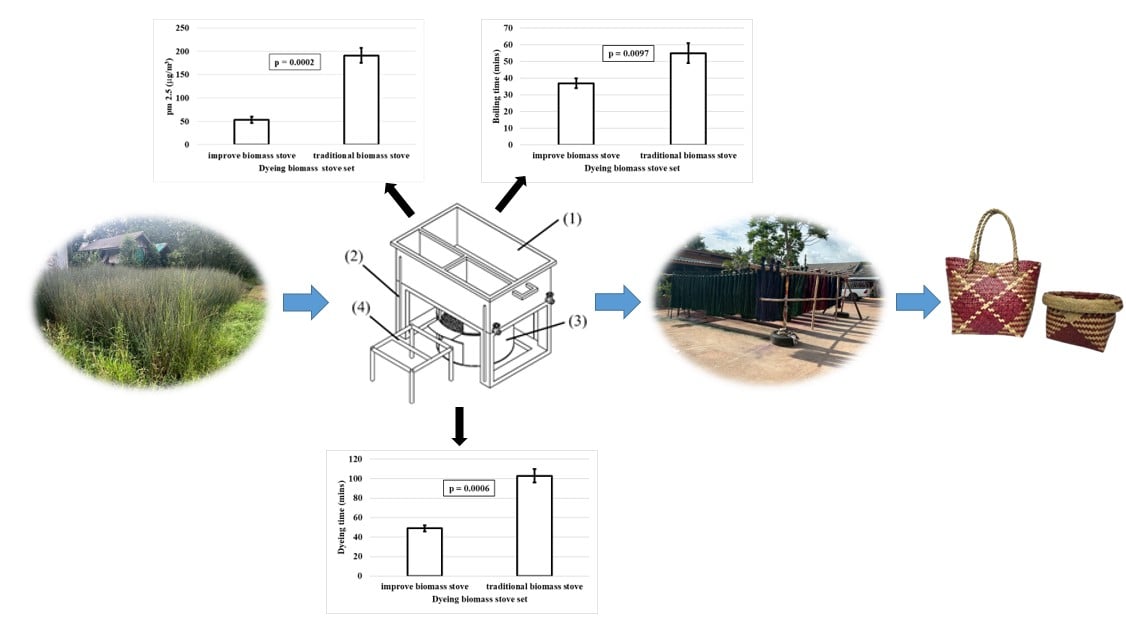
This research developed an improved biomass stove for dyeing Krajood (Lepironia articulata) as a sustainable, appropriate technology for small-scale industry applications. The new design features an integrated water reserve tank, improved combustion chamber, heat shield, and robust support structure while maintaining operational simplicity. Performance evaluation revealed the improved stove reduced PM2.5 emissions at the operator position by 72.25% (from 191±16 to 53±7 μg/m³, p=0.0002), decreased water boiling time by 32.73% (from 55±6 to 37±3 minutes, p=0.0097), shortened dyeing time by 52.43% (from 103±7 to 49±3 minutes, p=0.0006), and lowered ambient temperature at the operator position by 46.45% (from 62.0±4.8°C to 33.2±1.7°C, p=0.0003). These improvements collectively enabled a five-fold increase in daily production capacity from 20 bundles (44 kg) to 100 bundles (220 kg) in an 8-hour workday. Colorimetric analysis confirmed no significant differences in Lab* values between traditionally and newly dyed Krajood at all measurement positions (p>0.05), ensuring quality preservation despite the process modifications. Economic assessment indicates the 71.4% higher initial investment (12,000 vs. 7,000 THB) is rapidly offset by productivity gains. The design exemplifies appropriate technology principles through its simplicity, local material utilization, and alignment with existing production knowledge. This improved stove addresses critical health and efficiency constraints in traditional Krajood processing while preserving product quality, demonstrating how targeted technological interventions can enhance traditional craft productivity and worker wellbeing in rural communities.
Article Details

อนุญาตภายใต้เงื่อนไข Creative Commons Attribution-NonCommercial-NoDerivatives 4.0 International License.
เอกสารอ้างอิง
Kaewpradit, K.; Keeratiburana, Y.; Janta-po, A. Krajood: Creative economics development in communities through indigenous handicraft of Southern Thailand. International Journal of Academic Research in Business and Social Sciences, 2013, 3(9), 707–716. https://doi.org/10.6007/IJARBSS/v3-i9/260
Dezord, C.; Micolau, G.; Abbas, C.; Mesgouez, A.; Pozzo Di Borgo, E. Reliable, versatile and remotely controlled instrumentation of an hectometric loop antenna using appropriate technologies. HardwareX, 2023, 15, Article e00443. https://doi.org/10.1016/j.ohx.2023.e00443
Auliani, R.; Suprawihadi, R.; Avinash, B. Application of appropriate technology for clean water (A case study in Lateri Village, Baguala District, Ambon City). Pengabdian: Jurnal Abdimas, 2023, 1(1), 30–39. https://doi.org/10.55849/abdimas.v1i1.152
Lyman, A.H.; Chung, K. A new model of participatory design to improve social impact: Incorporating action research into the design of appropriate technology in rural Zambia. Design Studies, 2025, 97, Article 101325. https://doi.org/10.1016/j.destud.2025.101296
Zube, D. J. Heat transfer efficiency of biomass cookstoves [Master’s thesis]. Colorado State University; 2010.
MacCarty, N.A.; Bryden, K.M. A generalized heat-transfer model for shielded-fire household cookstoves. Energy for Sustainable Development, 2016, 96-107. https://doi.org/10.1016/j.esd.2016.03.003
Pundle, A.; Sulliva, B.; Means, P.; Posner, J.D.; Kramlich, J.C. Predicting and analyzing the performance of biomass-burning natural draft rocket cookstoves using computational fluid dynamics. Biomass and Bioenergy, 2019, 105402. https://doi.org/10.1016/j.biombioe.2019.105402
Bentson, S.; Evitt, D.; Still, D.; Lieberman, D.; MacCarty, N. Retrofitting stoves with forced jets of primary air improves speed, emissions, and efficiency: Evidence from six types of biomass cookstoves. Energy for Sustainable Development, 2022, 71, 104–117. https://doi.org/10.1016/j.esd.2022.09.005
Hafner, M.J.; Uckert, G.; Hoffmann, H. K.; Rosenstock, T. S.; Sieber, S.; Kimaro, A. A. Efficiency of three-stone fire and improved cooking stoves using on-farm and off-farm fuels in semi-arid Tanzania. Energy for Sustainable Development, 2020, 59, 199–207. https://doi.org/10.1016/j.esd.2020.10.012
, K.; Prasongchan, N.; Wunsri, S.; Joyphod, P.; Podkumnerd, N. Dyeing of screw pine (Pandanus tectorius) leaves using natural dyes from local plants in Songkhla Province, Thailand. Asia-Pacific Journal of Science and Technology, 2024, 29(4), Article ID.:APST-29-04-17
World Health Organization. WHO Global Air Quality Guidelines: Particulate Matter (PM2.5 and PM10), Ozone, Nitrogen Dioxide, Sulfur Dioxide and Carbon Monoxide; WHO: Geneva, 2021. https://www.who.int/publications/i/item/9789240034228 (accessed 2025-04-14).
Liu, X.; Wang, K.; Shen, Z. A novel strategy of inserting radiation shields to enhance the performance of thermoelectric generator systems for industrial high-temperature heat recovery. Energy, 2024, 301, 131704. https://doi.org/10.1016/j.energy.2024.131704
Yunusa, S.U.; Mensah, E.; Preko, K.; Narra, S.; Saleh, A.; Sanfo, S.; Isiaka, M.; Dalha, I.B.; Abdulsalam, M. Biomass cookstoves: A review of technical aspects and recent advances. Energy Nexus, 2023, 100225. https://doi.org/10.1016/j.nexus.2023.100225
