Physicochemical Properties of Carrageenan Extracted from Raw Dried Seaweed of Caluya, Antique, Philippines
Article Sidebar
Main Article Content
บทคัดย่อ
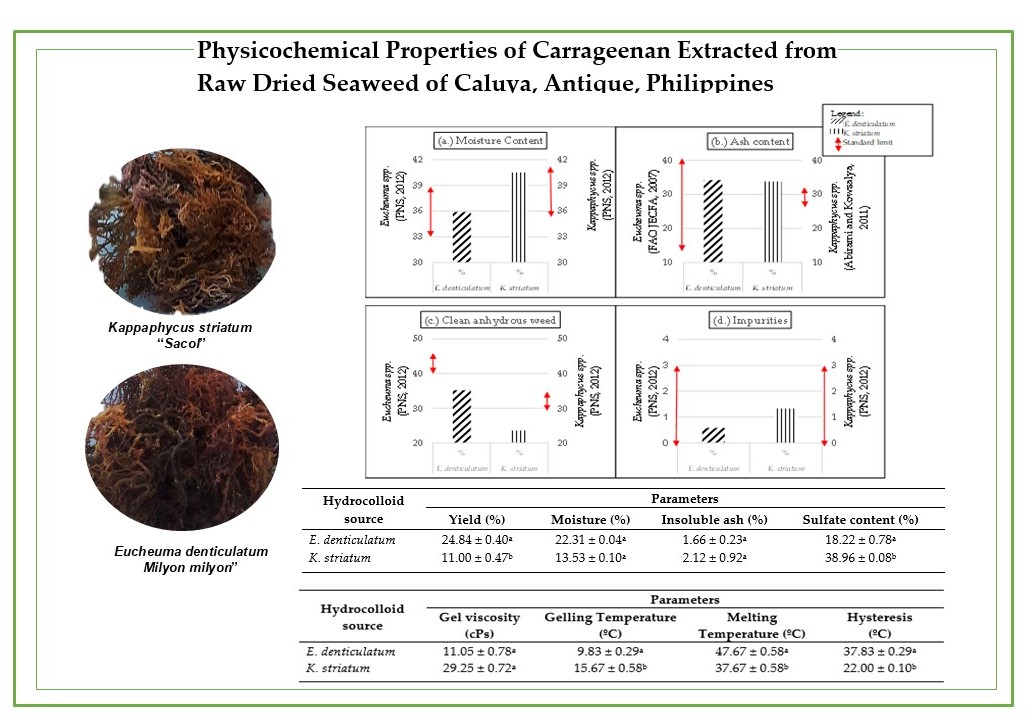
Marine hydrocolloids, such as carrageenan extracted from seaweeds, are widely used in food, industrial, and commercial applications. The Philippines has great potential to export carrageenan, but the industry requires strict quality regulations for the product. The specifications for raw dried seaweeds (RDS), including chemical and gel rheological properties, of Eucheuma denticulatum “Milyon milyon” and Kappaphycus striatum “Sacol”, collected from Caluya, Antique, Philippines, were investigated and compared to the national standards used by the carrageenan production industry. The RDS (moisture, ash, clean anhydrous weed, impurities) of E. denticulatum and K. striatum were within the limits of the Philippine National Standards. The chemical properties (moisture, ash, acid-insoluble ash, and sulfate content) of carrageenan extracted from E. denticulatum were within the standards, except for the acid-insoluble ash and sulfate content of K. striatum, which exceeded the limit. On the other hand, the rheological properties of carrageenan, including gel viscosity, gelling and melting temperatures, and hysteresis, were also within the standard limits. The study suggests using RDS from E. denticulatum to produce carrageenan, as it complies with the Philippine National Standards utilized by the seaweed industry.
Article Details

อนุญาตภายใต้เงื่อนไข Creative Commons Attribution-NonCommercial-NoDerivatives 4.0 International License.
เอกสารอ้างอิง
Islam, M. N.; Tamanna, S.; Pirsa, M. S.; Noman, M. Global Scenarios of Seaweed Cultivation: Science-policy Nexus for Enhancing the Seaweeds and Algae Farming. In Global Blue Economy; 2022; pp 1–32.
Food and Agriculture Organization; World Health Organization. Joint FAO/WHO Expert Committee on Food Additives Specification (FAO-JECFA); Food and Agriculture Organization of the United Nations: 2007; pp 1–154.
Khalil, H. P. S.; Lai, T. K.; Tye, Y. Y.; Rizal, S.; Chong, E. W. N.; Yap, S. W.; Hamzah, A. A.; Fazita, M. R.; Paridah, M. T. A Review of Extractions of Seaweed Hydrocolloids: Properties and Applications. eXPRESS Polym. Lett. 2018, 12(4), 296–317. https://doi.org/10.3144/expresspolymlett.2018.27
Pirsa, S.; Hafezi, K. Hydrocolloids: Structure, Preparation Method, and Application in Food and Pharmaceutical Industries. Res. Sq. 2022, 1–32. https://doi.org/10.21203/rs.3.rs-1582020/v1
Narvaez, T. Seaweeds Jobs Value-chain Analysis in Zamboanga Peninsula, Philippines. Int. J. Oceanogr. Aquacult. 2018, 2(2), 1–7. https://doi.org/10.23880/IJOAC-16000136
Bureau of Fisheries and Aquatic Resources (BFAR). Seaweed (Kappaphycus) Industry Roadmap 2022-2026; 2022; pp 1–169.
Bureau of Fisheries and Aquatic Resources (BFAR). Philippine Fisheries Profile of 2014; Department of Agriculture: Quezon City, Philippines, 2014; pp 1–70.
Arnold, S. Seaweed: The Nature of a Global Cash Crop in the Caluya Islands, Philippines. ChATSEA Working Paper No. 17, 2011; pp 1–25.
Arnold, S. Seaweed, Power, and Markets: A Political Ecology of the Caluya Islands, Philippines. Master’s Thesis, York University: Toronto, Ontario, Canada, 2008; pp 1–18.
Philippine National Standard (PNS). Dried Raw Seaweed-specification/Carrageenan – Food Grade – Specification; Bureau of Agriculture and Fisheries Product Standards: 2012; pp 1–5.
AOAC Official Methods of Analysis, 15th ed.; Helrich, K., Ed.; Association of Official Analytical Chemists: Arlington, VA, 1990.
McHugh, P. J. A Guide to the Seaweed Industry; FAO Fisheries Technical Paper No. 441; Food and Agriculture Organization of the United Nations: Rome, 2003; pp 1–111.
Distantina, S.; Moh, W.; Rochmadi, F. Carrageenan Properties Extracted from Eucheuma cottonii Indonesia. Int. J. Chem. Mol. Nucl. Mater. Metall. Eng. 2011, 5(6), 487–491.
Rhein-Knudsen, N.; Ale, M. T.; Ajalloueian, F.; Yu, L.; Meyer, A. Rheological Properties of Agar and Carrageenan from Ghanaian Red Seaweeds. Food Hydrocolloids 2017, 63, 50–58. https://doi.org/10.1016/j.foodhyd.2016.08.023
Abirami, R.; Kowsalya, S. Nutrient and Nutraceutical Potentials of Seaweed Biomass Ulva lactuca and Kappaphycus alvarezii. J. Agric. Sci. Technol. 2011, 5(1), 109–115.
Abel, J.; Tolentino, P. D. Characteristics of Carrageenan Extracted from Commercially Important Seaweeds from MIMAROPA Region, Philippines. Fish. Technol. 2024, 61, 45–52.
Gupta, S.; Cox, S.; Abu-Ghannam, N. Effect of Different Drying Temperatures on the Moisture and Phytochemical Constituents of Edible Irish Brown Seaweed. LWT--Food Sci. Technol. 2011, 44(5), 1266–1272. https://doi.org/10.1016/j.lwt.2010.12.022
Alfonso, C.; Juliao, D. R.; Pinto, E.; Almeida, A.; Ferreira, I.; Bandarra, N. M.; Cardoso, C. The Effect of Drying Process on Undervalued Brown and Red Seaweed Species: Elemental Composition. J. Appl. Phycol. 2022, 34, 1749–1761. https://doi.org/10.1007/s10811-022-02741-y
Syad, A. N.; Shunmugiah, K. P.; Kasi, P. D. Seaweeds as Nutritional Supplements: Analysis of Nutritional Profile, Physicochemical Properties and Proximate Composition of G. acerosa and S. wightii. Biomed. Prev. Nutr. 2013, 3(2), 139–144. https://doi.org/10.1016/j.bionut.2012.12.002
Alghazeer, R.; El Fatah, H.; Azwai, S.; Elghmasi, S.; Sidati, M.; El Fituri, A.; Althaluti, E.; Gammoudi, F.; Yudiati, E.; Talouz, N.; Shamlan, G.; Al-Farga, A.; Alansari, W.; Eskandrani, A. Nutritional and Non-nutritional Content of Underexploited Edible Seaweeds. Aquacult. Nutr. 2022, 1–8. https://doi.org/10.1155/2022/8422414
Katili, R. A.; Dali, F. A.; Yusuf, N. Quality of Dried Seaweed Kappaphycus alvarezii with Traditional Drying Methods from North Gorontalo. IOP Conf. Ser.: Earth Environ. Sci. 2019, 278, 012039. https://doi.org/10.1088/1755-1315/278/1/012039
Freile-Pelegrin, Y.; Robledo, D. Carrageenan of Eucheuma isoforme (Solieriaceae, Rhodophyta) from Nicaragua. J. Appl. Phycol. 2007, 20(5), 537–541.
Mendoza, W.; Montano, N.; Ganzon-Fortes, E.; Villanueva, R. Chemical and Gelling Profile of Ice-ice Infected Carrageenan from Kappaphycus striatum (Schmitz) Doty “Sacol” Strain (Solieriaceae, Gigartinales, Rhodophyta). J. Appl. Phycol. 2002, 14, 409–418. https://doi.org/10.1023/A:1022178119120
Diharmi, A.; Fardiaz, D.; Andarwulan, N.; Heruwati, E. Chemical and Physical Characteristics of Carrageenan Extracted from Eucheuma spinosum Harvested from Three Different Indonesian Coastal Sea Regions. Phycol. Res. 2017, 65(3), 256–261. https://doi.org/10.1111/pre.12178
European Food Safety Authority (EFSA). Re-evaluation of Carrageenan (E 407) and Processed Eucheuma Seaweed (E 407a) as Food Additives. EFSA J. 2018, 16(4), 5238. https://doi.org/10.2903/j.efsa.2018.5238
Duan, D.; Ma, F.; Zhao, L.; Yin, Y.; Zheng, Y.; Xu, X.; Sun, Y.; Xue, Y. Variation Law and Prediction Model to Determine the Moisture Content in Tea During Hot Air Drying. J. Food Process Eng. 2021, 44(12), e13966. https://doi.org/10.1111/jfpe.13966
Ismail, B. Ash Content Determination. In Food Analysis Laboratory Manual; Springer: Cham, 2017; pp 117–119. https://doi.org/10.1007/978-3-319-44127-6_11
Food and Agriculture Organization. Compendium of Food Additive Specifications; FAO/WHO Joint Expert Committee on Food Additives: Rome, 1992.
De Ruiter, G. A.; Rudolph, B. Carrageenan Biotechnology. Trends Food Sci. Technol. 1997, 8(12), 389–395. https://doi.org/10.1016/S0924-2244(97)01091-1
Peña-Rodriguez, A.; Mawhinney, T.; Ricque-Marie, D.; Cruz-Suarez, L. Chemical Composition of Cultivated Seaweed Ulva clathrata (Roth) C. Agardh. Food Chem. 2011, 129(2), 491–498. https://doi.org/10.1016/j.foodchem.2011.04.104
Geonzon, L.; Kobayashi, M.; Tassieri, M.; Bacabac, R.; Adachi, Y.; Matsukawa, S. Microrheological Properties and Local Structure of i-carrageenan Gels Probed by Using Optical Tweezers. Food Hydrocolloids 2023, 137, 108325. https://doi.org/10.1016/j.foodhyd.2022.108325
Van de Velde, F.; Knutsen, S.; Usov, A.; Rollema, H. S.; Cerezo, A. 1H and 13C High Resolution NMR Spectroscopy of Carrageenans: Application in Research and Industry. Trends Food Sci. Technol. 2002, 13 (3), 73–92. https://doi.org/10.1016/S0924-2244(02)00066-3
Imeson, A. P. Carrageenan. In Handbook of Hydrocolloids; Phillips, G. O., Williams, P. A., Eds.; Woodhead Publishing: 2000; pp 87–102.
Jiang, F.; Liu, Y.; Xiao, Q.; Chen, F.; Weng, H.; Chen, J.; Zhang, Y.; Xiao, A. Eco-friendly Extraction, Structure, and Gel Properties of i-carrageenan Extracted Using Ca(OH)2. Mar. Drugs 2022, 20(7), 419. https://doi.org/10.3390/md20070419
Darwaman, M.; Utomo, B. S. B.; Mulia, R. A. Y. The Quality of Alkali-treated Cottonii (ATC) Made from Eucheuma cottonii Collected from Regions in Indonesia. Squalene Bull. Mar. Fish. Postharvest Biotechnol. 2013, 8 (3), 117–127. https://doi.org/10.15578/squalene.v8i3.37
Necas, J.; Bartosikova, L. Carrageenan: A Review. Vet. Med. (Prague) 2013, 58(4), 187–205.
Campo, V. L.; Kawano, D.; Silva, D. B.; Carvalho, I. Carrageenans: Biological Properties, Chemical Modifications and Structural Analysis: A Review. Carbohydr. Polym. 2009, 77 (2), 167–180.
Narvarte, B.; Hinaloc, L. A.; Genovia, T.; Gonzaga, S. M.; Tabonda-Nabor, A. M.; Roleda, M. Physiological and Biochemical Characterization of New Wild Strains of Kappaphycus alvarezii (Gigartinales, Rhodophyta) Cultivated Under Land-based Hatchery Conditions. Aquat. Bot. 2022, 183, 103567. https://doi.org/10.1016/j.aquabot.2022.103567
Piriz, M. L.; Cerezo, A. S. Seasonal Variation of Carrageenan in Tetrasporic Cystocarpic and Sterile Stages of Gigartina skottsbergii (Rhodophyta, Gigartinales). Hydrobiologia 2004, 226, 65–69.
Montolalu, R. Effects of Extraction Parameters on Gel Properties of Carrageenan from Kappaphycus alvarezii. J. Appl. Phycol. 2008, 20(5), 525–526. https://doi.org/10.1007/978-1-4020-9619-8_10
