
Organic White Corn (Zea mays L. IPB var. 6) Production through the Integration of Bio-fertilizer on Chicken Manure
Article Sidebar
Main Article Content
บทคัดย่อ
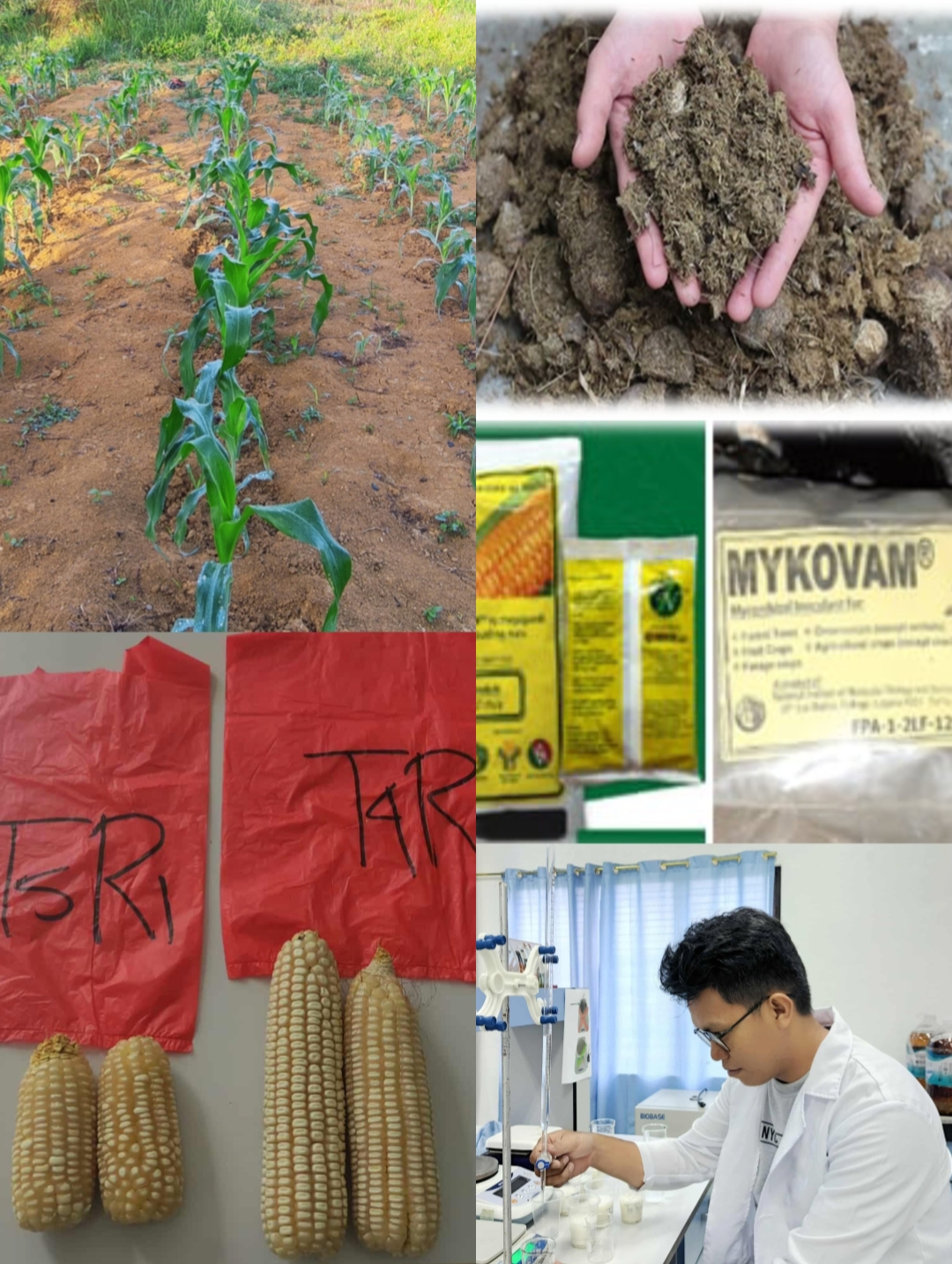
White corn is the most important substitute staple in periods of rice shortage. Currently, there is an increasing global trend toward reducing dependence on synthetic fertilizers. The increasing demand for organic produce among health-conscious consumers is driving the adoption of sustainable agricultural practices, including the use of organic fertilizers and bio-fertilizers to meet plant nutrient needs. A field experiment was conducted to evaluate the effectiveness of bio-fertilizer added to chicken manure in terms of growth, yield, and physicochemical characteristics of corn. The study used a Randomized Complete Block Design (RCBD) consisting of five treatments with three replications each, and data were collected on the growth, yield, and physicochemical parameters of corn. Data were analyzed using Analysis of Variance (ANOVA) in RCBD, and Comparisons among means were performed using Duncan Multiple Range Test (DMRT) to determine the specific significant differences among treatments. One-half the recommended rate of Azospirillum combined with half the recommended rate of Mykovam® at half the amount of chicken manure was comparable to using the full-recommended inorganic fertilizer in terms of plant height, days to silking, ear height, and average length of ears. Moreover, the same treatment combination significantly affected all growth and yield parameters, except for plant stand and average number of ears, which were comparable to using the full-recommended rate of chicken manure. The overall results of this study suggest that combining bio-fertilizer with organic amendments, like chicken manure, using only half the recommended rate, can effectively enhance corn production.
Article Details

อนุญาตภายใต้เงื่อนไข Creative Commons Attribution-NonCommercial-NoDerivatives 4.0 International License.
เอกสารอ้างอิง
Gerpacio, R. V.; Labios, J. D.; Labios, R. V.; Diangkinay, E. I. Maize in the Philippines: Production Systems, Constraints, and Research Priorities; Maize Production Systems Paper No. 7650; CIMMYT (International Maize and Wheat Improvement Center): Mexico, 2004. https://doi.org/10.22004/ag.econ.7650
Abello, N. F.; Remedios, E.; Carabio, D. E.; Pascual, P. Fermented Japanese Snail Fertilizer Reduced Vapor Pressure Deficit Which Improved Indigenous Corn Growth (Zea mays var. Tiniguib). Asian J. Agric. Biol. 2021, 4, 202102087. https://doi.org/10.35495/ajab.2021.02.087
Abdullahi, R.; Sheriff, H.; Lihan, S. Combined Effect of Biofertilizer and Poultry Manure on Growth, Nutrient Uptake, and Microbial Population Associated with Sesame (Sesamum indicum) in Northeastern Nigeria. IOSR J. Environ. Sci. Toxicol. Food Technol. 2013, 5(5), 60–65.
Ibanez, R. Y.; Balansag, G. C.; Puod, N. Effects of Different Manures on the Growth Performance of Petchay (Brassica rapa L.) under Visayas State University Conditions. J. Sci. Technol. Rep. 2025, 28(1), e255634.
Pascual, P. L.; Monsulod, C. F.; Monsulod, R. G.; Brown, M. B. Reduction of White Corn (Zea mays IPB Var. 6) Dependency on Inorganic Fertilizer through VAMRI and BIO-N Inoculation. Trop. Technol. J. 2015, 18, ISSN 1656-0264.
Amba, O.; Masnar, A. L.; Bangi, J. C.; Jambaro, G. Growth and Yield of Open-Pollinated Young Corn (Zea mays Linn.) as Influenced by Different Levels of Mykovam® Biofertilizer. Int. J. Sci. Basic Appl. Res. 2022, 62(2), 448–459.
Iwuagwu, M.; Chukwuka, K.; Uka, U.; Amandianeze, M. Effect of Biofertilizers on the Growth of Zea mays L. Asian J. Microbiol. Biotechnol. Environ. Sci. 2013, 15(2), 235–240.
Chen, Q.; Song, Y.; An, Y.; Lu, Y.; Zhong, G. Soil Microorganisms: Their Role in Enhancing Crop Nutrition and Health. Diversity 2024, 16(12), 734. https://doi.org/10.3390/d16120734
Cleyet-Marel, J.-C.; Larcher, M.; Bertrand, H.; Rapior, S.; Pinochet, X. Plant Growth Enhancement by Rhizobacteria in Nitrogen Assimilation by Plants: Physiological, Biochemical, and Molecular Aspects; Science Publishers: Enfield, NH, 2001; pp 185–199.
Kantikowati, E.; Yusdian, K.; Suryani, C. Chicken Manure and Biofertilizer for Increasing the Growth and Yield of Potato (Solanum tuberosum L.) of Granola Varieties. IOP Conf. Ser.: Earth Environ. Sci. 2019, 393, 012017. https://doi.org/10.1088/1755-1315/393/1/012017
Fadlalla, H.; Abukhlaif, H.; Mohamed, S. Effects of Chemical and Biofertilizers on Yield, Yield Components, and Grain Quality of Maize (Zea mays L.). Afr. J. Agric. Res. 2016, 11(45), 4654–4660. https://doi.org/10.5897/AJAR2016.11619
Naserirad, H.; Soleymanifard, A.; Naseri, R. Effect of Integrated Application of Biofertilizer on Grain Yield, Yield Components, and Associated Traits of Maize Cultivars. Am.-Eurasian J. Agric. Environ. Sci. 2011, 10(2), 271–277.
Rokhzadi, A.; Asharzadeh, A.; Darvish, F.; Ghorban, N.; Eslam, M. Influence of Plant Growth-Promoting Rhizobacteria on Dry Matter Accumulation and Yield of Chickpea (Cicer arietinum L.) under Field Conditions. Am.-Eurasian J. Agric. Environ. Sci. 2008, 3, 253–257.
Rotor, A.; Delima, P. Mycorrhizal Association, Nitrogen Fertilization, and Biocide Application on the Efficacy of Bio-N Corn (Zea mays L.) Growth and Productivity. E-Int. Sci. Res. J. 2010, 2.
Migahed, H.; Ahmed, A.; Abd, B.; Ghany, E. Effect of Different Bacterial Strains as Biofertilizer Agents on Growth, Production, and Oil Content of Apium graveolens under Calcareous Soil. Arab Univ. J. Agric. Sci. 2004, 12(2), 511–525.
Laraño, G. J. V.; Amper, C. D. Analysis of Soil Planted to Sweet Corn Applied with Mycorrhizal Inoculants and Varied Fertilizer Rates. Nativa 2023, 11(4), 500–504. https://doi.org/10.31413/nativa.v11i4.16654
Barky, M.; Soliman, Y.; Moussa, S. Importance of Micronutrients, Organic Manure, and Biofertilizer for Improving Maize Yield and Its Components Grown in Desert Sandy Soil. Res. J. Agric. Biol. Sci. 2009, 5 (1), 16–23.
Purwani, J.; Nurjaya. Effectiveness of Inorganic Fertilizer and Biofertilizer Application on Maize Yield and Fertilizer Use Efficiency on Inceptisol from West Java. J. Trop. Soils 2020, 25(1), 11–20. https://doi.org/10.5400/jts.2020.v25i1.11
Mahato, S.; Neupane, S. Comparative Study of Impact of Azotobacter and Trichoderma with Other Fertilizers on Maize Growth. J. Maize Res. Dev. 2017, 3(1), 1–16. https://doi.org/10.3126/jmrd.v3i1.18915
Zarabi, M.; Alahdadi, I.; Akbari, G. A. Effects of Different Biofertilizer Combinations on Yield, Its Components, and Growth Indices of Corn (Zea mays L.) under Drought Stress Conditions. Afr. J. Agric. Res. 2011, 6 (3), 681–685. https://doi.org/10.5897/AJAR10.870
Wani, F.; Ahmad, L.; Mushtaq, A. Role of Microorganisms in Nutrient Mobilization and Soil Health: A Review. J. Pure Appl. Microbiol. 2015, 9(2), 1401–1410.
Ratti, N.; Kumar, S.; Verma, H. N.; Gautam, S. P. Improvement in Bioavailability of Tricalcium Phosphate to Cymbopogon martinii var. motia by Rhizobacteria, AMF, and Azospirillum Inoculation. Microbiol. Res. 2001, 156(2), 145–149. https://doi.org/10.1078/0944-5013-00095
Javier, A.; Brown, M. Biofertilizer and Biopesticides Research and Development at UPLB; Food and Fertilizer Technology Center for the Asian and Pacific Region, 2009.
Mahdi, R.; Manea, A.; Aubied, I. Effect of Biofertilizer and Potassium Spraying on the Growth and Yield of Potatoes for Autumn Season. IOP Conf. Ser.: Earth Environ. Sci. 2023, 1158(4), 042050. https://doi.org/10.1088/1755-1315/1158/4/042050
Aryakia, E.; Roosta, H. R.; Rahmizade, N. Effects of Cow Manure, Ammonium Sulfate, and Potassium Sulfate on Physicochemical Indices of Fruit and Leaf of Mazafati Date (Phoenix dactylifera L.). J. Hortic. Sci. 2017, 31(3), 457–468. https://doi.org/10.22067/jhorts4.v31i3.36474
Bhattacharjee, R.; Dey, U. Biofertilizer, a Way Towards Organic Agriculture: A Review. Afr. J. Microbiol. Res. 2014, 8 (24), 2332–2342. https://doi.org/10.5897/AJMR2013.6374
Fageria, N. K.; Baligar, V. C.; Li, Y. C. The Role of Nutrient-Efficient Plants in Improving Crop Yields in the Twenty-First Century. J. Plant Nutr. 2008, 31(6), 1121–1157. https://doi.org/10.1080/01904160802116068
