Influence of Dietary Fermented Mulberry (Morus alba) Leaf Inclusion on Growth Performance and Immune Responses in Nile Tilapia (Oreochromis niloticus)
Article Sidebar
Main Article Content
บทคัดย่อ
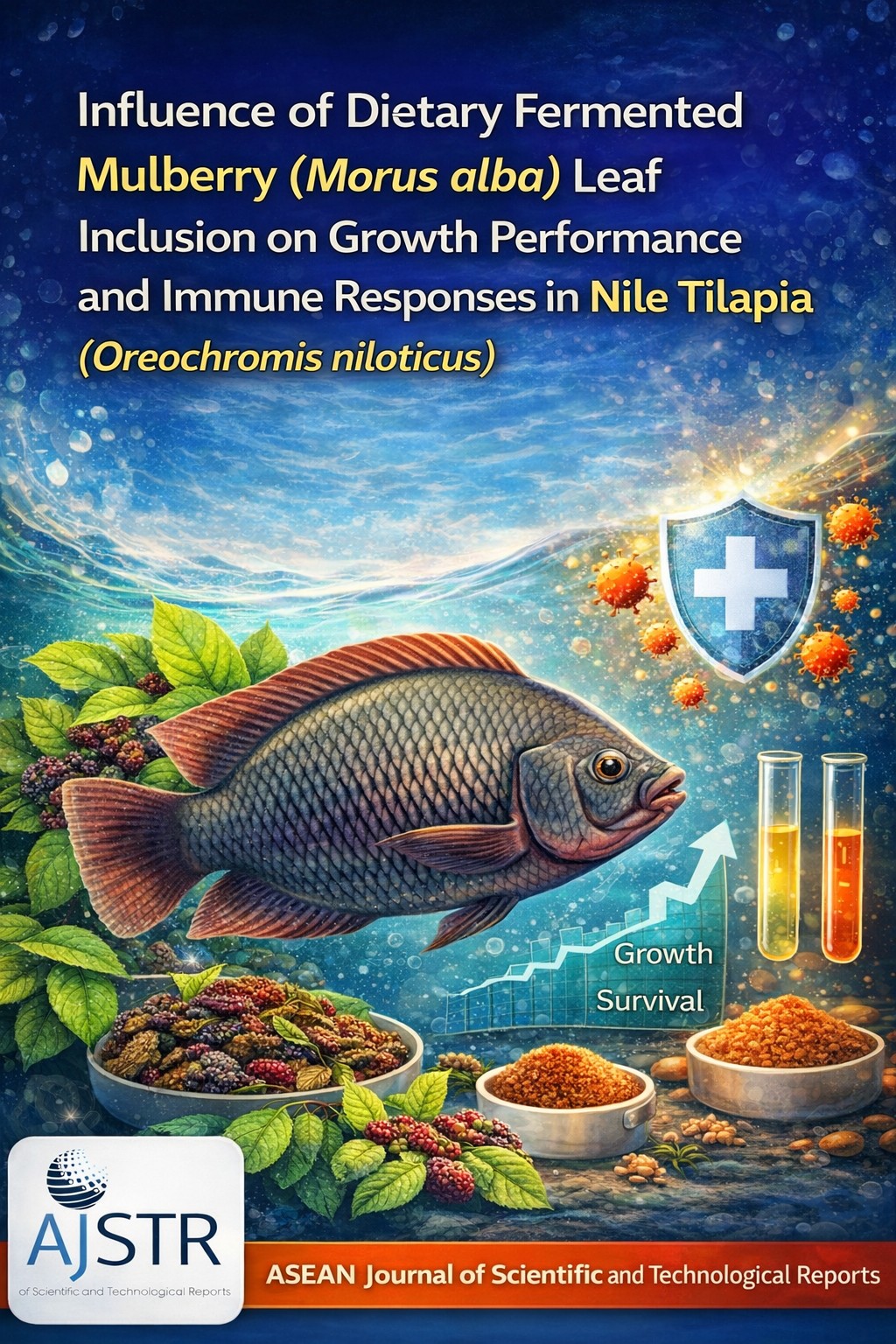
This study investigated the effects of dietary fermented mulberry leaves (FML) on growth performance, carcass traits, muscle composition, and innate immune responses of juvenile Nile tilapia (Oreochromis niloticus). The use of functional feed additives is increasingly emphasized in aquaculture to reduce antibiotic dependence, particularly during early life stages when fish are highly susceptible to disease. Juvenile tilapias were fed diets containing 0% (control), 1%, 2%, or 4% FML for 60 days. Dietary supplementation with FML significantly improved weight gain, length gain, average daily gain, feed conversion ratio, and survival (P < 0.05). The 2% FML diet produced the most favorable outcomes in muscle nutritional quality, including elevated crude protein and reduced lipid and fiber contents (P < 0.05). Immune parameters were also enhanced in fish receiving FML. Agglutination titers, lysozyme activity, and phagocytic efficiency increased significantly across FML-treated groups (P < 0.05). Moreover, the 2% inclusion level resulted in higher concentrations of the pro-inflammatory cytokines TNF-α and IL-1, indicating activation of innate immune pathways (P < 0.05). These findings demonstrate that FML, particularly at a 2% dietary inclusion, is an effective and environmentally sustainable feed supplement capable of improving growth performance, muscle composition, and immune competence in juvenile Nile tilapia. The incorporation of FML may therefore contribute to reduced reliance on antibiotics and support more sustainable aquaculture practices.
Article Details

อนุญาตภายใต้เงื่อนไข Creative Commons Attribution-NonCommercial-NoDerivatives 4.0 International License.
เอกสารอ้างอิง
FAO. The State of World Fisheries and Aquaculture; Food and Agriculture Organization of the United Nations: Rome, Italy, 2014; 223 pp.
Yue, G.; Ma, K.; Xia, J. Status of Conventional and Molecular Breeding of Salinity-Tolerant Tilapia. Rev. Aquacult. 2024, 16(1), 271–286. https://doi.org/10.1111/raq.12838
Arumugam, M.; Jayaraman, S.; Sridhar, A.; Venkatasamy, V.; Brown, P. B.; Abdul Kari, Z.; Tellez-Isaias, G.; Ramasamy, T. Recent Advances in Tilapia Production for Sustainable Developments in Indian Aquaculture and Its Economic Benefits. Fishes 2023, 8(4), 176. https://doi.org/10.3390/fishes8040176
Ess Team. The Global Tilapia Market in 2025: Trends, Opportunities and Challenges; 2025. https://essfeed.com/the-global-tilapia-market-in-2025-trends-opportunities-and-challenges-the-global-tilapia-market-in-2025-trends-opportunities-and-challenges/ (accessed 2025).
Aich, N.; Paul, A.; Choudhury, T. G.; Saha, H. Tilapia Lake Virus (TiLV) Disease: Current Status of Understanding. Aquacult. Fish. 2022, 7(1), 7–17. https://doi.org/10.1016/j.aaf.2021.04.007
Wang, B.; Thompson, K. D.; Wangkahart, E.; Yamkasem, J.; Bondad-Reantaso, M. G.; Tattiyapong, P.; Jian, J.; Surachetpong, W. Strategies to Enhance Tilapia Immunity to Improve Their Health in Aquaculture. Rev. Aquacult. 2023, 15, 41–56. https://doi.org/10.1111/raq.12731
Butt, M. S.; Nazir, A.; Sultan, M. T.; Schroën, K. Morus alba L.: Nature’s Functional Tonic. Trends Food Sci. Technol. 2008, 19 (10), 505–512. https://doi.org/10.1016/j.tifs.2008.06.002
Devi, B.; Sharma, N.; Kumar, D.; Jeet, K. Morus alba Linn: A Phytopharmacological Review. Int. J. Pharm. Pharm. Sci. 2013, 5(2), 14–18.
Lim, S. H.; Choi, C.-I. Pharmacological Properties of Morus nigra L. (Black Mulberry) as a Promising Nutraceutical Resource. Nutrients 2019, 11(2), 437. https://doi.org/10.3390/nu11020437
Wei, Y.; Huang, J.; Sun, H.; Feng, Z.; He, Y.; Chen, Y.; Lin, S. Impact of Different Processing of Mulberry Leaf on Growth, Metabolism, and Liver Immune Function of Largemouth Bass (Micropterus salmoides). Aquacult. Rep. 2023, 29, 101508. https://doi.org/10.1016/j.aqrep.2023.101508
Mondal, K.; Kaviraj, A.; Mukhopadhyay, P. K. Effects of Partial Replacement of Fishmeal by Mulberry Leaf Meal on Growth Performance and Digestive Enzyme Activities of Labeo bata. Int. J. Aquat. Sci. 2012, 3(1), 1–12.
Mithilasri, M.; Parthiban, K.; Shankar, S. Nutritional and Antinutritional Profiling of Mulberry Genetic Resources Amenable for Animal Feed. Range Manag. Agrofor. 2023, 44(1), 210–215. https://doi.org/10.59515/rma.2023.v44.i1.26
Novel Antioxidant Peptides from Mulberry (Morus atropurpurea Roxb.) Leaf Protein Hydrolysates with Hemolysis Inhibition Ability and Cellular Antioxidant Activity. J. Agric. Food Chem. 2019, 67(27), 7650–7659. https://doi.org/10.1021/acs.jafc.9b01115
Hajimohammadi, A.; Mottaghitalab, M.; Hashemi, M. Influence of Microbial Fermentation of Sesame Meal and Enzyme Supplementation on Broiler Performance. Ital. J. Anim. Sci. 2020, 19(1), 712–722. https://doi.org/10.1080/1828051X.2020.1790045
Kaviraj, A.; Mondal, K.; Mukhopadhyay, P. K.; Turchini, G. M. Impact of Fermented Mulberry Leaf and Fish Offal in Diet Formulation of Labeo rohita. Proc. Zool. Soc. 2013, 66(1), 64–73. https://doi.org/10.1007/s12595-012-0052-1
AOAC. Official Methods of Analysis, 11th ed.; Association of Official Analytical Chemists: Washington, DC, 2000; Vol. 11.
Hasan, B.; Putra, I.; Suharman, I.; Iriani, D.; Muchlisin, Z. A. Growth Performance and Carcass Quality of River Catfish (Hemibagrus nemurus) Fed Salted Trash Fish Meal. Egypt. J. Aquat. Res. 2019, 45(3), 259–264. https://doi.org/10.1016/j.ejar.2019.07.005
Yarahmadi, P.; Miandare, H. K.; Farahmand, H.; Mirvaghefi, A.; Hoseinifar, S. H. Dietary Fermentable Fiber Upregulated Immune Related Genes Expression, Increased Innate Immune Response and Resistance of Rainbow Trout (Oncorhynchus mykiss) against Aeromonas hydrophila. Fish Shellfish Immunol. 2014, 41(2), 326–331. https://doi.org/10.1016/j.fsi.2014.09.007
Swain, P.; Dash, S.; Sahoo, P.; Routray, P.; Sahoo, S.; Gupta, S.; Meher, P.; Sarangi, N. Non-Specific Immune Parameters of Labeo rohita and Seasonal Variations. Fish Shellfish Immunol. 2007, 22(1–2), 38–43. https://doi.org/10.1016/j.fsi.2006.03.010
Chandan, R.; Parry, R., Jr.; Shahani, K. Purification and Properties of Bovine Milk Lysozyme. Biochim. Biophys. Acta 1965, 110 (2), 389–398. https://doi.org/10.1016/S0926-6593(65)80046-7
Secombes, C. J. Isolation of Salmonid Macrophages and Analysis of Their Killing Activity. Tech. Fish Immunol. 1990, 1, 137–163.
Kayansamruaj, P.; Pirarat, N.; Hirono, I.; Rodkhum, C. Increasing of Temperature Induces Pathogenicity of Streptococcus agalactiae and the Up-regulation of Inflammatory Related Genes in Infected Nile Tilapia (Oreochromis niloticus). Vet. Microbiol. 2014, 172, 265–271. https://doi.org/10.1016/j.vetmic.2014.04.013
Chadzinska, M.; Savelkoul, H. F. J.; Lidy, B. M.; van Kemenade, B. M. Morphine Affects the Inflammatory Response in Carp by Impairment of Leukocyte Migration. Dev. Comp. Immunol. 2009, 33(1), 88–96. https://doi.org/10.1016/j.dci.2008.07.004
Dawood, M. A.; Koshio, S. Application of Fermentation Strategy in Aquafeed for Sustainable Aquaculture. Rev. Aquacult. 2020, 12(2), 987–1002. https://doi.org/10.1111/raq.12368
El-Ghafloul, M. S.; Ibrahim, M. A.; Abd El-Razek, I. M.; Abdo, S. E.; Amer, A. A.; Zaineldin, A. I.; Gewaily, M. S.; Dawood, M. A. Growth Performance and Antioxidative Status of Nile Tilapia Fed Fermented Rice Hulls. Aquaculture 2025, 742586. https://doi.org/10.1016/j.aquaculture.2025.742586
Siddik, M. A. B.; Julien, B. B.; Islam, S. M. M.; Francis, D. S. Fermentation in Aquafeed Processing: Achieving Sustainability in Feeds for Global Aquaculture Production. Rev. Aquacult. 2024, 16(3), 1244–1265. https://doi.org/10.1111/raq.12894
Álvarez, A.; Rodríguez, A.; Chaparro, S.; Borrás, L. M.; Rache, L. Y.; Brijaldo, M. H.; Martínez, J. J. Solid-State Fermentation as a Biotechnological Tool to Reduce Antinutrients and Increase Nutritional Content in Legumes and Cereals for Animal Feed. Fermentation 2025, 11(7), 359. https://doi.org/10.3390/fermentation11070359
Arbab Sakandar, H.; Chen, Y.; Peng, C.; Chen, X.; Imran, M.; Zhang, H. Impact of Fermentation on Antinutritional Factors of Legumes Seed. Food Rev. Int. 2023, 39(3), 1227–1249. https://doi.org/10.1080/87559129.2021.1931300
Jiang, W.; Lin, Y.; Qian, L.; Miao, L.; Liu, B.; Ge, X.; Shen, H. Mulberry Leaf Meal as a Feed Supplement for Juvenile Megalobrama amblycephala “Huahai No. 1”. Fish Shellfish Immunol. 2022, 128, 279–287. https://doi.org/10.1016/j.fsi.2022.07.022
Ilham, I.; Sucipto, S.; Fujaya, Y. Effects of Fermented Herbal Extract as a Phytobiotic on Growth Indices, Moulting Performance, and Feed Utilization of Juvenile Tiger Shrimp (Penaeus monodon). Fishes 2024, 9(9), 352. https://doi.org/10.3390/fishes9090352
Shi, Y.; Zhong, L.; Fan, Y.; Zhang, J.; Zhong, H.; Liu, X.; Hu, Y. Protective Effect of Mulberry Leaf Flavonoids on High-carbohydrate-induced Liver Oxidative Stress, Inflammatory Response and Intestinal Microbiota Disturbance in Monopterus albus. Antioxidants 2022, 11(5), 976. https://doi.org/10.3390/antiox11050976
Zhang, M.; Pan, L.; Fan, D.; He, J.; Su, C.; Gao, S.; Zhang, M. Effects of Fermented Feed by Mixed Strains and Their Effects on the Survival, Growth, Digestive Enzyme Activity and Intestinal Flora of Penaeus vannamei. Aquaculture 2021, 530, 735703. https://doi.org/10.1016/j.aquaculture.2020.735703
Neves, N. O. D. S.; De Dea Lindner, J.; Stockhausen, L.; Delziovo, F. R.; Bender, M.; Serzedello, L.; Perez Fabregat, T. E. H. Fermented Plant-Based Feeds with Lactobacillus acidophilus Improves the Survival and Intestinal Health of Juvenile Nile Tilapia (Oreochromis niloticus) Reared in a Biofloc System. Animals 2024, 14(2), 332. https://doi.org/10.3390/ani14020332
Dumas, A.; France, J.; Bureau, D. P. Modelling Growth and Body Composition in Fish Nutrition: Where Have We Been and Where Are We Going?. Aquacult. Res. 2010, 41(2), 161–181. https://doi.org/10.1111/j.1365-2109.2009.02323.x
Jobling, M. Fish Nutrition Research: Past, Present and Future. Aquacult. Int. 2016, 24(3), 767–786. https://doi.org/10.1007/s10499-014-9875-2
Miao, L.; Charles, O.; Lin, Y.; Gong, Y.; Zhu, W.; Wang, L.; Fu, J.; Zhang, Z.; Dong, Z. Interactive Effects of Mulberry Leaf Meal and Bamboo Charcoal Additive on Growth Performance, Anti-oxidant Capacity, and Disease Resistance of Genetically Improved Farmed Tilapia (GIFT) Juvenile (Oreochromis niloticus). Aquacult. Rep. 2020, 18, 100483. https://doi.org/10.1016/j.aqrep.2020.100483
Rombout, J.; Huttenhuis, H.; Picchietti, S.; Scapigliati, G. Phylogeny and Ontogeny of Fish Leucocytes. Fish Shellfish Immunol. 2005, 19 (5), 441–455. https://doi.org/10.1016/j.fsi.2005.03.007
Uribe, C.; Folch, H.; Enríquez, R.; Moran, G. Innate and Adaptive Immunity in Teleost Fish. Vet. Med. 2011, 56 (10), 486–503. https://doi.org/10.17221/3294-VETMED
Magnadottir, B. Immunological Control of Fish Diseases. Mar. Biotechnol. 2010, 12(4), 361–379. https://doi.org/10.1007/s10126-010-9279-x
Balcázar, J. L.; De Blas, I.; Ruiz-Zarzuela, I.; Cunningham, D.; Vendrell, D.; Múzquiz, J. L. The Role of Probiotics in Aquaculture. Vet. Microbiol. 2006, 114(3–4), 173–186. https://doi.org/10.1016/j.vetmic.2006.01.009
Vine, N. G.; Leukes, W. D.; Kaiser, H. Probiotics in Marine Larviculture. FEMS Microbiol. Rev. 2006, 30(3), 404–427. https://doi.org/10.1111/j.1574-6976.2006.00017.x
Lim, K. C.; Yusoff, F. M.; Karim, M.; Natrah, F. M. Carotenoids Modulate Stress Tolerance and Immune Responses in Aquatic Animals. Rev. Aquacult. 2023, 15 (2), 872–894. https://doi.org/10.1111/raq.12767
Ahmadifar, E.; Pourmohammadi Fallah, H.; Yousefi, M.; Dawood, M. A.; Hoseinifar, S. H.; Adineh, H.; Doan, H. V. The Gene Regulatory Roles of Herbal Extracts on the Growth, Immune System, and Reproduction of Fish. Animals 2021, 11(8), 2167. https://doi.org/10.3390/ani11082167
Adebo, J. A.; Njobeh, P. B.; Gbashi, S.; Oyedeji, A. B.; Ogundele, O. M.; Oyeyinka, S. A.; Adebo, O. A. Fermentation of Cereals and Legumes: Impact on Nutritional Constituents and Nutrient Bioavailability. Fermentation 2022, 8(2), 63. https://doi.org/10.3390/fermentation8020063
