Effects of Cassava Tails and Stalk and Superabsorbent Polymer on Soil Properties, Growth, and Yield of Cassava in Sandy Loam and Clay Loam Soils
Article Sidebar
Main Article Content
บทคัดย่อ
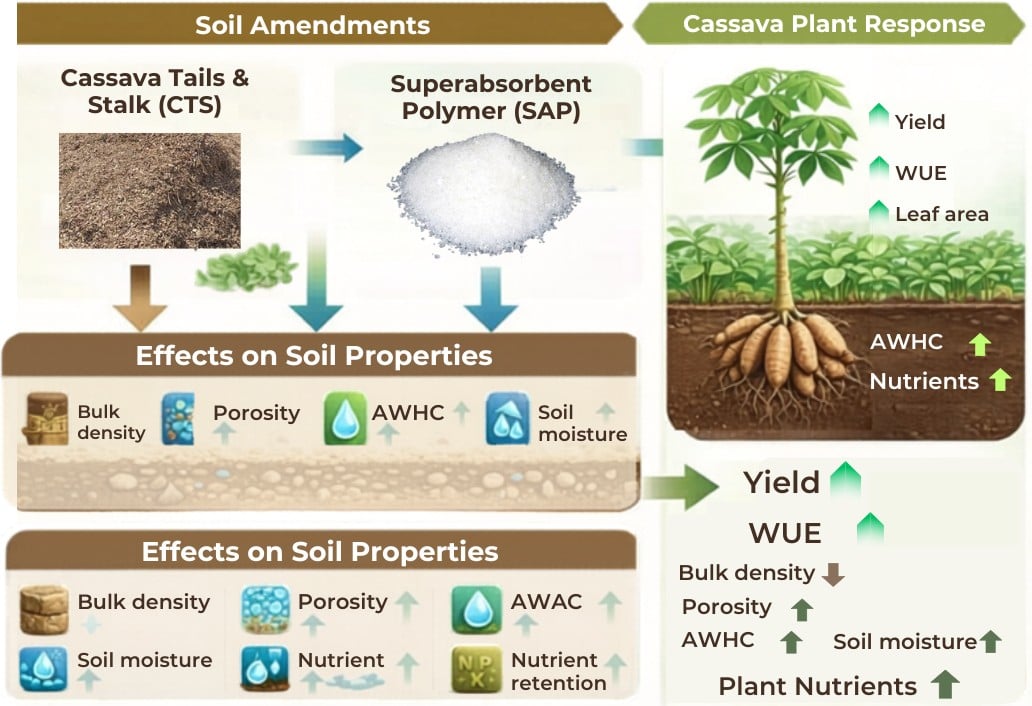
The objective of this study was to evaluate the effects of cassava tails and stalk (CTS) and superabsorbent polymer (SAP) on soil properties, as well as on cassava growth and yield in sandy loam and clay loam soils. The research employed a randomized complete block design with three treatments, including unamended soil (control, T1) , 8,000 kg/rai of fresh weight CTS (T2), and 0.25% (w/w) of SAP (T3) with four replications. In sandy loam soil, the SAP application showed a significant decrease in soil bulk density (BD) and increase in soil particle density (PD) and soil porosity (PO). Both soil amendment treatments increased organic matter (OM) (0.58%) compared with the control (0.51%). The SAP application showed the highest content of P and K (9 and 69 ppm, respectively), while CTS showed the highest content of Ca (411 ppm). In clay loam soil , the SAP application resulted in the lowest BD (1.36 g/cm³), while the CTS application resulted in the highest soil PO (50.11%). Both treatments increased OM (~1.00%) and the content of Ca and Mg (~2,000 ppm and ~220 ppm, respectively) compared with the control (0.73%, 1,559 ppm, and 182 ppm, respectively). The SAP application showed a better leaf water potential and stomatal conductance, which led to the highest plant height, leaf area, and stem diameter of cassava. In addition, the SAP application resulted in the highest cassava yield (7.83 and 6.20 tons/rai) in both soils and starch content (21.44%) in sandy loam soil. Therefore, both SAP and CTS applications improved soil properties and promoted cassava growth, resulting in higher yields; however, their effectiveness was strongly dependent on soil texture.
Article Details

อนุญาตภายใต้เงื่อนไข Creative Commons Attribution-NonCommercial-NoDerivatives 4.0 International License.
เอกสารอ้างอิง
Trade Policy and Strategy Office. The export of cassava has rebounded after 14 months, with exports to China increasing by 25.1%. Available online: https://tpso.go.th/en/home (accessed May 16, 2024).
Arunrat, N.; Kongsurakan, P.; Sereenonchai, S.; Hatano, R. Soil organic carbon in sandy paddy fields of Northeast Thailand: A review. Agronomy 2020, 10(8), 1061. https://doi.org/10.3390/agronomy10081061
Popradit, A.; Nakhokwik, Y.; Robischon, M.; Saiki, S. T.; Yoshimura, J.; Wanasiri, A.; Ishida, A. Soil degradation and herbicide pollution by repeated cassava monoculture within Thailand’s conservation region. PLoS ONE 2024, 19(8), e0308284. https://doi.org/10.1371/journal.pone.0308284
Kolinguenza, N.; Chabi, F.; Balogun, I.; Daouda, B.; Wayawaya, H. A.; Dockas, O.; Kosh-Komba, E.; Dagbenonbakin, G.; Amadji, G.; Saidou, A. Chemical characteristics of soils in forest and savannah zones and cassava productivity in the Central African Republic. Niger. J. Soil Sci. 2024, 55(2), 437–444.
Nilnoree, T.; Anusontpornperm, S.; Thanachit, S.; Kheoruenromne, I.; Petprapai, P. Effect of chicken manure and organic wastes from cassava starch manufacturing plant on cassava grown on Dan Khun Thot soil. Khon Kaen Agric. J. 2016, 44(1), 167–178.
Azarmi, R.; Giglou, M.; Taleshmikail, R. Influence of vermicompost on soil chemical and physical properties in tomato (Lycopersicum esculentum) field. Afr. J. Biotechnol. 2008, 7(14). https://doi.org/10.5897/AJB08.378
Mulugeta, A.; Getahun, B. Effects of organic amendments on soil fertility and environmental quality: A review. J. Plant Sci. 2020, 8 (5), 112–119. https://doi.org/10.11648/j.jps.20200805.12
Cercioglu, M. The role of organic soil amendments on soil physical properties and yield of maize (Zea mays L.). Commun. Soil Sci. Plant Anal. 2017, 48(6), 683–691. https://doi.org/10.1080/00103624.2017.1298787
Bilong, P.; Nguyen, T.; Ramirez, F. Biochar and organic matter additions improve soil structure and water retention in sandy soils. Agron. J. 2022, 114(2), 1234–1245. https://doi.org/10.1016/j.heliyon.2022.e09570
Eykelbosh, A. J.; Johnson, M. S.; Santos de Queiroz, E.; Dalmagro, H. J.; Guimarães Couto, E. Biochar from sugarcane filtercake reduces soil CO₂ emissions relative to raw residue and improves water retention and nutrient availability in a highly weathered tropical soil. PLoS ONE 2014, 9(6), e98523. https://doi.org/10.1371/journal.pone.0098523
Liu, Y.; Lan, X.; Hou, H.; Ji, J.; Liu, X.; Lv, Z. Multifaceted ability of organic fertilizers to improve crop productivity and abiotic stress tolerance: Review and perspectives. Agronomy 2024, 14(6), 1141. https://doi.org/10.3390/agronomy14061141
Jitkhamen, S.; Anusontpornperm, S.; Thanachit, S.; Kheoruenromne, I.; Phun-iam, M. Response of cassava Huay Bong 80 variety to potassium fertilizer in Warin soil series amended with cassava tails and stalk for two consecutive years. Agric. Sci. J. 2021, 52(2), 164–184.
Thai Tapioca Starch Association. Thai tapioca starch. Available online: https://www.thaitapiocastarch.org/en/ (accessed February 5, 2025).
Leitch, A.; Anusontpornperm, S.; Thanachit, S.; Jindaluang, W.; Phun-iam, M. Cassava response to phosphorus fertilizer in Warin soil series amended with cassava tails and stalk–bentonite mixture. Trends Sci. 2023, 20(5), 4885. https://doi.org/10.48048/tis.2023.4885
Malik, S.; Chaudhary, K.; Malik, A.; Punia, H.; Sewhag, M.; Berkesia, N.; Nagora, M.; Kalia, S.; Malik, K.; Kumar, D. Superabsorbent polymers as a soil amendment for increasing agricultural production while reducing water losses under water stress conditions. Polymers 2022, 15(1), 161. https://doi.org/10.3390/polym15010161
Hou, X.; Li, R.; He, W.; Dai, X.; Ma, K.; Liang, Y. Superabsorbent polymers influence soil physical properties and increase potato tuber yield in a dry-farming region. J. Soils Sediments 2018, 18(3), 816–826.
Blake, G. R. Bulk density. In Methods of Soil Analysis; Agronomy Monographs; American Society of Agronomy: Madison, WI, USA, 1965; pp 374–390. https://doi.org/10.2134/agronmonogr9.1.c30
Rühlmann, J.; Körschens, M.; Graefe, J. A new approach to calculate the particle density of soils considering properties of the soil organic matter and the mineral matrix. Geoderma 2006, 130(3), 272–283. https://doi.org/10.1016/j.geoderma.2005.01.024
Cera, J. S. How to compute soil porosity. 2024. https://doi.org/10.1515/ssa-2015
Walkley, A.; Black, I. A. An examination of the Degtjareff method for determining soil organic matter and a proposed modification of the chromic acid titration method. Soil Sci. 1934, 37, 29–37. https://doi.org/10.1097/00010694-193401000-00003
Bray, R. H.; Kurtz, L. T. Determination of total organic, and available forms of phosphorus in soil. Soil Sci. 1945, 59(1), 39–45. https://doi.org/10.1097/00010694-194501000-00006
Isaac, R. A.; Kerber, J. D. Atomic absorption and flame photometry: Techniques and uses in soil, plant and water analysis. In Instrumental Methods for Analysis of Soil and Plant Tissue; Walsh, L. M., Ed.; Soil Science Society of America: Madison, WI, USA, 1971. https://doi.org/10.2136/1971.instrumentalmethods.c2
Pereira, L. F. M.; Zanetti, S.; Silva, M. D. A. Water relations of cassava cultivated under water deficit levels. Acta Physiol. Plant. 2018, 40, 1–13. https://doi.org/10.1007/s11738-017-2590-7
Orek, C.; Gruissem, W.; Ferguson, M.; Vanderschuren, H. Morpho-physiological and molecular evaluation of drought tolerance in cassava (Manihot esculenta Crantz). Field Crops Res. 2020, 255, 107861. https://doi.org/10.1016/j.fcr.2020.107861
Cao, Y.; Wang, B.; Guo, H.; Xiao, H.; Wei, T. The effect of superabsorbent polymers on soil and water conservation on the terraces of the Loess Plateau. Ecol. Eng. 2017, 102, 270–279. https://doi.org/10.1016/j.ecoleng.2017.02.043
Zheng, H.; Mei, P.; Wang, W.; Yin, Y.; Li, H.; Zheng, M.; Cui, Z. Effects of superabsorbent polymer on crop yield, water productivity, and soil properties: A global meta-analysis. Agric. Water Manage. 2023, 282, 108290. https://doi.org/10.1016/j.agwat.2023.108290
Yang, Y.; Wu, J.; Han, Q.; He, F.; Han, W.; Yang, X. Quantitative analysis of the effect of water-retaining agent on soil pores. Sci. Soil Water Conserv. 2011, 9, 88–93. https://doi.org/10.3389/fenvs.2022.859434
Yang, Y.; Wu, J.; Zhao, S.; Han, Q.; Pan, X.; He, F.; Chen, C. Assessment of the responses of soil pore properties to combined soil structure amendments using X-ray computed tomography. Sci. Rep. 2018, 8, 695. https://doi.org/10.1038/s41598-017-18997-1
Spaccini, R.; Piccolo, A.; Mbagwu, J. S. C.; Teshale, A. Z.; Igwe, C. Influence of the addition of organic residues on carbohydrate content and structural stability of some highland soils in Ethiopia. Soil Use Manage. 2002, 18, 404–411. https://doi.org/10.1111/j.1475-2743.2002.tb00259.x
Ogunlade, M. O.; Adeoye, G. O.; Ipinmoroti, R. R.; Ibiremo, O. S.; Iloyanomon, C. I. Comparative effect of organic and NPK fertilizers on the growth and nutrient uptake of cocoa seedlings. Niger. J. Soil Sci. 2006, 16, 121–125.
Olatunji, O.; Ayuba, S. A.; Oboh, V. U. Growth and yield of okra and tomato as affected by pig dung and other organic manures: Issues for economic consideration in Benue State. In Proceedings of the 30th Annual Conference of the Soil Science Society of Nigeria; University of Agriculture: Makurdi, Nigeria, 2006; pp 91–98.
Amenkhienan, B.; Isitekhale, H. H. E.; Nwobi, N.; Ayemere, E. E.; Oriaifo, S. O. Influences of cassava peels on some soil physical properties, maize growth, and yield in an Ultisol. Int. J. Innov. Agric. Biol. Res. 2018, 6(3), 31–38.
Yang, Y.; Wu, J.; Zhao, S.; Gao, C.; Pan, X.; Tang, D. W.; Van der Ploeg, M. Effects of long-term superabsorbent polymer and organic manure on soil structure and organic carbon distribution in different soil layers. Soil Tillage Res. 2021, 206, 104781. https://doi.org/10.1016/j.still.2020.104781
Ketkhao, P.; Anusontpornperm, S.; Thanachit, S.; Kheoruenromne, I.; Phun-iam, M. Effect of bentonite and cassava tails and stalk on cassava planted in an upland Grossarenic Paleustult and soil property changes. Agric. Nat. Resour. 2024, 58(1), 67–80.
Goebel, M.; Bachmann, J.; Woche, S. K.; Fischer, W. R. Soil wettability, aggregate stability, and the decomposition of soil organic matter. Geoderma 2005, 128, 80–93. https://doi.org/10.1016/j.geoderma.2004.12.016
Li, X.; He, J. Z.; Liu, Y. R.; Zheng, Y. M. Effects of superabsorbent polymers on soil microbial properties and Chinese cabbage (Brassica chinensis) growth. J. Soils Sediments 2013, 13, 711–719. https://doi.org/10.1007/s11368-013-0657-7
Xu, S.; Zhang, L.; McLaughlin, N. B.; Mi, J.; Chen, Q.; Liu, J. Effect of synthetic and natural water-absorbing soil amendment on soil physical properties under potato production in a semi-arid region. Soil Tillage Res. 2015, 148, 31–39. https://doi.org/10.1016/j.still.2014.10.002
Singh, A.; Kumar, M. C.; Parmar, R.; Kumar, B. S. Performance of a new superabsorbent polymer on seedling and post-planting growth and water use pattern of chrysanthemum grown under controlled environment. Acta Hortic. 2007, 43–49. https://doi.org/10.17660/ActaHortic.2007.742.5
Verma, A. K.; Sindhu, S. S.; Singh, A.; Kumar, A.; Singh, A.; Chauhan, V. B. S. Conditioning effects of biodegradable superabsorbent polymer and vermi-products on media properties and growth of gerbera. Ecol. Eng. 2019, 132, 23–30. https://doi.org/10.1016/j.ecoleng.2019.03.012
Islam, M. R.; Hu, Y.; Mao, S.; Mao, J.; Eneji, A. E.; Xue, X. Effectiveness of a water-saving superabsorbent polymer in soil water conservation for corn (Zea mays L.) based on eco-physiological parameters. J. Sci. Food Agric. 2011, 91, 1998–2005. https://doi.org/10.1002/jsfa.4408
Opachat, T.; Anusontpornperm, S.; Thanachit, S.; Kheoruenromne, I. Major plant nutrient release in jasmine rice growing soils amended with biochar and organic wastes: An incubation study. Int. J. Soil Sci. 2018, 13, 9–17. https://doi.org/10.3923/ijss.2018.9.17
Pereira, L. F. M.; Zanetti, S.; Silva, M. d. A. Water relations of cassava cultivated under water deficit levels. Acta Physiol. Plant. 2018, 40, 1–13. https://doi.org/10.1007/s11738-017-2590-7
Situ, Y.; Yang, Y.; Huang, C.; Liang, S.; Mao, X.; Chen, X. Effects of several superabsorbent polymers on soil exchangeable cations and crop growth. Environ. Technol. Innov. 2023, 30, 103126. https://doi.org/10.1016/j.eti.2023.103126
Ndunge, B. D.; Obiero, J. P. O.; Mbuge, D. O. Contribution of superabsorbent polymers to growth and yield of African leafy vegetables. Adv. Agric. 2022, 1, 8020938. https://doi.org/10.1155/2022/8020938
Alotaibi, M. M.; Alharbi, M. M.; Alsudays, I. M.; Alsubeie, M. S.; Almuziny, M.; Alabdallah, N. M.; Alghanem, S. M. S.; Albalawi, B. F.; Ismail, K. A.; Alzuaibr, F. M.; Moustafa, M. M. I.; Abd-Elwahed, A. H. M.; Hassan, A. H. A.; Khalifa, S. M.; Awad-Allah, M. M. A. Influence of superabsorbent polymer on growth and productivity of green bean under drought conditions. Agronomy 2024, 14(6), 1146. https://doi.org/10.3390/w16223186
Shahrajabian, M. H.; Sun, W.; Cheng, Q.; Khoshkharam, M. The impact of soil amendment of superabsorbent polymer on grain yield and yield components of corn in center of Iran. Commun. Agric. Appl. Biol. Sci. 2019, 52, 151–157.
Negim, O. I. A.; Moharam, M. H. A.; Elsayed, E. F.; Thabit, F. N. The combination between superabsorbent polymers (SAPs) and biofertilizers could be an ecofriendly approach for soil chemical properties improving and sustainable wheat (Triticum sativum) production in sandy loam soil. J. Soil Sci. Plant Nutr. 2024, 24(3), 4349–4365. https://doi.org/10.1007/s42729-024-01839-1
Palma, D.; Lagos, O.; Souto, C.; Pérez, A.; Quezada, L.; Hirzel, J.; Vera, M.; Ulloa, J.; Urbano, B. Evaluation of a natural superabsorbent polymer on water retention capacity in coarse-textured soils. Water 2024, 16(22), 3186. https://doi.org/10.3390/w16223186
Ghobashy, M. M.; Amin, M. A.; Mustafa, A. E.; El-Diehy, M. A.; El-Damhougy, B. K.; Nady, N. S. Synthesis and application of a multifunctional poly(vinyl pyrrolidone)-based superabsorbent hydrogel for controlled fertilizer release and enhanced water retention in drought-stressed Pisum sativum plants. Sci. Rep. 2024, 14(1), 27734. https://doi.org/10.1038/s41598-024-76255-7
