Process Parameter Optimization of Ti-45Nb Titanium Alloy Produced Using the Design of Experiments Technique
Article Sidebar
Main Article Content
บทคัดย่อ
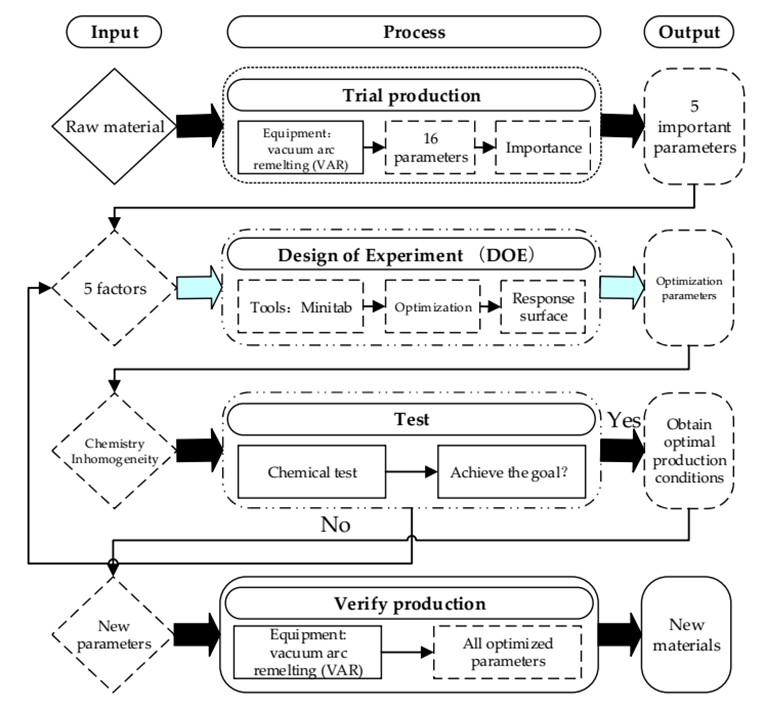
The goal of this study is to optimize the production conditions of Ti-45Nb titanium alloy by innovatively introducing the Design of Experiments (DOE) method and using the 2k method of full factor analysis in DOE, and to improve the chemical heterogeneity of Ti-45Nb titanium alloy by analyzing and optimizing the parameter conditions of the production process and a total of 32 experiments was conducted. Ti-45Nb titanium alloy was produced by vacuum arc remelting (VAR) according to the following process parameters. The titanium alloy products obtained from each production were cut into circular samples with a diameter of 16 cm, and the chemical inhomogeneity was measured by Energy-dispersive X-ray spectroscopy using the 5-point sampling method. Then, the chemical inhomogeneity data values were entered into the previous experimental design, and the appropriate factor levels were determined using the technology provided in the Minitab statistical software package, with a significance level of 0.05 (α = 0.05). Through full factorial design (DOE) and residual analysis, a regression model for chemical inhomogeneity was successfully constructed. After optimization, the production conditions of Ti-45Nb titanium alloy are: Smelting current (KA) = 1.7, Current coil (A) = 3.2542, Transform time (S) = 6, Inlet water temperature (°C) = 25, and Water flow (L/min) = 220. The chemical inhomogeneity value of the produced Ti-45Nb titanium alloy is theoretically 10%. It can provide a reference for enterprise production.
Article Details

อนุญาตภายใต้เงื่อนไข Creative Commons Attribution-NonCommercial-NoDerivatives 4.0 International License.
เอกสารอ้างอิง
Gosavi, S.; Gosavi, S.; Alla, R. Titanium: A Miracle Metal in Dentistry. Trends Biomater. Artif. Organs 2013, 27(1), 42–46.
Peters, M.; Kumpfert, J.; Ward, C. H.; Leyens, C. Titanium Alloys for Aerospace Applications. Adv. Eng. Mater. 2003, 5(6), 419–427. https://doi.org/10.1002/adem.200310095
Kumpfert, J.; Leyens, C. Orthorhombic Titanium Aluminides: Intermetallics with Improved Damage Tolerance. In Titanium and Titanium Alloys: Fundamentals and Applications; Leyens, C., Peters, M., Eds.; Wiley-VCH: Weinheim, Germany, 2003; pp 59–88. https://doi.org/10.1002/3527602119.ch3
Luo, Y. Biotribology. In Biotribology; Davim, J. P., Ed.; ISTE-Wiley: London, 2010; p 157.
Ribeiro, M. V.; Moreira, M. R.; Ferreira, J. R. Optimization of Titanium Alloy (6Al–4V) Machining. J. Mater. Process. Technol. 2003, 143, 458–463. https://doi.org/10.1016/S0924-0136(03)00457-6
Rahman, M.; Wang, Z. G.; Wong, Y. S. A Review on High-Speed Machining of Titanium Alloys. JSME Int. J., Ser. C 2006, 49(1), 11–20. https://doi.org/10.1299/jsmec.49.11
Donachie, M. J. Titanium: A Technical Guide, 2nd ed.; ASM International: Materials Park, OH, 2000.
Veiga, C.; Davim, J. P.; Loureiro, A. J. Properties and Applications of Titanium Alloys: A Brief Review. Rev. Adv. Mater. Sci. 2012, 32(2), 133–148.
Sverdrup, H. U.; Sverdrup, A. E. An Assessment of the Global Supply, Recycling, Stocks in Use and Market Price for Titanium Using the WORLD7 Model. Sustain. Horizons 2023, 7, 100067. https://doi.org/10.1016/j.horiz.2023.100067
Hu, N.; Xie, L.; Liao, Q.; Gao, A.; Zheng, Y.; Pan, H.; Tong, L.; Yang, D.; Gao, N.; Starink, M. J.; Chu, P. K. A More Defective Substrate Leads to a Less Defective Passive Layer: Enhancing the Mechanical Strength, Corrosion Resistance and Anti-Inflammatory Response of the Low-Modulus Ti-45Nb Alloy by Grain Refinement. Acta Biomater. 2021, 126, 524–536. https://doi.org/10.1016/j.actbio.2021.02.045
Zhang, L. C.; Chen, L. Y. A Review on Biomedical Titanium Alloys: Recent Progress and Prospect. Adv. Eng. Mater. 2019, 21(4), 1801215. https://doi.org/10.1002/adem.201801215
Gepreel, M. A.; Niinomi, M. Biocompatibility of Ti-Alloys for Long-Term Implantation. J. Mech. Behav. Biomed. Mater. 2013, 20, 407–415. https://doi.org/10.1016/j.jmbbm.2012.11.014
Niinomi, M. Recent Research and Development in Titanium Alloys for Biomedical Applications and Healthcare Goods. Sci. Technol. Adv. Mater. 2003, 4(5), 445–454. https://doi.org/10.1016/j.stam.2003.09.002
Titanium and Titanium Alloys: Fundamentals and Applications; Leyens, C., Peters, M., Eds.; Wiley-VCH: Weinheim, Germany, 2003. https://onlinelibrary.wiley.com/doi/book/10.1002/3527602119 (accessed 2022-09-26).
Li, Y.; Yang, C.; Zhao, H.; Qu, S.; Li, X.; Li, Y. New Developments of Ti-Based Alloys for Biomedical Applications. Materials 2014, 7(3), 1709–1800. https://doi.org/10.3390/ma7031709
Patel, D.; Kim, S. H.; Qiu, W.; Maeda, M.; Matsumoto, A.; Nishijima, G.; Kumakura, H.; Choi, S.; Kim, J. H. Niobium-Titanium (Nb-Ti) Superconducting Joints for Persistent-Mode Operation. Sci. Rep. 2019, 9(1), 14287. https://doi.org/10.1038/s41598-019-50549-7
El Khalloufi, M.; Drevelle, O.; Soucy, G. Titanium: An Overview of Resources and Production Methods. Minerals 2021, 11(12), 1425. https://doi.org/10.3390/min11121425
Durakovic, B. Design of Experiments Application, Concepts, Examples: State of the Art. Period. Eng. Nat. Sci. 2017, 5(3), 421–439. https://doi.org/10.21533/pen.v5i3.145
Sreela-or, C.; Tharungsri, P.; Yamkong, S.; Kotam, P.; Jaipong, P. Optimum Conditions of Using Bio-Extract from Urine with Vinasse and Manure Affecting Yields of Marigold. Life Sci. Environ. J. 2022, 23(2), 283–296 (in Thai). https://doi.org/10.14456/lsej.2022.22
Sonsiri, A.; Palicamin, P.; Amdee, N. Development of Plastic Green Composite for Vacuum Mold Process. FEAT J. Farm Eng. Autom. Technol. J. 2021, 7(1), 1–9. https://doi.org/10.14456/lsej.2024.25
