Improving Drying Efficiency for Red Chili Peppers Using Ventilated Solar Technology
Article Sidebar
Main Article Content
บทคัดย่อ
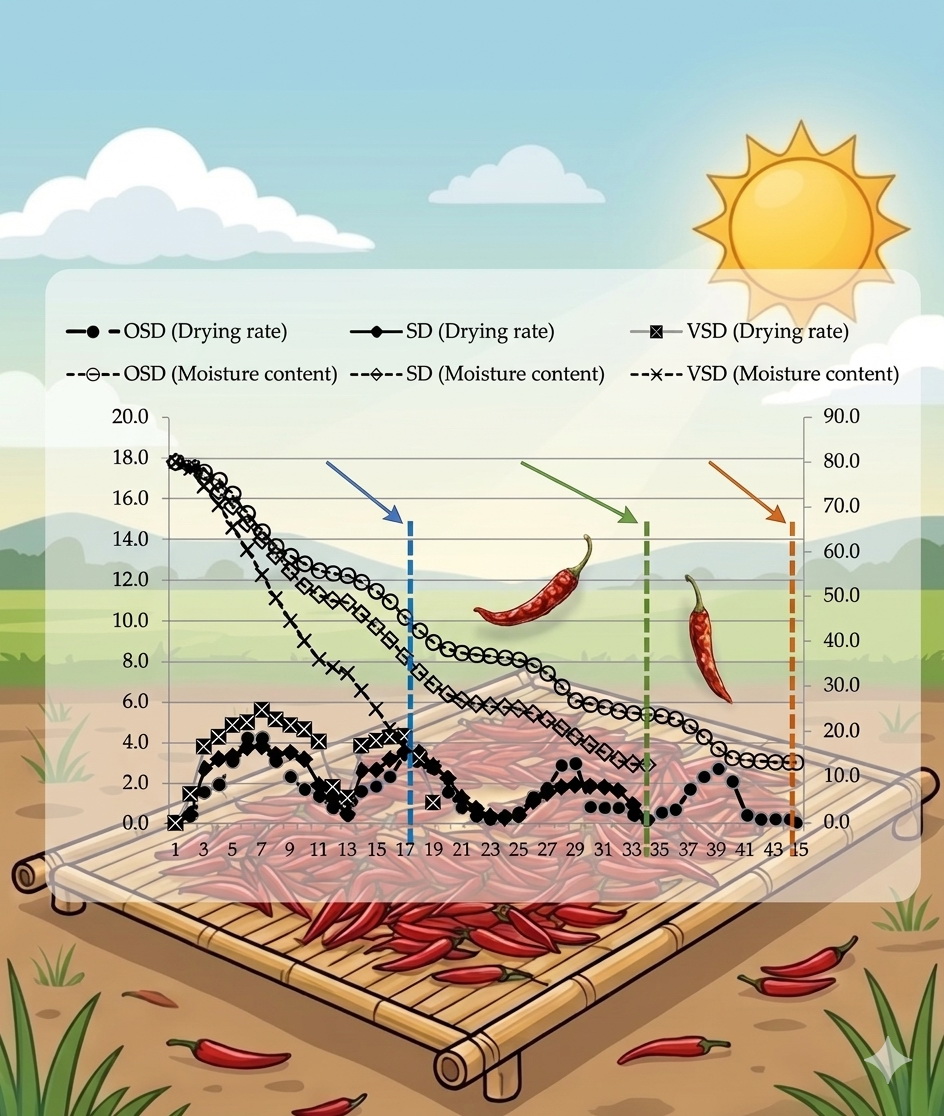
This study compares three drying methods for Jinda red chili peppers: open sun drying (OSD), conventional solar drying (SD), and ventilated solar drying (VSD). Fresh chilies with an initial moisture content of 80% were dried to achieve the industry standard of ≤13.5% final moisture content. Temperature monitoring showed that SD reached the highest peak temperature (75°C), followed by VSD (56°C) and OSD (52°C). Significant differences in drying time were observed: VSD reached appropriate moisture levels in under 17 hours, SD in 34 hours, and OSD in 45 hours. Compared with the first day of SD and OSD, which had drying rates of 49.5% and 55.5%, respectively, VSD showed the highest drying rate, reducing the moisture content to 34.6%. By the second day, VSD had a moisture content of 12.5%, while SD and OSD retained 33.7% and 37.3%, respectively. The enhanced efficiency of VSD is attributed to the combined effects of elevated temperature and mechanical ventilation, which accelerated moisture removal despite the lower chamber temperature than in SD. While solar dryers require greater initial investment than traditional methods, they offer significant advantages in processing time, product quality, contamination prevention, and labor requirements, potentially yielding faster returns on investment. These findings suggest that VSD is optimal for commercial chili drying operations in Thailand's agricultural sector.
Article Details

อนุญาตภายใต้เงื่อนไข Creative Commons Attribution-NonCommercial-NoDerivatives 4.0 International License.
เอกสารอ้างอิง
Anderson, H. A. Chillies: A Global History; Reaktion Books: London, 2016.
Andrews, J. The Pepper Trail: History & Recipes from around the World; 1999.
Hasan, M. U.; Malik, A. U.; Ali, S.; Imtiaz, A.; Munir, A.; Amjad, W.; Anwar, R. Modern Drying Techniques in Fruits and Vegetables to Overcome Postharvest Losses: A Review. J. Food Process. Preserv. 2019, 43 (12), e14280. https://doi.org/10.1111/jfpp.14280
Wongbubpa, N.; Treeamnuk, K.; Treeamnuk, T. Influence of Drying Air Velocity Characteristics on Paddy Drying. RMUTP Res. J. 2022, 16, 165–176.
Research Center. Research and Development of Technology and Machines for Chili; Department of Agriculture, Ministry of Agriculture and Cooperatives: Khon Kaen, Thailand, 2009.
Cruz-Domínguez, O.; Carrera-Escobedo, J. L.; Guzman-Valdivia, C. H.; Ortiz-Rivera, A.; García-Ruiz, M.; Duran-Muñoz, H. A.; Vidales-Basurto, C. A.; Castaño, V. M. A Novel Method for Dried Chili Pepper Classification Using Artificial Intelligence. J. Agric. Food Res. 2021, 3, 100099. https://doi.org/10.1016/j.jafr.2021.100099
AOAC International. Official Methods of Analysis of AOAC International, 17th ed.; AOAC International: Gaithersburg, MD, 2000.
Fudholi, A.; Othman, M. Y.; Ruslan, M. H.; Sopian, K. Drying of Malaysian Capsicum annuum L. (Red Chili) Dried by Open and Solar Drying. Int. J. Photoenergy 2013, 2013, 167895. https://doi.org/10.1155/2013/167895
Benyoucef, M.; Panigrahi, S. S. Fluidization-Bed Drying and Microwave Radiation Effects on Drying Rate, Fatty Acid, Protein and Germination of Rapeseed. J. Food Compos. Anal. 2025, 142, 107562. https://doi.org/10.1016/j.jfca.2025.107562
Jain, R.; Paul, A. S.; Sharma, D.; Panwar, N. L. Enhancement in Thermal Performance of Solar Dryer through Conduction Mode for Drying of Agricultural Produces. Energy Nexus 2023, 9, 100182. https://doi.org/10.1016/j.nexus.2023.100182
Korbuakaew, K.; Phoosomma, P. The Approach for Boosting the Drying Chamber's Temperature by Pulse Copper Pipes to Conduct Heat. ASEAN J. Sci. Technol. Rep. 2025, 28 (3), e254983. https://doi.org/10.55164/ajstr.v28i3.254983
Meghwar, B. L.; Khan, A.; Lakhiar, I. A.; Mirani, A. A.; Daper, M. S.; Kalroo, M. W. Comparison between Solar Tunnel, Solar-Cum Gas Dryer, and Open Sun Drying Methods for Drying Red Chilies. Pak. J. Agric. Res. 2023, 36, 63–70. https://doi.org/10.17582/journal.pjar/2022/36.1.63.70
Nimrothama, C.; Songprakorpa, R.; Thepa, S.; Monyakul, V. Experimental Research of Drying Red Chili by Two Methods: Solar Drying and Low-Temperature System Drying. Energy Procedia 2017, 138, 512–517. https://doi.org/10.1016/j.egypro.2017.10.237
Selvaraja, M.; Sadagopan, P.; Vijayan, S. Investigation of the Thermal Performance of an Indirect Forced Convection Solar Dryer for Tapioca Chips Drying. Desalin. Water Treat. 2021, 230, 430–441. https://doi.org/10.5004/dwt.2021.27214
Jeentada, W.; Niyomvas, B.; Thailul, A. Experimental Study on Drying Conditions of Solar Fish Dryer with Temperature Controlled by Open–Closed Ventilation System. J. KMITNB 2018, 28, 525–536.
Dussan, E. D.; Uribe, J. R.; Banout, J. Design and Evaluation of a Hybrid Solar Dryer for Postharvesting Processing of Parchment Coffee. Renew. Energy 2023, 215, 118961. https://doi.org/10.1016/j.renene.2023.118961
Krabch, H.; Tadili, R.; Idrissi, A. Design, Realization and Comparison of Three Passive Solar Dryers: Orange Drying Application for the Rabat Site (Morocco). Results Eng. 2022, 15, 100532. https://doi.org/10.1016/j.rineng.2022.100532
Purika, S.; Aunaudomvana, N.; Panyoyai, N. Pretreatment Techniques of Dehydrated Red Spur Chilli Peppers for Compliant Thai Agricultural and Community Food Standards. Sci. Technol. Community 2023, 1, 1–18.
Lakshmi, D. V. N.; Palanisamy, M. Design and Development of Mixed Mode Forced Convection Solar Dryer for Drying of Curcuma zedoaria. In Proc. Int. Conf. Therm. Eng. (ICTEA); 2019.
Nukulwar, M. R.; Tungikar, V. B. A Review on Performance Evaluation of Solar Dryer and Its Material for Drying Agricultural Products. Mater. Today: Proc. 2021, 46, 345–349. https://doi.org/10.1016/j.matpr.2020.08.354
