
Effect of Recycled Coarse Aggregate Quality on Compressive Strength of Concrete at Different Replacement Levels
Article Sidebar
Main Article Content
Abstract
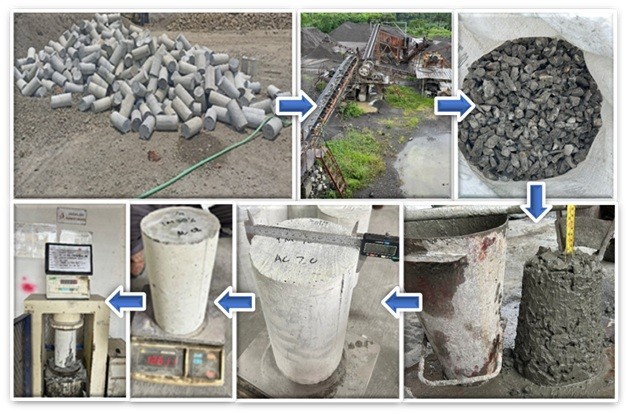
Recycled Coarse Aggregate (RCA) is produced from the processing of construction and demolition waste and is used as a replacement for Natural Coarse Aggregate (NCA). Waste concrete cylinders from compressive-strength testing in precast concrete factories are readily available but have not been optimally utilized. One potential solution for utilizing this waste is to recycle it into RCA. In previous studies, the quality of the RCA used was generally not known with certainty; therefore, its effect on Recycled Aggregate Concrete (RAC) remains to be further investigated. This study aims to determine the effect of RCA quality on the compressive strength of new concrete. The RCA used in this research consists of six quality levels: RCA67 (f'c = 67 MPa), RCA58 (f'c = 58 MPa), RCA50 (f'c = 50 MPa), RCA30 (f'c = 30 MPa), RCA25 (f'c = 25 MPa), and RCA20 (f'c = 20 MPa). NCA was replaced with RCA at two replacement levels: 50% and 100%. The tests included aggregate properties, slump, compressive strength, and unit weight. The results showed that the compressive strength of Natural Aggregate Concrete (NAC) with 100% NCA was higher than that of RAC with either 50% or 100% RCA. Compared to NAC, the compressive strength of RAC decreased by 14.11%–43.58% with 100% RCA and by 1.53%–13.75% with 50% RCA. The compressive strength of RAC decreased as the quality of RCA decreased. RCA quality had a significant effect on concrete compressive strength at both replacement levels.
Article Details

This work is licensed under a Creative Commons Attribution-NonCommercial-NoDerivatives 4.0 International License.
References
Kumar, V.; Kumar, E. R.; Singh, G. Utilization of Recycled Coarse Aggregates (RCA) for Development of Concrete: Review. Int. J. Creat. Res. Thoughts 2024, 12(3), 139–144.
Sadik, M. N.; Akter, T.; Proma, P. D.; Prodhan, M. A. R.; Momotaj, M. Impact of Recycled Coarse Aggregates on the Mechanical Properties and Durability of Concrete. Eur. J. Theor. Appl. Sci. 2024, 2(5), 738–759. https://doi.org/10.59324/ejtas.2024.2(5).66
Benito, E. K. D.; et al. Durability Performance of Concrete Containing Recycled Coarse Aggregates Derived from Laboratory-tested Specimens. World J. Eng. 2024, 21(3), 604–614. https://doi.org/10.1108/WJE-02-2023-0033
Bilal, H.; Ali, D. Overview of Studies on the Effect of Recycled Aggregates Sourced from Tested Cylinders on Concrete Material and Structural Properties. MATEC Web Conf. 2017, 120, 03007. https://doi.org/10.1051/matecconf/201712003007
Neupane, R. P.; Imjai, T.; Makul, N.; Garcia, R.; Kim, B.; Chaudhary, S. Use of Recycled Aggregate Concrete in Structural Members: A Review Focused on Southeast Asia. J. Asian Archit. Build. Eng. 2025, 24 (3), 1197–1220. https://doi.org/10.1080/13467581.2023.2270029
Ayub, T.; Khan, A.-R.; Mahmood, W. Effect of Recycled Concrete Aggregates on Compressive Strength and Water Permeability of Concrete. Int. J. Energy Environ. 2020, 14, 25–32. https://doi.org/10.46300/91012.2020.14.6
Xiao, Q.; Liu, X.; Qiu, J.; Li, Y. Capillary Water Absorption Characteristics of Recycled Concrete in Freeze-Thaw Environment. Adv. Mater. Sci. Eng. 2020, 2020, 1620914. https://doi.org/10.1155/2020/1620914
Gao, Q.; Ma, Z.; Xiao, J.; Li, F. Effects of Imposed Damage on the Capillary Water Absorption of Recycled Aggregate Concrete. Adv. Mater. Sci. Eng. 2018, 2018, 2890931. https://doi.org/10.1155/2018/2890931
Prasittisopin, L.; Tuvayanond, W.; Kang, T. H. K.; Kaewunruen, S. Concrete Mix Design of Recycled Concrete Aggregate (RCA): Analysis of Review Papers, Characteristics, Research Trends, and Underexplored Topics. Resources 2025, 14(2), 21. https://doi.org/10.3390/resources14020021
Shawais, Z. A.; Abdulhaleem, K. N.; Ahmed, S. H.; Hamada, H. M.; Mohammed, V. R. Influence of Recycled Coarse Aggregate and Steel Fiber on the Workability and Strength of Self-Compacting Concrete. IOP Conf. Ser.: Earth Environ. Sci. 2024, 1374(1), 012084. https://doi.org/10.1088/1755-1315/1374/1/012084
Tran, D. V. P.; Allawi, A.; Albayati, A.; Cao, T. N.; El-zohairy, A.; Nguyen, Y. T. H. Recycled Concrete Aggregate for Medium-Quality Concrete. Materials 2021, 14(16), 4612. https://doi.org/10.3390/ma14164612
Qasim, O. A.; Hilal, N.; Al Biajawi, M. I.; Sor, N. H.; Tawfik, T. A. Studying the Usability of Recycled Aggregate to Produce New Concrete. J. Eng. Appl. Sci. 2024, 71(1), 1–24. https://doi.org/10.1186/s44147-024-00463-1
Al-shamaa, M. F. K.; Ali, A. A.; Al-mulla, I. F. A. Mechanical Characteristics of Structural Concrete Using Building Rubbles as Recycled Coarse Aggregate. J. Mech. Behav. Mater. 2024, 33(1), 20240001. https://doi.org/10.1515/jmbm-2024-0001
Buller, A. H.; Husain, N.; Buller, A. S.; Channa, I. A.; Ali, T.; Shabbir, S. Effect of Recycled Aggregates on Physical and Mechanical Performance of Green Concrete Mix. Teh. Vjesn. 2025, 32(1), 306–312.
Halahla, A. M.; Akhtar, M.; Almasri, A. H. Utilization of Demolished Waste as Coarse Aggregate in Concrete. Civ. Eng. J. 2019, 5(3), 540–551. https://doi.org/10.28991/cej-2019-03091266
Hassan, S. S. Effects of Recycled Concrete Aggregate on Some Mechanical Properties of High Strength Concrete. IOP Conf. Ser.: Mater. Sci. Eng. 2018, 433, 012033. https://doi.org/10.1088/1757-899X/433/1/012033
Hegde, R.; Rao, K. S.; Shashank, H.; Madar, S. H.; Jakathi, A. H.; Vijaykumar, P. V. A Study on Strength Characteristics of Concrete by Replacing Coarse Aggregate by Demolished Column Waste. Int. J. Eng. Res. Technol. 2018, 7 (6), 386–395. https://doi.org/10.17577/IJERTV7IS060213
Jantarachot, K.; Yodsudjai, W.; Nokkaew, N.; Prayongphan, S. Compressive Strength of Recycled Aggregated Concrete From Concrete Waste and Plastic Waste. Int. J. GEOMATE 2023, 25(108), 72–80. https://doi.org/10.21660/2023.108.3857
Yoon, S.; Choi, W.; Jeon, C. Effects of the Recycled Coarse Aggregate Mixing Ratio on the Characteristics of Concrete with Different Design Strengths. J. Mater. Cycles Waste Manag. 2024, 26(5), 2792–2803. https://doi.org/10.1007/s10163-024-02007-4
Hamad, B. S.; Dawi, A. H. Sustainable Normal and High Strength Recycled Aggregate Concretes Using Crushed Tested Cylinders as Coarse Aggregates. Case Stud. Constr. Mater. 2017, 7, 228–239. https://doi.org/10.1016/j.cscm.2017.08.006
Badan Standarisasi Nasional Indonesia. Metode Pengujian Jumlah Bahan dalam Agregat yang Lolos Saringan No. 200 (0,075 mm). SNI 03-4142-1996; Jakarta, 1996.
Badan Standarisasi Nasional Indonesia. Cara Uji Berat Jenis dan Penyerapan Air Agregat Halus. SNI 1970:2016; Jakarta, 2016.
Badan Standarisasi Nasional Indonesia. Test Methods for Unit Weight and Voids in Aggregates. SNI 03-4804-1998; Jakarta, 1998.
Badan Standarisasi Nasional Indonesia. Metode Pengujian Kadar Air Agregat. SNI 03-1971-1990; Jakarta, 1990.
Badan Standarisasi Nasional Indonesia. Tata Cara Pembuatan Rencana Campuran Beton Normal. SNI 03-2834-2000; Jakarta, 2000.
Badan Standarisasi Nasional Indonesia. Cara Uji Berat Jenis และ Penyerapan Air Agregat Kasar. SNI 1969:2006; Jakarta, 2016.
Badan Standarisasi Nasional Indonesia. Cara Uji Kuat Tekan Beton dengan Benda Uji Silinder. SNI-1974-2011; Jakarta, 2011.
Noshin, S.; Aslam, M. S.; Kanwal, H.; Khan, M. A.; Ahmad, A. Effects on Compressive and Tensile Strength of Concrete by Replacement of Natural Aggregates with Various Percentages of Recycled Aggregates. Mehran Univ. Res. J. Eng. Technol. 2022, 41(1), 195–201.
Hassan, H. A.; El Moghazy, M.; El-Tehawy, E. Reusing Egyptian In-situ Construction & Demolition Waste (CDW) to Produce Sustainable Concrete: Investigation of Compressive & Bond Strengths Using Steel & Glass Fiber Reinforced Polymer (GFRP) Rebars. HBRC J. 2024, 20(1), 301–316. https://doi.org/10.1080/16874048.2024.2314884
