A Comprehensive Literature Review on Greenhouse Gas Mitigation in Thailand’s Building and Industrial Sectors: Technical, Economic, and Policy Insights from Recent Studies
Article Sidebar
Main Article Content
บทคัดย่อ
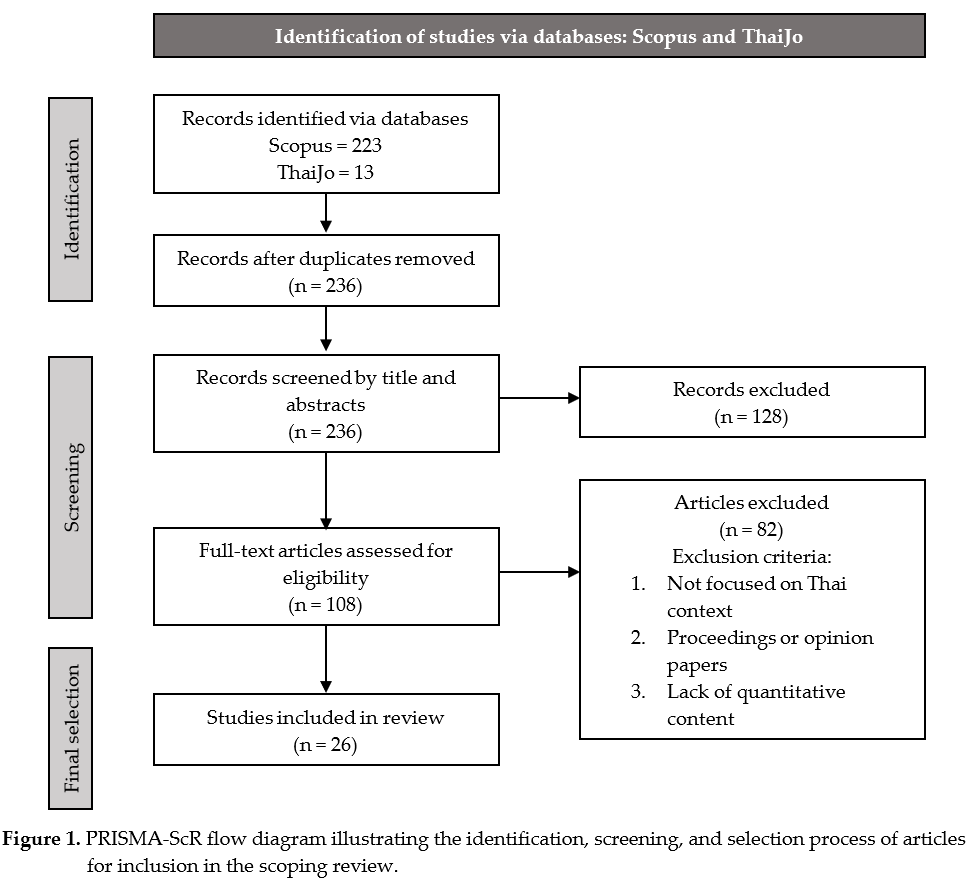
This scoping review examines greenhouse gas (GHG) mitigation options in Thailand's industrial and building sectors, synthesizing findings from 26 peer-reviewed articles and five national policy documents. The review is structured around three themes: technical viability, financial performance, and policy alignment of key mitigation strategies. Results indicate that energy-efficiency retrofitting, renewable energy integration, carbon capture and storage (CCS), and life-cycle assessment (LCA)-guided design — particularly when combined with Building Information Modeling (BIM) — can substantially reduce both operational and embodied emissions. Many of these approaches demonstrate strong financial attractiveness, characterized by high internal rates of return (IRR) and short payback periods. However, widespread deployment remains constrained by policy fragmentation, insufficient incentive mechanisms, and weak stakeholder coordination. The review also exposes critical gaps in sectoral strategies, including the absence of tailored energy conservation measures for certain building typologies. The limited uptake of local green certification schemes, such as TREES, which cover fewer than 15% of certified green buildings nationwide, further reflects structural barriers in Thailand's regulatory and market environments. To address these challenges, this study proposes a sectoral strategy matrix that maps appropriate technologies to specific building types alongside relevant economic indicators. It also recommends harmonizing existing frameworks — EEP2015, AEDP2015, and BEC2021 — with Thailand's 2022 Nationally Determined Contribution (NDC) and Long-Term Low Emissions Development Strategy (LT-LEDS). Future research should explore integrated models incorporating ESG criteria, stakeholder capacity-building, and carbon tracking linked to Science-Based Targets (SBTs). By bridging technical rigor with policy relevance, this review offers actionable guidance for researchers, policymakers, and industry practitioners.
Article Details

อนุญาตภายใต้เงื่อนไข Creative Commons Attribution-NonCommercial-NoDerivatives 4.0 International License.
เอกสารอ้างอิง
Pradhan, B. B.; Chaichaloempreecha, A.; Chunark, P.; Rajbhandari, S.; Pita, P.; Limmeechokchai, B. Energy system transformation for attainability of net zero emissions in Thailand. Int. J. Sustain. Energy Plan. Manag. 2022, 35, 27–44. https://doi.org/10.54337/ijsepm.7116
Tangprasert, S.; Leeprechanon, N. The mechanism to drive carbon neutrality policy and net-zero emissions for the building sector in Thailand. Sci. Technol. Asia 2023, 28(2), 75–87. https://doi.org/10.14456/scitechasia.2023.28
Kofoworola, O. F.; Gheewala, S. H. Life cycle energy assessment of a typical office building in Thailand. Energy Build. 2009, 41(10), 1076–1083. https://doi.org/10.1016/j.enbuild.2009.06.002
Energy Policy and Planning Office (EPPO). Energy Efficiency Plan (EEP 2015). https://www.eppo.go.th/images/POLICY/PDF/EEP2015.pdf (accessed 2024-06-25)
Department of Alternative Energy Development and Efficiency (DEDE). Alternative Energy Development Plan: AEDP 2015. https://www.eppo.go.th/images/POLICY/ENG/AEDP2015ENG.pdf (accessed 2024-06-25)
Energy Policy and Planning Office (EPPO). Thailand Power Development Plan 2015-2036 (PDP 2015). https://www.eppo.go.th/images/POLICY/ENG/PDP2015_Eng.pdf (accessed 2024-06-25).
Department of Alternative Energy Development and Efficiency (DEDE). Handbook of Building Design Guidelines for Energy Conservation. https://bec.dede.go.th/wp-content/uploads/2024/02/E-Book.pdf (accessed 2024-06-25)
Ministry of Energy. Energy Conservation Promotion Act, B.E. 2535 (1992). https://www.eppo.go.th/images/law/ENG/nation2.pdf (accessed 2024-06-25)
Tevis, R.; Schuster, N.; Evans, F.; Himmler, R.; Gheewala, S. H. A multi-scenario life cycle impact comparison of operational energy supply techniques for an office building in Thailand. Energy Build. 2019, 190, 172–182. https://doi.org/10.1016/j.enbuild.2019.02.038
Viriyaroj, B.; Kuittinen, M.; Gheewala, S. H. Life-cycle GHG emissions of standard houses in Thailand. Build. Cities 2024, 5(1), 247–267. https://doi.org/10.5334/bc.387
Tulevech, S. M.; Hage, D. J.; Jorgensen, S. K.; Guensler, C. L.; Himmler, R.; Gheewala, S. H. Life cycle assessment: A multi-scenario case study of a low-energy industrial building in Thailand. Energy Build. 2018, 168, 191–200. https://doi.org/10.1016/j.enbuild.2018.03.011
Inharwararak, P.; Stravoravdis, S. Building information modeling-based life cycle assessment (BIM-LCA) for housing estates in Thailand. IOP Conf. Ser.: Earth Environ. Sci. 2023, 1261, 012002. https://doi.org/10.1088/1755-1315/1261/1/012002
Kofoworola, O. F.; Gheewala, S. H. Environmental life cycle assessment of a commercial office building in Thailand. Int. J. Life Cycle Assess. 2008, 13(6), 498–511. https://doi.org/10.1007/s11367-008-0012-1
Oo, P. Z.; Ren, J.; Halog, A.; Gheewala, S. H. Framework for the development of Thai normalisation factors for life cycle assessment in Thailand. Thai Environ. Eng. J. 2021, 35(2), 69–79. https://researchonline.ljmu.ac.uk/id/eprint/18709 (accessed 2024-08-06)
Seeley, C. C.; Dhakal, S. Energy Efficiency Retrofits in Commercial Buildings: An Environmental, Financial, and Technical Analysis of Case Studies in Thailand. Energies 2021, 14(9), 2571. https://doi.org/10.3390/en14092571
Ananwattanaporn, S.; Patcharoen, T.; Bunjongjit, S.; Ngaopitakkul, A. Retrofitted existing residential building design in energy and economic aspect according to Thailand Building Energy Code. Appl. Sci. 2021, 11(4), 1398. https://doi.org/10.3390/app11041398
Yamtraipat, N.; Khedari, J.; Hirunlabh, J.; Kunchornrat, J. Assessment of Thailand indoor setpoint impact on energy consumption and environment. Energy Policy 2006, 34(6), 765–770. https://doi.org/10.1016/j.enpol.2004.07.009
Jareemit, D.; Suwanchaisakul, A.; Limmeechokchai, B. Assessment of key financial supports for promoting zero energy office buildings investment in Thailand using sensitivity analysis. Energy Rep. 2022, 8, 1144–1153. https://doi.org/10.1016/j.egyr.2022.07.086
Boonpanya, T.; Masui, T. Assessment of Thailand Socio-Economic Impact towards Greenhouse Gas Mitigation Actions in 2030 Using a Computable General Equilibrium Model. Chem. Eng. Trans. 2020, 78, 289–294. https://doi.org/10.3303/CET2078049
Rajbhandari, S.; Limmeechokchai, B.; Masui, T. The impact of different GHG reduction scenarios on the economy and social welfare of Thailand using a computable general equilibrium (CGE) model. Energy Sustain. Soc. 2019, 9, 19. https://doi.org/10.1186/s13705-019-0200-9
Thepkhun, P.; Limmeechokchai, B.; Fujimori, S.; Masui, T.; Shrestha, R. M. Thailand's Low-Carbon Scenario 2050: The AIM/CGE analyses of CO2 mitigation measures. Energy Policy 2013, 62, 561–572. https://doi.org/10.1016/j.enpol.2013.07.037
Kongwanarat, N.; Limmeechokchai, B. Socio-economic benefits of CO2 mitigation pathways to NAMAs in the Thai residential sector. Thammasat Int. J. Sci. Technol. 2016, 21(1), 69–79. https://doi.org/10.14456/tijsat.2016.16
Limmeechokchai, B.; Kongphunphin, C.; Winyuchakrit, P.; Pita, P.; Misila, P. Climate Change 2022 Mitigation of Climate Change: Urban System. Int. J. Build. Urban Interior Landsc. Technol. 2024, 22, 251630. https://doi.org/10.56261/built.v22.251630
Rajbhandari, S.; Limmeechokchai, B. Assessment of greenhouse gas mitigation pathways for Thailand towards achievement of the 2°C and 1.5°C Paris Agreement targets. Climate Policy 2021, 21(4), 492–513. https://doi.org/10.1080/14693062.2020.1857218
Limmeechokchai, B.; Chunark, P.; Fujimori, S.; Masui, T. Asian INDC assessments: The case of Thailand. In Post-2020 Climate Action; Springer: Singapore, 2017; pp 157–178. https://doi.org/10.1007/978-981-10-3869-3_10
Chaichaloempreecha, A.; Chunark, P.; Limmeechokchai, B. Assessment of Thailand’s energy policy on CO2 emissions: Implication of national energy plans to achieve NDC target. Int. Energy J. 2019, 19(1), 47–60. http://rericjournal.ait.ac.th/index.php/reric/article/view/2020 (accessed 2024-07-03)
Lohmeng, A.; Sudasna, K.; Tondee, T. State of the art of green building standards and certification system development in Thailand. Energy Procedia 2017, 138, 417–422. https://doi.org/10.1016/j.egypro.2017.10.188
Rahong, R.; Prapaspongsa, T. Design strategies to lead Thailand’s building sector toward net-zero greenhouse gas emissions: A review. Thai Environ. Eng. J. 2022, 36(1), 9–23. https://so05.tci-thaijo.org/index.php/teej/article/view/258533 (accessed 2024-07-01)
Inazumi, S.; Ohtsu, H.; Shiotani, T.; Katsumi, T. Environmental assessment and accounting for the waste disposal stream in Bangkok, Thailand. J. Mater. Cycles Waste Manag. 2011, 13(2), 153–159. https://doi.org/10.1007/s10163-011-0006-0
Limmeechokchai, B.; Rajbhandari, S.; Pradhan, B. B.; Chunark, P.; Chaichaloempreecha, A.; Fujimori, S.; Oshiro, K.; Ochi, Y. Scaling up climate ambition post-2030: A long-term GHG mitigation analysis for Thailand. Climate Policy 2023, 23(2), 168–183. https://doi.org/10.1080/14693062.2022.2126813
Saranrom, D.; Patthawong, P.; Saranrom, A. The forecast scenarios for the transformation of Thailand’s environmental smart city into a carbon neutral city. RMUTSB Acad. J. (Humanit. Soc. Sci.) 2023, 8(2), 163–171. https://so05.tci-thaijo.org/index.php/rmutsb-hs/article/view/262043 (accessed 2024-07-02)
