
Data-Driven Design of an Automatic Shower for the Elderly: Integrating the Kano Model and K-Means Clustering
Article Sidebar
Main Article Content
บทคัดย่อ
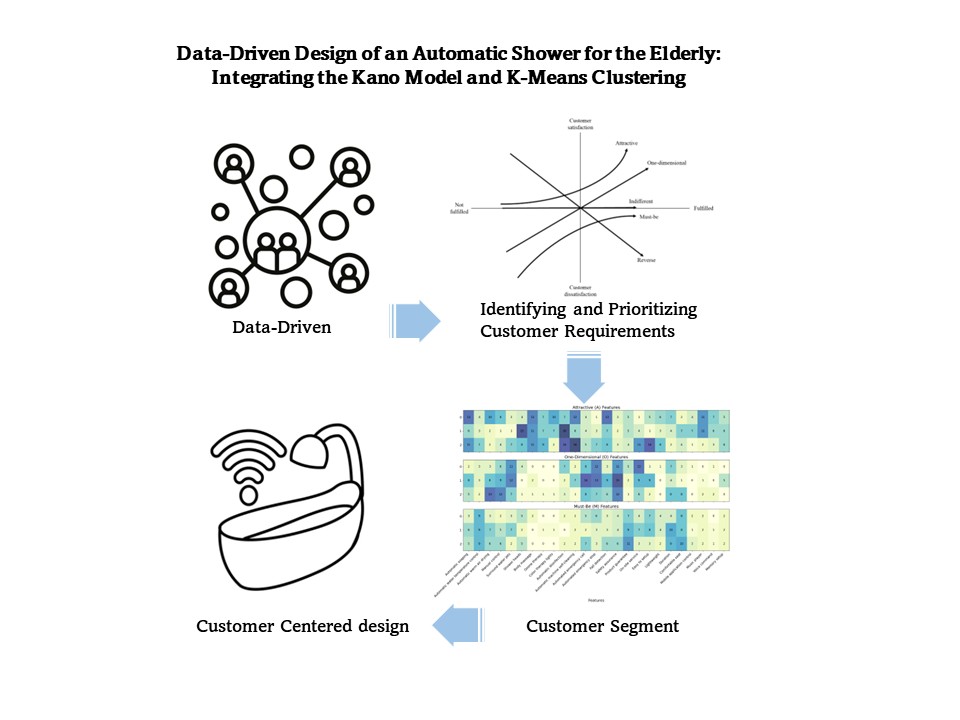
Automated devices designed for elderly users have become increasingly important in supporting independent living and addressing age-related challenges. Among these technologies, automatic shower devices play a key role in enhancing personal hygiene and reducing safety risks associated with conventional showering. This study applied the Kano model to identify factors influencing customer satisfaction with an automated shower device designed for older adults. Expert input was used to define and evaluate 25 quality elements across six dimensions, including washing, cleaning, safety, customer service, product-friendliness, and software–hardware integration. The results indicate that safety- and cleaning-related features—such as automatic disinfection, machine self-cleaning, automated emergency calls, emergency stop functions, and fall detection—exhibit high satisfaction coefficients, highlighting their importance in meeting elderly users’ expectations. To further explore variation in user preferences, K-means clustering was used to segment respondents based on their Kano response patterns. Three distinct user clusters were identified, each demonstrating different feature prioritization strategies. One cluster emphasized comfort-enhancing features, such as body massage and automatic warm-air drying, while another placed greater importance on essential safety functions, including fall detection and emergency alerts. By integrating the Kano model with K-Means clustering, this study proposes a data-driven, customer-centric design framework that supports informed decision-making in assistive technology development. The findings enable designers and manufacturers to balance core safety requirements with differentiated features tailored to diverse elderly user segments, ultimately enhancing usability, independence, and overall user satisfaction.
Article Details

อนุญาตภายใต้เงื่อนไข Creative Commons Attribution-NonCommercial-NoDerivatives 4.0 International License.
เอกสารอ้างอิง
Harmo, P.; Taipalus, T.; Knuuttila, J.; Vallet, J.; Halme, A. Needs and solutions-home automation and service robots for the elderly and disabled. In 2005 IEEE/RSJ International Conference on Intelligent Robots and Systems, 2005; IEEE: pp 3201–3206. https://doi.org/10.1109/IROS.2005.1545387
Marques, B.; McIntosh, J.; Valera, A.; Gaddam, A. Innovative and Assistive eHealth Technologies for Smart Therapeutic and Rehabilitation Outdoor Spaces for the Elderly Demographic. Multimodal Technol. Interact. 2020, 4(4), 76. https://doi.org/10.3390/mti4040076
Baucas, M. J.; Spachos, P.; Gregori, S. Internet-of-Things Devices and Assistive Technologies for Health Care: Applications, Challenges, and Opportunities. IEEE Signal Process. Mag. 2021, 38(4), 65–77. https://doi.org/10.1109/MSP.2021.3075929
Brouwer, D. M.; Sadlo, G.; Winding, K.; Hanneman, M. I. G. Limitations in Mobility: Experiences of Visually Impaired Older People. Br. J. Occup. Ther. 2008, 71(10), 414–421. https://doi.org/10.1177/030802260807101003
Chen, Z.; Yu, J.; Song, Y.; Chui, D. Aging Beijing: Challenges and strategies of health care for the elderly. Ageing Res. Rev. 2010, 9, S2–S5. https://doi.org/10.1016/j.arr.2010.07.001
Wang, H.-H.; Tsay, S.-F. Elderly and long-term care trends and policy in Taiwan: Challenges and opportunities for health care professionals. Kaohsiung J. Med. Sci. 2012, 28(9), 465–469. https://doi.org/10.1016/j.kjms.2012.04.002
Subramaniyaswamy, V.; Vijayakumar, V.; Logesh, R.; Indraganti, V. An ontology-driven personalized food recommendation in IoT-based healthcare system. J. Supercomput. 2019, 75, 3184–3216. https://doi.org/10.1007/s11227-018-2331-8
Wickramasinghe, A.; Torres, R. L. S.; Ranasinghe, D. C. Recognition of falls using dense sensing in an ambient assisted living environment. Pervasive Mobile Comput. 2017, 34, 14–24. https://doi.org/10.1016/j.pmcj.2016.06.004
Selvaraj, S.; Sundaravaradhan, S. Challenges and opportunities in IoT healthcare systems: a systematic review. SN Appl. Sci. 2019, 2 (1), 139. https://doi.org/10.1007/s42452-019-1925-y
Sixsmith, A. Ethical challenges in aging and technology. Presented at the 15th International Conference on PErvasive Technologies Related to Assistive Environments (PETRA), Corfu, Greece, 2022. https://doi.org/10.1145/3529190.3534756
Sixsmith, A. AgeTech: Technology-based solutions for aging societies. In Promoting the health of older adults: the Canadian experience; 2021; pp 135–151
Morato, J.; Sanchez-Cuadrado, S.; Iglesias, A.; Campillo, A.; Fernández-Panadero, C. Sustainable Technologies for Older Adults. Sustainability 2021, 13(15), 8465. https://doi.org/10.3390/su13158465
Haescher, M.; Höpfner, F.; Jähne-Raden, N.; Denker, K.; Koldrack, P.; Rostalski, P.; Kirste, T.; Bieber, G. Automated fall risk assessment of elderly using wearable devices. J. Rehabil. Assist. Technol. Eng. 2020, 7, 2055668320946209. https://doi.org/10.1177/2055668320946209
Perez, A. J.; Siddiqui, F.; Zeadally, S.; Lane, D. A review of IoT systems to enable independence for the elderly and disabled individuals. Internet Things 2023, 21, 100653. https://doi.org/10.1016/j.iot.2022.100653
Ramkumar, J.; Karthikeyan, C.; Vamsidhar, E.; Dattatraya, K. N. Automated pill dispenser application based on IoT for patient medication. In IoT and ICT for Healthcare Applications; Springer: 2020; pp 231–253. https://doi.org/10.1007/978-3-030-42934-8_13
Fernandes, N.; Amorim, A. R.; Silva, B.; Freitas, J.; Mendonça, J. P. TAB-Med: automated pill dispenser in residential environments. In Innovations in Mechanical Engineering; Springer: 2022; pp 359–370. https://doi.org/10.1007/978-3-030-79165-0_34
Maswadi, K.; Ghani, N. B. A.; Hamid, S. B. Systematic Literature Review of Smart Home Monitoring Technologies Based on IoT for the Elderly. IEEE Access 2020, 8, 92244–92261. https://doi.org/10.1109/ACCESS.2020.2992727
Sokullu, R.; Akkaş, M. A.; Demir, E. IoT supported smart home for the elderly. Internet Things 2020, 11, 100239. https://doi.org/10.1016/j.iot.2020.100239
Boumpa, E.; Kakarountas, A. Home supporting smart systems for elderly people. In Convergence of ICT and Smart Devices for Emerging Applications; Springer: 2020; pp 81–98. https://doi.org/10.1007/978-3-030-41368-2_4
Salichs, M. A.; Castro-González, Á.; Salichs, E.; Fernández-Rodríguez, R.; Maroto-Gómez, M.; Gamboa-Montero, J. J.; Marques-Villarroya, S.; Castillo, J. C.; Alonso-Martín, F.; Malfaz, M. Mini: A New Social Robot for the Elderly. Int. J. Soc. Rob. 2020, 12(6), 1231–1249. https://doi.org/10.1007/s12369-020-00687-0
de Barcelos Silva, A.; Gomes, M. M.; da Costa, C. A.; da Rosa Righi, R.; Barbosa, J. L. V.; Pessin, G.; De Paz, G. F.; Jose, V. R. Q. Intelligent personal assistants: A systematic literature review. Expert Syst. Appl. 2020, 147, 113193. https://doi.org/10.1016/j.eswa.2020.113193
Fong, J. H.; Mitchell, O. S.; Koh, B. S. Disaggregating activities of daily living limitations for predicting nursing home admission. Health Serv. Res. 2015, 50(2), 560–578. https://doi.org/10.1111/1475-6773.12235
Millán-Calenti, J. C.; Tubío, J.; Pita-Fernández, S.; González-Abraldes, I.; Lorenzo, T.; Fernández-Arruty, T.; Maseda, A. Prevalence of functional disability in activities of daily living (ADL), instrumental activities of daily living (IADL) and associated factors, as predictors of morbidity and mortality. Arch. Gerontol. Geriatr. 2010, 50(3), 306–310. https://doi.org/10.1016/j.archger.2009.04.017
Golding-Day, M.; Whitehead, P.; Radford, K.; Walker, M. Interventions to reduce dependency in bathing in community dwelling older adults: a systematic review. Syst. Rev. 2017, 6, 1–6. https://doi.org/10.1186/s13643-017-0586-4
Wang, W.; Chen, Y.; Zou, X.; Wang, S.; Ferreira, J. P.; Liu, T. Development of Bath Auxiliary Robot for the Disabled Elderly. In 2021 IEEE International Conference on Intelligence and Safety for Robotics (ISR), 2021; pp 85–88. https://doi.org/10.1109/ISR50024.2021.9419499
Zlatintsi, A.; Dometios, A. C.; Kardaris, N.; Rodomagoulakis, I.; Koutras, P.; Papageorgiou, X.; Maragos, P.; Asfour, T.; Lichtenthäler, R.; Reiser, U.; et al. I-Support: A robotic platform of an assistive bathing robot for the elderly population. Robotics Auton. Syst. 2020, 126, 103451. https://doi.org/10.1016/j.robot.2020.103451
Wenninger, A.; Rau, D.; Röglinger, M. Improving customer satisfaction in proactive service design. Electron. Mark. 2022, 32(3), 1399–1418. https://doi.org/10.1007/s12525-022-00565-9
Xi, L.; Zhang, H.; Li, S.; Cheng, J. Integrating fuzzy Kano model and fuzzy importance-performance analysis to analyse the attractive factors of new products. Int. J. Distrib. Sens. Netw. 2020, 16(5), 1550147720920222. https://doi.org/10.1177/1550147720920222
Zhao, S.; Zhang, Q.; Peng, Z.; Fan, Y. Integrating customer requirements into customized product configuration design based on Kano's model. J. Intell. Manuf. 2020, 31(3), 597–613. https://doi.org/10.1007/s10845-019-01467-y
Kohli, A.; Singh, R. An assessment of customers' satisfaction for emerging technologies in passenger cars using Kano model. Vilakshan-XIMB J. Manag. 2021, 18(1), 76–88. https://doi.org/10.1108/XJM-08-2020-0103
Lu, M.-T.; Lu, H.-P.; Chen, C.-S. Exploring the Key Priority Development Projects of Smart Transportation for Sustainability: Using Kano Model. Sustainability 2022, 14(15), 9319. https://doi.org/10.3390/su14159319
Yang, Y.; Li, Q.; Li, C.; Qin, Q. User requirements analysis of new energy vehicles based on improved Kano model. Energy 2024, 309, 133134. https://doi.org/10.1016/j.energy.2024.133134
Wang, T.; Wang, W.; Feng, J.; Fan, X.; Guo, J.; Lei, J. A novel user-generated content-driven and Kano model focused framework to explore the impact mechanism of continuance intention to use mobile APPs. Comput. Hum. Behav. 2024, 157, 108252. https://doi.org/10.1016/j.chb.2024.108252
Cavacece, Y.; Maggiore, G.; Resciniti, R.; Moretta Tartaglione, A. Evaluating digital health attributes for users' satisfaction: an application of the Kano model. TQM J. 2025, 37(3), 831–852. https://doi.org/10.1108/TQM-09-2023-0301
Li, Z.-Q.; Cao, G.-P.; Cai, S.-Y.; Wang, D.-Y.; Zhang, X.-C. Functional requirements and design strategy of E-sports chair based on the KANO model. BioResources 2024, 19(3), 4679–4697. https://doi.org/10.15376/biores.19.3.4679-4697
Tabianan, K.; Velu, S.; Ravi, V. K-means clustering approach for intelligent customer segmentation using customer purchase behavior data. Sustainability 2022, 14(12), 7243. https://doi.org/10.3390/su14127243
Chiu, C.-Y.; Chen, Y.-F.; Kuo, I.-T.; Ku, H. C. An intelligent market segmentation system using k-means and particle swarm optimization. Expert Syst. Appl. 2009, 36(3), 4558–4565. https://doi.org/10.1016/j.eswa.2008.05.029
Chen, Y.; Tan, P.; Li, M.; Yin, H.; Tang, R. K-means clustering method based on nearest-neighbor density matrix for customer electricity behavior analysis. Int. J. Electr. Power Energy Syst. 2024, 161, 110165. https://doi.org/10.1016/j.ijepes.2024.110165
Zhao, H.-H.; Luo, X.-C.; Ma, R.; Lu, X. An extended regularized K-means clustering approach for high-dimensional customer segmentation with correlated variables. IEEE Access 2021, 9, 48405–48412. https://doi.org/10.1109/ACCESS.2021.3067499
Fang, C.; Liu, H. Research and application of improved clustering algorithm in retail customer classification. Symmetry 2021, 13(10), 1789. https://doi.org/10.3390/sym13101789
Yin, S.; Cai, X.; Wang, Z.; Zhang, Y.; Luo, S.; Ma, J. Impact of gamification elements on user satisfaction in health and fitness applications: A comprehensive approach based on the Kano model. Comput. Hum. Behav. 2022, 128, 107106. https://doi.org/10.1016/j.chb.2021.107106
Jin, J.; Jia, D.; Chen, K. Mining online reviews with a Kansei-integrated Kano model for innovative product design. Int. J. Prod. Res. 2022, 60(22), 6708–6727. https://doi.org/10.1080/00207543.2021.1949641
He, C.; Li, Z.; Liu, D.; Zou, G.; Wang, S. Improving the functional performances for product family by mining online reviews. J. Intell. Manuf. 2023, 34(6), 2809–2824. https://doi.org/10.1007/s10845-022-01961-w
Pandey, A.; Sahu, R.; Joshi, Y. Kano Model Application in the Tourism Industry: A Systematic Literature Review. J. Qual. Assur. Hosp. Tour. 2022, 23(1), 1–31. https://doi.org/10.1080/1528008X.2020.1839995
Shi, Y.; Peng, Q. Enhanced customer requirement classification for product design using big data and improved Kano model. Adv. Eng. Inf. 2021, 49, 101340. https://doi.org/10.1016/j.aei.2021.101340
Dou, R.; Zhang, Y.; Nan, G. Application of combined Kano model and interactive genetic algorithm for product customization. J. Intell. Manuf. 2019, 30, 2587–2602. https://doi.org/10.1007/s10845-016-1280-4
Fofan, A. C.; Oliveira, L. A. B.; Melo, F. J. C.; Jerônimo, T. B.; Medeiros, D. D. An Integrated Methodology Using PROMETHEE and Kano's Model to Rank Strategic Decisions. Eng. Manage. J. 2019, 31(4), 270–283. https://doi.org/10.1080/10429247.2019.1655351
Shen, Y.; Kokkranikal, J.; Christensen, C. P.; Morrison, A. M. Perceived importance of and satisfaction with marina attributes in sailing tourism experiences: A kano model approach. J. Outdoor Recreat. Tour. 2021, 35, 100402. https://doi.org/10.1016/j.jort.2021.100402
Cai, M.; Wu, M.; Luo, X.; Wang, Q.; Zhang, Z.; Ji, Z. Integrated framework of Kansei engineering and Kano model applied to service design. Int. J. Hum.–Comput. Interact. 2023, 39(5), 1096–1110. https://doi.org/10.1080/10447318.2022.2102301
Tang, L.-L.; Chen, S.-H.; Lin, C.-C. Integrating FMEA and the Kano Model to Improve the Service Quality of Logistics Centers. Processes 2021, 9(1), 51. https://doi.org/10.3390/pr9010051
Bhardwaj, J.; Yadav, A.; Chauhan, M. S.; Chauhan, A. S. Kano model analysis for enhancing customer satisfaction of an automotive product for Indian market. Mater. Today: Proc. 2021, 46, 10996–11001. https://doi.org/10.1016/j.matpr.2021.02.093
Madzík, P.; Budaj, P.; Mikuláš, D.; Zimon, D. Application of the Kano Model for a Better Understanding of Customer Requirements in Higher Education-A Pilot Study. Adm. Sci. 2019, 9(1), 11. https://doi.org/10.3390/admsci9010011
Ma, M.-Y.; Chen, C.-W.; Chang, Y.-M. Using Kano model to differentiate between future vehicle-driving services. Int. J. Ind. Ergon. 2019, 69, 142–152. https://doi.org/10.1016/j.ergon.2018.11.003
Palumbo, F. Developing a new service for the digital traveler satisfaction: The Smart Tourist App. Int. J. Digit. Account. Res. 2015, 15. https://doi.org/10.4192/1577-8517-15_2
Violante, M. G.; Vezzetti, E. Kano qualitative vs quantitative approaches: An assessment framework for products attributes analysis. Comput. Ind. 2017, 86, 15–25. https://doi.org/10.1016/j.compind.2016.12.007
Minh, H.-L.; Sang-To, T.; Wahab, M. A.; Cuong-Le, T. A new metaheuristic optimization based on K-means clustering algorithm and its application to structural damage identification. Knowl.-Based Syst. 2022, 251, 109189. https://doi.org/10.1016/j.knosys.2022.109189
Elshaaer, N. I.; Elsayed, S. F. Improving Spa Services to a Better Customers' Attraction (A Case Study on Red Sea Resorts). J. Assoc. Arab Univ. Tour. Hosp. 2016, 13(1), 167–182. https://doi.org/10.21608/jaauth.2016.49970
Friedrich, P.; Schmid, S.; Fuchs, D. Acceptance of assistive fall prevention technologies: an online survey. Procedia Comput. Sci. 2024, 246, 4582–4591. https://doi.org/10.1016/j.procs.2024.09.322
Nyrop, K. A.; Zimmerman, S.; Sloane, P. D.; Bangdiwala, S. Fall prevention and monitoring of assisted living patients: an exploratory study of physician perspectives. J. Am. Med. Dir. Assoc. 2012, 13(5), 429–433. https://doi.org/10.1016/j.jamda.2011.08.003
Li, J.; Mo, Y.; Jiang, S.; Ma, L.; Zhang, Y.; Wei, S. Bathing assistive devices and robots for the elderly. Biomimetic Intell. Rob. 2025, 100218. https://doi.org/10.1016/j.birob.2025.100218
