
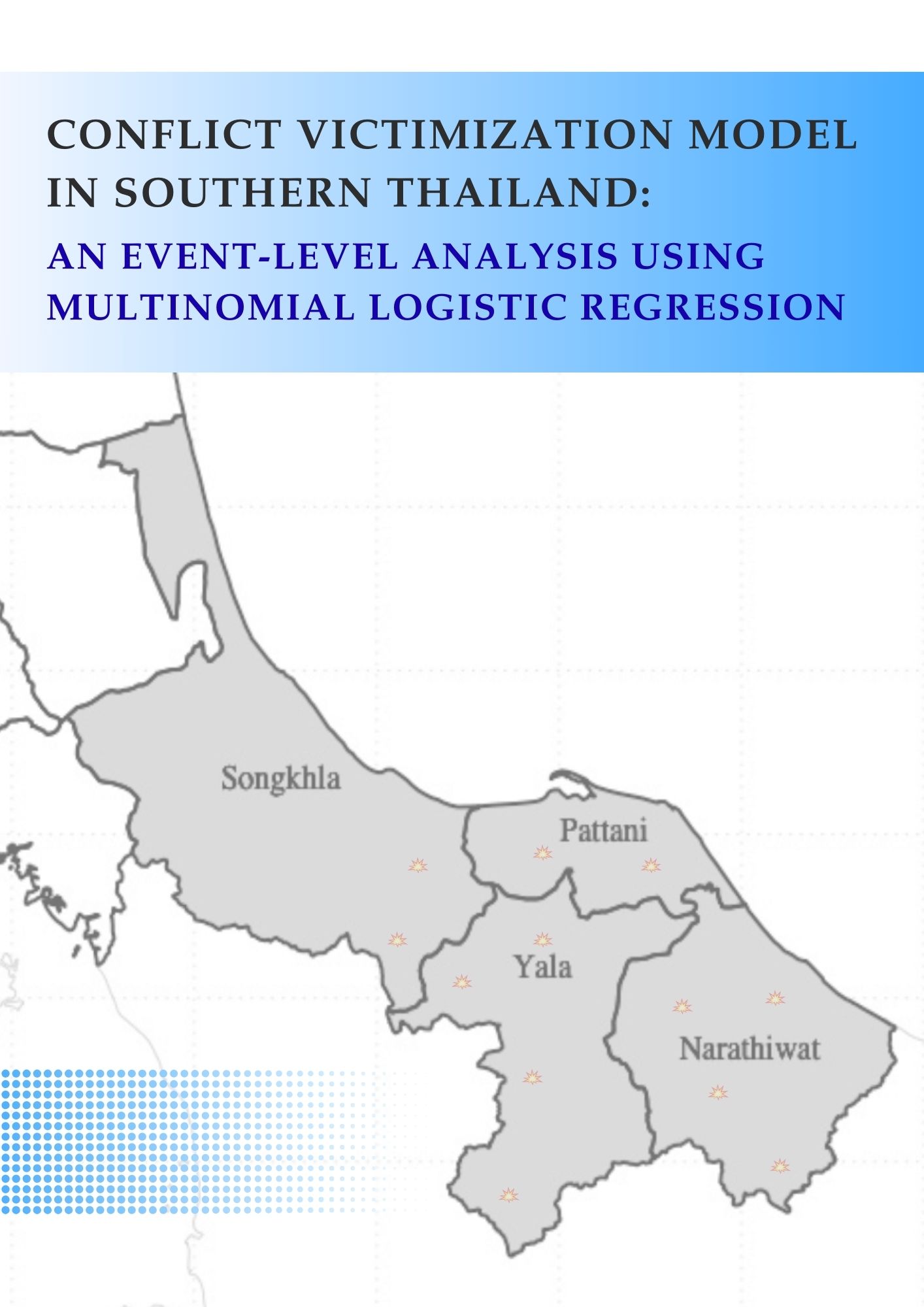
Conflict Victimization Model in Southern Thailand: An Event-Level Analysis Using Multinomial Logistic Regression
Article Sidebar
Main Article Content
บทคัดย่อ
This study investigates the determinants of conflict-related victimization severity in Thailand’s southernmost provinces using event-level data from 9,310 southern unrest incidents recorded between 2004 and 2020. Victimization outcomes were classified into three ordered severity categories—safe, injured, and dead—and analyzed using Multinomial Logistic Regression (MLR) to capture differentiated risk mechanisms. The dataset, compiled by the Deep South Coordination Center (DSCC), integrates police, military, and administrative records to provide comprehensive coverage of subnational conflict events. Feature selection was conducted using chi-squared screening followed by backward refinement, yielding nine key predictors encompassing temporal, spatial, contextual, and tactical dimensions. Model estimation was performed under both baseline and imbalance-adjusted weighted specifications, with robustness assessed through cross-validation and sensitivity analyses. Results indicate that non-residential locations, particularly public places, roads, and agricultural areas, substantially increase the likelihood of injury and fatal outcomes. At the same time, rural settings are associated with lower severity risk, and attacks targeting military personnel exhibit markedly elevated injury and fatality odds relative to civilian targets. Shooting attacks emerge as the most lethal modality, with an estimated 15.8-fold increase in fatal risk compared to bombings. Predictive evaluation demonstrates strong discrimination for safe outcomes (AUC = 0.94), with good to moderate performance for injury (AUC = 0.80) and fatal events (AUC = 0.75). The findings highlight the dominant roles of spatial context and attack modality in shaping victimization severity and demonstrate the value of interpretable statistical modeling for informing targeted security planning and conflict-prevention strategies.
Article Details

อนุญาตภายใต้เงื่อนไข Creative Commons Attribution-NonCommercial-NoDerivatives 4.0 International License.
เอกสารอ้างอิง
Brandt, P. T.; Mason, T. D.; Gurses, M.; Petrovsky, N.; Radin, D. When and How the Fighting Stops: Explaining the Duration and Outcome of Civil Wars. Def. Peace Econ. 2008, 19(6), 415–434. https://doi.org/10.1080/10242690701823267
Olabanjo, O. A.; Aribisala, B. S.; Mazzara, M.; Wusu, A. S. An Ensemble Learning Model for the Prediction of Danger Zones: Towards a Global Counter-Terrorism. J. Soft Comput. Lett. 2021, 3, 1–6. https://doi.org/10.1016/j.socl.2021.100020
Erbas, I.; Vargas, D. A.; Guclu, B. FPGA Implementation of Multinomial Logistic Regression for Vibrotactile Feedback in a Robotic Hand. In 2020 International Conference on e-Health and Bioengineering (EHB); IEEE, 2020; pp 1–4. https://doi.org/10.1109/EHB50910.2020.9280239
Wilkinson, K.; Seo, K.; Pierce, R.; Tonellato, P.; Kim, J. H.; Myers, D. Electronic Medical Record Specialty Group Comparison by Multinomial Logistic Regression. In 2021 IEEE 9th International Conference on Healthcare Informatics (ICHI); IEEE, 2021; pp 415–421. https://doi.org/10.1109/ICHI52183.2021.00067
Summer, J.; Ratcliff, K.; Smith, B. Spatial Analysis of U.S. Terrorism Incidents. National Consortium for the Study of Terrorism and Responses to Terrorism (START), 2017. 1-4.
Miller, E. Use of Firearms in Terrorist Attacks in the United States, 1970–2014. START, 2015. http://www.start.umd.edu/pubs/START_FirearmsinTerrorism_BackgroundReport_July2015.pdf
Boonthep, N.; Intharachat, S.; Iemsomboon, T. Factors Influencing Injury Severity Score Regarding Thai Military Personnel Injured in Mass Casualty Incident April 10, 2010: Lessons Learned from Armed Conflict Casualties: A Retrospective Study. BMC Emerg. Med. 2012, 12(1), 1-7. https://doi.org/10.1186/1471-227X-12-1
Eso, M.; McNeil, R.; Masamae, A. Factors Associated with Severe Violent Events in the Southernmost Provinces of Thailand. Adv. Appl. Stat. 2020, 63(1), 59–74. https://doi.org/10.17654/AS063010059
Stelmach, J.; Moch, N. Time in Responding to Terrorist Attacks in Cities. Sustainability 2022, 14 (21), 1-19. https://doi.org/10.3390/su142416643
Peng, A. An Integrated Machine Learning Approach to Studying Terrorism. B.S. Thesis, Department of Computer Science, Yale University, New Haven, CT, 2018.
Kalyvas, S. N. The Logic of Violence in Civil War; Cambridge University Press: Cambridge, 2006. https://doi.org/10.1017/CBO9780511818462
Shapiro, J.; Siegel, D. A. Coordination and Security: How Mobile Communications Affect Insurgency. J. Peace Res. 2015, 52 (3), 312–322. https://doi.org/10.1177/0022343314559624
Buhaug, H.; Rod, J. K. Local Determinants of African Civil Wars, 1970–2001. Polit. Geogr. 2006, 25(3), 315–335. https://doi.org/10.1016/j.polgeo.2006.02.005
Lafree, G.; Dugan, L. Introducing the Global Terrorism Database. Terror. Polit. Violence 2007, 19(2), 181–204. https://doi.org/10.1080/09546550701246817
Geneva Declaration Secretariat. Global Burden of Armed Violence. September 2008. https://www.refworld.org/reference/research/gds/2008/en/64390
