Acid Tolerance Response in Streptococcus mutans Biofilms: Role of Membrane Lipid Adaptations and ATPase Activity
Article Sidebar
Main Article Content
บทคัดย่อ
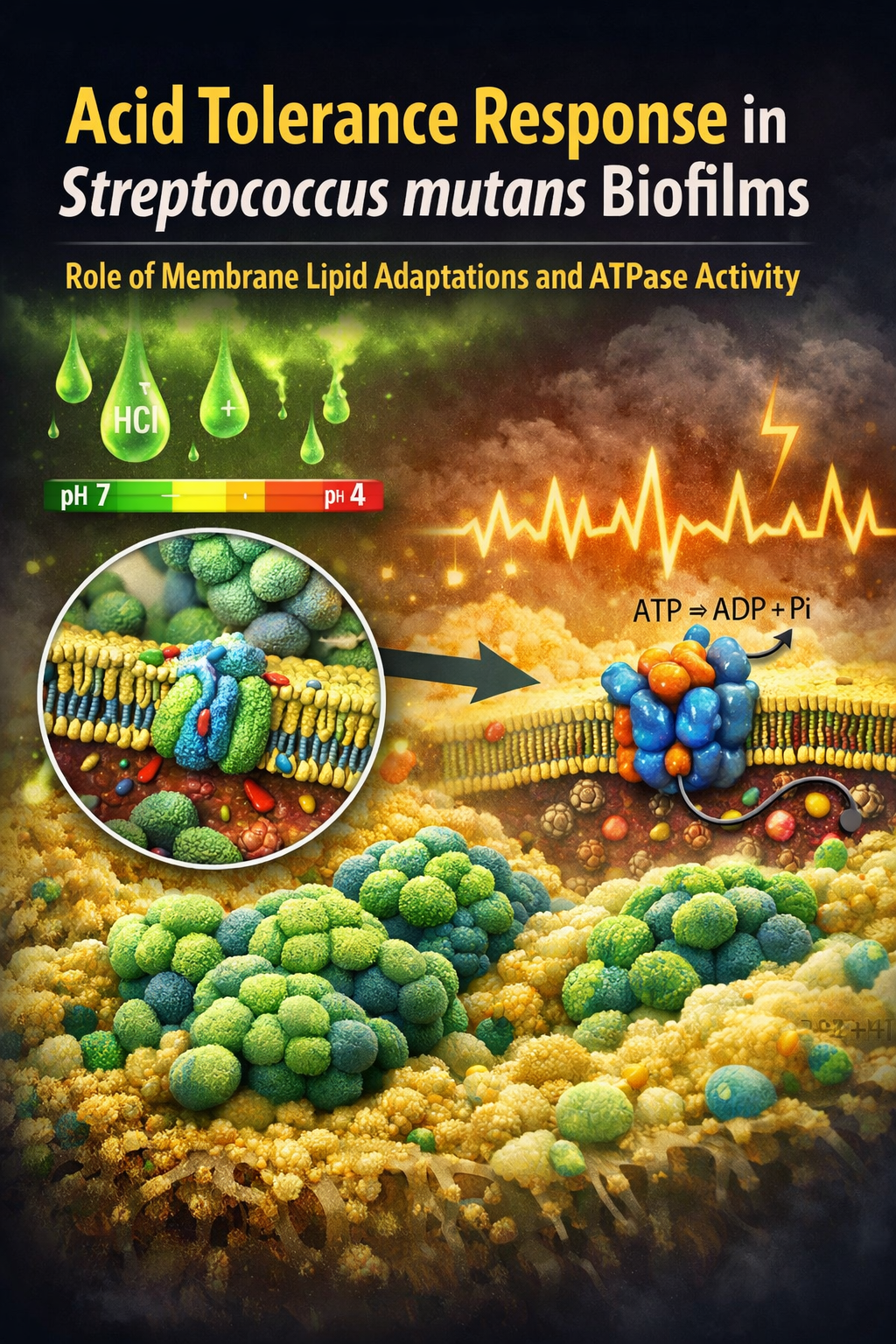
Streptococcus mutans is one of the main etiological factors of dental caries since it has an exceptional capacity for surviving and growing in acidic conditions in the mouth. Nevertheless, its cellular mechanisms of acid tolerance are not fully comprehended. This paper investigated the functions of membrane lipid remodeling and proton ATPase activity in the acid tolerance response (ATR) of S. mutans biofilms. The biofilms were cultivated in a flow-cell system and subjected to lethal (pH 3.5) or sub-lethal (pH 5.5) conditions after 3 hours, with neutral pH (7.5) as a control. Viable counts on blood agar were performed over a 2-hour exposure to determine cell survival. Pre-adaptation to pH 5.5 significantly improved survival at pH 3.5, with 66% survival recorded versus 1% in non-adapted biofilms. The fluorescence microscopy showed an increase in biofilm structural integrity after adaptation to acid. Lipid analysis of the membranes showed that there were significant changes in the fatty acid composition, with increases in the percentages of monounsaturated and long-chain fatty acids under sub-lethal acidic stress. Simultaneously, membrane-bound proton ATPase activity increased, facilitating cytoplasmic pH homeostasis by increasing proton extrusion. A combination of these adaptive responses will ensure the survival of bacteria in recurrent acidic challenges by safeguarding acid-sensitive intracellular elements. The results enhance the knowledge of S. mutans virulence and resistance.
Article Details

อนุญาตภายใต้เงื่อนไข Creative Commons Attribution-NonCommercial-NoDerivatives 4.0 International License.
เอกสารอ้างอิง
Lemos, J. A.; Palmer, S. R.; Zeng, L.; Wen, Z. T.; Kajfasz, J. K.; Freires, I. A.; Abranches, J.; Burne, R. A. The Biology of Streptococcus mutans. Microbiol. Spectr. 2019, 7(1). https://doi.org/10.1128/microbiolspec.GPP3-0051-2018
Wilkins, J. C.; Homer, K. A.; Beighton, D. Analysis of Streptococcus mutans Proteins Modulated by Culture under Acidic Conditions. Appl. Environ. Microbiol. 2002, 68(5), 2382–2390. https://doi.org/10.1128/AEM.68.5.2382-2390.2002
Forssten, S. D.; Björklund, M.; Ouwehand, A. C. Streptococcus mutans, Caries and Simulation Models. Nutrients 2010, 2(3), 290–298. https://doi.org/10.3390/nu2030290
Welin-Neilands, J.; Svensäter, G. Acid Tolerance of Biofilm Cells of Streptococcus mutans. Appl. Environ. Microbiol. 2007, 73(17), 5633–5638. https://doi.org/10.1128/AEM.01049-07
Krzysciak, W.; Jurczak, A.; Kościelniak, D.; Bystrowska, B.; Skalniak, A. The Virulence of Streptococcus mutans and the Ability to Form Biofilms. Eur. J. Clin. Microbiol. Infect. Dis. 2014, 33(4), 499–515. https://doi.org/10.1007/s10096-013-1993-7
Baker, J. L.; Faustoferri, R. C.; Quivey, R. G., Jr. Acid-Adaptive Mechanisms of Streptococcus mutans—The More We Know, the More We Don't. Mol. Oral Microbiol. 2017, 32(2), 107–117. https://doi.org/10.1111/omi.12162
Bojanich, M. A.; Calderón, R. O. Streptococcus mutans Membrane Lipid Composition: Virulence Factors and Structural Parameters. Arch. Oral Biol. 2017, 81, 74–80. https://doi.org/10.1016/j.archoralbio.2017.04.023
Fozo, E. M.; Scott-Anne, K.; Koo, H.; Quivey, R. G., Jr. Role of Unsaturated Fatty Acid Biosynthesis in Virulence of Streptococcus mutans. Infect. Immun. 2007, 75(3), 1537–1539. https://doi.org/10.1128/IAI.01938-06
Madigan, M. T.; Martinko, J. M.; Bender, K. S.; Buckley, D. H.; Stahl, D. A. Brock Biology of Microorganisms, 16th ed.; Pearson: Upper Saddle River, NJ, 2018.
Cvitkovitch, D. G.; Li, Y.-H.; Ellen, R. P. Quorum Sensing and Biofilm Formation in Streptococcal Infections. J. Clin. Invest. 2003, 112(11), 1626–1632. https://doi.org/10.1172/JCI200320430
Heydorn, A.; Nielsen, A. T.; Hentzer, M.; Sternberg, C.; Givskov, M.; Ersbøll, B. K.; Molin, S. Quantification of Biofilm Structures by the Novel Computer Program COMSTAT. Microbiology 2000, 146(10), 2395–2407. https://doi.org/10.1099/00221287-146-10-2395
Koo, H.; Xiao, J.; Klein, M. I.; Jeon, J. G. Biofilm Formation and Control in Cariology. Dent. Clin. North Am. 2011, 55(1), 1–16.
Snoep, J. L.; Maloolaka, P.; Kholodenko, B. N.; Westerhoff, H. V.; Barber, J. Safety Assessment and Risk Management for the Intentional Release of Organisms with Altered Traits. J. Biotechnol. 2009, 138(2–4), 91–98.
Sutton, S. Measurement of Microbial Cells by Optical Density. J. Validat. Technol. 2011, 17(1), 46–50.
Bligh, E. G.; Dyer, W. J. A Rapid Method of Total Lipid Extraction and Purification. Can. J. Biochem. Physiol. 1959, 37(8), 911–917. https://doi.org/10.1139/o59-099
Matsui, R.; Cvitkovitch, D. Acid Tolerance Mechanisms Utilized by Streptococcus mutans. Future Microbiol. 2010, 5(3), 403–417. https://doi.org/10.2217/fmb.09.129
Ames, B. N. Assay of Inorganic Phosphate, Total Phosphate and Phosphatases. Methods Enzymol. 1966, 8, 115–118. https://doi.org/10.1016/0076-6879(66)08014-5
Valm, A. M.; Mark Welch, J. L.; Rieken, C. W.; Hasegawa, Y.; Sogin, M. L.; Oldenbourg, R.; Dewhirst, F. E.; Borisy, G. G. Systems-Level Analysis of Microbial Community Organization. Proc. Natl. Acad. Sci. U. S. A. 2011, 108(12), 4152–4157. https://doi.org/10.1073/pnas.1101134108
Heydorn, A.; Nielsen, A. T.; Hentzer, M.; Sternberg, C.; Givskov, M.; Ersbøll, B. K.; Molin, S. Quantification of Biofilm Structures by the Novel Computer Program COMSTAT. Microbiology 2000, 146(10), 2395–2407. https://doi.org/10.1099/00221287-146-10-2395
Field, A. P. Discovering Statistics Using IBM SPSS Statistics, 5th ed.; Sage Publications: London, 2017.
Pearson, K. Notes on the History of Correlation. Biometrika 2020, 13(1), 25–45. https://doi.org/10.1093/biomet/13.1.25
Shapiro, S. S.; Wilk, M. B. An Analysis of Variance Test for Normality. Biometrika 1965, 52(3–4), 591–611. https://doi.org/10.1093/biomet/52.3-4.591
Kirk, P. L. Quantitative Ultramicroanalysis, 3rd ed.; Academic Press: New York, 1968.
Cevc, G.; Marsh, D. Phospholipid Bilayers: Physical Principles and Models; Wiley-Interscience: New York, 1987.
de Kruijff, B. Lipid Polymorphism and Membrane Function. Curr. Opin. Chem. Biol. 1997, 1(4), 564–569. https://doi.org/10.1016/S1367-5931(97)80053-1
Steinberg, D. A.; Zabriskie, J. B. Bacterial Cell Wall-Remodeling Enzymes as Targets for Antimicrobial Therapy. Curr. Opin. Microbiol. 1998, 1(5), 579–584.
Müller, V.; Hess, V. Minimum Biological Energy Quantum. Front. Microbiol. 2017, 8, 2019. https://doi.org/10.3389/fmicb.2017.02019
McDonnell, G.; Russell, A. D. Antiseptics and Disinfectants: Activity, Action, and Resistance. Clin. Microbiol. Rev. 1999, 12(1), 147–179. https://doi.org/10.1128/CMR.12.1.147
Burne, R. A.; Penders, J. M. Oral Anaerobes, Oral Candidosis, and Denture Stomatitis. Crit. Rev. Oral Biol. Med. 2002, 13(2), 141–154.
