Development and Physical Characterization of Molded Charcoal Souvenir Products from Rubberwood Charcoal Reinforced with Tea Waste
Article Sidebar
Main Article Content
บทคัดย่อ
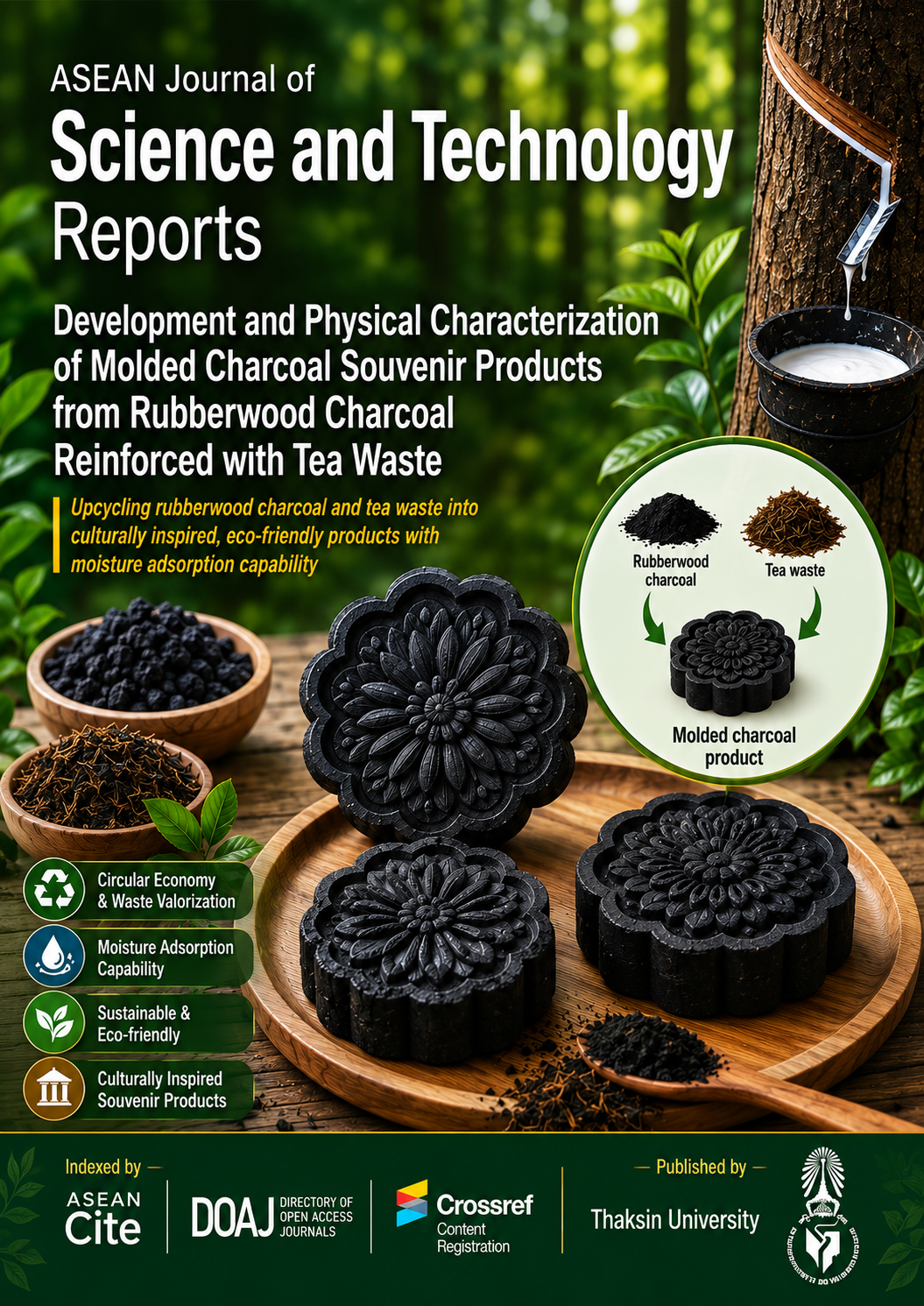
This research aimed to investigate the physical properties of molded charcoal produced from rubberwood biochar and tea waste, determine the optimal mixing ratio for forming stable products, and evaluate the production cost of the developed souvenir items. Rubberwood charcoal and tea waste were characterized for moisture content, volatile matter, ash content, fixed carbon, iodine adsorption, and moisture adsorption capacity. The rubberwood charcoal exhibited a moisture content of 2.82 ± 0.17%, volatile matter of 85.83 ± 2.07%, ash content of 2.90 ± 0.18%, fixed carbon of 8.45 ± 1.72%, and an iodine adsorption value of 479.94 ± 20.00 mg/g. The tea waste showed a moisture content of 2.75 ± 0.17% and an ash content of 2.83 ± 0.18%. Four formulations with different weight ratios of charcoal powder to tea waste (3:0, 3:1, 1:1, and 1:3) were prepared using tapioca starch as a binder, then formed into pieces using traditional mooncake molds. The 3:1 ratio was found to be the most suitable, providing compact, crack-free specimens with clear surface patterns, no loose powder after drying, and a slightly brown tea color. Moisture adsorption tests over 3 days confirmed that all formulations absorbed moisture, with the 3:1 formulation offering a good balance between structural integrity and functional performance. A preliminary cost analysis indicated that using 1 kg of mixed raw materials yielded 35 molded charcoal pieces at a total cost of 315.84 THB, or 9.02 THB per piece. The results demonstrate the technical feasibility and economic potential of upcycling rubberwood charcoal and tea waste into culturally inspired, environmentally friendly charcoal-based souvenir products with moisture adsorption capability suitable for community-based product development.
Article Details

อนุญาตภายใต้เงื่อนไข Creative Commons Attribution-NonCommercial-NoDerivatives 4.0 International License.
เอกสารอ้างอิง
Zhang, X.; Gao, B.; Zheng, Y.; Hu, X.; Creamer, A. E.; Annable, M. D.; Li, Y. Biochar for Volatile Organic Compound (VOC) Removal: Sorption Performance and Governing Mechanisms. Bioresour. Technol. 2017, 245, 606–614. https://doi.org/10.1016/j.biortech.2017.09.025
Rungwannasak, K.; Khongsanthia, C.; Phuetthonglang, C.; Inseang, T.; Trisutthi, W.; Kosinthov, W. The Souvenir Product Design from Banana Stalk Carving of Ethnic Group in the Learning Resource Area of Thai-Phuan Banphue Museum Udon Thani Province. Asian J. Tradit. Innov. Arts Text. 2024, 3(1), 1–14. https://doi.org/10.14456/tiat.2024.1
Lehmann, J.; Joseph, S., Eds. Biochar for Environmental Management: Science and Technology; Earthscan: London, 2009.
Ahmad, M.; Rajapaksha, A. U.; Lim, J. E.; Zhang, M.; Bolan, N.; Mohan, D.; Vithanage, M.; Lee, S. S.; Ok, Y. S. Biochar as a Sorbent for Contaminant Management in Soil and Water: A Review. Chemosphere 2014, 99, 19–33. https://doi.org/10.1016/j.chemosphere.2013.10.071
Antal, M. J., Jr.; Grønli, M. The Art, Science, and Technology of Charcoal Production. Ind. Eng. Chem. Res. 2003, 42(8), 1619–1640. https://doi.org/10.1021/ie0207919
Downie, A.; Crosky, A.; Munroe, P. Physical Properties of Biochar. In Biochar for Environmental Management: Science and Technology; Lehmann, J.; Joseph, S., Eds.; Earthscan: London, 2009; pp 13–32.
Alburo, C. L. P.; Neri, A. C. Biochar from Sewage Sludge on Soil and Plant Characteristics of Arugula (Eruca sativa). ASEAN J. Sci. Technol. Rep. 2025, 28(4), e257297. https://doi.org/10.55164/ajstr.v28i4.257297
Dittakit, P.; Singkham, J.; Viriyasuthee, W.; Sangmanee, K. Properties of Biochar from Coconut Waste and Application in Agriculture. ASEAN J. Sci. Technol. Rep. 2023, 26(1), 52–58. https://doi.org/10.55164/ajstr.v26i1.247574
Mohan, D.; Pittman, C. U., Jr. Activated Carbons and Low Cost Adsorbents for Remediation of Tri- and Hexavalent Chromium from Water. J. Hazard. Mater. 2006, 137(2), 762–811. https://doi.org/10.1016/j.jhazmat.2006.06.060
Tan, X.-F.; Liu, Y.-G.; Gu, Y.-L.; Xu, Y.; Zeng, G.-M.; Hu, X.-J.; Liu, S.-B.; Wang, X.; Liu, S.-M.; Li, J. Biochar-Based Nano-Composites for the Decontamination of Wastewater: A Review. Bioresour. Technol. 2016, 212, 318–333. https://doi.org/10.1016/j.biortech.2016.04.093
Marsh, H.; Rodríguez-Reinoso, F. Activated Carbon; Elsevier: Oxford, 2006
Lee, J.; Lee, S.; Park, Y.-K. Reduction of Odor-Causing Compounds in Wastewater Using Biochar: A Review. Bioresour. Technol. 2023, 385, 129419. https://doi.org/10.1016/j.biortech.2023.129419
Beesley, L.; Moreno-Jiménez, E.; Gomez-Eyles, J. L. Effects of Biochar and Greenwaste Compost Amendments on Mobility, Bioavailability and Toxicity of Inorganic and Organic Contaminants in a Multi-Element Polluted Soil. Environ. Pollut. 2010, 158(6), 2282–2287. https://doi.org/10.1016/j.envpol.2010.02.003
Hameed, B. H. Spent Tea Leaves: A New Non-Conventional and Low-Cost Adsorbent for Removal of Basic Dye from Aqueous Solutions. J. Hazard. Mater. 2009, 161(2–3), 753–759.
Auta, M.; Hameed, B. H. Preparation of Waste Tea Activated Carbon Using Potassium Acetate as an Activating Agent for Adsorption of Acid Blue 25 Dye. Chem. Eng. J. 2011, 171(2), 502–509. https://doi.org/10.1016/j.cej.2011.04.017
Ser, S. On Culture-Oriented Product Design: A Study to Transform Cultural Features to Design Elements. Int. J. Creat. Future Herit. 2018, 6(2). https://doi.org/10.47252/teniat.v6i2.198
Trinh, T. T.; Ryan, C. Souvenirs Development Related to Cultural Heritage: A Thematic Review. Sustainability 2023, 15(4), 2918. https://doi.org/10.3390/su15042918
Office of the National Economic and Social Development Council. Thailand Bio–Circular–Green Economy Model; NESDC: Bangkok, 2021.
Mani, S.; Tabil, L. G.; Sokhansanj, S. Effects of Compressive Force, Particle Size and Moisture Content on Mechanical Properties of Biomass Pellets from Grasses. Biomass Bioenergy 2006, 30(7), 648–654. https://doi.org/10.1016/j.biombioe.2005.01.004
Ramu, P.; Rout, S. K.; Das, A. K. Sustainable Bio-Bitumen Formulation Using a Grey Relational Taguchi Approach with Waste Oils and Biochar. ASEAN J. Sci. Technol. Rep. 2025, 28(6), e259576. https://doi.org/10.55164/ajstr.v28i6.259576
Ioannidou, O.; Zabaniotou, A. Agricultural Residues as Precursors for Activated Carbon Production—A Review. Renew. Sustain. Energy Rev. 2007, 11(9), 1966–2005. https://doi.org/10.1016/j.rser.2006.03.013
Yang, T.; Lua, A. C. Characteristics of Activated Carbon Prepared from Pistachio-Nut Shells by Physical Activation. J. Colloid Interface Sci. 2003, 267(2), 408–417.
Kirchherr, J.; Reike, D.; Hekkert, M. Conceptualizing the Circular Economy: An Analysis of 114 Definitions. Resour. Conserv. Recycl. 2017, 127, 221–232. https://doi.org/10.1016/j.resconrec.2017.09.005
Chen, B.; Zhou, D.; Zhu, L. Transitional Adsorption and Partition of Nonpolar and Polar Aromatic Contaminants by Biochars of Pine Needles with Different Pyrolytic Temperatures. Environ. Sci. Technol. 2008, 42(14), 5137–5143. https://doi.org/10.1021/es8002684
Demirbas, A. Effects of Temperature and Particle Size on Bio-Char Yield from Pyrolysis of Agricultural Residues. J. Anal. Appl. Pyrolysis 2004, 72(2), 243–248. https://doi.org/10.1016/j.jaap.2004.07.003
Kaliyan, N.; Morey, R. V. Densification Characteristics of Corn Stover and Switchgrass. Trans. ASABE 2009, 52(3), 907–920.
