Economic Valuation of Timber and Carbon Stock in the Ban Phru Toei Community Forest, Nakhon Si Thammarat Province, Thailand
Article Sidebar
Main Article Content
บทคัดย่อ
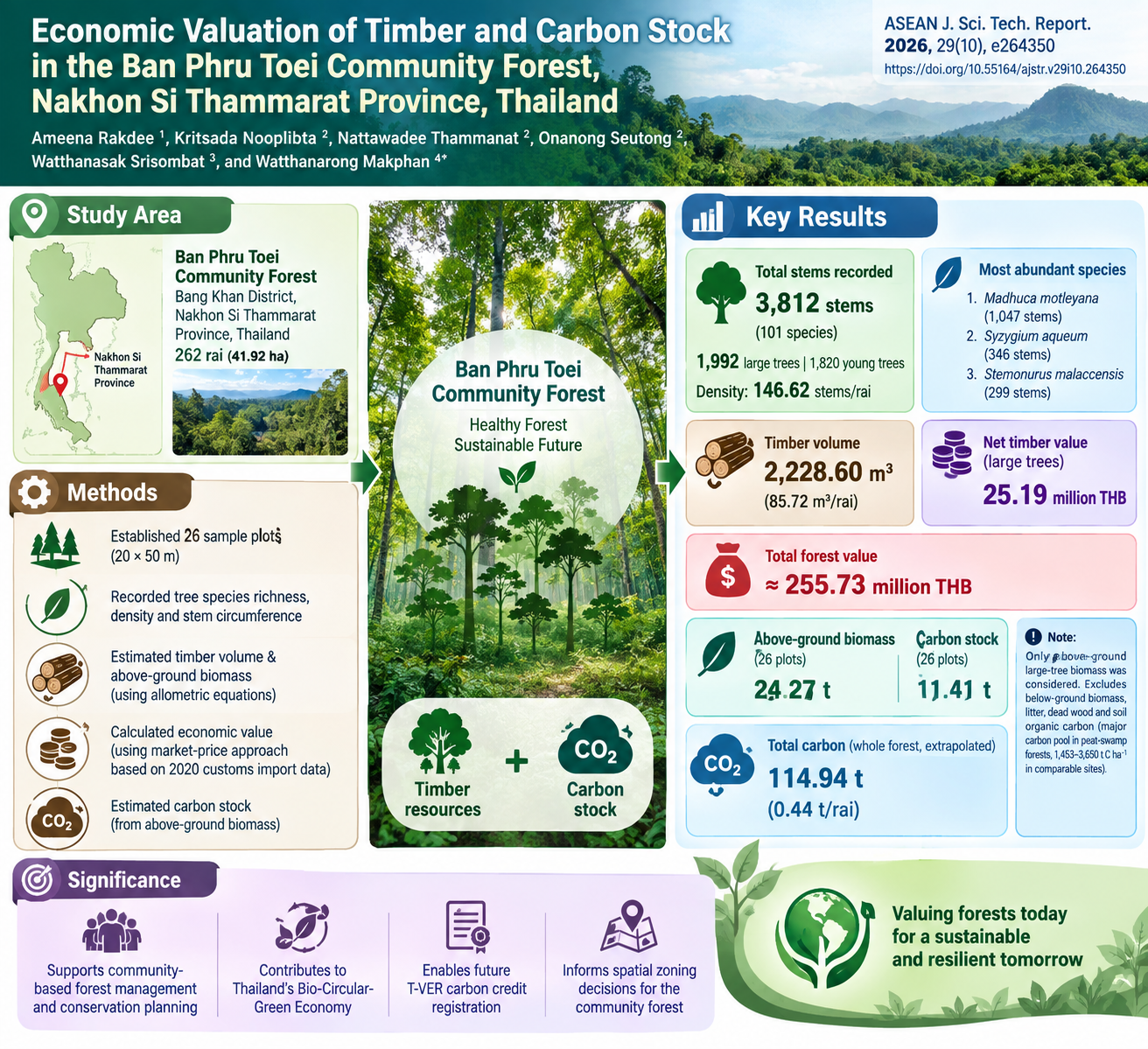
Community forests provide critical ecosystem services but are frequently undervalued in forest management decisions. This study assessed the economic value of timber resources and quantified the carbon stock of the Ban Phru Toei Community Forest (262 rai; 41.92 ha) in Bang Khan District, Nakhon Si Thammarat Province, Thailand. Twenty-six 20 × 50 m sample plots were systematically established. Tree species richness, density, and stem circumference were recorded; timber volume and above-ground biomass were estimated using published allometric equations. Economic values were derived using the market-price approach, based on 2020 customs import data. A total of 3,812 stems representing 101 species were recorded (1,992 large trees; 1,820 young trees), with a combined density of 146.62 stems per rai. The most abundant species was Madhuca motleyana (1,047 stems), followed by Syzygium aqueum (346 stems) and Stemonurus malaccensis (299 stems). Total timber volume was 2,228.60 m³ (85.72 m³ rai⁻¹). The net timber value of large trees was 25.19 million THB, and the total forest value reached approximately 255.73 million THB. Above-ground biomass in the 26 plots was 24.27 t, yielding a carbon stock of 11.41 t; extrapolated to the entire forest, total carbon was estimated at 114.94 t (0.44 t rai⁻¹), representing above-ground large-tree biomass only and excluding below-ground biomass, litter, dead wood, and soil organic carbon (the dominant carbon pool in peat-swamp forests, estimated at 1,453–3,650 t C ha⁻¹ in comparable Southeast Asian sites). These findings provide baseline data for community-based forest management, conservation planning, and participation in Thailand’s Bio-Circular-Green Economy framework, specifically by enabling future T-VER carbon credit registration and informing spatial zoning decisions for the community forest.
Article Details

อนุญาตภายใต้เงื่อนไข Creative Commons Attribution-NonCommercial-NoDerivatives 4.0 International License.
เอกสารอ้างอิง
Soonthornwong, S. Community Forests in Thailand; RECOFTC: Bangkok, Thailand, 2011.
Department of Public Relations. Community Forest Expansion News; Thai News Agency, 2022.
Buakong, W.; Suwanmanee, P.; Ruttajorn, K.; Asawatreratanakul, K.; Leake, J. E. Sustainable rubber production intercrop with mixed fruits to improve physiological factors, productivity, and income. ASEAN J. Sci. Technol. Rep. 2024, 27, e254945. https://doi.org/10.55164/ajstr.v27i6.254945
Tongkaemkaew, U.; Penot, E.; Chambon, B. Rubber agroforestry systems in mature plantations in Phatthalung Province, Southern Thailand. ASEAN J. Sci. Technol. Rep. 2024, 27, 78–85.
Saengsathien, J.; Teejuntuk, S.; Maelim, S. Tropical rain forest community after razing rubber tree on land encroachment in Khao Lak–Lam Ru National Park, Phang Nga Province. ASEAN J. Sci. Technol. Rep. 2024, 27, 75–86.
Tongnunui, S.; Wattanakornsiri, A.; Chainapong, T.; Phaewcham, S. Participatory action research for pattern development of restoration and conservation in fisheries resources. ASEAN J. Sci. Technol. Rep. 2024, 27, 18–28.
Saowalak, R.; Kaew-tong, N. Economic valuation of mangrove timber by participatory learning in Kokkha-yom Community, Satun Province. J. Thammasat Econ. 2007, 25.
Namfon, P. Economic Valuation of Timber and Young Trees on Khao Kho Hong, Hat Yai, Songkhla; M.Sc. Thesis, Prince of Songkla University, Songkhla, Thailand, 2012.
Pantamanatsopa, P.; Srivabut, C.; Homkhiew, C.; Boonchouytan, W.; Rawangwong, S.; Thongmung Kamnerdwam, A. Comparative analysis of rubberwood, plywood, and wood-plastic composites for safe elderly toy applications. ASEAN J. Sci. Technol. Rep. 2024, 29, e260685. https://doi.org/10.55164/ajstr.v29i4.260685
IPCC. 2006 IPCC Guidelines for National Greenhouse Gas Inventories; IGES: Japan, 2006.
Temchai, T.; Deekaew, P.; Saengsawang, M.; Jaikaew, P.; Hengsawang, D.; Kaewkate, C.; Wannamanee, S.; Jitra, N.; Thongsuk, P.; Matphang, P.; Thongkoet, T.; Jeevapong, S.; Buasri, C.; Pulla, N.; Khamklan, S.; Tubtimdaeng, C. Carbon Stock Assessment in Kui Buri National Park and Adjacent Corridors; Annual Report; Royal Forest Department: Bangkok, Thailand, 2017.
Watchara-kitti, S. Forest Resource Survey; Department of Forest Management, Kasetsart University: Bangkok, Thailand, 1982.
Kasem, R. Manual for Mangrove Protection Zone Management; Department of Marine and Coastal Resources: Bangkok, Thailand, 2007.
Kongsangchai, J. Forest Ecological Study of Mangrove Silviculture; Ph.D. Thesis, Kyoto University, Kyoto, Japan, 1988.
Thai Customs Department. Import Statistics for Processed Timber Products 2020. https://forestinfo.forest.go.th/Content.aspx?id=10400 (accessed March 1, 2023).
Khiriratnikom, A.; Khiriratnikom, S.; Sumpanthamit, T.; Asirameethi, K. Carbon sequestration value in above-ground biomass in peat-swamp forest, Nakhon Si Thammarat. J. Rajamangala Univ. Technol. 2014.
IPCC. Good Practice Guidance for Land Use, Land-Use Change and Forestry; IPCC: Geneva, Switzerland, 2003.
National Park Innovation Research Centre, Phetchaburi. Carbon Stock in Kaeng Krachan National Park; Royal Forest Department: Bangkok, Thailand, 2019.
Kasetsirabutr, A.; Ounkerd, K.; Sunthornhao, P.; Puangchit, L. Species diversity, biomass, and carbon sequestration in Khao Wong Community Forest, Chaiyaphum Province. Walailak J. Sci. Technol. 2015.
Page, S. E.; Rieley, J. O.; Banks, C. J. Global and regional importance of the tropical peatland carbon pool. Glob. Change Biol. 2011, 17, 798–818. https://doi.org/10.1111/j.1365-2486.2010.02279.x
Warren, M.; Hergoualc'h, K.; Kauffman, J. B.; Murdiyarso, D.; Kolka, R. An appraisal of Indonesia’s immense peat carbon stock using national peatland maps: Uncertainties and potential losses from conversion. Glob. Change Biol. 2012, 18, 3311–3322. https://doi.org/10.1111/j.1365-2486.2012.02739.x
Murdiyarso, D.; Hergoualc'h, K.; Verchot, L. V. Opportunities for reducing greenhouse gas emissions in tropical peatlands. Proc. Natl. Acad. Sci. U.S.A. 2010, 107, 19655–19660. https://doi.org/10.1073/pnas.0911966107
