Physiological Role of Genetic Polymorphisms in the AGTR1 Gene and Their Association with Inflammatory Cytokines in Blood Pressure Regulation
Article Sidebar
Main Article Content
บทคัดย่อ
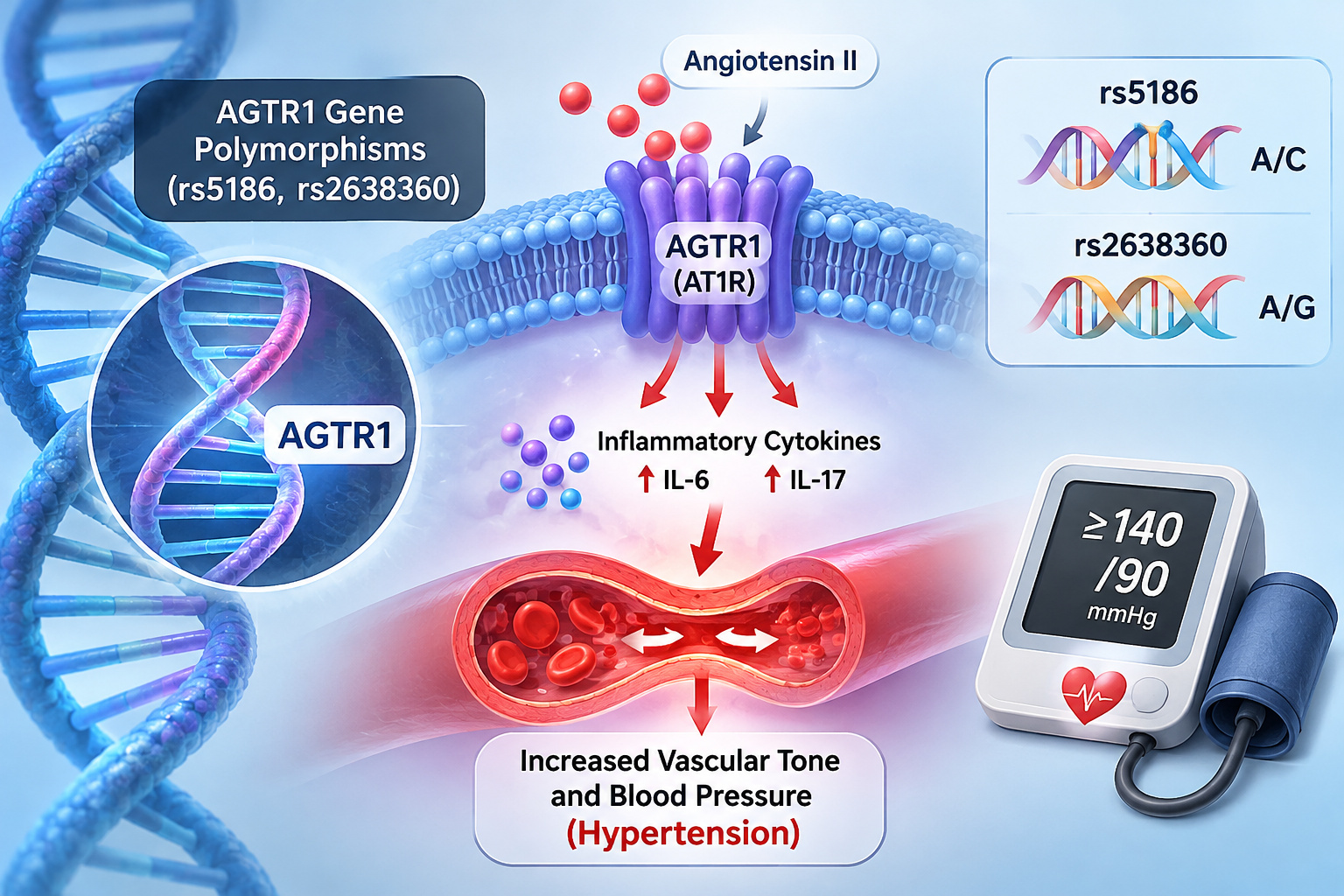
Hypertension is a major and largely asymptomatic contributor to cardiovascular morbidity, and genetic variation within the renin–angiotensin system is an important determinant of individual susceptibility. This case–control study examined the physiological contribution of two single-nucleotide polymorphisms (SNPs) in the angiotensin II type 1 receptor gene (AGTR1), rs5186 and rs2638360, to hypertension, together with the serum concentrations of the pro-inflammatory cytokines interleukin-6 (IL-6) and interleukin-17 (IL-17), in a cohort from Al-Qadisiyah Province, Iraq. Forty-eight hypertensive patients—stratified into mild, moderate, and severe subgroups—and 48 apparently healthy controls were genotyped by tetra-primer amplification refractory mutation system PCR (tetra-ARMS-PCR), and ELISA quantified serum cytokines. For rs5186, the A allele was associated with increased risk (OR = 2.14, P < 0.01), the C allele and the AC genotype showed protective odds ratios (OR = 0.47 and 0.37, respectively; P < 0.05), and the AA genotype was associated with increased risk (OR = 11.50, P < 0.001). For rs2638360, the AA genotype and the A allele were protective (OR = 0.055 and 0.20, respectively; P < 0.0001), whereas the AG and GG genotypes and the G allele conferred increased risk (OR = 4.86, 6.05, and 4.89, respectively; P < 0.05). Neither SNP was significantly associated with hypertension severity. Control genotype frequencies conformed to Hardy–Weinberg equilibrium for rs2638360 but deviated significantly for rs5186 (P < 0.001), so the rs5186 results require confirmation by an independent genotyping method. IL-6 and IL-17 were markedly elevated in patients (6.01 ± 0.42 and 2.87 ± 0.25 pg/mL, respectively; P < 0.0001) but did not differ across genotypes. These findings suggest that AGTR1 rs5186 and rs2638360 are associated with hypertension susceptibility in the Iraqi population and are consistent with a contributory role of vascular inflammation in disease pathophysiology, offering potential targets for population-specific management strategies.
Downloads
Article Details

อนุญาตภายใต้เงื่อนไข Creative Commons Attribution-NonCommercial-NoDerivatives 4.0 International License.
เอกสารอ้างอิง
[1] Unger, T.; Borghi, C.; Charchar, F.; et al. 2020 International Society of Hypertension Global Hypertension Practice Guidelines. Hypertension 2020, 75(6), 1334–1357. https://doi.org/10.1161/HYPERTENSIONAHA.120.15026
[2] Schmieder, R. E.; Ruilope, L. M. Blood Pressure Control in Patients with Comorbidities. J. Clin. Hypertens. (Greenwich) 2008, 10(8), 624–631. https://doi.org/10.1111/j.1751-7176.2008.08172.x
[3] Lauder, L.; Mahfoud, F.; Azizi, M.; Bhatt, D. L.; Ewen, S.; Kario, K.; et al. Hypertension Management in Patients with Cardiovascular Comorbidities. Eur. Heart J. 2023, 44(23), 2066–2077. https://doi.org/10.1093/eurheartj/ehac395
[4] Acelajado, M. C.; Oparil, S. Hypertension in the Elderly. Clin. Geriatr. Med. 2009, 25(3), 391–412.
https://doi.org/10.1016/j.cger.2009.06.001
[5] Bozkurt, B.; Aguilar, D.; Deswal, A.; Dunbar, S. B.; Francis, G. S.; Horwich, T.; Jessup, M.; et al. Contributory Risk and Management of Comorbidities of Hypertension, Obesity, Diabetes Mellitus, Hyperlipidemia, and Metabolic Syndrome in Chronic Heart Failure: A Scientific Statement from the American Heart Association. Circulation 2016, 134(23), e535–e578. https://doi.org/10.1161/CIR.0000000000000450
[6] World Health Organization. Global Health Risks: Mortality and Burden of Disease Attributable to Selected Major Risks; World Health Organization: Geneva, 2023.
[7] Levy, D.; Ehret, G. B.; Rice, K.; Verwoert, G. C.; Launer, L. J.; Dehghan, A.; et al. Genome-Wide Association Study of Blood Pressure and Hypertension. Nat. Genet. 2009, 41(6), 677–687. https://doi.org/10.1038/ng.384
[8] Newton-Cheh, C.; Johnson, T.; Gateva, V.; Tobin, M. D.; Bochud, M.; Coin, L.; et al. Genome-Wide Association Study Identifies Eight Loci Associated with Blood Pressure. Nat. Genet. 2009, 41(6), 666–676.
[9] Ganesh, S. K.; Tragante, V.; Guo, W.; Guo, Y.; Lanktree, M. B.; Smith, E. N.; et al. Loci Influencing Blood Pressure Identified Using a Cardiovascular Gene-Centric Array. Hum. Mol. Genet. 2013, 22(8), 1663–1678.
[10] Johnson, A. D.; Newton-Cheh, C.; Chasman, D. I.; Ehret, G. B.; Johnson, T.; Rose, L.; et al. Association of Hypertension Drug Target Genes with Blood Pressure and Hypertension in 86,588 Individuals. Hypertension 2011, 57(5), 903–910. https://doi.org/10.1161/HYPERTENSIONAHA.110.158667
[11] Ehret, G. B.; Munroe, P. B.; Rice, K. M.; Bochud, M.; Johnson, A. D.; Chasman, D. I.; et al. Genetic Variants in Novel Pathways Influence Blood Pressure and Cardiovascular Disease Risk. Nature 2011, 478, 103–109. https://doi.org/10.1038/nature10405
[12] Wain, L. V.; Verwoert, G. C.; O'Reilly, P. F.; Shi, G.; Johnson, T.; Johnson, A. D.; et al. Genome-Wide Association Study Identifies Six New Loci Influencing Pulse Pressure and Mean Arterial Pressure. Nat. Genet. 2011, 43(10), 1005–1011. https://doi.org/10.1038/ng.940
[13] Tragante, V.; Barnes, M. R.; Ganesh, S. K.; Lanktree, M. B.; Guo, W.; Franceschini, N.; et al. Gene-Centric Meta-Analysis in 87,736 Individuals of European Ancestry Identifies Multiple Blood-Pressure-Related Loci. Am. J. Hum. Genet. 2014, 94(3), 349–360.
[14] Wain, L. V.; Vaez, A.; Jansen, R.; Joehanes, R.; van der Most, P. J.; Erzurumluoglu, A. M.; et al. Novel Blood Pressure Locus and Gene Discovery Using Genome-Wide Association Study and Expression Data Sets from Blood and the Kidney. Hypertension 2017, 70, e4–e19.
[15] Hoffmann, T. J.; Ehret, G. B.; Nandakumar, P.; Ranatunga, D.; Schaefer, C.; Kwok, P. Y.; et al. Genome-Wide Association Analyses Using Electronic Health Records Identify New Loci Influencing Blood Pressure Variation. Nat. Genet. 2017, 49, 54–64. https://doi.org/10.1038/ng.3715
[16] Evangelou, E.; Warren, H. R.; Mosen-Ansorena, D.; Mifsud, B.; Pazoki, R.; Gao, H.; et al. Genetic Analysis of over 1 Million People Identifies 535 New Loci Associated with Blood Pressure Traits. Nat. Genet. 2018, 50(10), 1412–1425.
[17] Giri, A.; Hellwege, J. N.; Keaton, J. M.; Park, J.; Qiu, C.; Warren, H. R.; et al. Trans-Ethnic Association Study of Blood Pressure Determinants in over 750,000 Individuals. Nat. Genet. 2019, 51, 51–62. https://doi.org/10.1038/s41588-018-0303-9
[18] Cabrera, C. P.; Ng, F. L.; Nicholls, H. L.; Gupta, A.; Barnes, M. R.; Munroe, P. B.; Caulfield, M. J. Over 1000 Genetic Loci Influencing Blood Pressure with Multiple Systems and Tissues Implicated. Hum. Mol. Genet. 2019, 28(R2), R151–R161. https://doi.org/10.1093/hmg/ddz197
[19] Shahid, M.; Rehman, K.; Akash, M. S. H.; et al. Genetic Polymorphism in Angiotensinogen and Its Association with Cardiometabolic Diseases. Metabolites 2022, 12(12), 1291. https://doi.org/10.3390/metabo12121291
[20] Masenga, S. K.; Kirabo, A. Hypertensive Heart Disease: Risk Factors, Complications and Mechanisms. Front. Cardiovasc. Med. 2023, 10, 1205475. https://doi.org/10.3389/fcvm.2023.1205475
[21] Takeuchi, F.; Yamamoto, K.; Katsuya, T.; et al. Reevaluation of the Association of Seven Candidate Genes with Blood Pressure and Hypertension: A Replication Study and Meta-Analysis with a Larger Sample Size. Hypertens. Res. 2012, 35(8), 825–831. https://doi.org/10.1038/hr.2012.43
[22] World Health Organization. Hypertension—Iraq 2023 Country Profile. Available online: https://www.who.int/publications/m/item/hypertension-irq-2023-country-profile (accessed 2025).
[23] Mousa, N. A. W.; Khaleefah, M. A.; Al-Badri, H. J. Hypertension Control among Adult Iraqis. J. Fac. Med. Baghdad 2022, 64(3), 145–152. https://doi.org/10.32007/jfacmedbagdad.6431935
[24] Fu, M.; Lv, M.; Guo, J.; Mei, A.; Qian, H.; Yang, H.; et al. The Clinical Significance of T-Cell Regulation in Hypertension Treatment. Front. Immunol. 2025, 16, 1550206. https://doi.org/10.3389/fimmu.2025.1550206
[25] Medrano, R. F. V.; de Oliveira, C. A. Guidelines for the Tetra-Primer ARMS-PCR Technique Development. Mol. Biotechnol. 2014, 56 (7), 599–608. https://doi.org/10.1007/s12033-014-9734-4
[26] Sahan, K. A.; Aziz, I. H. Polymorphism of Angiotensin Type 1 Receptor Gene (SNP rs5186 A1166C) Related with Hypertension Patients in Baghdad. Iraqi J. Biotechnol. 2018, 17(3), 32–39.
[27] Jasim, Z. H.; Jubair, S.; Abood, H. A. A. N. The Impact of Angiotensin II Type 1 Receptor (ATR1) Gene Polymorphism (A1166C) on Cardiovascular and Renal Complications in Iraqi Hypertensive Patients Treated with Candesartan. Bull. Natl. Inst. Health Sci. 2022, 140(1), 1133–1140.
[28] Semianiv, M. M.; Sydorchuk, L. P.; Dzhuryak, V. S.; Gerush, O. V.; Palamar, A. O.; Muzyka, N. Y.; et al. Association of AGTR1 (rs5186), VDR (rs2228570) Genes Polymorphism with Blood Pressure Elevation in Patients with Essential Arterial Hypertension. J. Med. Life 2021, 14(6), 782–789.
[29] Sofronova, S. I.; Klimova, T. M.; Kirillina, M. P.; Nikolaev, V. M.; Kononova, I. V.; Kuzmina, A. A.; Romanova, A. N. Association of the AGTR1 Gene A1166C (rs5186) Polymorphism with Essential Hypertension in the Indigenous Population of the Arctic. Int. J. Biomed. 2021, 11(3), 361–366. https://doi.org/10.21103/Article11(3)_OA14
[30] Wang, W. Y.; Zee, R. Y.; Morris, B. J. Association of Angiotensin II Type 1 Receptor Gene Polymorphism with Essential Hypertension. Clin. Genet. 1997, 51(1), 31–34. https://doi.org/10.1111/j.1399-0004.1997.tb02410.x
[31] Jiang, Z.; Zhao, W.; Yu, F.; Xu, G. Association of Angiotensin II Type 1 Receptor Gene Polymorphism with Essential Hypertension. Chin. Med. J. (Engl.) 2001, 114(12), 1249–1251.
[32] Hashim Abd Ali, A.; Teplyakova, E. D.; Bocharova, O. V.; Karantysh, G. V.; Shkurat, T. P. Investigation of the Association of AGTR1 A1166C rs5186 and FTO rs9939609 Polymorphisms with Obesity in Children and Adolescents. Baghdad Sci. J. 2022, 19(6), Article 21. https://doi.org/10.21123/bsj.2022.6540
[33] Marianna, M.; Sydorchuk, L.; Semianiv, I.; Sydorchuk, R. Dyslipidemia as a Predictor of Essential Arterial Hypertension Depending on AGTR1 (rs5186) and VDR (rs2228570) Genes Polymorphism. Rom. J. Diabetes Nutr. Metab. Dis. 2022, 29(2), 253–260.
[34] Farrag, W.; Eid, M.; El-Shazly, S.; Abdallah, M. Angiotensin II Type 1 Receptor Gene Polymorphism and Telomere Shortening in Essential Hypertension. Mol. Cell. Biochem. 2011, 351(1–2), 13–18. https://doi.org/10.1007/s11010-010-0706-0
[35] Kalideen, K.; Rayner, B.; Ramesar, R. Genetic Factors Contributing to the Pathogenesis of Essential Hypertension in Two African Populations. J. Pers. Med. 2024, 14(3), 323. https://doi.org/10.3390/jpm14030323
[36] Ghafil, F. A.; Mohammad, B. I.; Al-Janabi, H. S.; Hadi, N. R.; Al-Aubaidy, H. A. Genetic Polymorphism of Angiotensin II Type 1 Receptors and Their Effect on the Clinical Outcome of Captopril Treatment in Arab Iraqi Patients with Acute Coronary Syndrome (Mid Euphrates). Indian J. Clin. Biochem. 2021, 36(1), 81–87. https://doi.org/10.1007/s12291-019-00860-x
[37] Chaimati, S.; Shantavasinkul, P. C.; Sritara, P.; Sirivarasai, J. Effects of AGT and AGTR1 Genetic Polymorphisms and Changes in Blood Pressure over a Five-Year Follow-Up. Risk Manag. Healthc. Policy 2023, 16, 2931–2942. https://doi.org/10.2147/RMHP.S442983
[38] Yang, H.; Bai, S.; Wu, Y.; Li, Q.; Luo, F.; Li, B.; Jin, Y.; Xiao, C. Polymorphisms within Angiotensin II Receptor Type 1 Gene Associated with Essential Hypertension in Chinese Hani and Yi Minorities. J. Renin Angiotensin Aldosterone Syst. 2015, 16(3), 653–659. https://doi.org/10.1177/1470320314565839
[39] Gu, D.; Kelly, T. N.; Hixson, J. E.; Chen, J.; Liu, D.; Chen, J.-C.; et al. Genetic Variants in the Renin-Angiotensin-Aldosterone System and Salt Sensitivity of Blood Pressure. J. Hypertens. 2010, 28(6), 1210–1220. https://doi.org/10.1097/HJH.0b013e3283383655
[40] Mente, A.; O'Donnell, M. J.; Rangarajan, S.; et al. Association of Urinary Sodium and Potassium Excretion with Blood Pressure. N. Engl. J. Med. 2014, 371(7), 601–611. https://doi.org/10.1056/NEJMoa1311989
[41] Wu, Z.; Huang, C.; Zhou, T.; et al. Association of Polymorphisms in AGTR1 and AGTR2 Genes with Primary Aldosteronism in the Chinese Han Population. J. Renin Angiotensin Aldosterone Syst. 2014, 16(4), 880–887. https://doi.org/10.1177/1470320314534511
[42] Mozaffarian, D.; Fahimi, S.; Singh, G. M.; et al. Global Sodium Consumption and Death from Cardiovascular Causes. N. Engl. J. Med. 2014, 371(7), 624–634. https://doi.org/10.1056/NEJMoa1304127
[43] Nierenberg, J. L.; Li, C.; He, J.; et al. Blood Pressure Genetic Risk Score Predicts Blood Pressure Responses to Dietary Sodium and Potassium. Hypertension 2017, 70(6), 1106–1112. https://doi.org/10.1161/HYPERTENSIONAHA.117.10108
[44] Liu, K.; Xi, B.; Liu, Z.; Han, Q.; Liu, B.; Zhang, J.; et al. Genetic Predisposition and Salt Sensitivity in a Chinese Han Population: The EpiSS Study. Int. J. Hypertens. 2020, 2020, 3167875. https://doi.org/10.1155/2020/3167875
[45] Xie, Y.; Liu, Z.; Liu, K.; Qi, H.; Peng, W.; Cao, H.; et al. Candidate Gene Polymorphisms Influence the Susceptibility to Salt Sensitivity of Blood Pressure in a Han Chinese Population: Risk Factors as Mediators. Front. Genet. 2021, 12, 675230. https://doi.org/10.3389/fgene.2021.675230
[46] Taylor, W. R. Hypertensive Vascular Disease and Inflammation: Mechanical and Humoral Mechanisms. Curr. Hypertens. Rep. 1999, 1 (1), 96–101. https://doi.org/10.1007/s11906-999-0079-5
[47] Sun, L.; Gao, Y. H.; Tian, D. K.; Zheng, J. P.; Zhu, C. Y.; Ke, Y. Inflammation of Different Tissues in Spontaneously Hypertensive Rats. Sheng Li Xue Bao 2006, 58, 318–323.
[48] Madhur, M. S.; Lob, H. E.; McCann, L. A.; Iwakura, Y.; Blinder, Y.; Guzik, T. J.; Harrison, D. G. Interleukin 17 Promotes Angiotensin II-Induced Hypertension and Vascular Dysfunction. Hypertension 2010, 55(2), 500–507. https://doi.org/10.1161/HYPERTENSIONAHA.109.145094
[49] Bernatova, I. Endothelial Dysfunction in Experimental Models of Arterial Hypertension: Cause or Consequence? BioMed Res. Int. 2014, 2014, 598271. https://doi.org/10.1155/2014/598271
[50] Weeks, C. J.; Bekele, B. B.; Altvater, M.; Cheng, J.; Zhu, H.; Huang, Y.; et al. The Association between Short-Term Blood Pressure Variability and Inflammation in Healthy Young Adults. J. Cardiovasc. Dev. Dis. 2025, 12(10), 399. https://doi.org/10.3390/jcdd12100399
[51] Li, R.; Guo, L.; Liang, B.; Sun, W.; Hai, F. Review of Mechanisms and Frontier Applications in IL-17A-Induced Hypertension. Open Med. 2025, 20(1), 20251159. https://doi.org/10.1515/med-2025-1159
[52] Liu, Y.; Liu, T.; McCarron, R. M.; et al. Evidence for Activation of Endothelium and Monocytes in Hypertensive Rats. Am. J. Physiol. Heart Circ. Physiol. 1996, 270(6), H2125–H2131. https://doi.org/10.1152/ajpheart.1996.270.6.H2125
[53] Ross, R. Atherosclerosis—An Inflammatory Disease. N. Engl. J. Med. 1999, 340(2), 115–126. https://doi.org/10.1056/NEJM199901143400207
[54] Li, Q. Z.; Deng, Q.; Li, J. Q.; Yi, G. H. Valsartan Reduces Interleukin-1β Secretion by Peripheral Blood Mononuclear Cells in Patients with Essential Hypertension. Clin. Chim. Acta 2005, 355, 131–136. https://doi.org/10.1016/j.cccn.2004.12.006
[55] Tanase, D. M.; Gosav, E. M.; Radu, S.; Ouatu, A.; Rezus, C.; Ciocoiu, M.; et al. Arterial Hypertension and Interleukins: Potential Therapeutic Target or Future Diagnostic Marker? Int. J. Hypertens. 2019, 2019, 3159283. https://doi.org/10.1155/2019/3159283
[56] Nordlohne, J.; von Vietinghoff, S. Interleukin 17A in Atherosclerosis—Regulation and Pathophysiologic Effector Function. Cytokine 2019, 122, 154089. https://doi.org/10.1016/j.cyto.2017.06.016
[57] Liuzzo, G.; Trotta, F.; Pedicino, D. Interleukin-17 in Atherosclerosis and Cardiovascular Disease: The Good, the Bad, and the Unknown. Eur. Heart J. 2013, 34, 556–559. https://doi.org/10.1093/eurheartj/ehs399
[58] Xue, G. L.; Li, D. S.; Wang, Z. Y.; Liu, Y.; Yang, J. M.; Li, C. Z.; et al. Interleukin-17 Upregulation Participates in the Pathogenesis of Heart Failure in Mice via NF-κB-Dependent Suppression of SERCA2a and Cav1.2 Expression. Acta Pharmacol. Sin. 2021, 42, 1780–1789. https://doi.org/10.1038/s41401-020-00580-6
[59] Baumhove, L.; van Essen, B. J.; Dokter, M. M.; Zijlstra, S. N.; Deiman, F. E.; Laman, J. D.; et al. IL-17 Is Associated with Disease Severity and Targetable Inflammatory Processes in Heart Failure. ESC Heart Fail. 2024, 11(6), 3530–3538. https://doi.org/10.1002/ehf2.14968
[60] Gan, L.; Ye, D.; Feng, Y.; Pan, H.; Lu, X.; Wan, J.; et al. Immune Cells and Hypertension. Immunol. Res. 2024, 72, 1–13. https://doi.org/10.1007/s12026-023-09414-z