
การประเมินคาร์บอนฟุตพริ้นท์จากการปลดปล่อยก๊าซมีเทน และก๊าซไนตรัสออกไซด์ กรณีศึกษา ฟาร์มเลี้ยงไก่เนื้อในจังหวัดชลบุรี ประเทศไทย
บทคัดย่อ
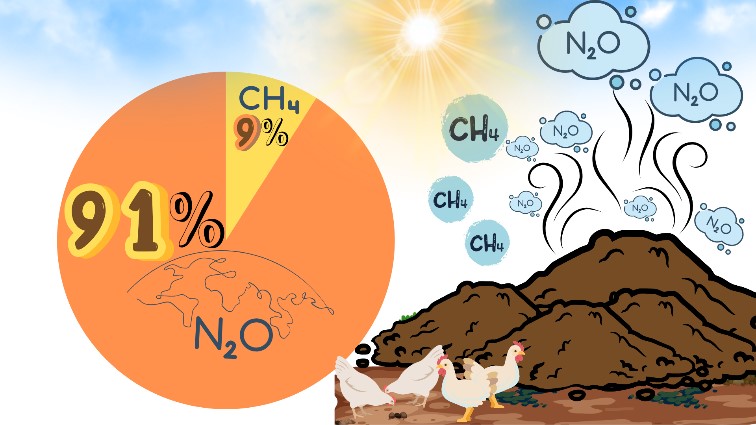
งานวิจัยครั้งนี้มีวัตถุประสงค์เพื่อประเมินการปลดปล่อยก๊าซเรือนกระจกประเภทก๊าซมีเทน (CH4) และก๊าซไนตรัสออกไซด์ (N2O) รวมถึงคำนวณคาร์บอนฟุตพริ้นท์ขององค์กรจากกิจกรรมการจัดการมูลไก่เนื้อที่กองในที่ โล่งแจ้ง ณ ฟาร์มเลี้ยงไก่เนื้อในจังหวัดชลบุรี ประเทศไทย การประเมินดำเนินการโดยใช้วิธีการคำนวณตามหลักการของ Intergovernmental Panel on Climate Change (IPCC) และค่าสัมประสิทธิ์การปลดปล่อยจากงานวิจัยที่เกี่ยวข้อง ผลการศึกษาพบว่าการปลดปล่อย CH4 มีค่าอยู่ในช่วง 2,576.21 – 2,674.97 kgCH4 และ N2O อยู่ในช่วง 2,596.22 – 2,813.88 kgN2O-N ต่อรุ่น ตามลำดับ เมื่อพิจารณาสัดส่วนของการปลดปล่อยก๊าซเรือนกระจกทั้งหมดจากกองมูลไก่ที่ศึกษา พบว่า N2O คิดเป็น 91% ในขณะที่ CH4 คิดเป็น 9% การปลดปล่อย N2O ที่สูงนี้สอดคล้องกับคุณสมบัติ ของมูลไก่ที่มีปริมาณไนโตรเจนสูงและสภาพแวดล้อมภายในกองมูลที่เอื้อต่อทั้งกระบวนการไนตริฟิเคชันและเดนไนตริฟิเคชัน ซึ่งเป็นปัจจัยสำคัญในการผลิต N2O นอกจากนี้ การที่ N2O มีศักยภาพในการทำให้เกิดภาวะโลกร้อน (Global Warming Potential, GWP) สูงถึง 298 เท่าของ CO2 ทำให้การปลดปล่อย N2O จากกองมูลไก่มีผลกระทบ อย่างมีนัยสำคัญต่อการเปลี่ยนแปลงสภาพภูมิอากาศและสุขภาพของมนุษย์ ผลการศึกษานี้เป็นข้อมูลพื้นฐานที่สำคัญสำหรับองค์กรในการจัดทำบัญชีก๊าซเรือนกระจก (Carbon Footprint for Organization, CFO) และใช้ประกอบการขอรับรองฉลากคาร์บอนฟุตพริ้นท์ตามข้อกำหนดขององค์การบริหารจัดการก๊าซเรือนกระจก (องค์การมหาชน) หรือ อบก. นอกจากนี้ งานวิจัยยังชี้ให้เห็นถึงประโยชน์ของค่าสัมประสิทธิ์การปลดปล่อย (EF) ในการประเมินเบื้องต้น และเสนอแนะให้มีการศึกษาในอนาคตเพื่อจัดทำค่า (EF) ที่เฉพาะเจาะจงตามสายพันธุ์ไก่และช่วงเวลาการปลดปล่อย (กลางวันและกลางคืน)รวมถึงการวัดภาคสนามจริง เพื่อเพิ่มความแม่นยำในการประเมินและพัฒนากลยุทธ์การลดการปล่อยก๊าซเรือนกระจกใน ภาคปศุสัตว์ได้อย่างยั่งยืน
เอกสารอ้างอิง
พรพรรณ โพธิ์ประสิทธิ์, ธีรวิทย์ เป่ยคําภา, ชัยภูมิ บัญชาศักดิ์,วิริยา ลุ้งใหญ่ และ เชาว์วิทย์ ระฆังทอง. (2556). การประมาณ ค่าการปลดปล่อยมีเทนและไนตรัสออกไซด์จากไก่ไข่ใน 13 ฟาร์ม. วารสารวิทยาศาสตร์เกษตร 44 (1) (พิเศษ) 231-234 ค้นจากhttps://anscku.files.wordpress.com/2013/04/p09_oral.pdf
Aneja, V. P., Schlesinger, W. H., and Erisman, J. W. (2009). Effects of agriculture upon the air quality and climate:Research, policy, and regulations. Environmental Science and Technology, 43(12), 4234–4240. doi: 10.1021/es8024403
Bhatnagar, N., Ryan, D., Murphy, R., and Enright, A. M. (2022). A comprehensive review of green policy, anaerobic digestion of animal manure and chicken litter feedstock potential–Global and Irish perspective. Renewable and Sustainable Energy Reviews, 154, 111884. doi: 10.1016/j.rser.2021.111884
Clemens, J., Trimborn, M., Weiland, P., and Amon, B. (2006). Mitigation of greenhouse gas emissions by anaerobic digestion of cattle slurry. Agriculture, Ecosystems and Environment, 112(2–3), 171–177. doi: 10.1016/j.agee.2005.08.016
Dong, H., Zhu, Z., Zhou, Z., Xin, H., and Chen, Y. (2011). Greenhouse gas emissions from swine manure stored at different stack heights. Animal Feed Science and Technology, 166–167, 557–561. doi: 10.1016/j.anifeedsci.2011.04.039
Food and agriculture organization of the United Nations (FAOSTAT). (2024). FAO statistical database. Retrieved from https://www.fao. org/faostat/en/#data/QCL.
Hao, X., Chang, C., and Larne, F. (2004). Carbon, Nitrogen balances and greenhouse gas emission during cattle feedlot manure composting. Journal of Environmental Quality. 33 (1), 37–44. doi: 10.2134/jeq2004.3700
Intergovernmental Panel on Climate Change (IPCC). (2018). Global Warming of 1.5๐C: Summary for Policymakers. Retrieved from https://www.ipcc.ch/sr15/
Intergovernmental Panel on Climate Change IPCC. (2014). Climate Change 2014: Synthesis Report. Contribution of working groups I, II and III to the Fifth Assessment Report of the Intergovernmental Panel on Climate Change. Retrieved from
chrome- https://www.ipcc.ch/site/assets/uploads/2018/05/SYR_AR5_FINAL_full_wcover.pdf
Intergovernmental Panel on Climate Change (IPCC). (2006). Guidelines for national greenhouse gas inventories: Prepared by the national greenhouse gas inventories.Retrieved from https://www.ipcc-nggip.iges.or.jp/public/2006gl/
Jiang, J., Stevenson, D. S., Uwizeye, A., Tempio, G., and Sutton, M. A. (2021). A climate dependent global model of ammonia emissions from chicken farming. Biogeosciences, 18 (1), 135–158. doi:10.5194/bg-18-135-2021
Kamp J.N. and Feilberg A., (2024). Covering reduces emissions of ammonia, methane, and nitrous oxide
from stockpiled broiler litter. Biosystems Engineering 248 (2024) 73–81.
doi: 10.1016/j.biosystemseng.2024.10.002
Lemes, Y. M., Nyord, T., Feilberg, A., and Kamp, J. N. (2023). Effect of covering deep litter stockpiles on methane and ammonia emissions analyzed by an inverse dispersion method. Agricultural Science and Technology, 3(5), 399–412. doi: 10.1021/ acsagscitech.2c00289
Mottet, A., and Tempio, G. (2017). Global poultry production: Current state and future outlook and challenges. World’s Poultry Science Journal, 73(2), 245–256. doi: 10.1017/S0043933917000071
Mulbry, W., and Ahn, H.K., (2014). Greenhouse gas emissions during composting of dairy manure: Influence of the timing of pile mixing on total emissions. Biosystem Engineering 126, 117–122.
doi: 10.1016/j.biosystemseng.2014.08.003.
Nielsen, O.-K., Plejdrup, M. S., Winther, M., Nielsen, M., Gyldenkaerne, S., Mikkelsen, M. H., et al. (2022). Denmark’s national inventory report 2022. Emission inventories 1990-2020 - submitted under the unitednations framework convention on climate change and the kyoto protocol. Aarhus university, DCE – Danish centre for environment and energy. Scientific Report 494, 969.
Nahm, K. H. (2003). Evaluation of the nitrogen content in poultry manure. World’s Poultry Science Journal, 59(1), 77–88. doi: 10.1079/WPS20030004
Pardo, G., Moral, R., Aguilera, E. and Del Prado, A. (2015). Gaseous emissions from management of solid waste: A systematic review. Glob. Chang. Biol. 21, 1313–1327. doi: 10.1111/gcb.12806
United Nations Environment Programmer (UNEP). (2020). Emission Gap Report 2020. Retrieved from https://www.unep.org/emissions-gap
UNDP. (2022). Global Climate Promise, Thailand Asia and the Pacific.
Retrieved from https://climatepromise.undp.org/What-we-do/where-we-work/Thailand
Wyer, K. E., Kelleghan, D. B., Blanes-vidal, V., Schauberger, G., and Curran, T. P. (2022). Ammonia emissions from agriculture and their contribution to fine particulate matter: A review of implications for human health. Journal of Environmental Management, 323, Article 116285. Retrieved from https://doi.org/10.1016/j. jenvman.2022.116285
World health organization (WHO). (2023). Climate Change. Retrieved from https://www.who.int/news- room/fact-sheets/detail/climate change - and-health
Wang, X., Cui, H., Shi, J., Zhao, X., Zhao, Y., and Wei, Z. (2015). Relationship between bacterial diversity and environmental parameters during composting of different raw materials. Bioresource Technology,198, 395–402. doi: 10.1016/j.biortech.2015.09.041
Zhu, Z., Li, L., Dong, H., and Wang, Y. (2020). Ammonia and greenhouse gas emissions of different types of livestock and poultry manure during storage. Transactions of the ASABE. 63(6): 1723-1733. doi: 10.13031/trans.14079
ดาวน์โหลด
เผยแพร่แล้ว
ฉบับ
ประเภทบทความ
สัญญาอนุญาต
ลิขสิทธิ์ (c) 2025 Loei Rajabhat University

อนุญาตภายใต้เงื่อนไข Creative Commons Attribution-NonCommercial-NoDerivatives 4.0 International License.
บทความที่ได้รับการตีพิมพ์



