Designing a Smart Classroom System for Teaching and Learning to Improve Potential of Air Cadets
Keywords:
Smart Classroom, Teaching and Learning, Air CadetAbstract
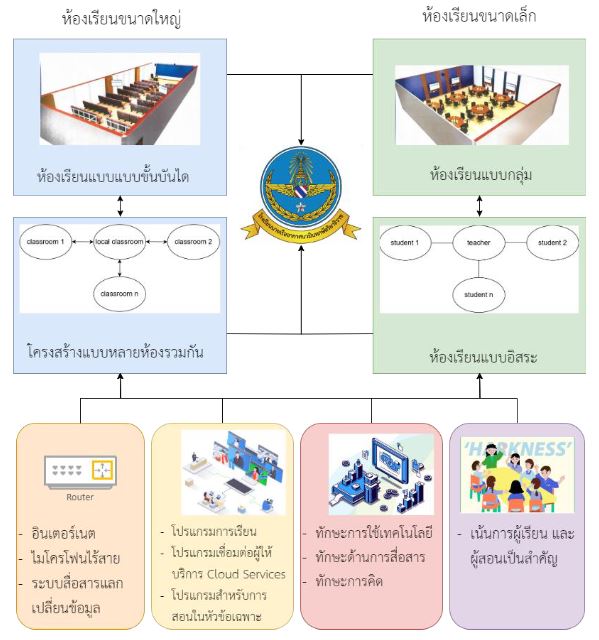
This research aimed to investigate the opinions of lecturers and air cadets regarding the teaching and learning model of the smart classroom system. The collected data were analyzed and used to design a smart classroom system for teaching and learning to enhance the potential of air cadets. The sample group consisted of 69 lecturers and 112 air cadets. The study found that a tiered classroom layout is suitable for large classrooms, while group seating arrangements are more appropriate for smaller classrooms. However, in the field of Social Sciences, it was found that classroom layout had no impact on learning in small classrooms, whereas in Mathematics, the layout was perceived to have no effect on learning in large classrooms. Regarding classroom structure, multiple interconnected classrooms were found to be suitable for large classes, while independent classroom setups were more appropriate for small classes. Nonetheless, Mathematics lecturers believed that classroom structure did not affect learning performance, regardless of classroom size. Most lecturers and air cadets agreed that a blended learning approach was preferable. However, air cadets in the Social Sciences placed more importance on learner-centered teaching methods. In terms of essential skills, both instructors and air cadets considered digital technology proficiency to be the most important. In contrast, for the Humanities, communication skills were deemed more critical than technological skills. As for hardware, the most essential components identified were a reliable internet network and wireless microphones. In terms of software, both lecturers and air cadets agreed on the need for subject-specific programs and interactive learning software. Additionally, there was a strong demand for systems integrated with cloud services, especially in the Humanities and Social Sciences.
References
เนาวนิตย์ สงคราม และธนัท สมณคุปต์, การพัฒนาระบบห้องเรียนอัจฉริยะเสมือนเพื่อส่งเสริมทักษะการเรียนรู้ในศตวรรษที่ 21 ด้านทักษะการเรียนรู้และนวัตกรรมสำหรับผู้เรียนระดับอุดมศึกษา. สำนักงานคณะกรรมการส่งเสริมวิทยาศาสตร์ วิจัยและนวัตกรรม, กรุงเทพฯ: จุฬาลงกรณ์มหาวิทยาลัย, 2560.
ธีรศักดิ์ สะกล และศิริรัตน์ เพ็ชร์แสงศรี, “การศึกษาสภาพปัจจุบันและปัญหาในการจัดการเรียนการสอนวิชาคอมพิวเตอร์เพื่อการออกแบบโดยใช้ห้องเรียนอัจฉริยะของนักศึกษาระดับปริญญาตรี สาขาออกแบบหัตถอุตสาหกรรม คณะศิลปกรรม มหาวิทยาลัยธรรมศาสตร์ (ศูนย์ลำปาง),” วารสารครุศาสตร์อุตสาหกรรม, ปีที่ 17, ฉบับที่ 1, หน้า 104-112, มกราคม-เมษายน, 2561.
ธัชกร สุวรรณจรัส, “รูปแบบห้องเรียนอัจฉริยะแบบผสมผสาน 4.0 โดยใช้การเรียนรู้ร่วมกันเพื่อส่งเสริมทักษะการคิดเชิงนวัตกรรมของนักศึกษาระดับปริญญาตรี มหาวิทยาลัยราชภัฏบ้านสมเด็จเจ้าพระยา,” วารสารอิเล็กทรอนิกส์ Veridian มหาวิทยาลัยศิลปากร, ปีที่ 12, ฉบับที่ 4, หน้า 1001-1020, กรกฎาคม – สิงหาคม, 2562.
พีระศักดิ์ จิ้วตั้น และอภิญญา ลิ้มสุวัฒน์, “การศึกษาความคิดเห็นและความพึงพอใจการเรียนการสอนแบบมีส่วนร่วม (Active Learning) ของนักศึกษา และการปรับปรุงพัฒนาห้องเรียนอัจฉริยะ (Smart Classroom) ของมหาวิทยาลัยเทคโนโลยีสุรนารี,” วารสารมนุษยศาสตร์และสังคมศาสตร์ มหาวิทยาลัยมหาสารคาม, ปีที่ 40, ฉบับที่ 3, หน้า 66-78, พฤษภาคม-มิถุนายน, 2563.
เขมณัฏฐ์ มิ่งศิริธรรม และประกอบ กรณีกิจ, การพัฒนาแอปพลิเคชันสำหรับห้องเรียนอัจฉริยะแบบเปิดเพื่อส่งเสริมทักษะการเรียนรู้ในศตวรรษที่ 21 ด้านทักษะสารสนเทศ สื่อและเทคโนโลยีสำหรับผู้เรียนระดับอุดมศึกษา. สำนักงานคณะกรรมการส่งเสริมวิทยาศาสตร์ วิจัยและนวัตกรรม, กรุงเทพฯ: มหาวิทยาลัยธรรมศาสตร์, 2560.
อัญชุลี สุวัฑฒน, วัลลภ พัฒนพงศ์ และกฤษมันต์ วัฒนาณรงค์, “การพัฒนารูปแบบเทคโนโลยีเสมือนจริงเชิงปฏิสัมพันธ์สำหรับห้องเรียนอัจฉริยะ,” วารสารวิชาการครุศาสตร์อุตสาหกรรม พระจอมเกล้าพระนครเหนือ, ปีที่ 15, ฉบับที่ 2, หน้า 42–50, 2564.
สุภาวดี ลีลายุทธ และธนานพ ลิ่มสุวรรณโรจน์, “การเปรียบเทียบผลการศึกษาทางการเรียนวิชาสถิติโดยใช้การใช้แอปพลิเคชัน,” วารสารวิทยาศาสตร์และเทคโนโลยีนายเรืออากาศ, ปีที่ 19, ฉบับที่ 2, หน้า 87–95, มกราคม-มิถุนายน, 2566.
เยาวทิวา นามคุณ และคณะ, “รูปแบบการจัดการเรียนการสอนห้องเรียนอัจฉริยะสำหรับโรงเรียนที่ขาดแคลนครู,” วารสารศึกษาศาสตร์ มหาวิทยาลัยสงขลานครินทร์ วิทยาเขตปัตตานี, ปีที่ 32, ฉบับที่ 1, หน้า 108-112, มกราคม-เมษายน, 2563.
สุภาวรรณ ฤๅกำลัง, “นวัตกรรมห้องเรียน: การจัดการเรียนรู้ในศตวรรษที่ 21,” วารสารครุศาสตร์ มหาวิทยาลัยราชภัฏเลย, ปีที่ 15, ฉบับที่ 2, หน้า 18–27, กรกฎาคม-ธันวาคม, 2564.
R. Huang, Y. Hu, J. Yang and G. Xiao, “The Functions of Smart Classroom in Smart Learning Age” [Online]. Available: http://www.lsl.nic.edu.sgicce2012/wp-content/uploads/2012/12/C4-3-162.pdf. (Accessed: January 2014).
อนุศร หงษ์ขุนทด, “ห้องเรียนอัจฉริยะ (Smart Classroom),” [ออนไลน์]. Available: https://pitcforteach.blogspot.com/2014/05/smart-classroom.html. (เข้าถึงเมื่อ: มกราคม 2567).
S. S. Yau et al., “Smart Classroom: Enhancing Collaborative Learning Using Pervasive Computing Technology,” in ASEE 2003 Annual Conference and Exposition, 2003, pp. 13633-13642.
D. Pishva and G. G. D. Nishantha, “Smart Classrooms for Distance Education and their Adoption to Multiple Classroom Architectures,” Journal of Networks, vol. 5, no. 3, pp. 54–64, June 2018.
M. Bialik and C. Fadel, Skills for the 21st century: What should students learn?, Boston: Center for Curriculum Redesign, 2015.
สุนันท์ สีพาย และไพฑูรย์ สินลารัตน์, “เปลี่ยนผ่านการศึกษาไทยสู่ การศึกษา 4.0,” วารสารศึกษาศาสตร์ มหาวิทยาลัยมหาสารคาม, ปีที่ 24, ฉบับที่ 2, หน้า 13–27, ธันวาคม, 2559.
วสันต์ เต็งกวน, ห้องเรียนอัจฉริยะ: เพื่อการศึกษาไทยในยุค 4.0, มหาวิทยาลัยราชภัฏเชียงใหม่, หน้า 173–180, 2561.
นารีลักษณ์ ศิริวรรณ, “ห้องเรียนอัจฉริยะ (Smart Classroom),” [ออนไลน์]. Available: https://library.parliament.go.th/th/radioscript/rr2565-may1. (เข้าถึงเมื่อ: มกราคม 2567).
Downloads
Published
How to Cite
License
Copyright (c) 2025 NKRAFA JOURNAL OF SCIENCE AND TECHNOLOGY

This work is licensed under a Creative Commons Attribution-NonCommercial-NoDerivatives 4.0 International License.
- Content and information in articles published in NKRAFA Journal of Science and Technology are comment and responsibility of authors of articles directly. Journal editorial do no need to agree or share any responsibility.
- NKRAFA Journal of Science and Technology Articles holds the copyright of the content, pictures, images etc. which published in it. If any person or agency require to reuse all or some part of articles, the permission must be obtained from the NKRAFA Journal of Science and Technology.