Assessment of the Potential of Forage Maize Residues as an Alternative Biomass Fuel for Mitigating Haze Pollution in Chiang Mai
Keywords:
Agricultural Residue, Maize, Biomass Fuel, Haze Pollution, Environmental ImpactAbstract
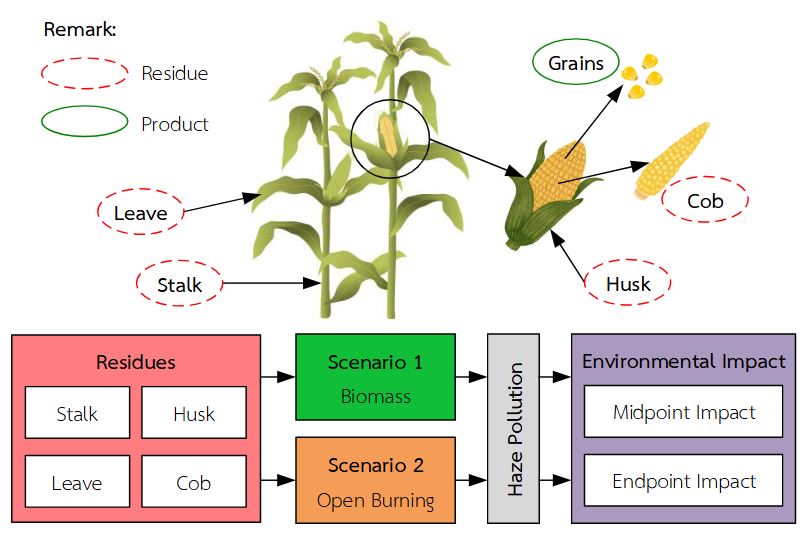
This study aims to assess the potential of maize residues in Chiang Mai as an alternative biomass fuel for small-scale combustion systems (< 50 kW), as an alternative to conventional open-field burning practices. The results indicate that the total amount of agricultural residues generated in Chiang Mai during the 2023–2024 cropping season was approximately 1,159,316.84 tons, of which maize residues accounted for 731,910.66 tonnes. Analysis of their thermal properties shows an average lower heating value for maize residues of approximately 17.15 MJ/kg. Based on this value, the estimated thermal energy potential from maize residues is approximately 12,552,267.82 GJ. In terms of air pollution, utilizing maize residues as biomass fuel could reduce air pollutant emissions by approximately 31,387.55 tons, representing a reduction of about 63.08% compared to open-field burning. Furthermore, the environmental impact assessment using the ReCiPe 2016 methodology indicates that using maize residues as biomass fuel could mitigate human health impacts by 2.43x10⁻⁶ DALY/kg and ecosystem impacts by 6.63x10⁻¹⁰ species·y/kg, relative to open-field burning. The findings reveal that maize residues possess significant potential for energy production and environmental impact mitigation, representing a sustainable alternative to open-field burning.
References
กรมควบคุมมลพิษ, “ข้อมูลย้อนหลัง (รายปี): สถานการณ์หมอกควัน (ภาคเหนือ) ปี พ.ศ.2567,” Air4Thai: ระบบรายงานคุณภาพอากาศประเทศไทย [ออนไลน์]. Available: http://air4thai.pcd.go.th/webV3/# /History (เข้าถึงเมื่อ: 28 พฤษภาคม 2568).
สำนักงานพัฒนาเทคโนโลยีอวกาศและภูมิสารสนเทศ (องค์การมหาชน), “ASIA-AQ บินเก็บคุณภาพอากาศ..เติมเต็มข้อมูล-ตอบโจทย์แหล่งที่มา PM 2.5, ” [ออนไลน์]. Available: https://www.gistda.or.th/news_ view.php? n_id=8474&lang=EN (เข้าถึงเมื่อ: 28 พฤษภาคม 2568).
P. Ponsawansong et al., “Sources of PM2.5 oxidative potential during haze and non-haze seasons in Chiang Mai, Thailand,” Aerosol and Air Quality Research, vol. 23, no. 10, pp. 1-17, October, 2023.
สำนักงานเกษตรและสหกรณ์จังหวัดเชียงใหม่, “ข้อมูลพื้นฐานของจังหวัดเชียงใหม่,” [ออนไลน์]. Available: https://www.opsmoac.go.th/chiangmai-dwl-files-461691791926?utm_source=chatgpt.com (เข้าถึงเมื่อ: 28 พฤษภาคม 2568).
G. Ruggeri, C. Mazzocchi, E. De Marchi, A. Banterle, and G. Sali, “Provincial assessment of agricultural biomass residues for renewable energy in Italy,” Energy Reports, vol. 13, pp. 2946–2957, June, 2025.
M. Pradeep, N. L. Panwar, and N. Divyangkumar, “Torrefaction of agricultural biomass: A state-of-the-art review on transforming waste into clean energy,” Energy 360, vol. 3, pp. 1-17, June, 2025.
M. Cortazar et al., “A comprehensive review of primary strategies for tar removal in biomass gasification,” Energy Conversion and Management, vol. 276, pp.1-36, January, 2023.
J. Zhu, X. Fei, and K. Yin, “Assessment of waste-to-energy conversion technologies for biomass waste under different shared socioeconomic pathways,” Energy & Environmental Sustainability, vol. 1, no. 2, pp. 1-10, June, 2025.
W. H. Chen et al., “Progress in biomass torrefaction: Principles, applications and challenges,” Progress in Energy and Combustion Science, vol. 82, pp. 1-34, January, 2021.
S. S. Siwal, K. Sheoran, A. K. Saini, D. V. N. Vo, Q. Wang, and V. K. Thakur, “Advanced thermochemical conversion technologies used for energy generation: Advancement and prospects,” Fuel, vol. 321, August, 2022.
L. J. Nunes, J. C. D. O. Matias, and J. P. D. S. Catalão, Torrefaction of biomass for energy applications: from fundamentals to industrial scale, 1st ed. Amsterdam, The Netherlands: Academic Press, 2017.
W. H. Chen, J. Peng, X. T. Bi, “A state-of-the-art review of biomass torrefaction, densification and applications,” Renewable and Sustainable Energy Reviews, vol. 44, pp. 847-866, April, 2015.
M. P. P. Granado, A. M. T. Gadelha, D. S. Rodrigues, G. C. Antonio, and A. C. De Conti, “Effect of torrefaction on the properties of briquettes produced from agricultural waste,” Bioresource Technology Reports, vol. 21, February, 2023.
A. Kinyar and K. Bothongo, “The impact of natural gas, biomass, and energy from waste on CO2 and PM2.5 emissions in the UK: Does eco-innovation matter?,” Renewable Energy, vol. 249, August, 2025.
F. Bilgili, E. Koçak, Ü. Bulut, and S. Kuşkaya, “Can biomass energy be an efficient policy tool for sustainable development?,” Renewable and Sustainable Energy Reviews, vol. 71, pp. 830–845, May, 2017.
R. Ulucak, “Linking biomass energy and CO2 emissions in China using dynamic Autoregressive-Distributed Lag simulations,” Journal of Cleaner Production, vol. 250, March, 2020.
C. Sulaiman, A. S. Abdul-Rahim, and C. A. Ofozor, “Does wood biomass energy use reduce CO2 emissions in European Union member countries? Evidence from 27 members,” Journal of Cleaner Production, vol. 253, April, 2020.
Y. Shen, S. Sun, S. Yun, and L. Huang, “Impacts of biomass power generation on ambient air quality–evidence from China,” Applied Economics Letters, vol. 31, no. 16, pp. 1494–1498, March, 2024.
European Environment Agency (EEA), “EMEP/EEA air pollutant emission inventory guidebook 2023.” [Online]. Available: https://www.eea.europa.eu/en/analysis/publications/emep-eea-guidebook-2023 (Accessed: May. 25, 2025).
M. A. J. Huijbregts et al., “ReCiPe 2016 v1.1: A harmonized life cycle impact assessment method at midpoint and endpoint level. Report I: Characterization.” [Online]. Available: https://www.rivm.nl /sites/default/files/2018-11/Report%20ReCiPe_Update_20171002_0.pdf (Accessed: May. 25, 2025).
European Environment Agency (EEA), “1.A.4 Small combustion.” [Online]. Available: https://www.eea.europa.eu/publications/emep-eea-guidebook-2023/part-b-sectoral-guidance-chapters/1-energy/1-a-combustion/1-a-4-small-combustion-2023/view (Accessed: May. 25, 2025).
European Environment Agency (EEA), “3.F Field burning of agricultural residues.” [Online]. Available: https://www.eea.europa.eu/publications/emep-eea-guidebook-2023/part-b-sectoral-guidance-chapters/3-agriculture/3-f-field-burning-of/view (Accessed: May. 25, 2025).
T. Supasri and S. Sampattagul, “Attributional and consequential life cycle assessment for biomass energy production from maize cob in Chiang Dao district,” Thai Environmental Engineering Journal, vol. 33, no. 1, pp. 11–19, January-April, 2019.
สำนักงานเลขานุการของคณะกรรมการยุทธศาสตร์ชาติ และสำนักงานคณะกรรมการพัฒนาเศรษฐกิจและสังคมแห่งชาติ, “ยุทธศาสตร์ชาติ พ.ศ. 2561-2580,” [ออนไลน์]. Available: https://www.nesdc.go.th/ download/document/SAC/NS_SumPlanOct2018.pdf (เข้าถึงเมื่อ: 16 กรกฎาคม 2568).
A. Koopmans and J. Koppejan, “Agricultural and forest residues – generation, utilization and availability.” [Online]. Available: https://www.fao.org/4/ad576e/ad576e00.pdf (Accessed: May. 20, 2025).
สำนักงานนโยบายและแผนพลังงาน, “แผนพัฒนากำลังการผลิตไฟฟ้าของประเทศไทย พ.ศ. 2561-2580,” [ออนไลน์]. Available: https://www.eppo.go.th/images/Infromation_service/public_relations/ PDP2018/PDP2018Rev1.pdf (เข้าถึงเมื่อ: 29 พฤษภาคม 2568).
C. D. Bray, W. Battye, V. P. Aneja, D. Q. Tong, P. Lee, and Y. Tang, “Ammonia emissions from biomass burning in the continental United States,” Atmospheric Environment, vol. 187, pp. 50–61, August, 2018.
R. Daroudi, A. A. Sari, A. Nahvijou, and A. Faramarzi, “Cost per DALY averted in low, middle- and high-income countries: evidence from the global burden of disease study to estimate the cost-effectiveness thresholds,” Cost Effectiveness and Resource Allocation, vol. 19, no. 7, February, 2021.
Thailand Board of Investment, “Macroeconomics: Facts about Thailand.” [Online]. Available: https://www.boi.go.th/index.php?page=macroeconomics (Accessed: July. 2, 2025).
สภาพัฒนาเศรษฐกิจและสังคมแห่งชาติ, “ร่างแผนพัฒนาเศรษฐกิจและสังคมแห่งชาติ ฉบับที่ 13,” [ออนไลน์]. Available: https://www.nesdc.go.th/download/Plan13/Doc/Plan13_DraftFinal.pdf. (เข้าถึงเมื่อ: 2 กรกฎาคม 2568).
Downloads
Published
How to Cite
Issue
Section
Categories
License
Copyright (c) 2025 NKRAFA JOURNAL OF SCIENCE AND TECHNOLOGY

This work is licensed under a Creative Commons Attribution-NonCommercial-NoDerivatives 4.0 International License.
- Content and information in articles published in NKRAFA Journal of Science and Technology are comment and responsibility of authors of articles directly. Journal editorial do no need to agree or share any responsibility.
- NKRAFA Journal of Science and Technology Articles holds the copyright of the content, pictures, images etc. which published in it. If any person or agency require to reuse all or some part of articles, the permission must be obtained from the NKRAFA Journal of Science and Technology.