Evaluation of Engineering Properties of Recycled Asphalt Concrete Mixtures Containing 100% Original Asphalt Concrete Using Three Types of Asphalt Recycling Agent
Keywords:
Recycled Asphalt Concrete Mixtures, RAP, Asphalt Recycling AgentAbstract
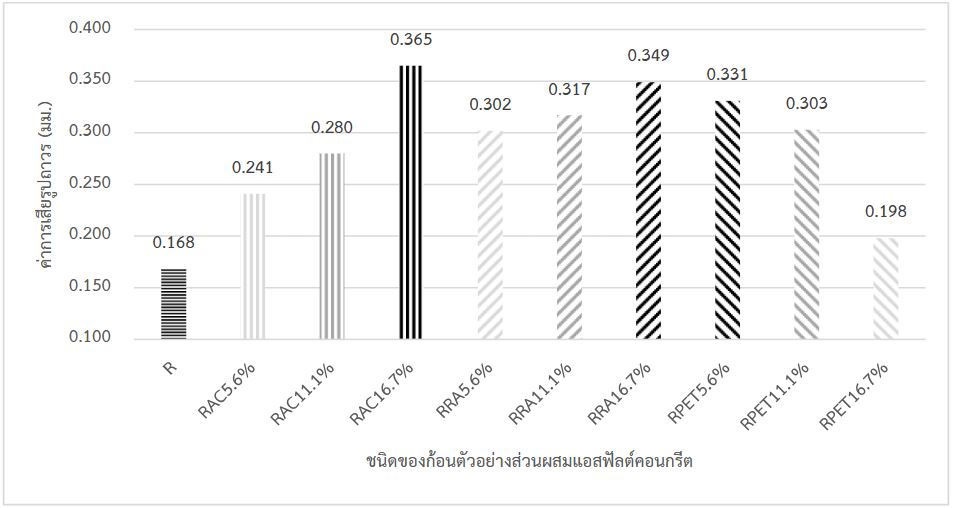
This study investigated the laboratory engineering properties of 100 percent reclaimed asphalt pavement (RAP) mixtures, modified with three types of asphalt recycling agent. The RAP contained asphalt cement grade AC 60–70 as the original binder, with a residual RAP binder content of 4.50% by aggregate weight, equivalent to 54 grams. The recycled asphalt concrete specimens were prepared using the Marshall method and divided into four groups: Group 1 RAP without asphalt recycling agent (R), Group 2 RAP with AC 80–100 (RAC), Group 3 RAP with RA5 (RRA) and Group 4 RAP with PET (RPET). The asphalt recycling agent was added at proportions of 5.6, 11.1 and 16.7 % by weight of the residual RAP binder, using the dry mixing method. The engineering properties tested included density, stability, flow, indirect tensile strength, stiffness modulus, rutting resistance, and fatigue cracking resistance. The test results showed that, compared with Group 1 (R), the specimens in Groups 2 (RAC), 3 (RRA), and 4 (RPET) exhibited increased indirect tensile strength and stiffness modulus at 5.6% asphalt recycling agent content, but decreased values at 11.1% and 16.7%. An exception was found in Group 3, where at test temperatures of 30 degrees Celsius and 40 degrees Celsius, the stiffness modulus decreased at 5.6% RA5 content and continued to decrease with higher RA5 contents. Flow values and fatigue cracking resistance increased with the addition of asphalt recycling agent, whereas stability decreased as asphalt recycling agent content increased. For density and rutting resistance, Groups 2 (RAC) and 3 (RRA) showed increasing values with higher AC 80–100 and RA5 contents, while Group 4 (RPET) showed an initial increase followed by a decrease as PET content increased. In conclusion, the specimens in Group 2 with 5.6% AC 80–100 exhibited the most suitable combination of indirect tensile strength, stiffness modulus, and rutting resistance for pavement performance under Thai environmental conditions.
References
ศูนย์เทคโนโลยีสารสนเทศการขนส่งและจราจร สำนักงานนโยบายและแผนการขนส่งและจราจร กระทรวงคมนาคม, รายงานโครงสร้างพื้นฐานคมนาคมประจำปี 2565, กรุงเทพฯ: ศูนย์เทคโนโลยีสารสนเทศการขนส่งและจราจร, 2565, หน้า 2-8. [ออนไลน์]. เข้าถึงได้: https://www.otp.go.th/uploads/tiny_uploads/PDF/2566-11/25661106-TransportInfrastructureAnnualReport2022.pdf
D. Daryaee, M. Ameri, and A. Mansourkhaki, “Utilization of waste polymer modified bitumen in combination with rejuvenator in high reclaimed asphalt pavement mixtures,” Construction and Building Materials, vol. 235, 2020, Art. no. 117516, doi: 10.1016/j.conbuildmat.2019.117516.
Z. Leng, A. Sreeram, R. K. Padham, and Z. Tan, “Value-added application of waste PET based additives in bituminous mixtures containing high percentage of reclaimed asphalt pavement (RAP),” Journal of Cleaner Production, vol. 196, pp. 615–625, Sep. 2018, doi: 10.1016/j.jclepro.2018.06.119.
Asphalt Hot-Mix Recycling, มาตรฐานที่ ทล. -ม. 410/2542, สำนักมาตรฐานและประเมินผล กรมทางหลวง, 2542. [ออนไลน์]. เข้าถึงได้: https://doh.go.th/doh/images/aboutus/standard/01/dhs410-42.pdf
H. Ziari, A. Moniri, P. Bahri, and Y. Saghafi, “Evaluation of performance properties of 50% recycled asphalt mixtures using three types of rejuvenators,” Petroleum Science and Technology, vol. 37, pp. 2355–2361, Oct. 2019, doi: 10.1080/10916466.2018.1550505.
A. Dony, J. Colin, D. Bruneau, I. Drouadaine, and J. Navaro, “Reclaimed asphalt concretes with high recycling rates: Changes in reclaimed Binder Properties according to rejuvenating Agent,” Construction and Building Materials, vol. 41, pp. 175–181, Apr. 2013, doi: 10.1016/j.conbuildmat.2012.11.031.
T. Blomberg, M. Makowska, and T. Pellinen, “Laboratory simulation of bitumen aging and rejuvenation to mimic multiple cycles of reuse,” Transportation Research Procedia, vol. 14, pp. 694–703, 2016, doi: 10.1016/j.trpro.2016.05.335.
K. Zhang, J. Xiong, C. Ruiz, and J. Zhang, “Design and performance assessment of sustainable road pothole patching materials using waste cooking oil, plastic, and reclaimed asphalt pavement,” Construction and Building Materials, vol. 429, May 2024, Art. no. 136426, doi: 10.1016/j.conbuildmat.2024.136426.
N. R. Bastola, B. Olson, J. E. S. L. Teixeira, and H. H. Fatmehsari, “Effects of the simultaneous use of post-industrial polypropylene waste plastic and soybean oil recycling additive on the performance of high-RAP recycled mixtures,” Construction and Building Materials, vol. 424, Apr. 2024, Art. no. 135945, doi: 10.1016/j.conbuildmat.2024.135945.
วิธีการทดลองแอสฟัลต์ติกคอนกรีต โดยวิธี Marshall, การทดลองที่ ทล. -ท. 604/2517, กองวิเคราะห์และวิจัย กรมทางหลวง, 2517. [ออนไลน์]. เข้าถึงได้: https://doh.go.th/doh/images/aboutus/standard/02/dht604-17.pdf
Standard Test Method for Indirect Tensile (IDT) Strength of Bituminous Mixtures, ASTM D6931-82, ASTM International, 2012. [Online]. Available: https://doh.go.th/doh/images/aboutus/standard/02/dht604-17.pdf
Bituminous Mixtures Test Methods for Hot Mix Asphalt-Part 26: Stiffness, BS EN 12697-26, British Standards Institution, 2018, [Online]. Available: https://knowledge.bsigroup.com/products/bituminous-mixtures-test-methods-stiffness
Bituminous Mixtures Test Methods for Hot Mix Asphalt-Part 25: Cyclic Compression Test, BS EN 12697-25, British Standards Institution, 2016, [Online]. Available: https://knowledge.bsigroup.com/products/bituminous-mixtures-test-methods-cyclic-compression-test
Bituminous mixtures test methods for hot mix asphalt-part 24: Resistance to fatigue, BS EN 12697-24, British Standards Institution, 2018, [Online]. Available: https://knowledge.bsigroup.com/products/bituminous-mixtures-test-methods-resistance-to-fatigue
S. B. Chaves-Pabon, H. A. Rondon-Quintana, and J. G. Bastidas-Martinez, “Aging of asphalt binders and asphalt mixtures. Summary part I: Effect on physical-chemical properties,” International Journal of Civil Engineering and Technology (IJCIET), vol. 10, no. 12, pp. 259–273, Dec. 2019. [Online]. Available: https://iaeme.com/Home/article_id/IJCIET_10_12_026
วัชรินทร์ วิทยกุล, การออกแบบแอสฟัลต์คอนกรีตซูเปอร์เพฟ, พิมพ์ครั้งที่ 1. กรุงเทพฯ: สำนักพิมพ์มหาวิทยาลัยเกษตรศาสตร์, 2547, หน้า 1–14.
H. Taherkhani, and M. R. Arshadi, “Investigating the mechanical properties of asphalt concrete containing waste polyethylene terephthalate,” Road Materials and Pavement Design, vol. 20, no. 2, pp. 381–398, Feb. 2017, doi: 10.1080/14680629.2017.1395354.
Specification for Asphalt Cement, ข้อกำหนดที่ ทล.-ก. 401/2559, สำนักมาตรฐานและประเมินผล กรมทางหลวง, 2559. [ออนไลน์]. เข้าถึงได้: https://doh.go.th/uploads/tinymce/general/standard/standard_dhsp/dhsp401-2559.pdf
Standard Practice for Classifying Hot-Mix Recycling Agents, ASTM D4552-92, ASTM International, 1999. [Online]. Available: https://store.astm.org/d4552-92r99.html
คู่มือบัญชีของเสียที่เป็นแหล่งทรัพยากรทดแทน (กลุ่มครัวเรือน), กรมอุตสาหกรรมพื้นฐานและการเหมืองแร่ กระทรวงอุตสาหกรรม, กรุงเทพฯ, 2556, หน้า 21.
Superlock, “7 ประเภทพลาสติกที่อยู่รอบตัวคุณ,” Micronware. เข้าถึงเมื่อ: 27 มิ.ย. 2568. [ออนไลน์]. เข้าถึงได้: https://shorturl.at/pOY0D
การทางพิเศษแห่งประเทศไทย, “แบบรูปรายการงานก่อสร้างงานปรับปรุงผิวจราจรทางพิเศษกาญจนาภิเษก (บางพลี-สุขสวัสดิ์),” การทางพิเศษแห่งประเทศไทย. เข้าถึงเมื่อ: 27 มิ.ย. 2568. [ออนไลน์]. เข้าถึงได้: https://www.exat.co.th/download/purchases/e-bidding/a4.pdf
T. B. Moghaddam, M. Soltani, and M. R. Karim, “Experimental characterization of rutting performance of Polyethylene Terephthalate modified asphalt mixture under static and dynamic load,” Construction and Building Materials, vol. 65, pp. 487–494, Aug. 2014, doi: 10.1016/j.conbuildmat.2014.05.006.
T. B. Moghaddam, M. Soltani, M. R. Karim, and H. Baaj, “Optimization of asphalt and modifier contents for polyethylene terephthalate modified asphalt mixtures using response surface methodology,” Measurement, vol. 74, pp. 159–169, Oct. 2015, doi: 10.1016/j.measurement.2015.07.012.
AASHTO, Guide for Design of Pavement Structure Washington DC, Washington DC, USA: American Association of State Highway and Transportation Officials, 1993, pp. 11–17. [Online]. Available: https://habib00ugm.wordpress.com/wp-content/uploads/2010/05/aashto1993.pdf
Downloads
Published
How to Cite
License
Copyright (c) 2025 NKRAFA JOURNAL OF SCIENCE AND TECHNOLOGY

This work is licensed under a Creative Commons Attribution-NonCommercial-NoDerivatives 4.0 International License.
- Content and information in articles published in NKRAFA Journal of Science and Technology are comment and responsibility of authors of articles directly. Journal editorial do no need to agree or share any responsibility.
- NKRAFA Journal of Science and Technology Articles holds the copyright of the content, pictures, images etc. which published in it. If any person or agency require to reuse all or some part of articles, the permission must be obtained from the NKRAFA Journal of Science and Technology.