Development of an Augmented Reality (AR) Application for Cultural Tourism in Nonthaburi Province: A Case Study of Five Cultural Sites
Keywords:
Augmented Reality, Application, Cultural TourismAbstract
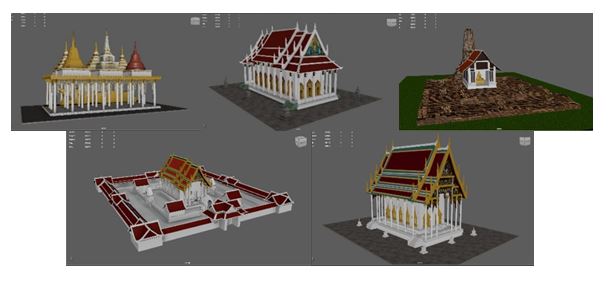
This research aimed to 1) study, analyze, and design requirements for presenting cultural tourism sites in Nonthaburi Province through five case study locations; and 2) develop an augmented reality (AR) application to support cultural tourism in these areas. This study employed a research and development (R&D) approach based on the System Development Life Cycle (SDLC). The process began with analyzing user requirements from tourists and the general public, followed by problem analysis and content design. Data were collected through field surveys, including photographs and video recordings of cultural tourism sites, which were used to design presentation formats and develop three-dimensional (3D) models integrated into the application. The application was designed to present information using augmented reality (AR) by integrating multimedia elements, including images, text, video, and three-dimensional (3D) models, in order to create an interactive learning experience for users. The development tools included Unity 3D in conjunction with the EasyAR SDK, and the application was implemented on the Android platform using Android Studio to support multimedia and AR-based content presentation. The application was developed using Unity 3D in conjunction with the EasyAR SDK and implemented on the Android platform to support multimedia and AR-based content presentation.
The results indicated that data collected from 120 participants through random sampling, categorized into four age groups (below 20, 21–30, 31–40, and above 41 years), showed an overall high level of satisfaction (Mean = 4.25, S.D. = 0.49). Satisfaction was evaluated across three dimensions: content, design, and usability. The findings revealed that participants aged over 41 reported the highest overall satisfaction. In terms of individual dimensions, participants aged 21–30 showed the highest satisfaction in content, while those aged over 41 demonstrated the highest satisfaction across all dimensions. Participants under 20 reported the lowest satisfaction in design.
The findings demonstrated that the AR application effectively enhanced the presentation of cultural tourism sites, resulting in high user satisfaction and improved understanding of cultural information. Furthermore, the development of the application enhanced the attractiveness of tourism destinations and positively influenced tourists’ travel decision-making.
References
Y. B. Leau, W. K. Loo, W. Y. Tham, and S. F. Tan, “Software development life cycle AGILE vs traditional approaches,” in International Conference on Information and Network Technology, 2012, pp 162–167. [Online]. Available: https://ku-fpg.github.io/files/agile-traditional.pdf
ภาณุวัฒน์ เรืองกุลทรัพย์, ศรัณยู บุตรโคตร, และ อิทธิชัย อินลุเพท, “การพัฒนาสื่อแอปพลิเคชันบน อุปกรณ์เคลื่อนที่สำหรับการเรียนรู้คำศัพท์ภาษาญี่ปุ่นระดับพื้นฐานด้วยเทคโนโลยีความจริงเสริม,” วารสารวิชาการและวิจัยมหาวิทยาลัยภาคตะวันออกเฉียงเหนือ, ปีที่ 12, ฉบับที่ 2, หน้า 298–312, เม.ย.–มิ.ย. 2565. [ออนไลน์]. เข้าถึงได้: https://so04.tci-thaijo.org/index.php/neuarj/article/view/258580/175896
เบญนภา พัฒนาพิภัทร และนัจภัค มีอุสาห์, “การพัฒนาสื่อการเรียนรู้เพื่อส่งเสริมกระบวนการคิดเชิงสร้างสรรค์ในการสร้างสื่อยุคดิจิทัลร่วมกับเทคโนโลยีความเป็นจริงเสริม (AR),” วารสารมหาวิทยาลัยศิลปากร (สังคมศาสตร์ มนุษยศาสตร์ และศิลปะ), ปีที่ 42, ฉบับที่ 1, หน้าที่ 15–30, ม.ค.–ก.พ. 2565, doi: 10.14456/sujthai.2022.2.
คลังความรู้ SciMath สถาบันส่งเสริมการสอนวิทยาศาสตร์และเทคโนโลยี (สสวท.), “Virtual Reality เทคโนโลยีความเป็นจริงเสมือน,” เข้าถึงเมื่อ: 20 ต.ค. 2568. [ออนไลน์]. เข้าถึงได้: https://www.scimath.org/article-technology/item/4818-virtual-reality
Azuma, R. T, “A survey of augmented reality,” Presence: Teleoperators and Virtual Environments, vol. 6, no. 4, pp. 355–385, Aug. 1997, doi: 10.1162/pres.1997.6.4.355.
ภทรพรรณ กุลด้วง, ต้นศักดิ์ สนิตนาม และ สุวัตร์ ผาทอง, “การพัฒนาสื่อการเรียนรู้เทคโนโลยีเสมือนจริงภูมิศาสตร์ เพื่อส่งเสริมผลสัมฤทธิ์ทางการเรียนภูมิศาสตร์ของนักเรียนชั้นมัธยมศึกษาปีที่ 3,” วารสารสหวิทยาการวิจัยและนวัตกรรมการศึกษา, ปีที่ 2, ฉบับที่ 2, หน้า 33–42, ก.ค.–ธ.ค. 2566. [ออนไลน์]. เข้าถึงได้: https://so08.tci-thaijo.org/index.php/JIREI/article/view/2112
G. C. Burdea and P. Coiffet, Virtual reality technology. Hoboken, NJ, USA: John Wiley & Sons Wiley-IEEE Press, 2003.
พจน์ศิรินทร์ ลิมปินันทน, “การส่งเสริมแหล่งท่องเที่ยวจังหวัดมหาสารคามโดยใช้เทคโนโลยีเสมือนจริง,” วารสารวิชาการการจัดการเทคโนโลยีสารสนเทศและนวัตกรรม, ปีที่ 6, ฉบับที่ 1, หน้า 8–16, ม.ค.–มิ.ย., 2562. [ออนไลน์]. เข้าถึงได้: https://so04.tci-thaijo.org/index.php/abc/article/view/54197
บุญเลิศ จิตตั้งวัฒนา, อุตสาหกรรมการท่องเที่ยว, พิมพ์ครั้งที่ 1. กรุงเทพฯ: เพรสแอนด์ดีไซน์, 2548.
นุชนารถ รัตนสุวงศ์ชัย, “กลยุทธ์การพัฒนาการท่องเที่ยวเชิงวัฒนธรรม,” บทความในวารสารมนุษยศาสตร์.มหาวิทยาลัยเกษตรศาสตร์, ปีที่ 18, ฉบับที่ 1, หน้า 31–50, ม.ค.–มิ.ย. 2554. [ออนไลน์]. เข้าถึงได้: https://so04.tci-thaijo.org/index.php/abc/article/view/54197
กาญจนา สุคัณธสิริกุล, “การพัฒนาคุณภาพการท่องเที่ยวเชิงวัฒนธรรมในภาคตะวันออกเฉียงเหนือ,” มหาวิทยาลัยเทคโนโลยีสุรนารี, 2556. [ออนไลน์]. เข้าถึงได้: http://sutir.sut.ac.th:8080/sutir/bitstream/123456789/6225/2/Fulltext.pdf
ชายชาญ ปฐมกาญจนา และ นรินทร์ สังข์รักษา, “แนวทางการส่งเสริมการท่องเที่ยวเชิงวัฒนธรรมแบบมีส่วนร่วมของชุมชนตลาดบางหลวง อำเภอบางเลน จังหวัดนครปฐม,” วารสารวิทยบริการ มหาวิทยาลัยสงขลา นครินทร์, ปีที่ 26, ฉบับที่ 1, หน้า 118–129, 2558, doi: 10.14456/asj-psu.2015.2.
บุญชม ศรีสะอาด, การวิจัยเบื้องต้น, พิมพ์ครั้งที่ 10. กรุงเทพฯ: สุวีริยาสาส์น, 2545.
วรรวสา ยุระรัตน์, รินลดา อามาตย์สมบัติ และ สุรารักษ์ ศรีลาศักดิ์, “ปัจจัยที่มีผลต่อการตัดสินใจท่องเที่ยวเชิงวัฒนธรรมของนักท่องเที่ยวผู้สูงอายุ กรณีศึกษาพญาศรีสัตตนาคราช จังหวัดนครพนม,” วารสารศิลปะศาสตร์ราชมงคลพระนคร, ปีที่ 4, ฉบับที่ 1, หน้า 19–31, ม.ค.–มิ.ย. 2567. [ออนไลน์]. เข้าถึงได้: https://so07.tci-thaijo.org/index.php/LiberalJ/article/view/5201
อดิพล เอื้อจรัสพันธุ์, “พฤติกรรมการใช้สื่อสังคมออนไลน์ ทัศนคติ ความพึงพอใจ และความรู้ความเข้าใจเกี่ยวกับสื่อสังคมออนไลน์ของคนรุ่นเจนเนอเรชั่น X เจนเนอเรชั่น Y และเจนเนอเรชั่น Z,” วารสารวิจัยสหวิทยาการนานาชาติ PSAKU, เล่มที่ 10, ฉบับที่ 2, หน้า 44–58, 2564. [ออนไลน์]. เข้าถึงได้: https://so05.tci-thaijo.org/index.php/PSAKUIJIR/article/view/255898
จันทิรา แซ่เตียว และสุรีรัตน์ อินทร์หม้อ, “พฤติกรรมการเลือกใช้แอพพลิเคชันบนโทรศัพท์เคลื่อนที่สมาร์ทโฟนสำหรับวัยกลางคน,” วารสารรัชต์ภาคย์, ปีที่ 11, ฉบับที่ 23, หน้า 43–52, พ.ค.–ส.ค. 2560. [ออนไลน์]. เข้าถึงได้: https://so05.tci-thaijo.org/index.php/RJPJ/article/view/171870/123387
Downloads
Published
How to Cite
Issue
Section
License
Copyright (c) 2026 NKRAFA JOURNAL OF SCIENCE AND TECHNOLOGY

This work is licensed under a Creative Commons Attribution-NonCommercial-NoDerivatives 4.0 International License.
- Content and information in articles published in NKRAFA Journal of Science and Technology are comment and responsibility of authors of articles directly. Journal editorial do no need to agree or share any responsibility.
- NKRAFA Journal of Science and Technology Articles holds the copyright of the content, pictures, images etc. which published in it. If any person or agency require to reuse all or some part of articles, the permission must be obtained from the NKRAFA Journal of Science and Technology.