การจัดกลุ่มและวิเคราะห์ตัวชี้วัดเศรษฐกิจหมุนเวียนตามภาคเศรษฐกิจและประเภทของเสียโดยใช้เทคนิคการเรียนรู้ของเครื่อง
คำสำคัญ:
เศรษฐกิจหมุนเวียน, ตัวชี้วัดเศรษฐกิจหมุนเวียน, การจัดกลุ่มข้อมูล, การเรียนรู้ของเครื่อง, การเรียนรู้แบบไม่มีผู้สอน, การวิเคราะห์องค์ประกอบหลักบทคัดย่อ
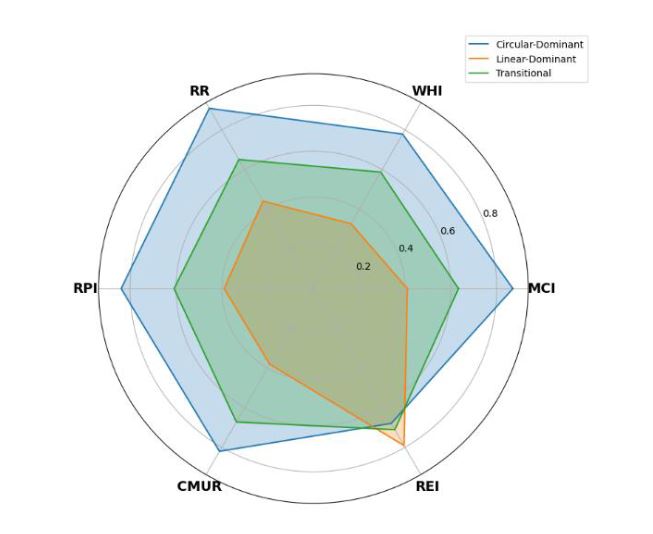
งานวิจัยนี้มีวัตถุประสงค์เพื่อวิเคราะห์และจำแนกรูปแบบของระบบเศรษฐกิจหมุนเวียนในแต่ละภาคเศรษฐกิจ โดยบูรณาการการวิเคราะห์ข้อมูลทุติยภูมิร่วมกับเทคนิคการเรียนรู้ของเครื่อง ซึ่งยังไม่เคยมีการศึกษาที่เชื่อมโยงตัวชี้วัดเศรษฐกิจหมุนเวียน กับภาคเศรษฐกิจและประเภทของเสียอย่างเป็นระบบมาก่อน การวิจัยใช้ข้อมูลทุติยภูมิจากบทความวิจัยจำนวน 877 เรื่องในฐานข้อมูล Scopus (ปี 2010–2024) โดยพิจารณาตัวชี้วัดเศรษฐกิจหมุนเวียนหลัก 6 ด้าน ได้แก่ ตัวชี้วัดการหมุนเวียนของวัสดุ (Material Circularity Indicator: MCI) ตัวชี้วัดการจัดลำดับขั้นของเสีย (Waste Hierarchy Index: WHI) อัตราการรีไซเคิล (Recycling Rate: RR) ตัวชี้วัดศักยภาพการใช้ซ้ำ (Reuse Potential Index: RPI) ตัวชี้วัดประสิทธิภาพการใช้ทรัพยากร (Resource Efficiency Indicator: REI) และอัตราการใช้วัสดุหมุนเวียน (Circular Material Use Rate: CMUR) พร้อมประยุกต์ใช้การวิเคราะห์องค์ประกอบหลัก (Principal Component Analysis: PCA) และการจัดกลุ่มแบบ K-Means Clustering เพื่อค้นหารูปแบบของระบบในแต่ละคลัสเตอร์ ผลการวิเคราะห์พบว่า ภาคเกษตรกรรมและอุตสาหกรรมอาหารมีลักษณะโดดเด่นในกลุ่ม Circular-Dominant ขณะที่ภาคก่อสร้างและโลหกรรมอยู่ในกลุ่ม Linear-Dominant ซึ่งยังมีข้อจำกัดด้านประสิทธิภาพการหมุนเวียน อย่างไรก็ตามในการประมวลผลยังพบข้อจำกัด เช่น ความไม่สมดุลของข้อมูลในแต่ละภาค และความหลากหลายของนิยามตัวชี้วัด การค้นพบนี้สามารถนำไปใช้สนับสนุนการออกแบบนโยบายที่ตรงตามลักษณะของแต่ละภาคเศรษฐกิจ รวมถึงการพัฒนาระบบแนะนำการใช้ตัวชี้วัดเศรษฐกิจหมุนเวียนที่เหมาะสมกับประเภทของเสียและอุตสาหกรรมเป้าหมาย เพื่อเร่งการเปลี่ยนผ่านสู่ระบบเศรษฐกิจหมุนเวียนอย่างเป็นรูปธรรม
เอกสารอ้างอิง
M. Azizuddin, A. Shamsuzzoha, and S. Piya, “Influence of circular economy phenomenon to fulfil global sustainable development goal: Perspective from Bangladesh,” Sustainability, vol. 13, no. 20, Oct. 2021, Art. No. 11455, doi: 10.3390/su132011455.
A. de Pascale et al., “The circular economy implementation at the European Union level. Past, present and future,” Journal of Cleaner Production, vol. 423, Oct. 2023, Art. no. 138658, doi: 10.1016/j.jclepro.2023.138658.
ฐิติกร หมายมั่น, ชำนาญ ทองมาก, บัณฑิต รัตนไตร, และ ฐานิสร โรจนดิลก. "โมเดลเศรษฐกิจ BCG เพื่อการพัฒนาที่สมดุลและยั่งยืน" วารสารวิชาการมหาวิทยาลัยอีสเทิร์นเอเชีย (สังคมศาสตร์และมนุษยศาสตร์), ปีที่ 13, ฉบับที่ 2, หน้า 14–27, พ.ค.–ส.ค. 2566 [ออนไลน์]. เข้าถึงได้: https://so01.tci-thaijo.org/index.php/EAUHJSocSci/article/download/265111/173729/1016066
B. Corona, L. Shen, D. Reike, J. R. Carreón, and E. Worrell, “Towards sustainable development through the circular economy—A review and critical assessment on current circularity metrics,” Resources, Conservation and Recycling, vol. 151, Dec. 2019, Art. no. 104498, doi: 10.1016/j.resconrec.2019.104498.
Z. Kowalski, J. Kulczycka, M. Banach, and A. Makara, “A complex circular-economy quality indicator for assessing production systems at the micro level,” Sustainability, vol. 15, no. 18, Sep. 2023, Art. no. 13495, doi: 10.3390/su151813495.
G. Moraga et al., “Circular economy indicators: What do they measure?,” Resources, Conservation and Recycling, vol. 146, pp. 452–461, Jul. 2019, doi: 10.1016/j.resconrec.2019.03.045.
A. Pires and G. Martinho, “Waste hierarchy index for circular economy in waste management,” Waste Management, vol. 95, pp. 298–305, Jul. 2019, doi: 10.1016/j.wasman.2019.06.014.
M. Haupt, C. Vadenbo, and S. Hellweg, “Do we have the right performance indicators for the circular economy?: Insight into the swiss waste management system,” Journal of Industrial Ecology, vol. 21, no. 3, pp. 615–627, Oct. 2016, doi: 10.1111/jiec.12506.
J. Y. Park and M. R. Chertow, “Establishing and testing the ‘reuse potential’ indicator for managing wastes as resources,” Journal of Environmental Management, vol. 137, pp. 45–53, May. 2014, doi: 10.1016/j.jenvman.2013.11.053.
G. Moraga, S. Huysveld, S. De Meester, and J. Dewulf, “Resource efficiency indicators to assess circular economy strategies: A case study on four materials in laptops,” Resources, Conservation and Recycling, vol. 178, Feb. 2022, Art. no. 106099, doi: 10.1016/j.resconrec.2021.106099.
CE Monitor, “Circular Material Use Rate (CMURR).” Circular Flanders. Accessed: May. 1, 2025. [Online]. Available: https://cemonitor.be/en/indicator/circularity/r-strategies/circular-material-use-rate-cmur/
Z. Farshadfar, T. Mucha, and K. Tanskanen, “Leveraging machine learning for advancing circular supply chains: A systematic literature review,” Logistics, vol. 8, no. 4, Oct. 2024, Art. no. 108, doi: 10.3390/logistics8040108.
S. L. Nañez Alonso, R. F. Reier Forradellas, O. Pi Morell, and J. Jorge-Vazquez, “Digitalization, circular economy and environmental sustainability: The application of artificial intelligence in the efficient self-management of waste,” Sustainability, vol. 13, no. 4, Feb. 2021, Art. no. 2092, doi: 10.3390/su13042092.
H. H. Chin, P. S. Varbanov, F. You, F. Sher, and J. J. Klemeš, “Plastic circular economy framework using hybrid machine learning and pinch analysis,” Resources, Conservation and Recycling, vol.184, Sep. 2022, Art. no. 106387, doi: 1016/j.resconrec.2022.106387.
G. Liu, J. Yang, Y. Hao, and Y. Zhang, “Big data-informed energy efficiency assessment of China industry sectors based on K-means clustering,” Journal of Cleaner Production, vol. 183, pp. 304–314, May. 2018, doi: 10.1016/j.jclepro.2018.02.129.
M. Chaudhry, I. Shafi, M. Mahnoor, D. L. R. Vargas, E. B. Thompson, and I. Ashraf, “A systematic literature review on identifying patterns using unsupervised clustering algorithms: A data mining perspective,” Symmetry, vol. 15, no. 9, Aug. 2023, Art. no. 1679, doi.10.3390/sym15091679.
S. Licen, A. Astel, and S. Tsakovski, “Self-organizing map algorithm for assessing spatial and temporal patterns of pollutants in environmental compartments: A review,” Science of The Total Environment, vol. 878, Jun. 2023, Art. no. 163084, doi: 10.1016/j.scitotenv.2023.163084.
เจนจิรา สุภาใส และ นิภาพร ชนะมาร, “การจัดกลุ่มข้อมูลเศรษฐกิจครัวเรือนด้วยการประยุกต์ใช้เทคนิคการจัดกลุ่มแบบ K-Means Clustering Clustering,” วารสารวิทยาศาสตร์ วิศวกรรมศาสตร์ และเทคโนโลยี, ปีที่ 3, ฉบับที่ 1, หน้า 1–12, ม.ค.–มิ.ย., 2566. [ออนไลน์]. เข้าถึงได้: https://ph02.tci-thaijo.org/index.php/JSET/article/view/247693
K. Gomonov, S. Ratner, I. Lazanyuk, and S. Revinova, “Clustering of EU countries by the level of circular economy: An object-oriented approach,” Sustainability, vol. 13, no. 13, Jun. 2021, Art. no. 7158, doi: 10.3390/su13137158.
F. Kamalov, H. Sulieman, A. Alzaatreh, M. Emarly, H. Chamlal, and M. Safaraliev, “Mathematical methods in feature selection: A review,” Mathematics, vol. 13, no. 6, Mar. 2025, Art. no. 996, doi: 10.3390/math13060996.
L. R. Kaufman and P. Rousseeuw, Finding Groups in Data: An Introduction to Cluster Analysis. Hoboken, NY: John Wiley & Sons Inc., 2005.
UCLA Statistical Consulting Group, Exploratory factor analysis (EFA) with SPSS [Online]. Available: https://stats.oarc.ucla.edu/wp-content/uploads/2020/05/pca-efa-V12.pdf
I. Marjanović, J. J. Stanković, J. Östh, M. Marković, and M. Stanojević, “Insight into territorial efficiency of circular economy through data envelopment analysis,” Frontiers in Environmental Science, vol. 13, Apr. 2025, Art. no. 1494184, doi: 10.3389/fenvs.2025.1494184.
S. Krämer and S. Engell, Improving Resource Efficiency in Process Plants: Monitoring and Improvement. Wiley-VCH Verlag GmbH & Co. KGaA, Weinheim, 2017.
X. Tong, T. Wang, J. Li, and X. Wang, “Extended producer responsibility to reconstruct the circular value chain,” Circular Economy, vol. 3, no. 1, Feb. 2024, Art. no. 100076, doi: 10.1016/j.cec.2024.100076.
อดิศร์ อิศรางกูล ณ อยุธยา, ปริญญารัตน์ เลี้ยงเจริญ, เกศินี ธารีสังข์, กาญจนา ย่าเสน, และ ทิพวัลย์ แก้วมีศรี, “นโยบายการเกษตรเพื่อรองรับ BCG,” สถาบันวิจัยเพื่อการพัฒนาประเทศไทย (TDRI). เข้าถึงเมื่อ: 13 มิถุนายน 2568. [ออนไลน์]. เข้าถึงได้: https://tdri.or.th/2023/03/bio-circular-green/
มูลนิธิสถาบันสิ่งแวดล้อมไทย, “การขับเคลื่อนการดำเนินงาน BCG Implementation เรื่อง การพัฒนาตัวชี้วัดและฐานข้อมูลด้าน CO2, CE, SDG เพื่อการค้าและความยั่งยืน,” มูลนิธิสถาบันสิ่งแวดล้อมไทย. เข้าถึงเมื่อ: 13 มิถุนายน 2568. [ออนไลน์]. เข้าถึงได้: https://www.tei.or.th/th/environment_news_detail.php?eid=2901
ดาวน์โหลด
เผยแพร่แล้ว
รูปแบบการอ้างอิง
ฉบับ
ประเภทบทความ
หมวดหมู่
สัญญาอนุญาต
ลิขสิทธิ์ (c) 2025 วารสารวิทยาศาสตร์และเทคโนโลยีนายเรืออากาศ

อนุญาตภายใต้เงื่อนไข Creative Commons Attribution-NonCommercial-NoDerivatives 4.0 International License.
- เนื้อหาและข้อมูลในบทความที่ตีพิมพ์ในวารสารวิทยาศาสตร์และเทคโนโลยีนายเรืออากาศ ถือเป็นข้อคิดเห็นและความรับผิดชอบของผู้เขียนบทความโดยตรง กองบรรณาธิการวารสาร ไม่จำเป็นต้องเห็นด้วย หรือร่วมรับผิดชอบใด ๆ
- บทความ ข้อมูล เนื้อหา รูปภาพ ฯลฯ ที่ได้รับการตีพิมพ์ในวารสารวิทยาศาสตร์และเทคโนโลยีนายเรืออากาศถือเป็นลิขสิทธิ์ของวารสารวิทยาศาสตร์และเทคโนโลยีนายเรืออากาศ หากบุคคลหรือหน่วยงานใดต้องการนำทั้งหมดหรือส่วนหนึ่งส่วนใดไปเผยแพร่ หรือเพื่อกระทำการใด ๆ จะต้องได้รับอนุญาตเป็นลายลักอักษรณ์จากวารสารวิทยาศาสตร์และเทคโนโลยีนายเรืออากาศ ก่อนเท่านั้น