การพัฒนาระบบตรวจข้อสอบอัตโนมัติด้วยเทคนิคการประมวลผลภาพดิจิทัลร่วมกับ การจำแนกแบบลูกผสม K-Means และ K-Nearest Neighbor
คำสำคัญ:
การประมวลผลภาพดิจิทัล, การจำแนกแบบลูกผสม, ตรวจข้อสอบแบบฝน, การสกัดคุณลักษณะ, การวิเคราะห์ผล, เมทริกซ์ความสับสน, การจัดกลุ่มแบบเคมีนส์, ขั้นตอนวิธีการเพื่อนบ้านใกล้ที่สุดบทคัดย่อ
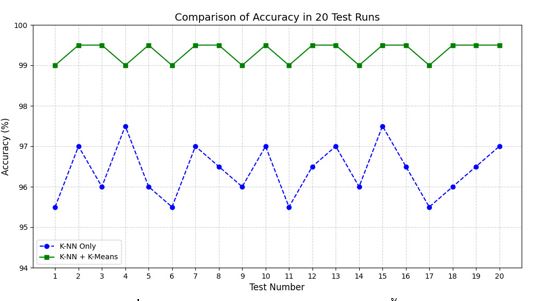
งานวิจัยนี้มุ่งพัฒนาระบบการรู้จำเครื่องหมายเชิงแสง (Optical Mark Recognition: OMR) เพื่อแก้ปัญหาความล่าช้าและข้อผิดพลาดจากการตรวจด้วยแรงงานคน โดยใช้เทคนิคการประมวลผลภาพดิจิทัลร่วมกับการจำแนกแบบลูกผสม (Hybrid Classification) ที่ผสานอัลกอริทึม K-Means และ K-Nearest Neighbor (K-NN) เพื่อเพิ่มความแม่นยำและลดสัญญาณรบกวนของข้อมูล ระบบต้นแบบประมวลผลกระดาษคำตอบ 100 แผ่น แผ่นละ 150 ช่อง รวม 15,000 ตัวอย่าง แบ่งเป็นชุดฝึก 80% และชุดทดสอบ 20% ขั้นตอนประกอบด้วยการปรับปรุงภาพ การแบ่งส่วนภาพ และการสกัดคุณลักษณะ ได้แก่ ค่าเฉลี่ยระดับความเข้ม (Mean Intensity) ความแปรปรวน (Variance) และความหนาแน่นของพิกเซล (Pixel Density) เพื่อจำแนกว่า “ฝน” หรือ “ว่าง” ผลการเปรียบเทียบ 4 วิธี ได้แก่
K-NN, SVM, Decision Tree และ K-Means + K-NN พบว่าเทคนิคหลังให้ค่า Accuracy เฉลี่ยจากการทดลองซ้ำหลายครั้งสูงสุดที่ 99.30% (SD = 0.23) ขณะที่การประเมินด้วย Confusion Matrix ของชุดทดสอบ 3,000 ตัวอย่าง ให้ค่า Accuracy 99.30% Precision 99.11% Recall 98.56% และ F1-score 98.83% ผลการทดลองยืนยันว่าการผสาน K-Means กับ K-NN ช่วยเพิ่มความถูกต้องและความเสถียรของระบบอย่างมีนัยสำคัญ พร้อมศักยภาพในการใช้งานจริงโดยไม่ต้องพึ่งกระดาษเฉพาะหรือเครื่องสแกนคุณภาพสูง
เอกสารอ้างอิง
E.M. de Elias, P. M. Tasinafo, and R. Hirata Jr, “Optical mark recognition: Advances, difficulties, and limitations,” SN Computer Science, vol. 2, Jul. 2021, Art. no. 367, doi: 10.1007/s42979-021-00760-z.
T. V. Ha and N. T. Thu, “An application of image processing in optical mark recognition,” Vietnam Journal of Agricultural Sciences, vol. 3, no. 4, pp. 864–871, Dec. 2020, doi: 10.31817/vjas.2020.3.4.09.
Z. Küçükkara and A. E. Tümer, “An image processing oriented optical mark recognition and evaluation system,” International Journal of Applied Mathematics, Electronics and Computers (IJAMEC), vol. 6, no. 4, pp. 59–64, Dec. 2018. [Online]. Available: https://ijamec.org/index.php/ijamec/article/view/261
S. Ravindra, “Automated OMR analyser using ML and image processing,” International Journal for Research in Applied Science and Engineering Technology, vol. 13, no. 6, pp. 1843–1845, Jun. 2025,doi: 10.22214/ijraset.2025.72535.
B. Lu, “Research and application of digit recognition based on K-nearest neighbor classifier,” in Proceedings of the 2023 International Conference on Data Science, Advanced Algorithm and Intelligent Computing (DAI 2023), Xi’an, China, Nov. 24–26, 2024, pp. 36–42, doi: 10.2991/978-94-6463-370-2_5.
Y. Hernández-Mier, M. A. Nuño-Maganda, S. Polanco-Martagón, G. Acosta-Villarreal, and R. Posada-Gómez, “Unsupervised optical mark recognition on answer sheets for massive printed multiple choice tests,” Journal of Imaging, vol. 11, no. 9, 2025, Art. no. 308, doi: 10.3390/jimaging11090308.
P. Surlakar, S. Araujo, and K. Meenakshi Sundaram, “Comparative analysis of K-Means and K-Nearest neighbor image segmentation techniques,” in Proc. 2016 IEEE 6th International Conference on Advanced Computing (IACC), Bhimavaram, India, Feb. 27–28, 2016, pp. 96–100, doi: 10.1109/IACC.2016.27.
J. Memon, M. Sami, R. A. Khan, and M. Uddin, “Handwritten optical character recognition (OCR): A comprehensive systematic literature review (SLR),” IEEE Access, vol. 8, pp. 142642–142668, 2020, doi: 10.1109/ACCESS.2020.3012542.
Y. Sancar, U. Yavuz, and I. K. Aksakalli, “Personal mark density-based high-performance Optical Mark Recognition (OMR) system using K-means clustering algorithm,” Multimedia Tools and Applications, vol. 84, pp. 24671–24703, Sep. 2024, doi: 10.1007/s11042-024-20218-7.
S. Singh, N. k. Garg, and M. Kumar “Feature extraction and classification techniques for handwritten character recognition: A survey,” Multimedia Tools and Applications, vol. 82, pp. 745–775, Jun. 2022, doi: 10.1007/s11042-022-13318-9.
R. C. Gonzalez and R. E. Woods, Digital Image Processing, 4th ed. NY, USA: Pearson, 2018.
N. Otsu, “A threshold selection method from gray-level histograms,” IEEE Trans. Syst. Man Cybern., vol. 9, no. 1, pp. 62–66, 1979. [Online]. Available: https://ieeexplore.ieee.org/stamp/stamp.jsp?tp=&arnumber=4310076
E. O. Gyamfi and Y. M. Missah, “Pixel-based unsupervised classification approach for information detection on optical markup recognition sheet,” Advances in Science, Technology and Engineering Systems Journal (ASTESJ), vol. 2, no. 4, pp. 121–132, 2017, doi: 10.25046/aj020417.
T. Cover and P. Hart, “Nearest neighbor pattern classification,” IEEE Transactions on Information Theory, vol. 13, no. 1, pp. 21–27, Jan. 1967, doi: 10.1109/TIT.1967.1053964.
G. Guo, H. Wang, D. Bell, Y. Bi, and K. Greer, “KNN model-based approach in classification,” in On the Move to Meaningful Internet Systems 2003: CoopIS, DOA, and ODBASE. OTM 2003. Lecture Notes in Computer Science, R. Meersman, Z. Tari, and D. C. Schmidt, Eds., 2003, Heidelberg, Berlin, Germany: Springer, doi: 10.1007/978-3-540-39964-3_62.
M. L. Zhang and Z. H. Zhou, “ML-KNN: A lazy learning approach to multi-label learning,” Pattern Recognition and Artificial Intelligence., vol. 40, no. 7, pp. 2038–2048, 2007, doi: 10.1016/j.patcog.2006.12.019.
J. MacQueen, “Some methods for classification and analysis of multivariate observations,” in Proc. 5th Berkeley Symp. Math. Stat. Probab., 1967, pp. 281–297. [Online]. Available: https://scispace.com/pdf/some-methods-for-classification-and-analysis-of-multivariate-4pswti19oz.pdf
S. P. Lloyd, “Least squares quantization in PCM,” IEEE Trans. Inf. Theory, vol. 28, no. 2, pp. 129–137, Mar. 1982, doi: 10.1109/TIT.1982.1056489.
X. Wu et al., “Top 10 algorithms in data mining,” Knowl. Inf. Syst., vol. 14, no. 1, pp. 1–37, 2008, doi: 10.1007/s10115-007-0114-2.
R. O. Duda and P. E. Hart, “Use of the Hough transformation to detect lines and curves in pictures,” Commun. ACM, vol. 15, no. 1, pp. 11–15, Jan. 1972, doi: 10.1145/361237.361242.
S. Suzuki and K. Abe, “Topological structural analysis of digitized binary images by border following,” Computer Vision Graphics and Image Processing, vol. 30, no. 1, pp. 32–46, Apr. 1985, doi: 10.1016/0734-189X(85)90016-7.
ดาวน์โหลด
เผยแพร่แล้ว
รูปแบบการอ้างอิง
ฉบับ
ประเภทบทความ
หมวดหมู่
สัญญาอนุญาต
ลิขสิทธิ์ (c) 2026 วารสารวิทยาศาสตร์และเทคโนโลยีนายเรืออากาศ

อนุญาตภายใต้เงื่อนไข Creative Commons Attribution-NonCommercial-NoDerivatives 4.0 International License.
- เนื้อหาและข้อมูลในบทความที่ตีพิมพ์ในวารสารวิทยาศาสตร์และเทคโนโลยีนายเรืออากาศ ถือเป็นข้อคิดเห็นและความรับผิดชอบของผู้เขียนบทความโดยตรง กองบรรณาธิการวารสาร ไม่จำเป็นต้องเห็นด้วย หรือร่วมรับผิดชอบใด ๆ
- บทความ ข้อมูล เนื้อหา รูปภาพ ฯลฯ ที่ได้รับการตีพิมพ์ในวารสารวิทยาศาสตร์และเทคโนโลยีนายเรืออากาศถือเป็นลิขสิทธิ์ของวารสารวิทยาศาสตร์และเทคโนโลยีนายเรืออากาศ หากบุคคลหรือหน่วยงานใดต้องการนำทั้งหมดหรือส่วนหนึ่งส่วนใดไปเผยแพร่ หรือเพื่อกระทำการใด ๆ จะต้องได้รับอนุญาตเป็นลายลักอักษรณ์จากวารสารวิทยาศาสตร์และเทคโนโลยีนายเรืออากาศ ก่อนเท่านั้น