Analysis of an SVIR Epidemic Model with Vaccination and Nonlinear Incidence
คำสำคัญ:
SVIR Model, Basic Reproduction Number, Disease-free Equilibrium, Endemic Equilibrium, Global Stabilityบทคัดย่อ
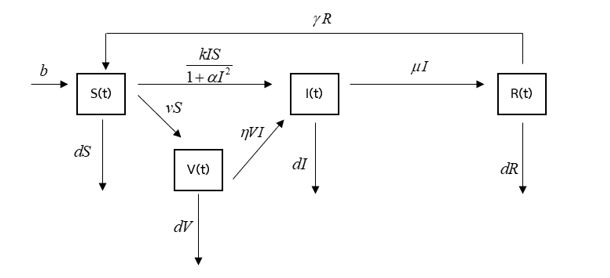
This paper studies an SVIR epidemic model that incorporates vaccination and a nonlinear incidence term to represent behavioral responses and saturation in disease transmission.
The population was divided into four classes—susceptible, vaccinated, infectious, and recovered states —and both vaccine‑induced and naturally acquired immunity were allowed to wane, so that individuals could return to the susceptible class. The original model is an SIR model with nonmonotone incidence. Then we added a vaccinated compartment and assumed imperfect vaccination, meaning that vaccinated individuals may still become infected at a reduced rate.
We derived the disease‑free and endemic equilibria and computed the basic reproduction number by the next‑generation method, obtaining a threshold that separated disease elimination from persistence. Stabilities of the equilibria were investigated under appropriate parameter conditions using Jacobian and Routh–Hurwitz criteria. Numerical simulations then illustrated how changes in the vaccination rate and other key parameters shaped the long‑term dynamics, including convergence to a disease‑free equilibrium or approach to an endemic equilibrium with a nonzero infectious population. The findings indicated that maintaining vaccination coverage above a critical level was essential to keep
and prevented sustained endemic transmission in the presence of nonlinear incidence and waning immunity.
เอกสารอ้างอิง
K. Ergen, A. Çilli, and N. Yahnioğlu, "Predicting epidemic diseases using mathematical modelling of SIR," Acta Physica Polonica A, vol. 128, no. 2-B, pp. B-273–B-275, Aug. 2015, doi: 10.12693/APhysPolA.128.B-273.
B. Dubey, P. Dubey, and U. S. Dubey, “Role of media and treatment on an SIR model,” Nonlinear Analysis: Modelling and Control, vol. 21, no. 2, pp. 185–200, Mar. 2016, doi: 10.15388/NA.2016.2.3.
Y. Ucakan, S. Gulen, and K. Koklu, “Analysing of tuberculosis in Turkey through SIR, SEIR and BSEIR mathematical models,” Mathematical and Computer Modelling of Dynamical Systems, vol. 27, no. 1, pp. 179–202, Mar. 2021, doi: 10.1080/13873954.2021.1881560.
S. Paul, A. Mahata, U. Ghosh, and B. Roy, "Study of SEIR epidemic model and scenario analysis of COVID-19 pandemic," Ecological Genetics and Genomics, vol. 19, 2021, Art. no. 100087, doi: 10.1016/j.egg.2021.100087.
V. Capasso and G. Serio, "A generalization of the Kermack-McKendrick deterministic epidemic model," Mathematical Biosciences, vol. 42, no. 1–2, pp. 43–61, Nov. 1978, doi: 10.1016/0025-5564(78)90006-8.
S. Ruan and W. Wang, "Dynamical behavior of an epidemic model with a nonlinear incidence rate," Journal of Differential Equations, vol. 188, no.1, pp. 135–163, Feb. 2003, doi: 10.1016/S0022-0396(02)00089-X.
D. Xiao and S. Ruan, "Global analysis of an epidemic model with nonmonotone incidence rate," Mathematical Biosciences, vol. 208, no.2, pp. 419–429, Aug. 2007, doi: 10.1016/j.mbs.2006.09.025.
W. Yang, C. Sun, and J. Arino, "Global analysis for a general epidemiological model with vaccination and varying population," Journal of Mathematical Analysis and Applications, vol. 372, no. 1, pp. 208–223, Dec. 2010, doi: 10.1016/j.jmaa.2010.07.017.
C.M. Kribs-Zaleta and J.X. Velasco-Hernandez, "A simple vaccination model with multiple endemic states," Mathematical Biosciences, vol. 164, pp. 183–201, 2000, doi: 10.1016/S0025-5564(00)00003-1.
D. G. Luenberger, Introduction to Dynamic Systems: Theory, Models and Applications, New York: John Wiley & Sons, 1979, pp. 336–337.
ดาวน์โหลด
เผยแพร่แล้ว
รูปแบบการอ้างอิง
ฉบับ
ประเภทบทความ
หมวดหมู่
สัญญาอนุญาต
ลิขสิทธิ์ (c) 2026 วารสารวิทยาศาสตร์และเทคโนโลยีนายเรืออากาศ

อนุญาตภายใต้เงื่อนไข Creative Commons Attribution-NonCommercial-NoDerivatives 4.0 International License.
- เนื้อหาและข้อมูลในบทความที่ตีพิมพ์ในวารสารวิทยาศาสตร์และเทคโนโลยีนายเรืออากาศ ถือเป็นข้อคิดเห็นและความรับผิดชอบของผู้เขียนบทความโดยตรง กองบรรณาธิการวารสาร ไม่จำเป็นต้องเห็นด้วย หรือร่วมรับผิดชอบใด ๆ
- บทความ ข้อมูล เนื้อหา รูปภาพ ฯลฯ ที่ได้รับการตีพิมพ์ในวารสารวิทยาศาสตร์และเทคโนโลยีนายเรืออากาศถือเป็นลิขสิทธิ์ของวารสารวิทยาศาสตร์และเทคโนโลยีนายเรืออากาศ หากบุคคลหรือหน่วยงานใดต้องการนำทั้งหมดหรือส่วนหนึ่งส่วนใดไปเผยแพร่ หรือเพื่อกระทำการใด ๆ จะต้องได้รับอนุญาตเป็นลายลักอักษรณ์จากวารสารวิทยาศาสตร์และเทคโนโลยีนายเรืออากาศ ก่อนเท่านั้น