
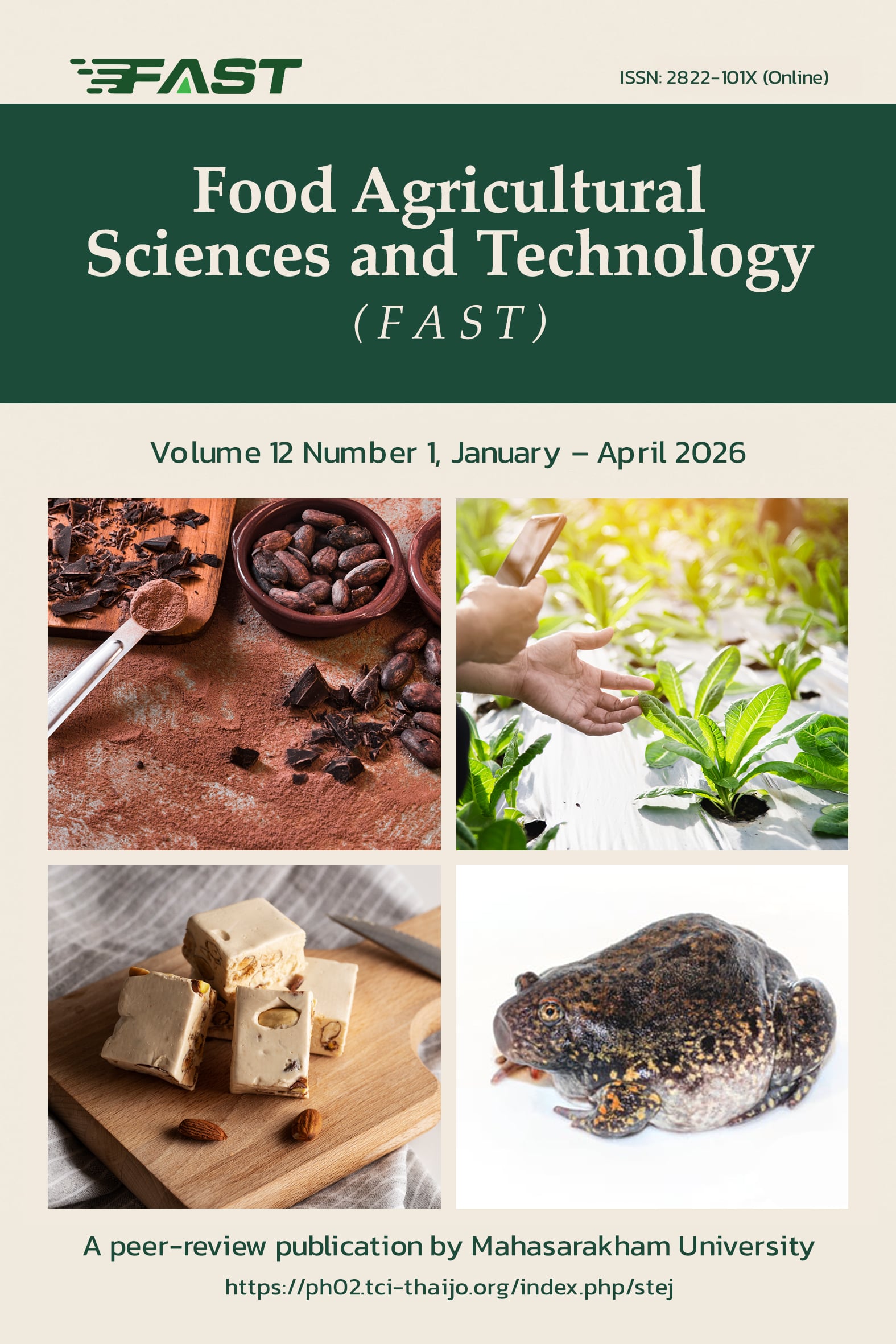
Karyotypic analysis of the blunt-headed burrowing frog (Glyphoglossus molossus) using conventional staining and NOR-banding techniques
DOI:
https://doi.org/10.14456/fast.2026.5Keywords:
Glyphoglossus molossus, chromosome, karyotype, ThailandAbstract
This study investigated the karyotype of the blunt-headed burrowing frog (Glyphoglossus molossus) using ten individuals (five males and five females) collected from Chombueng district, Ratchaburi province. Chromosome preparations were made from bone marrow cells, and mitotic chromosomes were obtained using a colchicine-hypotonic-fixation-air drying technique. Conventional staining was performed with 20% Giemsa’s solution to assess the diploid number, shape, and size of the chromosomes. The results revealed that the diploid chromosome number (2n) for the blunt-headed burrowing frog is 26, with the fundamental number (NF) of 52 in both males and females. The karyotype consists of 6 large metacentric chromosomes, 2 medium metacentric, 2 medium submetacentric, 12 small metacentric, and 4 small submetacentric chromosomes. NOR staining revealed a pair of NOR loci located at the subtelomeric region of the short arm of a submetacentric chromosome. Notably, no distinguishable sex chromosomes were observed. The karyotype formula for the species is 2n (26) = Lm6+ Mm2+Msm2+ Sm12+ Ssm4.
References
Aguiar, O., Jr., de Carvalho, K. A., & Giaretta, A. A. (2004). Cytogenetics of Hylodes and Crossodactylus species (Anura, Leptodactylidae) with comments on Hylodinae/Dendrobatidae relationships. Genetica, 121(1), 43–53. https://doi.org/10.1023/B:GENE.0000019926.50310.26
Aguiar, O., Lima, A. P., Giaretta, A. A., & Recco-Pimentel, S. M. (2002). Cytogenetic analysis of four poison frogs of the Epipedobates genus (Anura: Dendrobatidae). Herpetologica, 58(3), 293–303. https://doi.org/10.1655/0018-0831(2002)058[0293:CAOFPF]2.0.CO;2
Aiumsumang, S., Khoomsab, K., Tangsuwan, I., & Phimphan, S. (2023). Standardized chromosome pattern of some amphibians in Phetchabun Province. KKU Science Journal, 51(3), 306–313. https://doi.org/10.14456/kkuscij.2023.25
Chaithiangtham, P., & Patawang, I. (2020). Karyotypic study of Taylor’s stream frog (Limnonectes taylori) in Chiang Mai, Thailand. Journal of Science and Technology, Mahasarakham University, 39(4), 355–360.
Chaiyasut, K. (1989). Cell genetics and phylogenetic cell classification of the Zephyranthes genus [Doctoral dissertation, Chulalongkorn University]. Thai-Lis.
Donsakul, T., & Rangsiruji, A. (2005). Liver karyotypes in Limnonectes blythii, Rana erythraea, Rana leptoglossa, Occidozyga martensii and Glyphoglossus molossus (Amphibia, Anura). In Proceedings of the 43rd Kasetsart University Annual Conference: Veterinary Science and Science Fields (pp. 544–551). Kasetsart University.
Howell, W. M., & Black, D. A. (1980). Controlled silver-staining of nucleolus organizer regions with a protective colloidal developer: A 1-step method. Experientia, 36(8), 1014–1015. https://doi.org/10.1007/BF01953855
Lauhachinda, W. (2009). Herpetology of reptiles and amphibians [in Thai]. Kasetsart University.
Miura, I. (2018). Sex determination and sex chromosomes in Amphibia. Sexual Development, 11(5–6), 298–306. https://doi.org/10.1159/000485270
Niyomwan, P., Srisom, P., & Pawangkhanant, P. (2019). Amphibians of Thailand [in Thai]. Pappim.
Nonsrirach, T. (2019). Genetic diversity, genetic structure, and morphological variation of the truncated-snouted burrowing frog (Glyphoglossus molossus) in northeastern Thailand [Unpublished master’s thesis]. Mahasarakham University.
Phapakdee, J., Pakdeenarong, N., & Lauprasert, K. (2019). Cell genetics of the frogs consumed in Kalasin Province. In Proceedings of the 14th academic conference of Mahasarakham University: "50 years of Mahasarakham University, wisdom for the people" (pp. 702–710). Faculty of Humanities and Social Sciences, Mahasarakham University.
Rosa, C., Aguiar, O., Giaretta, A. A., & Recco-Pimentel, S. M. (2003). Karyotypic variation in the genus Megaelosia (Anura, Hylodinae) with the first description of a B-chromosome in a leptodactylid frog. Copeia, 2003(1), 166–174. https://doi.org/10.1643/0045-8511(2003)003[0166:KVITGM]2.0.CO;2
Schmid, M., Steinlein, C., Nanda, I., & Epplen, J. T. (1990). Chromosome banding in Amphibia. In E. Olmo (Ed.), Cytogenetics of amphibians and reptiles (pp. 21–45). Birkhäuser Verlag.
Siripiyasing, P., Srihabut, J., Aunboon, C., & Yomsawat, C. (2018). Research report on cell genetics of some amphibians in the area of Mahasarakham Rajabhat University. Mahasarakham Rajabhat University.
Stace, C. A. (2000). Cytology and cytogenetics as a fundamental taxonomic resource for the 20th and 21st centuries. Taxon, 49(3), 451–477. https://doi.org/10.2307/1224344
Sumner, A. T. (1990). Chromosome banding. Unwin Hyman.
Supanuam, P. (2018). Chromosome evolution of amphibians in Thailand. KKU Science Journal, 46(4), 654–663. https://ph01.tci-thaijo.org/index.php/KKUSciJ/article/view/249939
Supaprom, T., & Udomsirichakorn, K. (2005). Cytogenetics and biodiversity of amphibians in Patam National Park Ubon Ratchathani Province: Report on the implementation of the Cultural Conservation Project. Ubon Ratchathani University.
Supaprom, T., Arunmongkhonphon, W., & Udomsirichakorn, K. (1992). Studies on the chromosome complements and karyotypes of Glypholossus molossus Gunther and Rhacophorus leucomystax Kuhl. In Proceedings of the 30th Kasetsart University Annual Conference (pp. 717–724). Kasetsart University.
Downloads
Published
How to Cite
Issue
Section
License
Copyright (c) 2026 Food Agricultural Sciences and Technology

This work is licensed under a Creative Commons Attribution-NoDerivatives 4.0 International License.