
Development and Evaluation of a Web-Based GIS-Enabled Demographic Profiling System for Data-Driven Local Government Policy Making
Article Sidebar
Main Article Content
Abstract
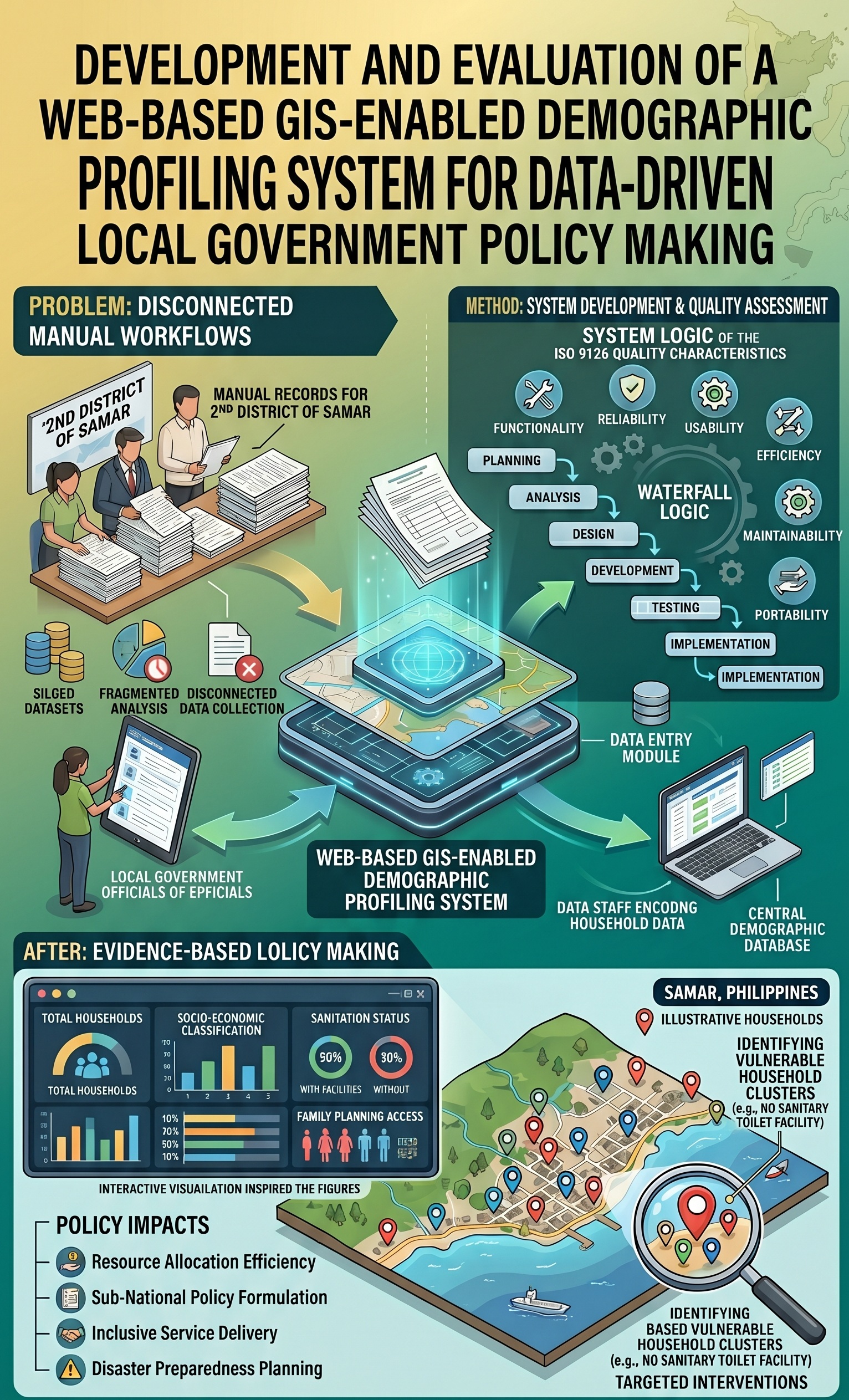
effective local governance. However, many municipalities in the 2nd District of Samar have yet to gather and collate household data automatically. Advanced methods often yield siloed datasets that clutter analysis and reduce the likelihood of spatial visualization. Consequently, the information generated is less useful in formulating effective sub-national policies. Furthermore, current demographic information systems are not integrated with GIS or web-based applications, creating a disconnect between data collection and information generation. This study aimed to fill the gap by developing a web-based GIS-enabled demographic profiling system to strengthen evidence-based policy-making among local government units (LGUs) in the 2nd District of Samar. The system integrates household-level demographic records and visualizes them through interactive GIS maps and dashboards for easier access, management, and spatial analysis. A descriptive research design was used to evaluate the system's functionality, reliability, usability, efficiency, maintainability, and portability, following the ISO 9126/25010 software quality framework. Further, the system's development follows the Waterfall System Development Life Cycle (SDLC) model. Results showed that the system met essential software quality standards and substantially improved how demographic data are accessed and analyzed. Thus, the system enhances Samar’s LGUs' ability to design well-informed, inclusive, and community-oriented local policies.
Article Details

This work is licensed under a Creative Commons Attribution-NonCommercial-NoDerivatives 4.0 International License.
References
Chen, C.-W.; Wei, J. C.-C. Employing Digital Technologies for Effective Governance: Taiwan’s Experience in COVID-19 Prevention. Health Policy Technol. 2023, 12(2), 100755. https://doi.org/10.1016/j.hlpt.2023.100755
Jones, M.; Moeller, E. A.; Meara, J. G.; Juran, S. The Importance of Geographic and Demographic Data from Census for Locating and Mapping Vulnerable Populations. Stat. J. IAOS 2021, 37(1), 13–17. https://doi.org/10.3233/SJI-200760
Vinueza-Martinez, J.; Correa-Peralta, M.; Ramirez-Anormaliza, R.; Franco Arias, O.; Vera Paredes, D. Geographic Information Systems (GISs) Based on WebGIS Architecture: Bibliometric Analysis of the Current Status and Research Trends. Sustainability 2024, 16(15), 6439. https://doi.org/10.3390/su16156439
Duarte, L.; Teodoro, A. C. GIS Open-Source Plugins Development: A 10-Year Bibliometric Analysis on Scientific Literature. Geomatics 2021, 1 (2), 206–245. https://doi.org/10.3390/geomatics1020013
Lata, K.; Sood, A.; Kaur, K.; Benipal, A. K.; Pateriya, B. Web-GIS Based Dashboard for Real-Time Data Visualization & Analysis Using Open Source Technologies. J. Geomat. 2022, 16(2), 134–146. https://doi.org/10.58825/jog.2022.16.2.42
Rita Uchenna Attah; Baalah Matthew Patrick Garba; Ifechukwu Gil-Ozoudeh; Obinna Iwuanyanwu. Leveraging Geographic Information Systems and Data Analytics for Enhanced Public Sector Decision-Making and Urban Planning. Magna Sci. Adv. Res. Rev. 2024, 12(2), 152–163. https://doi.org/10.30574/msarr.2024.12.2.0191
Karademir, M.; Özbakır Acımert, B. A. Sustainable Waste Governance Framework via Web-GIS: Kadikoy Case. Sustainability 2024, 16(16), 7171. https://doi.org/10.3390/su16167171
Li, Y.; Lai, Y.; Lin, Y. The Role of Diversified Geo-Information Technologies in Urban Governance: A Literature Review. Land 2024, 13(9), 1408. https://doi.org/10.3390/land13091408
Gnyawali, B.; Sigdel, U. Geodemography: Geospatial Stream of Demographic Analysis. Janajyoti J. 2025, 3(1), 173–187. https://doi.org/10.3126/jj.v3i1.83307
Wijaya, A. P.; Nugraha, A. L.; Sukmono, A.; Firdaus, H. S. Study on the Analysis of Demographic Data Based on Spatial Information Systems. IOP Conf. Ser. Earth Environ. Sci. 2022, 1098(1), 012029. https://doi.org/10.1088/1755-1315/1098/1/012029
Reyes, C.; Vargas, A. R.; Arboneda, A. Evidence-Based Local Planning and Budgeting Using the CBMS; Research Paper Series; Philippine Institute for Development Studies, 2022. https://doi.org/10.62986/rps2022.02
Abidoye, B.; Orlic, E. Localizing the Sustainable Development Goals: A Case for Investment in Data and Impact Evaluation. Stat. J. IAOS 2022, 38(3), 863–878. https://doi.org/10.3233/SJI-220058.
Daud, M.; Ugliotti, F. M.; Osello, A. Comprehensive Analysis of the Use of Web-GIS for Natural Hazard Management: A Systematic Review. Sustainability 2024, 16(10), 4238. https://doi.org/10.3390/su16104238
Belizario, Jr., V. Y.; Delos Trinos, J. P. C. R.; Lentejas, N.; Alonte, A. J.; Cuayzon, A. N.; Isiderio, M. E.; Delgado, R.; Tejero, M.; Molina, V. B. Use of Geographic Information System as a Tool for Schistosomiasis Surveillance in an Endemic Municipality in Eastern Samar, The Philippines. Geospatial Health 2021, 16(1). https://doi.org/10.4081/gh.2021.957
Salubre, H. C.; Dela Cerna, M. A.; Chua, F. V. A.; Buniel, G. G.; Tiu, G. D. Web-Based Election Monitoring Integrating Barangay Geospatial Mapping. In 2022 IEEE 3rd Global Conference for Advancement in Technology (GCAT); IEEE: Bangalore, India, 2022; pp 1–8. https://doi.org/10.1109/GCAT55367.2022.9971959
Sasmito, G. W.; Ratono, R. WebGIS Development to Integrate, Visualize, Map, and Disseminate Population Data. In 2023 International Conference on Computer Science, Information Technology and Engineering (ICCoSITE); IEEE: Jakarta, Indonesia, 2023; pp 784–789. https://doi.org/10.1109/ICCoSITE57641.2023.10127778
Pantolla, H.; Atibagos-Nacion, N. Spatial Analysis of Poverty Incidence and Road Networks in Eastern Visayas Region, Philippines. Philipp. J. Sci. 2023, 152(4). https://doi.org/10.56899/152.04.01
Faza, A.; Prasetiawan, I.; Donovan, D.; Eldora, K.; Zethro, Z.; Indrawan, S. R.; Kurniawan, M. I. Design and Development of an Audit Information System Prototype. In 2024 International Conference on Informatics Engineering, Science & Technology (INCITEST); IEEE: Bandung, Indonesia, 2024; pp 1–7. https://doi.org/10.1109/INCITEST64888.2024.11121485
M, S.; R, B. L.; Balakkrishnan, M.; H, A. The Development of a Design Theory for Web Based Information Systems. J. Comput. Nat. Sci. 2023, 113–123. https://doi.org/10.53759/181X/JCNS202303011
Pargaonkar, S. A Comprehensive Research Analysis of Software Development Life Cycle (SDLC) Agile & Waterfall Model Advantages, Disadvantages, and Application Suitability in Software Quality Engineering. Int. J. Sci. Res. Publ. 2023, 13(8), 120–124. https://doi.org/10.29322/IJSRP.13.08.2023.p14015
Suparto, H. S.; Dai, R. H. Evaluasi Kualitas Sistem Informasi Pengukuran Prestasi Kerja Berdasarkan ISO/IEC 25010. Jambura J. Inform. 2021, 3(2), 109–120. https://doi.org/10.37905/jji.v3i2.11744
Ariyani, S.; Sudarma, M.; Wicaksana, P. A. Analysis of Functional Suitability and Usability in Sales Order Procedure to Determine Management Information System Quality. INTENSIF J. Ilm. Penelit. Dan Penerapan Teknol. Sist. Inf. 2021, 5(2), 234–248. https://doi.org/10.29407/intensif.v5i2.15537
AbdulKareem, A. K.; Oladimeji, K. A. Cultivating the Digital Citizen: Trust, Digital Literacy and e-Government Adoption. Transform. Gov. People Process Policy 2024, 18(2), 270–286. https://doi.org/10.1108/TG-11-2023-0196
Hakeem, M. J.; Sulphey, M. M. Investigating the Adoption of Smart Local Government Services: The Impact of Service Quality, Trust, and Social Influence. Transform. Gov. People Process Policy 2024, 18(4), 785–802. https://doi.org/10.1108/TG-06-2024-0136
Master of Science in Management Information Systems, Lamar University, Texas, USA.; Barua, T.; Rahman, M. A.; MBA in Management Information System, International American University, Los Angeles, USA. A Systematic Literature Review Of User-Centric Design In Digital Business Systems Enhancing Accessibility, Adoption, And Organizational Impact. Am. J. Sch. Res. Innov. 2023, 02(02), 193–216. https://doi.org/10.63125/36w7fn47
Bastardo, R.; Pavão, J.; Rocha, N. P. Methodological Quality of User-Centered Usability Evaluation of Digital Applications to Promote Citizens’ Engagement and Participation in Public Governance: A Systematic Literature Review. Digital 2024, 4(3), 740–761. https://doi.org/10.3390/digital4030038
Hamdat, A.; B, C.; Samalam, A. G.; Rizal, M.; Lawalata, I. L. D. The Impact of Management Information Systems on Decision-Making Efficiency. Vifada Manag. Digit. Bus. 2024, 1(2), 56–74. https://doi.org/10.70184/qpw1rq78
Ortega, J. H. J. C.; Lagman, A. C.; De Angel, R. M.; Alix, A. L.; Lagrazon, P. G. G. Evaluation of Program Completion Decision-Based Recommendation System with the ISO Software Quality Model. In 2023 IEEE 15th International Conference on Humanoid, Nanotechnology, Information Technology, Communication and Control, Environment, and Management (HNICEM); IEEE: Coron, Palawan, Philippines, 2023; pp 1–6. https://doi.org/10.1109/HNICEM60674.2023.10589184
Martin, C. P.; Cochanco, A.; Cochanco, R. A. HighDro: An Intelligent Asset and Pressure Management Application for Local Water Utilities Using GIS. QUEST J. Multidiscip. Res. Dev. 2024, 3(1). https://doi.org/10.60008/thequest.v3i1.132
Manun-og, M.; Flores, J. B. Optimizing Registry of Inhabitants’ Record Management: The Development of Municipal Consolidation System for Local Governance. SciEnggJ 2023, 17(1), 1–7. https://doi.org/10.54645/VTHW47150
Purbaratri, W.; Hartomo, K. D.; Hendry; Tambotoh, J. J. C. The New Smart Government Software Quality Framework Uses Modifications to ISO/IEC 25010. In 2023 Eighth International Conference on Informatics and Computing (ICIC); IEEE: Manado, Indonesia, 2023; pp 1–6. https://doi.org/10.1109/ICIC60109.2023.10382109
