
Quality, Nutritional, and Sensory Evaluation of Noodles Enriched with Oyster Mushroom (Pleurotus sajor-caju)
Article Sidebar
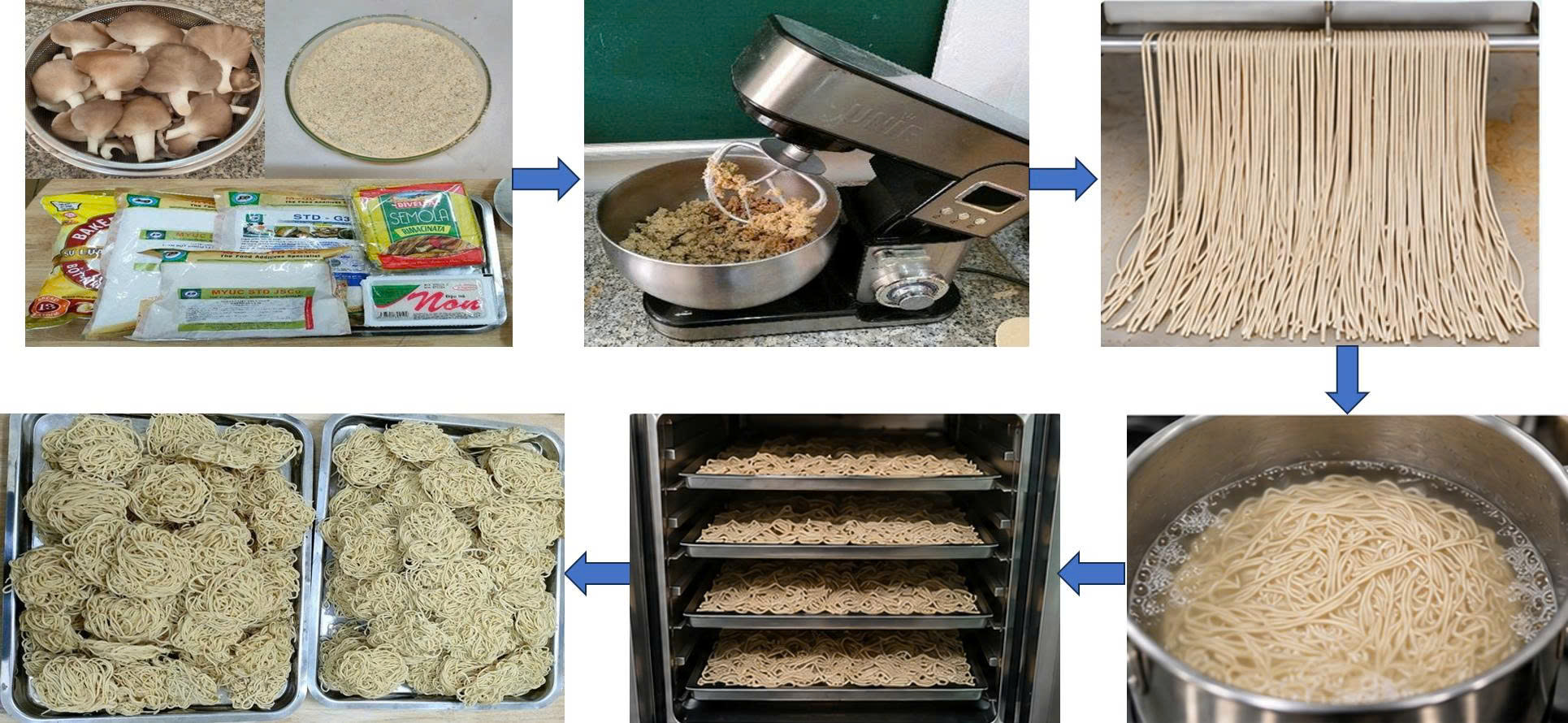
Main Article Content
Abstract
Noodles are considered one of the staple foods, especially in Asian countries. Traditional noodles are typically made from wheat flour; however, their nutritional value is relatively low. Previous studies have also explored this topic with an emphasis on improving the nutritional quality of noodles, but the sensory quality was often poorly rated. Therefore, this study focuses on enhancing the nutritional and sensory qualities of noodles, thereby contributing to product diversification through the use of abundant local commodities in line with sustainable development goals. This investigation examined the optimal level of oyster mushroom flour incorporated into noodle formulations at 40, 50, 60, and 70 g, along with a control sample without mushroom flour. The formulation containing 60 g of oyster mushroom flour showed the most favorable nutritional, physical, and sensory characteristics. The selected sample received the highest scores for all sensory attributes. Noodles’ elasticity and cooking quality also performed well, with 59.28 g-force, high water absorption, and volume expansion (276.53% and 273.61%), and low cooking loss (2.90%). At the same time, this sample also contained higher levels of nutritional components and bioactive compounds, with 6.07 g protein, 1.94 g cellulose, 0.20 g β-glucan, 0.0051 g QE/100 g flavonoid, and 0.37 g TAE/100 g phenolic. These findings suggest that oyster mushroom flour can be used as a functional ingredient to improve the nutritional and sensory quality of noodles and may support the development of value-added mushroom-based food products.
Article Details

This work is licensed under a Creative Commons Attribution-NonCommercial-NoDerivatives 4.0 International License.
References
U.S. Department of Agriculture, Foreign Agricultural Service. Grain and Feed Annual: Vietnam – Ho Chi Minh City; Report No. VM2025-0015; USDA FAS: Washington, DC, 2025. https://apps.fas.usda.gov/newgainapi/api/Report/DownloadReportByFileName?fileName=Grain+and+Feed+Annual_Ho+Chi+Minh+City_Vietnam_VM2025-0015.pdf (accessed October 30, 2025).
World Instant Noodles Association (WINA). Instant Noodles at a Glance; World Instant Noodles Association. (accessed October 30, 2025).
Obadi, M.; et al. A Review of Recent Advances and Techniques in Noodle Processing and Fortification. LWT–Food Sci. Technol. 2022, 154, 112680. https://doi.org/10.1016/j.lwt.2021.112680
Nunchanok, N.; Intira, L.; Palida, T.; Pradit, K. Development of Pumpkin Flour Incorporated Instant Noodles. Curr. Res. Nutr. Food Sci. J. 2020, 8(2), 524-530. https://doi.org/10.12944/CRNFSJ.8.2.18
Kumar, K.; et al. Edible Mushrooms: A Comprehensive Review on Bioactive Compounds with Health Benefits and Processing Aspects. Foods 2021, 10(12), 2996. https://doi.org/10.3390/foods10122996
Giang, N. T. N.; Khai, T. V.; Thuy, N. M. Changes in Yield and Quality of Pleurotus sajor-caju by Seasons, Harvest Times and during Maturation. Vietnam J. Agric. Rural Dev. 2021, 1, 39–47.
Nguyen, T. M. Effect of Extraction Conditions (Temperature, pH and Time) by Cellulase on Chemical Properties of Dried Oyster Mushroom (Pleurotus sajor-caju) Extract. Food Res. 2021, 5(3), 351–358. https://doi.org/10.26656/fr.2017.5(3).613
Galappaththi, M. C. A.; Dauner, L.; Madawala, S.; Karunarathna, S. C. Nutritional and Medicinal Benefits of Oyster (Pleurotus) Mushrooms: A Review. Fungal Biotec. 2021, 1(2), 65–87. https://doi.org/10.5943/FunBiotec/1/2/5
Fogarasi, M.; et al. Bioactive Secondary Metabolites in Mushrooms: A Focus on Polyphenols, Their Health Benefits and Applications. Food Biosci. 2024, 62, 105166. https://doi.org/10.1016/j.fbio.2024.105166
Giang, N. T. N.; Thuy, N. M. Effects of Drying Methods on the Characteristics of Pleurotus sajor-caju Mushroom. Malays. Appl. Biol. 2020, 49(3), 31–36. https://doi.org/10.55230/mabjournal.v49i3.1538
Devi, P. V.; Islam, J.; Narzary, P.; Sharma, D.; Sultana, F. Bioactive Compounds, Nutraceutical Values and Its Application in Food Product Development of Oyster Mushroom. J. Future Foods 2024, 4(4), 335–342. https://doi.org/10.1016/j.jfutfo.2023.11.005
Kumaresan, K.; Gopalakrishnan, S.; Sivasamy, R. K.; Alagu, T.; Sathishkumar, T. Fortification of Soy Milk with Prebiotic Natural β-Glucan Derived from Edible Mushrooms Pleurotus ostreatus and Agaricus bisporus. J. Appl. Biol. Biotech. 2022, 10(1), 157–163.. https://doi.org/10.7324/JABB.2021.100119
Thuy, N. M.; Chi, N. T. D.; Huyen, T. H. B.; Tai, N. V. Orange-Fleshed Sweet Potato Grown in Viet Nam as a Potential Source for Making Noodles. Food Res. 2020, 4(3), 712–721. https://doi.org/10.26656/fr.2017.4(3).390
Too, B. C.; Ngo, V. T.; Nguyen, M. T. Formulation and Quality Evaluation of Noodles with Starchy Flours Containing High Levels of Resistant Starch. Acta Sci. Pol. Technol. Aliment. 2022, 21(2), 145–154. https://doi.org/10.17306/J.AFS.2022.1011
Fournier, E. Colorimetric Quantification of Carbohydrates. Curr. Protoc. Food Anal. Chem. 2001, 1, E1.1.1–E1.1.8. https://doi.org/10.1002/0471142913.fae0101s00
Sumaiyah; Masfria; Dalimunthe, A. Determination of Total Phenolic Content, Total Flavonoid Content, and Antimutagenic Activity of Ethanol Extract Nanoparticles of Raphidophora pinnata (L.F.) Schott Leaves. Rasayan J. Chem. 2015, 11(2), 505–510. https://doi.org/10.31788/RJC.2018.1122068
Nielsen, S. S. Food Analysis Laboratory Manual, 2nd ed.; Springer: Cham, 2017.
Nielsen, S. S. Protein Nitrogen Determination. In Food Analysis Laboratory Manual; Nielsen, S. S., Ed.; Springer International Publishing: New York, 2017; pp 131–135. https://doi.org/10.1007/978-3-319-44127-6_13
Nguyen, V. M. Biochemistry Practice; Hanoi National University Publishing House: Vietnam, 2001.
Thuy, N. M.; Cuong, N. P.; Tuyen, N. T. M.; Quan, T. H.; Hong, N. T. T.; Toan, T. H. Changes in Physical, Chemical and Sensory Characteristics during Maturation and Storage of Rambutans cv. “Nhãn” (Nephelium lappaceum L.). Can Tho Univ. J. Sci. 2012, 23(S), 118–128.
Bui, D. H.; Le, H. K.; Mai, V. L.; Le, T. C.; Hoang, T. N. C.; Le, N. T.; Luong, H. N. Food Processing Techniques, Vol. 2; Science and Technology Publishing House: Hanoi, 2009.
Zhang, H.; Meng, Y.; Liu, X.; Guan, X.; Huang, K.; Li, S. Effect of Extruded Mung Bean Flour on Dough Rheology and Quality of Chinese Noodles. Cereal Chem. 2019, 96(5), 836–846. https://doi.org/10.1002/cche.10184
Shere, P. D.; Devkatte, A. N.; Pawar, V. N. Cooking and Textural Qualities of Carrot Incorporated Instant Noodles. J. Pharmacogn. Phytochem. 2018, 7(3), 3040–3045.
Gülsün, Ö.; Leyla, U.; Ilknur, Y.; Saadet, G.; Gökçe, A.; Burcu, A.; Oya, I. Evaluation of the Cooking Quality Characteristics of Pasta Enriched with Spirulina platensis. J. Food Qual. 2015, 38, 268–272. https://doi.org/10.1111/jfq.12142
Kankanit, J.; Panyapathk, P. Development of Nutrient-Enriched Gluten-Free Pasta Using Brown Rice Flour and Green Leafy Vegetables as Natural Sources of Calcium and Dietary Fiber. Discov. Food 2025, 5, 240–233. https://doi.org/10.1007/s44187-025-00555-8
Kang, J.; et al. Physicochemical and Textural Properties of Noodles Prepared from Different Potato Varieties. Prev. Nutr. Food Sci. 2017, 22(3), 246–250. https://doi.org/10.3746/pnf.2017.22.3.246
Deepalakshmi, K.; Sankaran, M. Pleurotus ostreatus: An Oyster Mushroom with Nutritional and Medicinal Properties. J. Biochem. Technol. 2014, 5(2), 718–726.
Sobota, A.; Wirkijowska, A.; Zarzycki, P. Application of Vegetable Concentrates and Flours in Coloured Pasta Production. Int. J. Food Sci. Technol. 2020, 55, 2677–2687. https://doi.org/10.1111/ijfs.14521
Giancarlo, A. F.; Gaia, C.; Roberto, V.; Paola, A. The Glucans Mushrooms: Molecules of Significant Biological and Medicinal Value. Polysaccharides 2024, 5(3), 212–224. https://doi.org/10.3390/polysaccharides5030016
Melinda, F.; et al. Bioactive Secondary Metabolites in Mushrooms: A Focus on Polyphenols, Their Health Benefits and Applications. Food Biosci. 2024, 62, 105166. https://doi.org/10.1016/j.fbio.2024.105166
