
Drinking Water Treatment Plant’s Sludge as an Adsorbent for Removal of Heavy Metals: Effects of Contact Time, Adsorbent Dosage, and pH Level
Article Sidebar
Main Article Content
Abstract
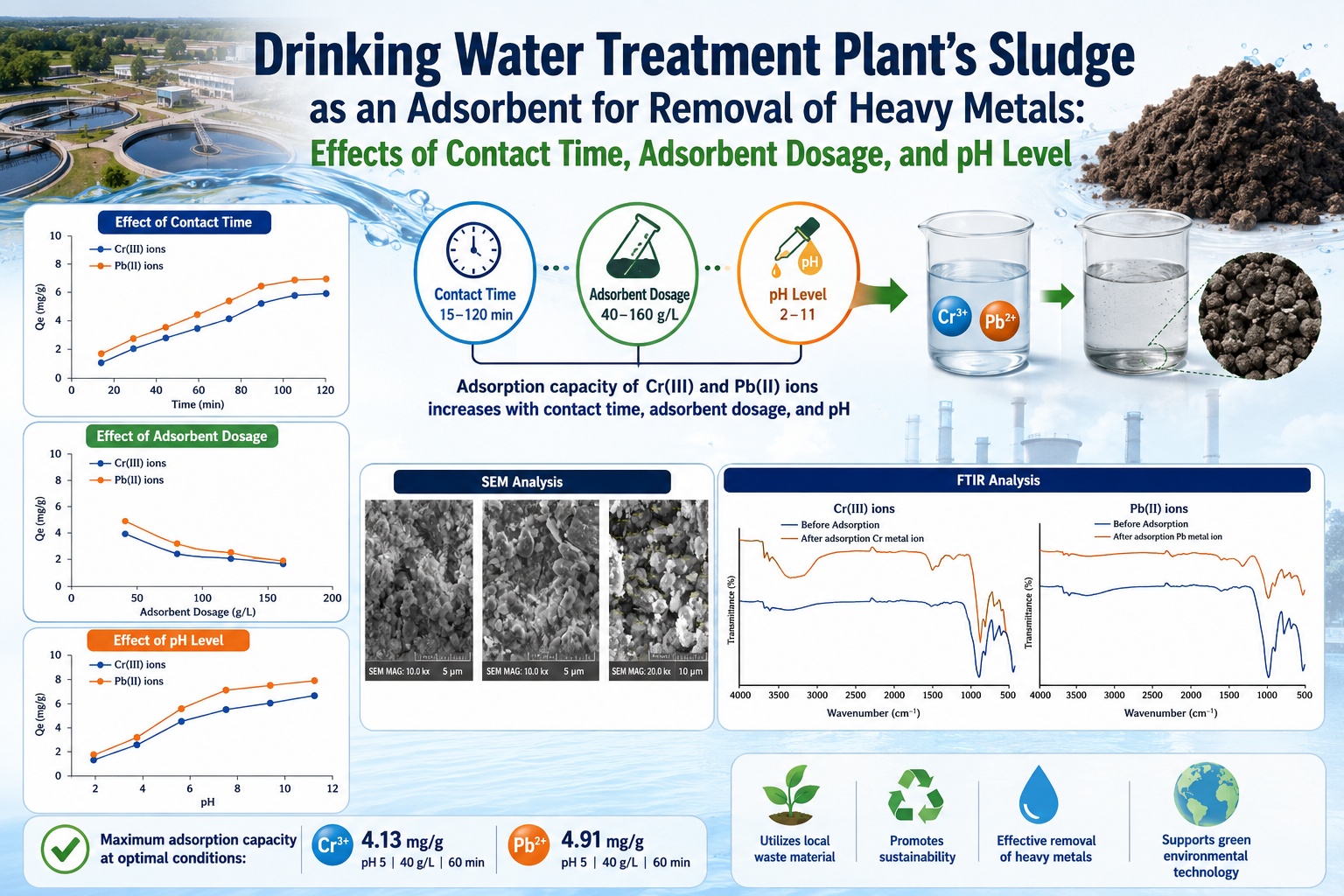
Heavy metals such as chromium, lead, copper, iron, manganese, and vanadium are several common heavy metals that can enter the environment through industrial activities, wastewater plants, and much more. A high concentration of these metals may cause severe health issues for living things. To address this issue, the present study reports the removal of chromium (Cr) and lead (Pb) metal ions from aqueous solution by activated sludge as an adsorbent. The effects of contact time (15-120 min), adsorbent dosage (40-160 g/L), and pH level (2-11) were studied in a batch experiment. The adsorbents were characterized using an X-ray fluorescence spectrometer (XRF), a Fourier Transform Infrared (FTIR) spectrometer, and a Scanning Electron Microscope (SEM). Adsorption results showed that the adsorption capacity of Cr(III) and Pb(II) ions increased with increasing contact time, adsorbent dosage, and pH. The variation in adsorbent dosage showed the highest adsorption capacities for Cr(III) and Pb(II) ions, 4.13 mg/g and 4.91 mg/g, respectively, at pH 5, an adsorbent dosage of 40 g/L, and a contact time of 60 min. These findings show that sludge from drinking water treatment plants can be effectively and sustainably used as an adsorbent to remove heavy metals. These findings also encourage the reuse of local waste materials and help in creating new environmental technologies.
Article Details

This work is licensed under a Creative Commons Attribution-NonCommercial-NoDerivatives 4.0 International License.
References
Wu, H.; Kawamura, T.; Kim, S. Adsorption and Separation Behaviors of Y(III) and Sr(II) in Acid Solution by a Porous Silica Based Adsorbent. Nucl. Eng. Technol. 2021, 53(10), 3352–3358. https://doi.org/10.1016/j.net.2021.04.009
Fu, Z.; Xi, S. The Effects of Heavy Metals on Human Metabolism. Toxicol. Mech. Methods 2020, 30(3), 167–176. https://doi.org/10.1080/15376516.2019.1701594
Nguyen, M. D.; Thomas, M.; Surapaneni, A.; Moon, E. M.; Milne, N. A. Beneficial Reuse of Water Treatment Sludge in the Context of Circular Economy. Environ. Technol. Innov. 2022, 28, 102651. https://doi.org/10.1016/j.eti.2022.102651
Portillo, E.; et al. Sustainable Adsorbents from Sewage Sludge: Efficient Removal of Cytostatic Compounds in Single and Complex Aqueous Matrices. J. Environ. Chem. Eng. 2025, 13(3), 116927. https://doi.org/10.1016/j.jece.2025.116927
Ahmaruzzaman, M. Industrial Wastes as Low-Cost Potential Adsorbents for the Treatment of Wastewater Laden with Heavy Metals. Adv. Colloid Interface Sci. 2011, 166(1–2), 36–59. https://doi.org/10.1016/j.cis.2011.04.005
Rajakaruna, R. M. A. S. D.; Sewwandi, B. G. N.; Najim, M. M. M.; Baig, M. B.; Alotaibi, B. A.; Traore, A. Sustainable Approaches for Wastewater Treatment: An Analysis of Sludge-Based Materials for Heavy Metal Removal from Wastewater by Adsorption. Sustainability 2023, 15(20), 14937. https://doi.org/10.3390/su152014937
Shumiye, E.; Nadew, T. T.; Tedla, T. S.; Getiye, B.; Mengie, D. A.; Ayalew, A. G. Preparation of an Activated Adsorbent from Water Treatment Plant Sludge for Phosphate Removal from Wastewater: Optimization, Characterization, Isotherm, and Kinetics Studies. J. Water Sanit. Hyg. Dev. 2024, 14(2), 122–143. https://doi.org/10.2166/washdev.2024.278
Radchatawin, S.; Paritporndheera, D.; Singkram, N.; Suntigul, N.; Nuntang, S. Acid Dye Removal from Wastewaters Using Rice Husk Ash Functionalized with Organic Amine Groups as Adsorbent. ASEAN J. Sci. Technol. Rep. 2024, 27(1), 102–109. https://doi.org/10.55164/ajstr.v27i1.250741
Senanu, L. D.; Kranjac-Berisavljevic, G.; Cobbina, S. J. The Use of Local Materials to Remove Heavy Metals for Household-Scale Drinking Water Treatment: A Review. Environ. Technol. Innov. 2023, 29, 103005. https://doi.org/10.1016/j.eti.2023.103005
Zoroufchi Benis, K. Transforming Drinking Water Treatment Residuals into Efficient Adsorbents: A Review of Activation and Modification Methods. Environ. Res. 2024, 262, 119893. https://doi.org/10.1016/j.envres.2024.119893
Djekoune, L.; Salem, Z.; Maaliou, A.; Boucetta, S.; Ouakouak, A. Reuse of Sludge from Drinking Water Production in Dye Wastewater Treatment of Textile Industry. Desalin. Water Treat. 2022, 277, 72–84. https://doi.org/10.5004/dwt.2022.28962
Bensitel, N.; et al. Potential Reuse of Sludge from a Potable Water Treatment Plant in Al Hoceima City in Northern Morocco. Water Cycle 2023, 4, 154–162. https://doi.org/10.1016/j.watcyc.2023.07.002
Singh, D. K.; Garg, A. Application of Sewage Sludge Derived Hydrochar as an Adsorbent for Removal of Methylene Blue. Sustainable Chem. Environ. 2024, 8, 100158. https://doi.org/10.1016/j.scenv.2024.100158
Guo, H.; et al. Preparation of Three Kinds of Efficient Sludge-Derived Adsorbents for Metal Ions and Organic Wastewater Purification. Arab. J. Chem. 2024, 17(4), 105671. https://doi.org/10.1016/j.arabjc.2024.105671
Sangthong, K.; Sumanatrakul, P.; Khaorapapong, N.; Intachai, S. Highly Enhanced Adsorption and Photodegradation of Various Dyes in Wastewater: Novel Multifunctional Composites of CuAl-Layered Double Oxide, Activated Carbon and Magnetite. Diamond Relat. Mater. 2025, 158, 112618. https://doi.org/10.1016/j.diamond.2025.112618
Intachai, S.; Na Nakorn, M.; Kaewnok, A.; Pankam, P.; Sumanatrakul, P.; Khaorapapong, N. Versatile Inorganic Adsorbent for Efficient and Practical Removal of Hexavalent Chromium in Water. Mater. Chem. Phys. 2022, 288, 126388. https://doi.org/10.1016/j.matchemphys.2022.126388
Ghorpade, A.; Ahammed, M. M. Water Treatment Sludge for Removal of Heavy Metals from Electroplating Wastewater. Environ. Eng. Res. 2018, 23 (1), 92–98. https://doi.org/10.4491/eer.2017.065
Saenplee, P.; et al. Multifunctional Magnetic Fe3O4@AC/NiAl-LDO Composite for Efficient Removal of Anionic and Cationic Dyes in Wastewater. Int. J. Environ. Res. 2025, 20(1), 15. https://doi.org/10.1007/s41742-025-00971-9
Intachai, S.; Tongchoo, P.; Sumanatrakul, P.; Pankam, P.; Khaorapapong, N. Efficient and Practical Adsorption of Mixed Anionic Dyes in Aqueous Solution by Magnetic NiFe-Layered Double Oxide. Korean J. Chem. Eng. 2022, 39(10), 2675–2684. https://doi.org/10.1007/s11814-022-1099-y
Wołowiec, M.; Komorowska-Kaufman, M.; Pruss, A.; Rzepa, G.; Bajda, T. Removal of Heavy Metals and Metalloids from Water Using Drinking Water Treatment Residuals. Minerals 2019, 9, 487. https://doi.org/10.3390/min9080487
Intachai, S.; Sumanatrakul, P.; Pankam, P.; Suppaso, C.; Khaorapapong, N. Efficient Removal of Both Anionic and Cationic Dyes by Activated Carbon/NiFe-Layered Double Oxide. J. Inorg. Organomet. Polym. Mater. 2022, 32(6), 1999–2008. https://doi.org/10.1007/s10904-022-02254-8
Shah, A.; et al. Removal of Cadmium and Zinc from Water Using Sewage Sludge-Derived Biochar. Sustainable Chem. Environ. 2024, 6, 100118. https://doi.org/10.1016/j.scenv.2024.100118
Du, X.; Cui, S.; Fang, X.; Wang, Q.; Liu, G. Adsorption of Cd(II), Cu(II), and Zn(II) by Granules Prepared Using Sludge from a Drinking Water Purification Plant. J. Environ. Chem. Eng. 2020, 8(6), 104530. https://doi.org/10.1016/j.jece.2020.104530
Mohanta, J.; Dey, B.; Dey, S. Highly Porous Iron-Zirconium Binary Oxide for Efficient Removal of Congo Red from Water. Desalin. Water Treat. 2020, 189, 227–242. https://doi.org/10.5004/dwt.2020.25570
Wang, Q.; Li, J. S.; Poon, C. S. Recycling of Incinerated Sewage Sludge Ash as an Adsorbent for Heavy Metals Removal from Aqueous Solutions. J. Environ. Manage. 2019, 247, 509–517. https://doi.org/10.1016/j.jenvman.2019.06.115
Mouratib, R.; et al. Efficiency of Dry Drinking Water Treatment Sludge as Adsorbent for Methylene Blue and Acid Red 97 Removal from Aqueous Solutions. Desalin. Water Treat. 2024, 318, 100372. https://doi.org/10.1016/j.dwt.2024.100372
Jaber, L.; et al. Adsorptive Removal of Lead and Chromate Ions from Water by Using Iron-Doped Granular Activated Carbon Obtained from Coconut Shells. Sustainability 2022, 14(17), 10877. https://doi.org/10.3390/su141710877
Duarte, V. G. O.; et al. Sewage Sludge-Derived Biochar Modified with MgCl2: Used as Adsorbent Material for Phosphorus Removal from Aqueous Medium. Next Sustainability 2025, 6, 100156. https://doi.org/10.1016/j.nxsust.2025.100156
Mardwita; Robiah; Khotimah, H. Adsorption of Lead from Synthetic Solution Using Adsorbent Developed from Drinking Water Treatment Plant’s Sludge. Int. J. Adv. Eng. Manag. Res. 2025, 10(2), 222–230. https://doi.org/10.51505/ijaemr.2025.1111
Bougine, O.; et al. Advancing Circular Economy: A Study of Drinking Water Sludge for Potential Uses. Results Eng. 2024, 23, 102426. https://doi.org/10.1016/j.rineng.2024.102426
Alnajjar, M.; Hethnawi, A.; Nafie, G.; Hassan, A.; Vitale, G.; Nassar, N. N. Silica-Alumina Composite as an Effective Adsorbent for the Removal of Metformin from Water. J. Environ. Chem. Eng. 2019, 7(3), 102994. https://doi.org/10.1016/j.jece.2019.102994
El-Sawaf, A. K.; et al. Green Synthesis and Characterization of Magnetic Gamma Alumina Nanoparticles for Copper Ions Adsorption from Synthetic Wastewater. Results Eng. 2024, 22, 101971. https://doi.org/10.1016/j.rineng.2024.101971
