
Efficient Removal of Organic Pollutants Using Magnetic Biochar Derived from Corn Husk
Article Sidebar
Main Article Content
Abstract
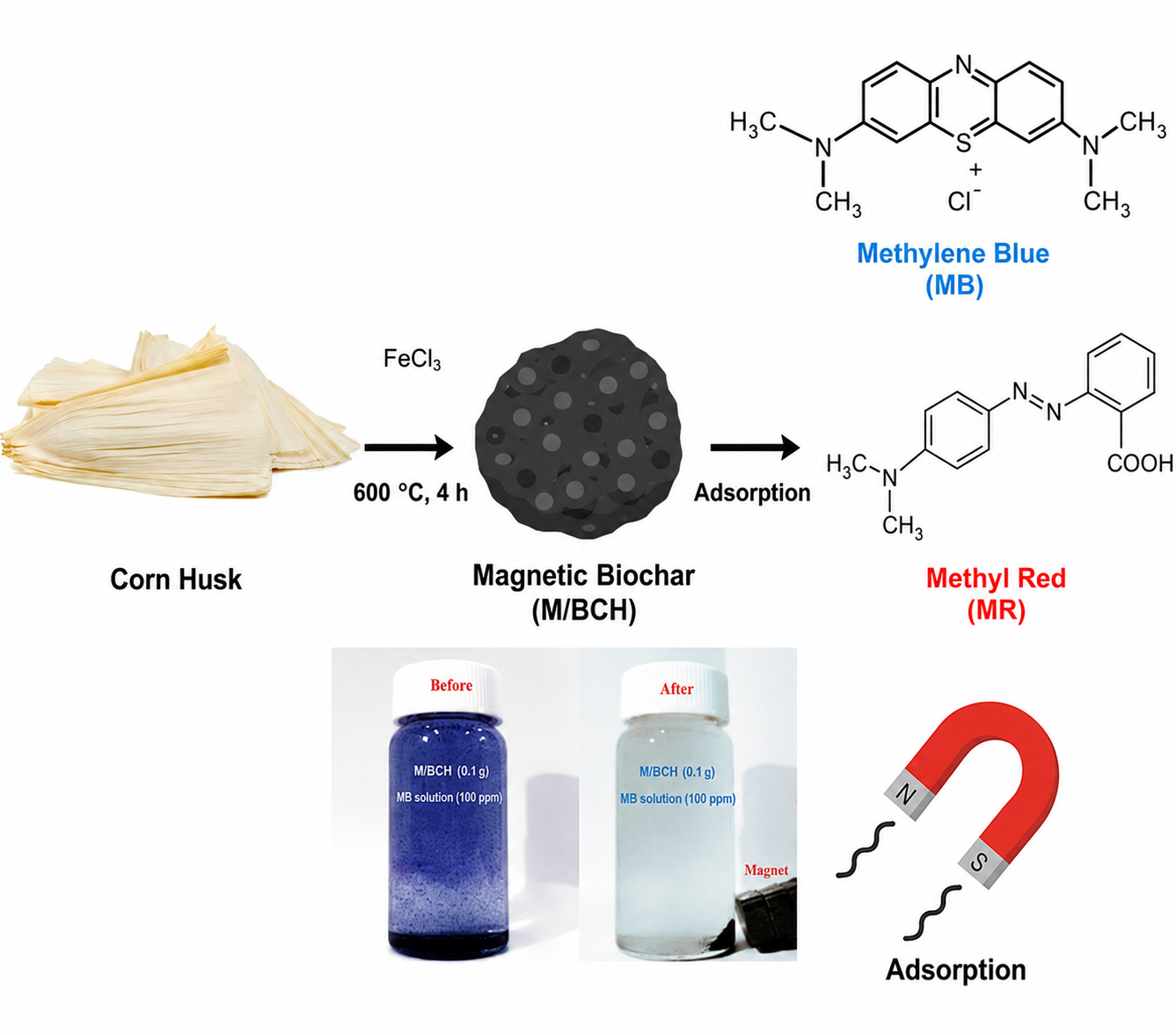
The development of cost-effective and sustainable adsorbents for dye-contaminated wastewater remains a critical environmental challenge. In this study, a magnetic biochar composite (M/BCH) was synthesized from corn husk biomass through FeCl3 impregnation followed by pyrolysis at 600 °C for 4 h. The physicochemical characteristics of the pristine biochar (BCH) and the magnetic composite were systematically investigated using XRD, FTIR, SEM/EDS, and N2 adsorption–desorption techniques. XRD and FTIR analyses confirmed the successful incorporation of Fe2O3 into the carbon matrix, while SEM/EDS mapping revealed uniform Fe distribution (~12 wt.%). Textural analysis showed that Fe2O3 deposition reduced the BET surface area and pore volume, indicating partial pore occupation. The adsorption performance of BCH and M/BCH for methylene blue (MB) and methyl red (MR) was evaluated over varying contact times, initial concentrations, adsorbent dosages, and shaking speeds. BCH exhibited relatively higher MB adsorption, attributed to its higher surface area and mesoporous structure, whereas M/BCH showed higher MR removal compared to BCH due to modified surface chemistry, improved electrostatic interactions, and additional mechanisms such as complexation and π–π interactions. The M/BCH composite reached adsorption equilibrium within 120 min and showed increasing dye uptake with higher adsorbent dosage and shaking speed. Importantly, its magnetic properties enabled rapid and efficient post-treatment separation. Overall, the findings demonstrate that corn husk-derived M/BCH was an effective, multifunctional, magnetically separable adsorbent with potential for wastewater treatment applications.
Article Details

This work is licensed under a Creative Commons Attribution-NonCommercial-NoDerivatives 4.0 International License.
References
Khatri, A.; Peerzada, M. H.; Mohsin, M.; White, M. A Review on Developments in Dyeing Cotton Fabrics with Reactive Dyes for Reducing Effluent Pollution. J. Clean. Prod. 2015, 87, 50–57. https://doi.org/10.1016/j.jclepro.2014.09.017
Shi, Y.; Chang, Q.; Zhang, T.; Song, G.; Sun, Y.; Ding, G. A Review on Selective Dye Adsorption by Different Mechanisms. J. Environ. Chem. Eng. 2022, 10(6), 108639. https://doi.org/10.1016/j.jece.2022.108639
Katheresan, V.; Kansedo, J.; Lau, S. Y. Efficiency of Various Recent Wastewater Dye Removal Methods: A Review. J. Environ. Chem. Eng. 2018, 6(4), 4676–4697. https://doi.org/10.1016/j.jece.2018.06.060
Ahmed, M. J. Application of Agricultural-Based Activated Carbon by Microwave and Conventional Activations for Basic Dye Adsorption: Review. J. Environ. Chem. Eng. 2016, 4, 89–99. https://doi.org/10.1016/j.jece.2015.10.027
El-Shafey, E.; Ali, S. N.; Al-Busafi, S.; Al-Lawati, H. A. Preparation and Characterization of Surface-Functionalized Activated Carbons from Date Palm Leaflets and Application for Methylene Blue Removal. J. Environ. Chem. Eng. 2016, 4, 2713–2724. https://doi.org/10.1016/j.jece.2016.05.015
Mukherjee, S.; Thakur, A. K.; Goswami, R.; Mazumder, P.; Taki, K.; Vithanage, M.; Kumar, M. Efficacy of Agricultural Waste-Derived Biochar for Arsenic Removal. J. Environ. Manage. 2021, 281, 111814. https://doi.org/10.1016/j.jenvman.2020.111814
Verma, L.; Singh, J. Synthesis of Novel Biochar from Waste Plant Litter Biomass for the Removal of Arsenic (III and V). J. Environ. Manage. 2019, 248, 109235. https://doi.org/10.1016/j.jenvman.2019.07.006
Iwuozor, K. O.; Emenike, E. C.; Bakare, B. F.; Eleregbe, F. O.; Aransiola, F. T.; Omonayin, E.; et al. A Review on Plant Husk-Based Biomass Conversion into Biochar. Biofuels 2024, 15(10), 1331–1345. https://doi.org/10.1080/17597269.2024.2376367
Sasujit, K.; Sanpinit, W.; Wongrin, N.; Dussadee, N. Study of Process Densification of Corn Cob and Corn Husk Briquettes by Cold Extrusion Technique Using Starch with Lime Mixed as Binder. Thaksin Univ. J. 2015, 18(1), 5–14.
Baikousi, M.; Bourlinos, A. B.; Douvalis, A.; Bakas, T.; Anagnostopoulos, D. F.; Tuček, J.; et al. γ-Fe₂O₃/Carbon Hybrids for Cr(VI) Removal. Langmuir 2012, 28(8), 3918–3930. https://doi.org/10.1021/la204006d
Xu, L. C.; Dai, J. D.; Pan, J. M.; Li, X. X.; Huo, P. W.; Yan, Y. S.; et al. Magnetic Mesoporous Silica Spheres for Antibiotic Adsorption. Chem. Eng. J. 2011, 174(1), 221–230. https://doi.org/10.1016/j.cej.2011.09.003
Rong, X.; Xie, M.; Kong, L.; Natarajan, V.; Ma, L.; Zhan, J. Magnetic Banana-Peel Biochar for Persulfate Activation. Chem. Eng. J. 2019, 372, 294–303. https://doi.org/10.1016/j.cej.2019.04.135
Tran, N. D. N.; Bui, T. H. A.; Nguyen, P.; Nguyen, T.-T.; Nguyen, V. M.; Duong, N. L.; Nguyen, T. Silver-Biochar from Citrus maxima Peel for Pollutant Adsorption. Green Chem. Lett. Rev. 2022, 15(1), 18–27. https://doi.org/10.1080/17518253.2021.2015456
Elnour, A. Y.; Alghyamah, A. A.; Shaikh, H. M.; Poulose, A. M.; Al-Zahrani, S. M.; Anis, A.; Al-Wabel, M. I. Effect of Pyrolysis Temperature on Biochar Properties. Appl. Sci. 2019, 9(6), 1149. https://doi.org/10.3390/app9061149
Bukhari, A.; Ijaz, I.; Nazir, A.; Hussain, S.; Zain, H.; Gilani, E.; et al. Fe₂O₃/MXene-Functionalized Biochar for Dye/Lead Removal. RSC Adv. 2024, 14, 3732–3747. https://doi.org/10.1039/D3RA07250A
Shi, J.; Wang, J.; Liang, L.; Xu, Z.; Chen, Y.; Chen, S.; et al. Biochar-Supported Metallic Silver for Methylene Blue Degradation. J. Hazard. Mater. 2021, 401, 123382. https://doi.org/10.1016/j.jhazmat.2020.123382
Dong, Y.; Liang, J.; E, Z.; Song, J.; Liu, C.; Ding, Z.; et al. Biochar/Iron Mineral Composites for Methyl Orange Adsorption. RSC Adv. 2024, 14, 33977–33986. https://doi.org/10.1039/D4RA05529B
Gu, J.; Fang, C.; Li, X.; Ma, Y.; Duan, D.; Hao, C.; et al. Fe₂O₃/Biochar with Dual Active Centers for Pollutant Removal. Appl. Catal. A Gen. 2024, 195, 207008. https://doi.org/10.1016/j.apcata.2024.207008
Mu, Y.; Du, H.; He, W.; Ma, H. Mesoporous Magnetic Biochar for Methylene Blue Removal. Diamond Relat. Mater. 2022, 121, 108795. https://doi.org/10.1016/j.diamond.2021.108795
