
Development of Geopolymer Properties from Cement Industry Waste as Raw Material for Clay Pottery Products
Article Sidebar
Main Article Content
Abstract
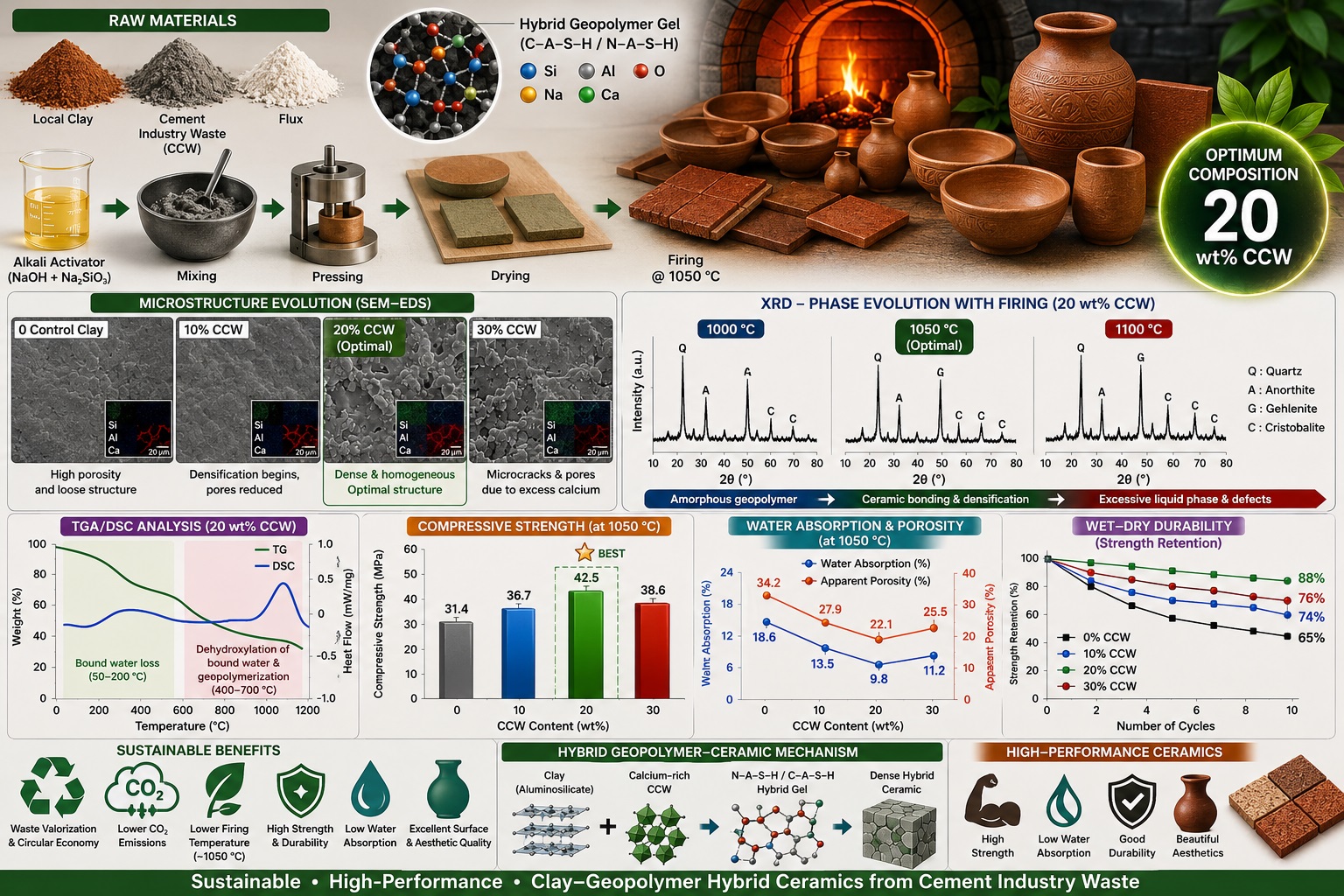
This study demonstrates that cement industry waste (CCW) can be effectively utilized to produce high-performance clay–geopolymer hybrid ceramics with enhanced mechanical, physical, thermal, and durability properties. An optimum substitution of 20 wt% CCW achieved the highest compressive strength (42.5 MPa), compared with 31.4 MPa for the control, together with reduced porosity (22.1%) and water absorption (9.8%). These improvements are attributed to the combined effects of geopolymer reaction product development, improved particle packing, and microstructural densification, resulting in a dense and homogeneous matrix. Thermal and phase analyses suggest a progressive transition from geopolymer-dominated bonding to ceramic bonding during firing, with optimum densification at approximately 1050 °C, whereas firing at 1100 °C promoted over-fluxing and microstructural defects. The optimized composition also exhibited superior durability, retaining approximately 88% of its compressive strength after wet–dry cycling, and demonstrated good environmental compatibility, with heavy metal leaching below regulatory limits. In addition, CCW incorporation improved workability, reduced drying shrinkage from 6.5% to 4.0%, and enhanced surface quality while achieving comparable performance at lower firing temperatures than those typically required for conventional ceramics, suggesting the potential for reduced firing energy demand. Overall, the results demonstrate that CCW offers a promising and sustainable approach for producing durable, high-value ceramic materials while promoting waste valorization, resource efficiency, and circular economy practices.
Article Details

This work is licensed under a Creative Commons Attribution-NonCommercial-NoDerivatives 4.0 International License.
References
Li, W.; Zhang, J. Sustainable Recycling of Cement Industry Waste: A Review on Materials and Environmental Impacts. Constr. Build. Mater. 2022, 335, 127436. https://doi.org/10.1016/j.conbuildmat.2022.127436
Zhang, C.; Lee, H. K. Reuse of Cement Kiln Dust in Sustainable Cementitious Materials: A Review. J. Clean. Prod. 2021, 280, 124365. https://doi.org/10.1016/j.jclepro.2020.124365
Maslehuddin, M.; Al-Amoudi, O. S. B.; Shameem, M.; Rehman, M. K.; Ibrahim, M. Usage of Cement Kiln Dust in Cement Products—Research Review and Preliminary Investigations. Constr. Build. Mater. 2008, 22(12), 2369–2375. https://doi.org/10.1016/j.conbuildmat.2007.09.005
Khattri, R. P.; Sirivivatnanon, V. Use of Cement Kiln Dust in Cement Concrete and Its Leachate Characteristics. Resour. Conserv. Recycl. 2012, 61, 59–68. https://doi.org/10.1016/j.resconrec.2012.01.006
Al-Bakri, A. Y.; Ahmed, H. M.; Hefni, M. A. Cement Kiln Dust (CKD): Potential Beneficial Applications and Eco-Sustainable Solutions. Sustainability 2022, 14(12), 7022. https://doi.org/10.3390/su14127022
Nath, P.; Sarker, P. K. Use of Industrial By-Products in Geopolymer Concrete. J. Mater. Res. Technol. 2020, 9(1), 463–473. https://doi.org/10.1016/j.jmrt.2019.10.018
Li, Z.; Wang, Y.; Liu, Q. Development of Clay-Geopolymer Composites for Sustainable Ceramic Products. Ceram. Int. 2023, 49(6), 9012–9023. https://doi.org/10.1016/j.ceramint.2023.01.145
Huang, M.; Bao, S.; Zhang, Y.; Luo, Y.; Xu, X.; Yang, S. Calcium-activated geopolymer ceramics: Study of powder calcination and amorphous gel phases. J. Am. Ceram. Soc. 2023, 106(6), 3964–3977. https://doi.org/10.1111/jace.19052
Rooney, D. F. Folk Pottery in South-East Asia; Oxford University Press: Singapore, 1987.
Sriruksa, K. Isan Pottery: Prehistoric Wisdom Passed Down to the Present. Asian J. Tradit. Innov. Arts Text. 2022, 1(1), 17–41. https://so06.tci-thaijo.org/index.php/TIAT/article/view/252121
Xu, H.; van Deventer, J. S. J. The Geopolymerization of Alumino-Silicate Minerals. Int. J. Miner. Process. 2000, 59(3), 247–266. https://doi.org/10.1016/S0301-7516(99)00074-5
Heah, C. Y.; Kamarudin, H.; Al Bakri, A. M. M.; Bnhussain, M.; Luqman, M.; Nizar, I. K.; Ruzaidi, C. M. Effect of Curing Profile on Kaolin-Based Geopolymer Ceramics. J. Am. Ceram. Soc. 2012, 95(2), 627–635. https://doi.org/10.1111/j.1551-2916.2011.04949.x
Davidovits, J. Geopolymers: Inorganic Polymeric New Materials; Journal of Thermal Analysis, 1991; Vol. 37, pp 1633–1656. https://doi.org/10.1007/BF01912193
Duxson, P.; Fernández-Jiménez, A.; Provis, J. L.; Lukey, G. C.; Palomo, A.; van Deventer, J. S. J. Geopolymer Technology: The Current State of the Art. J. Mater. Sci. 2007, 42(9), 2917–2933. https://doi.org/10.1007/s10853-006-0637-z
Provis, J. L. Alkali-Activated Materials. Cem. Concr. Res. 2018, 114, 40–48. https://doi.org/10.1016/j.cemconres.2017.02.009
Turner, L. K.; Collins, F. G. Carbon Dioxide Equivalent (CO₂-e) Emissions: A Comparison between Geopolymer and OPC Cement Concrete. Constr. Build. Mater. 2013, 43, 125–130. https://doi.org/10.1016/j.conbuildmat.2013.01.023
Habert, G.; d'Espinose de Lacaillerie, J. B.; Roussel, N. Environmental evaluation of geopolymer-based materials. J. Clean. Prod. 2011, 19, 1229–1238. https://doi.org/10.1016/j.jclepro.2011.03.012
Duxson, P.; Provis, J. L.; Lukey, G. C.; van Deventer, J. S. J. The Role of Inorganic Polymer Technology in the Development of “Green Concrete”. Cem. Concr. Res. 2007, 37(12), 1590–1597. https://doi.org/10.1016/j.cemconres.2007.08.018
Rickard, W. D. A.; van Riessen, A. Performance of Solid and Cellular Structured Fly Ash Geopolymers Exposed to High Temperatures. J. Mater. Sci. 2014, 49, 2883–2893. https://doi.org/10.1007/s10853-013-7954-6
Reig, L.; Soriano, L.; Borrachero, M. V.; Monzó, J.; Payá, J.; Tashima, M. M. Synthesis and characterization of geopolymers using clay ceramic waste as source of aluminosilicate. Sustain. Mater. Technol. 2021, 28, e00264. https://doi.org/10.1016/j.susmat.2021.e00264
Huseien, G. F.; Sam, A. R. M.; Shah, K. W.; Asaad, M. A.; Tahir, M. M.; Mirza, J. Properties of ceramic-like geopolymer materials: A review. Ceram. Int. 2019, 45(10), 12617–12632. https://doi.org/10.1016/j.ceramint.2019.03.193
Zawrah, M. F.; Khattab, R. M.; Girgis, L. G.; El Daidamony, H. Recycling and utilization of waste materials for production of geopolymer composites. Ceram. Int. 2016, 42(1), 172–179. https://doi.org/10.1016/j.ceramint.2015.08.061
Kuenzel, C.; Vandeperre, L. J.; Donatello, S.; Boccaccini, A. R.; Cheeseman, C. R. Ambient temperature drying shrinkage and cracking in metakaolin-based geopolymers. J. Am. Ceram. Soc. 2013, 96(6), 1911–1918. https://doi.org/10.1111/jace.12268
Hanjitsuwan, S.; Hunpratub, S.; Thongbai, P.; Maensiri, S.; Sata, V.; Chindaprasirt, P. Effects of NaOH concentrations on physical and electrical properties of high calcium fly ash geopolymer paste. Cem. Concr. Compos. 2014, 45, 9–14. https://doi.org/10.1016/j.cemconcomp.2013.09.012
Kong, D. L. Y.; Sanjayan, J. G. Effect of elevated temperatures on geopolymer paste, mortar and concrete. Cem. Concr. Res. 2010, 40(2), 334–339. https://doi.org/10.1016/j.cemconres.2009.10.017
Fernández-Jiménez, A.; Palomo, A.; López-Hombrados, C. Engineering properties of alkali-activated fly ash concrete. ACI Mater. J. 2006, 103(2), 106–112. https://doi.org/10.14359/15261
Prud'homme, E.; Michaud, P.; Joussein, E.; Peyratout, C.; Smith, A. Silica fume as porogent agent in geopolymer materials. J. Eur. Ceram. Soc. 2011, 31(15), 2697–2707. https://doi.org/10.1016/j.jeurceramsoc.2011.03.014
Carty, W. M.; Senapati, U. Porcelain—Raw materials, processing, phase evolution, and mechanical behavior. J. Am. Ceram. Soc. 1998, 81(1), 3–20. https://doi.org/10.1111/j.1151-2916.1998.tb02290.x
Palomo, A.; Grutzeck, M. W.; Blanco, M. T. Alkali-activated fly ashes: A cement for the future. Cem. Concr. Res. 1999, 29(8), 1323–1329. https://doi.org/10.1016/S0008-8846(98)00243-9
Reed, J. S. Principles of Ceramics Processing, 2nd ed.; John Wiley & Sons: New York, NY, USA, 1995.
Rahaman, M. N. Ceramic Processing and Sintering, 2nd ed.; Marcel Dekker: New York, NY, USA, 2003.
Heah, C. Y.; Kamarudin, H.; Al Bakri Abdullah, M. M.; Bnhussain, M.; Luqman, M.; Nizar, I. K.; Ruzaidi, C. M. Effect of Curing Profile on Kaolin-Based Geopolymers. Phys. Procedia 2011, 22, 305–311. https://doi.org/10.1016/j.phpro.2011.11.048
Somna, K.; Jaturapitakkul, C.; Kajitvichyanukul, P.; Chindaprasirt, P. NaOH-Activated Ground Fly Ash Geopolymer Cured at Ambient Temperature. Fuel 2011, 90(6), 2118–2124. https://doi.org/10.1016/j.fuel.2011.01.018
