
A Contextual Framework for Agricultural IoT Adoption: Integrating TAM, Innovation–Decision Process, and Governmental Support in Smart Farming Contexts
Article Sidebar
Main Article Content
Abstract
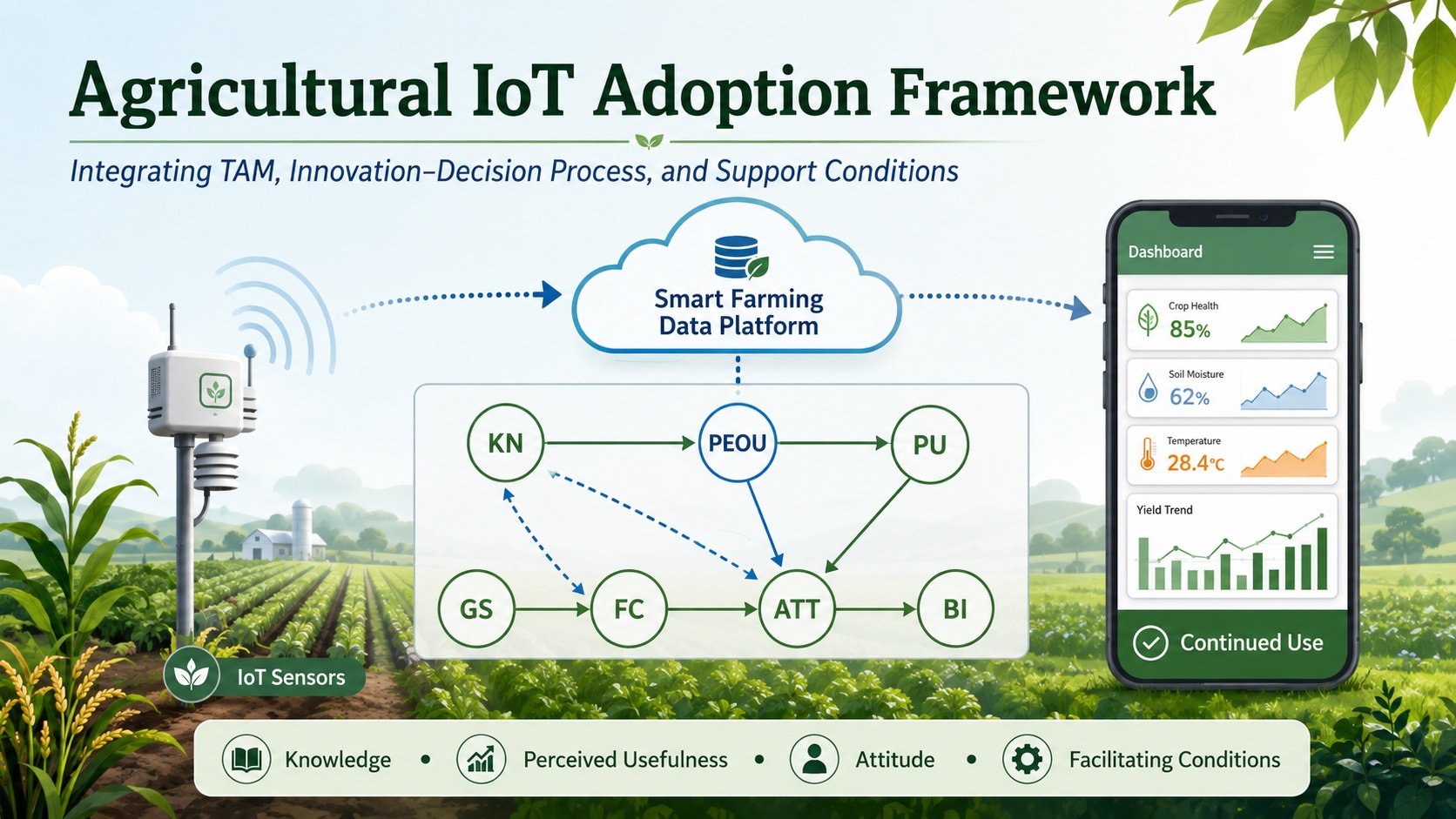
Agricultural Internet of Things (IoT) adoption in developing contexts remains constrained by a fragmented understanding of cognitive, behavioral, and contextual factors. A contextual framework is developed by integrating the Technology Acceptance Model (TAM), selected components of the Innovation–Decision Process (IDP), and key enabling conditions to explain continued use intention in smart farming environments. Data from 250 Thai agricultural stakeholders with prior exposure to or implementation experience with IoT-based agricultural applications were analyzed using partial least squares structural equation modeling (PLS-SEM). Results indicate that perceived usefulness is the strongest predictor of attitude toward use, which in turn drives continued use intention. Knowledge plays a critical role as a precursor, shaping perceived ease of use, persuasion, and perceived usefulness, underscoring the importance of cognitive readiness even among experienced users. Facilitating conditions significantly support continued use intention, whereas governmental support shows no direct effect. Perceived ease of use does not significantly influence attitude, suggesting that functional value may outweigh usability considerations in post-adoption or experience-based contexts. The framework offers a context-sensitive explanation of agricultural IoT adoption by linking cognitive processes with operational support mechanisms, while the model-fit results indicate that conclusions should be interpreted with appropriate caution.
Article Details

This work is licensed under a Creative Commons Attribution-NonCommercial-NoDerivatives 4.0 International License.
References
Charania, I. L.; Xinrong. Smart Farming: Agriculture's Shift from a Labor Intensive to Technology Native Industry. Internet Things 2020, 9, 100142. https://doi.org/10.1016/j.iot.2019.100142
Wolfert, S.; Ge, L.; Verdouw, C.; Bogaardt, M. J. Big Data in Smart Farming—A Review. Agric. Syst. 2017, 153, 69–80. https://doi.org/10.1016/j.agsy.2017.01.023
Kamilaris, A.; Kartakoullis, A.; Prenafeta-Boldú, F. X. Agri-IoT: A Semantic Framework for Internet of Things-Enabled Smart Farming Applications. In Proceedings of the 2016 IEEE 3rd World Forum on Internet of Things (WF-IoT); IEEE, 2016. https://doi.org/10.1109/WF-IoT.2016.7845467
Digital Economy Promotion Agency. Thailand Digital Outlook Report 2021; Digital Economy Promotion Agency: Bangkok, Thailand, 2021.
Koech, R.; Langat, P. Improving Irrigation Water Use Efficiency: A Review of Advances, Challenges and Opportunities in the Australian Context. Water 2018, 10, 1771. https://doi.org/10.3390/w10121771
Morchid, A.; et al. IoT-Based Smart Irrigation Management System to Enhance Agricultural Water Security Using Embedded Systems, Telemetry Data, and Cloud Computing. Results Eng. 2024, 23, 102829. https://doi.org/10.1016/j.rineng.2024.102829
Al Mamun, M. R.; et al. IoT-Enabled Solar-Powered Smart Irrigation for Precision Agriculture. Smart Agric. Technol. 2025, 10, 100773. https://doi.org/10.1016/j.atech.2025.100773
Thameeza; Mohammed Tanzeem, A. IoT Based Smart Irrigation System for Precision Agriculture. Int. J. Eng. Res. Appl. 2021, 11, 66–69.
Song, Y.; Bi, J.; Wang, X. Design and Implementation of Intelligent Monitoring System for Agricultural Environment in IoT. Internet Things 2024, 25, 101029. https://doi.org/10.1016/j.iot.2023.101029
Chinedu, P. U.; Isah, Y.; Chinedu, N. B. An Internet of Things (IoT)-Based Smart Agriculture Monitoring System for Enhanced Productivity in a Controlled Farm Environment. J. Sci. Technol. Educ. 2022, 10, 122–136.
Fatima, S. F.; Ali, S.; Shinde, U. Overview of IoT-Based Agriculture Monitoring System. Int. J. Innov. Eng. Res. Technol. 2020, 7, 37–40.
Rabak, A.; et al. Sensor System for Precision Agriculture Smart Watering Can. Results Eng. 2023, 19, 101297. https://doi.org/10.1016/j.rineng.2023.101297
Serin, J.; et al. AI-Driven Smart Farming for Automated Plant Health Monitoring and Nutrient Deficiency Detection. ASEAN J. Sci. Technol. Rep. 2026, 29, e258175. https://doi.org/10.55164/ajstr.v29i1.258175
Singh, J. P.; et al. Design and Development of a Smart Automated System for Poultry Farm Management Using Internet of Things (IoT). ASEAN J. Sci. Technol. Rep. 2026, 29, e260601. https://doi.org/10.55164/ajstr.v29i4.260601
Chomanee, J.; et al. An Experimental Set for Studying the Changing State of Matter with Smart Learning Media Displayed through the IoT System for Smart-Lab. ASEAN J. Sci. Technol. Rep. 2024, 27, 42–49. https://doi.org/10.55164/ajstr.v25i4.247317
Chomanee, J.; et al. Development of an Apparatus for Educational Heat of Reaction in Chemical Laboratory with Digital Thermal Sensor and IoT on Smartphone. ASEAN J. Sci. Technol. Rep. 2024, 27, 70–78.
Otanasap, N.; Kanchanawongkul, V.; Chalermsuk, C. Design and Development of Saline Infusion Administration System Using IoT. ASEAN J. Sci. Technol. Rep. 2024, 27, 41–49. https://doi.org/10.55164/ajstr.v25i1.244460
Sangkhiew, N.; et al. A Study of Disruptive Technology Impacts on Industrial Engineering Professionals under the Context of Thailand 4.0. ASEAN J. Sci. Technol. Rep. 2024, 27, 1–9.
Gzar, D. A.; Mahmood, A. M.; Al-Adilee, M. K. A. Recent Trends of Smart Agricultural Systems Based on Internet of Things Technology: A Survey. Comput. Electr. Eng. 2022, 104, 108453. https://doi.org/10.1016/j.compeleceng.2022.108453
Rajak, P.; et al. Internet of Things and Smart Sensors in Agriculture: Scopes and Challenges. J. Agric. Food Res. 2023, 14, 100776. https://doi.org/10.1016/j.jafr.2023.100776
Zhang, Q.-Y.; Zhang, T.-T. Introduction to the System of Agricultural Internet of Things. In Design, Manufacturing and Mechatronics; pp 548–557. https://doi.org/10.1142/9789814730518_0066
Jabeen, M.; Ishaq, K. Adoption of Internet of Things in Telecommunications: An Emerging Market Case. Int. J. Innov. Technol. Manage. 2024, 21, 2450020. https://doi.org/10.1142/S0219877024500202
Davis, F. D. Perceived Usefulness, Perceived Ease of Use, and User Acceptance of Information Technology. MIS Q. 1989, 13, 319–340. https://doi.org/10.2307/249008
Duang-Ek-Anong, S.; Pibulcharoensit, S.; Phongsatha, T. Technology Readiness for Internet of Things (IoT) Adoption in Smart Farming in Thailand. Int. J. Simul. Syst. Sci. Technol. 2019. https://doi.org/10.5013/IJSSST.a.20.05.12
Thomas, R. J.; et al. Development of a Scale to Measure Technology Acceptance in Smart Agriculture. arXiv 2022, arXiv:2203.15423.
Alzahrani, A. Analysis of the Technology Acceptance Model TAM in Understanding Faculty’s Behavioral Intention to Use Internet of Things IOT. Int. J. Educ. Res. Innov. 2023, 153–169. https://doi.org/10.46661/ijeri.7461
Mishra, N.; et al. Technology in Farming: Unleashing Farmers’ Behavioral Intention for the Adoption of Agriculture 5.0. PLoS One 2024, 19, e0308883. https://doi.org/10.1371/journal.pone.0308883
Okai, G.; Agangiba, W.; Agangiba, M. Assessment of Farmers’ Acceptance of Intelligent Agriculture System Using Technology Acceptance Model. Int. J. Comput. Appl. 2024, 186, 16–22. https://doi.org/10.5120/ijca2024923953
Rodzoan, M. Smart Farming: Integrating IoT and UAV Technologies for Precision Agriculture through the Lens of Technology Acceptance and the UTAUT2 Model. Pak. J. Life Soc. Sci. 2024, 22. https://doi.org/10.57239/PJLSS-2024-22.2.00468
Li, L.; et al. The Influence Mechanism Analysis on the Farmers’ Intention to Adopt Internet of Things Based on UTAUT-TOE Model. Sci. Rep. 2024, 14, 15016. https://doi.org/10.1038/s41598-024-65415-4
Bahari, M.; et al. Driving Agricultural Transformation: Unraveling Key Factors Shaping IoT Adoption in Smart Farming with Empirical Insights. Sustainability 2024, 16, 2129. https://doi.org/10.3390/su16052129
Jaroenwanit, P.; et al. Risk Management in the Adoption of Smart Farming Technologies by Rural Farmers. Uncertain Supply Chain Manage. 2023, 11, 533–546. https://doi.org/10.5267/j.uscm.2023.2.011.
Dibbern, T.; Romani, L. A. S.; Massruhá, S. M. F. S. Main Drivers and Barriers to the Adoption of Digital Agriculture Technologies. Smart Agric. Technol. 2024, 8, 100459. https://doi.org/10.1016/j.atech.2024.100459
Far, S. T.; Rezaei-Moghaddam, K. Impacts of the Precision Agricultural Technologies in Iran: An Analysis of Experts’ Perception and Their Determinants. Inf. Process. Agric. 2018, 5, 173–184. https://doi.org/10.1016/j.inpa.2017.09.001
Zhang, X.; et al. Acceptance of New Agricultural Technology among Small Rural Farmers. Humanit. Soc. Sci. Commun. 2024, 11, 1641. https://doi.org/10.1057/s41599-024-04163-2
Okai, G.; et al. Evaluation of Rice Farmers' Acceptance of a Knowledge Management System Using the Technology Acceptance Model. Int. J. Comput. Appl. 2025, 186, 45–53. https://doi.org/10.5120/ijca2025924744
Zhahir, A.; et al. Smart Farming Adoption—A Scoping Review. Konstelasi: Konvergensi Teknol. Sist. Inf. 2024, 4, 14–23. https://doi.org/10.24002/konstelasi.v4i1.9257
Venkatesh, V.; Bala, H. Technology Acceptance Model 3 and a Research Agenda on Interventions. Decis. Sci. 2008, 39, 273–315. https://doi.org/10.1111/j.1540-5915.2008.00192.x
Rogers, E. M. Diffusion of Innovations, 3rd ed.; Free Press: New York, NY, 1983.
Food and Agriculture Organization of the United Nations. In Brief to The State of Food and Agriculture 2020: Overcoming Water Challenges in Agriculture; FAO: Rome, Italy, 2020.
Li, L.; et al. Investigating the Intention and Behavior of Vegetable Farmers to Adopt IoT Technology: Survey-Based Evidence from China. Front. Sustain. Food Syst. 2024, 8. https://doi.org/10.3389/fsufs.2024.1340874
Hair, J. F.; Hult, G. T. M.; Ringle, C. M.; Sarstedt, M. Partial Least Squares Structural Equation Modeling (PLS-SEM) Using R; SAGE Publications: Thousand Oaks, CA, 2019. https://doi.org/10.3926/oss.37
Venkatesh, V. Determinants of Perceived Ease of Use: Integrating Control, Intrinsic Motivation, and Emotion into the Technology Acceptance Model. Inf. Syst. Res. 2000, 11, 342–365. https://doi.org/10.1287/isre.11.4.342.11872
Cronbach, L. J. Coefficient Alpha and the Internal Structure of Tests. Psychometrika 1951, 16, 297–334. https://doi.org/10.1007/BF02310555
Fornell, C.; Larcker, D. F. Evaluating Structural Equation Models with Unobservable Variables and Measurement Error. J. Mark. Res. 1981, 18, 39–50. https://doi.org/10.2307/3151312
Henseler, J.; Ringle, C. M.; Sarstedt, M. A New Criterion for Assessing Discriminant Validity in Variance-Based Structural Equation Modeling. J. Acad. Mark. Sci. 2015, 43, 115–135. https://doi.org/10.1007/s11747-014-0403-8
