
Enhancing Biogas Yield Prediction Using Artificial Neural Networks: A Case Study with Agricultural Residues
Article Sidebar
Main Article Content
Abstract
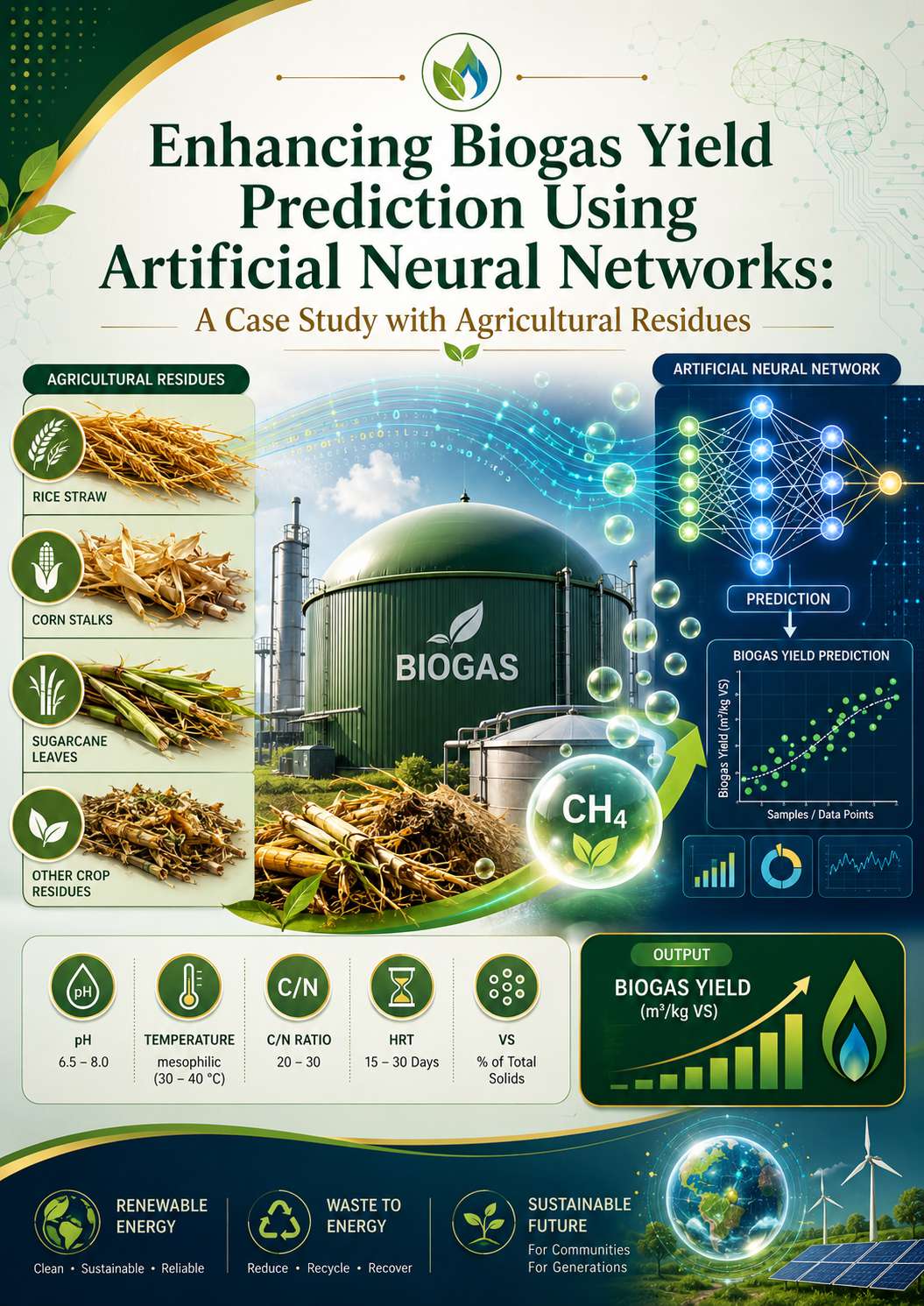
Accurate prediction of biogas yield is fundamentally important for the proper running of anaerobic digestion (AD) processes, and it involves complex interactions between process parameters and very nonlinear interactions. To address this problem, the present study systematically developed and evaluated different ANN models for predicting biogas yield from the anaerobic digestion of agricultural residues, including rice straw, cattle manure (CM), and palm oil residues. In all, 200 experimental observations were used to develop the models, with feed pH, temperature, volatile solids (%TS), C/N ratio, and HRT (days) as input variables and biogas yield as the output variable. Five ANN models with different network depths and training algorithms were developed and evaluated. The various performance criteria used for model validation were R² (coefficient of determination), RMSE (root mean squared error), and MAPE (mean absolute percentage error). The experimental results showed that deep ANN models outperformed shallow architectures in modeling the nonlinear trends of the AD phenomenon. Among the tested models, the multi-layered ANN-4 with the Levenberg-Marquardt algorithm achieved the highest predictive accuracy (R² = 0.962, RMSE = 0.018 m³/kg VS, MAPE = 3.1%). Regression analysis and 10-fold cross-validation verified the generalization ability of ANN-4. Sensitivity analysis showed that the C/N ratio, volatile solids (%TS) and HRT were the most significant parameters affecting biogas yield, consistent with established anaerobic digestion mechanisms. Overall, the findings indicate that deep ANN models can be effective tools for optimizing agricultural residue-based anaerobic digestion systems.
Article Details

This work is licensed under a Creative Commons Attribution-NonCommercial-NoDerivatives 4.0 International License.
References
Maclean, J. A.; Bartelt-Hunt, S.; Snow, D. D.; Borsuah, J. F.; Becker, R. W.; Hazra, M. Aquatic Occurrence, Fate and Potential Ecotoxicity of Insecticide and Fungicide Residues Originating from a Biofuels Production Facility Using Pesticide-Treated Seeds. J. Hazard. Mater. 2025, 486, 136922. https://doi.org/10.1016/j.jhazmat.2024.136922
Askary, T. H.; Abd-Elgawad, M. M. M. Opportunities and Challenges of Entomopathogenic Nematodes as Biocontrol Agents in Their Tripartite Interactions. Egypt. J. Biol. Pest Control 2021, 31, 42. https://doi.org/10.1186/s41938-021-00391-9
Pascual, M. L. D.; Pascual, P. R. L.; Alburo, H. M. Heterorhabditis taysearae and Heterorhabditis bacteriophora: Promising Indigenous Entomopathogenic Nematodes against Vegetable Insect Pest. J. Agric. Technol. Manage. 2018, 8–13.
Shapiro-Ilan, D.; Hazir, S.; Glazer, I. Basic and Applied Research: Entomopathogenic Nematodes. In Microbial Control of Insect and Mite Pests; Lacey, L. A., Ed.; Academic Press: London, 2017; pp 91–105. https://doi.org/10.1016/B978-0-12-803527-6.00006-8
Glover, J. P.; Spaulding, N.; George, J.; Portilla, M.; Reddy, G. V.; Dillman, A. Efficacy of the Newly Discovered Entomopathogenic Nematode Steinernema adamsi against Helicoverpa zea: Life Stage Susceptibility, UV Tolerance, and Field Performance. J. Nematol. 2025, 57(1), 20250012. https://doi.org/10.2478/jofnem-2025-0012
Griffin, C. T.; Boemare, N. E.; Lewis, E. E. Biology and Behaviour. In Nematodes as Biocontrol Agents; Grewal, P. S., Ehlers, R.-U., Shapiro-Ilan, D. I., Eds.; CAB International: Wallingford, U.K., 2005; pp 47–64. https://doi.org/10.1079/9780851990170.0047
Nugrohorini. Eksplorasi Nematoda Entomopatogen pada Beberapa Wilayah di Jawa Timur. J. Pertan. MAPETA 2010, 12(2), 72–144.
Indriyanti, D. R.; Muharromah, N. L. Mass Cultivation of Entomopathogenic Nematode in Artificial Media. Biosaintifika 2016, 8(1), 113–120. https://doi.org/10.15294/biosaintifika.v8i1.5579
Peters, A.; Han, R.; Yan, X.; Leite, L. G. Production of Entomopathogenic Nematodes. In Microbial Control of Insect and Mite Pests; Academic Press: London, 2017; pp 157–170. https://doi.org/10.1016/B978-0-12-803527-6.00010-X
House, H. L.; Welch, H. E.; Cleugh, T. R. Food Medium of Prepared Dog Biscuit for the Mass-Production of the Nematode DD136 (Nematoda; Steinernematidae). Nature 1965, 206(4986), 847–847. https://doi.org/10.1038/206847a0
Hussein, M. A.; El-Mahdi, I. F. S. Artificial Solid Media for In Vitro Mass Production of Two Egyptian Nematodes. Biosci. Res. 2020, 17(1), 298–303.
Safitri, M.; Ratnasari, E.; Ambarwati, R. Efektivitas Steinernema sp. dalam Pengendalian Hama Serangga Tanah pada Berbagai Tekstur Tanah. LenteraBio 2013, 2(1), 25–31.
Thiruchchelvan, N.; Thirukkumaran, G.; Mikunthan, G. Mass Production of the Nematode Acrobeloides longiuterus Using Tribolium castaneum and Artificial Solid Media. Ruhuna J. Sci. 2021, 12(1). https://doi.org/10.4038/rjs.v12i1.97
Koppenhöfer, A. M.; Campbell, J. F.; Kaya, H. K.; Gaugler, R. Estimation of Entomopathogenic Nematode Population Density in Soil by Correlation between Bait Insect Mortality and Nematode Penetration. Fundam. Appl. Nematol. 1998, 21(1), 95–102.
Kvvs, K. K.; Yadav, S.; Patil, J. In Vitro Mass Production of Entomopathogenic Nematodes on Solid Media: A Review. J. Entomol. Zool. Stud. 2020, 8(3), 565–570.
Dunn, M. D.; Malan, A. P. Population Dynamics of a South African Isolate of Steinernema yirgalemense In Vitro Liquid Culture, Using Egg Yolk as Protein Source. J. Helminthol. 2024, 98, e64. https://doi.org/10.1017/S0022149X24000452
Shapiro-Ilan, D. I.; Leite, L. G.; Han, R. Production of Entomopathogenic Nematodes. In Mass Production of Beneficial Organisms; Morales-Ramos, J. A.; Rojas, M. G.; Shapiro-Ilan, D. I., Eds.; Academic Press: London, 2023; pp 293–315. https://doi.org/10.1016/B978-0-12-822106-8.00005-1
Mathew, J.; Vani, C.; Titus, J. Isolation and Mass Production of Entomopathogenic Nematode Steinernema saimkayai Using Semi-Solid Dog Feed Medium. J. Pure Appl. Microbiol. 2020, 14(1), 499–507. https://doi.org/10.22207/JPAM.14.1.52
Cho, J. H.; Kim, I. Fish Meal—Nutritive Value. J. Anim. Physiol. Anim. Nutr. 2011, 95(6), 685–692. https://doi.org/10.1111/j.1439-0396.2010.01109.x
Gupta, N.; Srivastava, N.; Bhagyawant, S. S. Vicilin, a Major Storage Protein of Mungbean, Exhibits Antioxidative Potential, Antiproliferative Effects and ACE Inhibitory Activity. PLoS One 2018, 13(2), e0191265. https://doi.org/10.1371/journal.pone.0191265
Feng, Q.; Niu, Z.; Zhang, S.; Wang, L.; Qun, S.; Yan, Z.; Zhou, S. Mung Bean Protein as an Emerging Source of Plant Protein: A Review on Production Methods, Functional Properties, Modifications and Its Potential Applications. J. Sci. Food Agric. 2024, 104(5), 2561–2573. https://doi.org/10.1002/jsfa.13107
Sable, S.; Vairal, A.; Bhosale, V.; Surve, S.; Raza, U.; Thengre, M. Bioplastic from Agar Powder: Preparation and Its Characterization. Sci. Adv. Mater. 2024, 16(10), 1040–1046. https://doi.org/10.1166/sam.2024.4713
Karimi, S.; Eivazian Kary, N.; Mohammadi, D. Optimization of Carboxymethyl Cellulose-Based Formulations for Enhanced Shelf Life of an Entomopathogenic Nematode, Steinernema carpocapsae. Egypt. J. Biol. Pest Control 2025, 35 (1), 1–14. https://doi.org/10.1186/s41938-025-00858-z
Nguyen, K. B.; Hunt, D. J. Entomopathogenic Nematodes: Systematics, Phylogeny and Bacterial Symbionts; Brill: Leiden, The Netherlands, 2007; Vol. 5. https://doi.org/10.1163/ej.9789004152939.i-816
Pascual, P. R. L.; Pascual, M. L. D.; Alburo, H. M. First Report of Entomopathogenic Nematode Heterorhabditidae (Rhabditida) in Organic Vegetable Farms in Cebu, Philippines. J. Agric. Technol. Manage. 2017, 1–9.
Widiyaningrum, P.; Khasanah, M.; Indriyanti, D. R. Mealworm Powder as Culture Media of Local Isolate Semarang Entomopathogenic Nematodes. Biosaintifika 2018, 10(1), 191–197. https://doi.org/10.15294/biosaintifika.v10i1.13874
Zhen, S.; Li, Y.; Hou, Y.; Gu, X.; Zhang, L.; Ruan, W.; Shapiro-Ilan, D. Enhanced Entomopathogenic Nematode Yield and Fitness via Addition of Pulverized Insect Powder to Solid Media. J. Nematol. 2018, 50(4), 495–503. https://doi.org/10.21307/jofnem-2018-050
Somwong, P.; Petcharat, J. Culture of the Entomopathogenic Nematode Steinernema carpocapsae (Weiser) on Artificial Media. J. Agric. Biol. Sci. 2012, 7(4), 292–295.
Cimen, H. The Role of Photorhabdus-Induced Bioluminescence and Red Cadaver Coloration on the Deterrence of Insect Scavengers from Entomopathogenic Nematode-Infected Cadavers. J. Invertebr. Pathol. 2023, 196, 107871. https://doi.org/10.1016/j.jip.2022.107871
Booysen, E.; Malan, A. P.; Dicks, L. M. Colour of Heterorhabditis zealandica-Infected Galleria mellonella Dependent on the Photorhabdus Symbiont, with Two New Nematode-Symbiotic Associations Reported. J. Invertebr. Pathol. 2022, 189, 107729. https://doi.org/10.1016/j.jip.2022.107729
Singh, S.; Eric, M.; Floyd, I.; Leonard, H. D. Characterization of Photorhabdus luminescens Growth for the Rearing of the Beneficial Nematode Heterorhabditis bacteriophora. Indian J. Microbiol. 2012, 52(3), 325–331. https://doi.org/10.1007/s12088-011-0238-7
Shapiro-Ilan, D. I.; Rojas, M. G.; Morales-Ramos, J. A.; Tedders, W. L. Optimization of a Host Diet for In Vivo Production of Entomopathogenic Nematodes. J. Nematol. 2012, 44(3), 264–273.
Koppenhöfer, A. M.; Shapiro-Ilan, D. I.; Hiltpold, I. Entomopathogenic Nematodes in Sustainable Food Production. Front. Sustain. Food Syst. 2020, 4, 125. https://doi.org/10.3389/fsufs.2020.00125
McMullen, J. G., II; Stock, S. P. In Vivo and In Vitro Rearing of Entomopathogenic Nematodes (Steinernematidae and Heterorhabditidae). J. Vis. Exp. 2014, (91), e52096. https://doi.org/10.3791/52096
Cortés-Martínez, C. I.; Rodríguez-Hernández, A. I.; López-Cuellar, M. R.; Chavarría-Hernández, N. Surface Culture of Steinernema sp. on Two Solid Media and Their Pathogenicity against Galleria mellonella. J. Helminthol. 2021, 95, e63. https://doi.org/10.1017/S0022149X21000560
Kaya, H. K.; Gaugler, R. Entomopathogenic Nematodes. Annu. Rev. Entomol. 1993, 38, 181–206. https://doi.org/10.1146/annurev.en.38.010193.001145
Lewis, E. E.; Campbell, J.; Griffin, C.; Kaya, H.; Peters, A. Behavioral Ecology of Entomopathogenic Nematodes. Biol. Control 2006, 38(1), 66–79. https://doi.org/10.1016/j.biocontrol.2005.11.007
Boemare, N. E. Biology, Taxonomy and Systematics of Photorhabdus and Xenorhabdus. In Entomopathogenic Nematology; Gaugler, R., Ed.; CABI Publishing: Wallingford, U.K., 2002; pp 35–56. https://doi.org/10.1079/9780851995670.0035
