
Antibacterial Activity of Fungal Endophytes Isolated from Kratom (Mitragyna speciosa) in Thailand
Article Sidebar
Main Article Content
Abstract
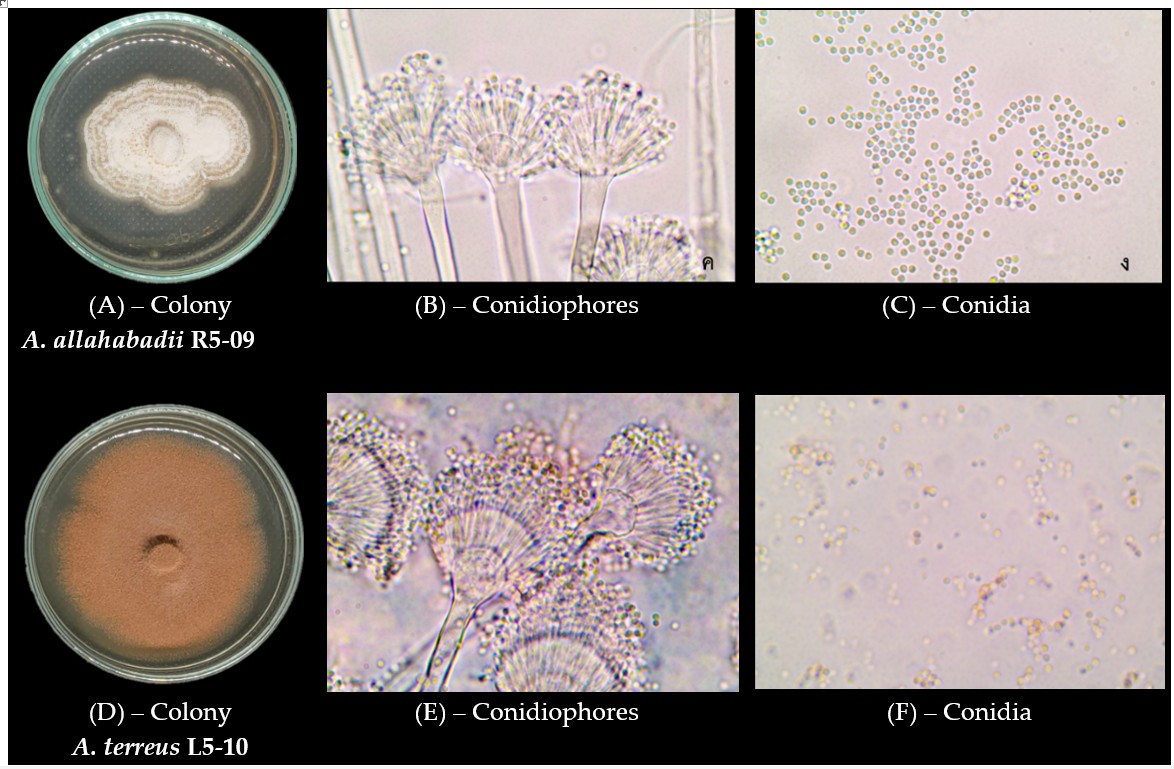
Kratom (Mitragyna speciosa), which is an indigenous plant in Asia, has been used as traditional medicine for decades. This study focuses on fungal endophytes originally isolated from kratom and their antibacterial activity. Kratom plants were obtained from seven locations in Thailand. In each location, three plant parts, including leaves, stems, and roots, were collected. The plant materials were surface-sterilized and isolated for endophytic fungi on PDA amended with kanamycin. A total of 347 isolates of fungal endophytes were isolated, and 92 isolates were randomly selected for antibacterial activity against Bacillus subtilis, Staphylococcus aureus, Escherichia coli, and Pseudomonas aeruginosa. They were cultured in 50 ml of potato dextrose broth (PDB) at 25°C for 4 weeks, and the culture broth was tested against 4 bacteria using an agar well diffusion method. 11 isolates (12%) inhibited at least one bacterial species. Eight endophytes inhibited B. subtilis, while four, three, and one endophytes inhibited the other three bacteria, respectively. Six isolates of fungal endophytes were chosen for further screening. They were cultured in 2 L of PDB and incubated at 25°C for four weeks. After mycelium was separated, only culture broth was extracted three times with ethyl acetate using rotary evaporation, and the extracts were dissolved in DMSO before testing. Antibacterial activity was determined by disk diffusion, and inhibition zones were recorded. One crude extract (L1-01) partially inhibited E. coli (8.28 mm). In the three crude extract tests against S. aureus, L5-10 exhibited the highest activity (17.51 mm). Among four crude extracts inhibiting B. subtilis, R5-09 had the strongest activity (21.3 mm). These two fungal endophyte isolates (R5-09 and L5-10) were identified based on morphological and molecular characteristics and assigned to Aspergillus allahabadii and Aspergillus terreus, respectively. This finding emphasized that fungal endophytes from kratom have potential as a source of antibacterial substances and should be further studied for other bioactivities.
Article Details

This work is licensed under a Creative Commons Attribution-NonCommercial-NoDerivatives 4.0 International License.
References
Emerick, T.; Durbhakula, S.; Eibel, M. R.; Kohan, L. Kratom: A Primer for Pain Physicians. Curr. Opin. Anaesthesiol. 2024, 37(5), 575–580. https://doi.org/10.1097/ACO.0000000000001413
Heywood, J.; Smallets, S.; Paustenbach, D. Beneficial and Adverse Health Effects of Kratom (Mitragyna speciosa): A Critical Review of the Literature. Food Chem. Toxicol. 2024, 192, 114913. https://doi.org/10.1016/j.fct.2024.114913
Substance Abuse and Mental Health Services Administration (SAMHSA). Key Substance Use and Mental Health Indicators in the United States: Results from the 2021 National Survey on Drug Use and Health; U.S. Department of Health and Human Services: Rockville, MD, 2022; p 72.
Naghavi, M.; Vollset, S. E.; Ikuta, K. S.; Swetschinski, L. R.; Gray, A. P.; Wool, E. E.; Robles Aguilar, G.; Mestrovic, T.; Smith, G.; Han, C.; et al. Global Burden of Bacterial Antimicrobial Resistance 1990–2021: A Systematic Analysis with Forecasts to 2050. Lancet 2024, 404(10459), 1199–1226. https://doi.org/10.1016/S0140-6736(24)01867-1
Phongpaichit, S.; Rungjindamai, N.; Rukachaisirikul, V.; Sakayaroj, J. Antimicrobial Activity in Cultures of Endophytic Fungi Isolated from Garcinia Species. FEMS Immunol. Med. Microbiol. 2006, 48(3), 367–372. https://doi.org/10.1111/j.1574-695X.2006.00155.x
Al-Rajhi, A. M. H.; Mashraqi, A.; Al Abboud, M. A.; Shater, A. M.; Al Jaouni, S. K.; Selim, S.; Abdelghany, T. M. Screening of Bioactive Compounds from Endophytic Marine-Derived Fungi in Saudi Arabia: Antimicrobial and Anticancer Potential. Life 2022, 12(8), 1182. https://doi.org/10.3390/life12081182
Devi, R.; Verma, R.; Dhalaria, R.; Kumar, A.; Kumar, D.; Puri, S.; Thakur, M.; Chauhan, S.; Chauhan, P. P.; Nepovimova, E.; et al. A Systematic Review on Endophytic Fungi and Its Role in the Commercial Applications. Planta 2023, 257(4), 70. https://doi.org/10.1007/s00425-023-04087-2
Sukmawaty, E.; Karim, A.; Dwyana, Z.; Natsir, H.; Karim, H.; Ahmad, A.; Larekeng, S. H. Bioactivity and Metabolites Compounds of Medicinal Plants Endophytic Fungi in Indonesia. J. Trop. Biodivers. Biotechnol. 2024, 9(2). https://doi.org/10.22146/jtbb.79070
Nischitha, R. Role of Grass Endophytic Fungi as a Natural Resource of Bioactive Metabolites. Arch. Microbiol. 2024, 206(10). https://doi.org/10.1007/s00203-024-04132-y
Singwongwatana, S. Bioactive Compounds from Endophytic Fungi Isolated from Mitragyna speciosa Korth. Chulalongkorn University, 2004.
Inayatul, F. Diversity of Endophytic Fungi of Kratom (Mitragyna speciosa Korth). Syarif Hidayatullah State Islamic University Jakarta, 2023.
Phankaeo, N.; Nuchthien, K.; Pitthayajirakul, N.; Rungjindamai, N. Biological Control of Pichia bruneiensis AL3 against Green Mould Disease on Oranges. J. Agric. Sci. Technol. 2024, 26(5), 999–1012. https://doi.org/10.22034/jast.26.5.999
Schoch, C. L.; Seifert, K. A.; Huhndorf, S.; Robert, V.; Spouge, J. L.; Levesque, C. A.; Chen, W.; Consortium, F. B. Nuclear Ribosomal Internal Transcribed Spacer (ITS) Region as a Universal DNA Barcode Marker for Fungi. Proc. Natl. Acad. Sci. U.S.A. 2012, 109(16), 6241–6246. https://doi.org/10.1073/pnas.1117018109
Santos, I. P. D.; Silva, L. C. N. D.; Silva, M. V. D.; Araújo, J. M. D.; Cavalcanti, M. D. S.; Lima, V. L. D. M. Antibacterial Activity of Endophytic Fungi from Leaves of Indigofera suffruticosa Miller (Fabaceae). Front. Microbiol. 2015, 6, 350. https://doi.org/10.3389/fmicb.2015.00350
Breijyeh, Z.; Jubeh, B.; Karaman, R. Resistance of Gram-Negative Bacteria to Current Antibacterial Agents and Approaches to Resolve It. Molecules 2020, 25(6), 1340. https://doi.org/10.3390/molecules25061340
Xing, Y.-M.; Chen, J.; Cui, J.-L.; Chen, X.-M.; Guo, S.-X. Antimicrobial Activity and Biodiversity of Endophytic Fungi in Dendrobium devonianum and Dendrobium thyrsiflorum from Vietnam. Curr. Microbiol. 2011, 62(4), 1218–1224. https://doi.org/10.1007/s00284-010-9848-2
Jouda, J. B.; Tamokou, J. D.; Mbazoa, C. D.; Douala-Meli, C.; Sarkar, P.; Bag, P. K.; Wandji, J. Antibacterial and Cytotoxic Cytochalasins from the Endophytic Fungus Phomopsis sp. Harbored in Garcinia kola (Heckel) Nut. BMC Complement. Altern. Med. 2016, 16, 462. https://doi.org/10.1186/s12906-016-1454-9
Sadrati, N.; Zerroug, A.; Demirel, R.; Harzallah, D. Anti-Multidrug-Resistant Staphylococcus aureus and Anti-Dermatophyte Activities of Secondary Metabolites of the Endophytic Fungus Penicillium brevicompactum ANT13 Associated with the Algerian Endemic Plant Abies numidica. Arch. Microbiol. 2023, 205(4), 110. https://doi.org/10.1007/s00203-023-03452-9
Liao, F.; He, J.; Li, R.; Hu, Y. Endophytic Fungus UJ3-2 from Urtica fissa: Antibacterial Activity and Mechanism of Action against Staphylococcus aureus. Molecules 2024, 29(20), 4850. https://doi.org/10.3390/molecules29204850
Caruso, D. J.; Palombo, E. A.; Moulton, S. E.; Zaferanloo, B. Exploring the Promise of Endophytic Fungi: A Review of Novel Antimicrobial Compounds. Microorganisms 2022, 10(10), 1990. https://doi.org/10.3390/microorganisms10101990
Hagag, A.; Abdelwahab, M. F.; Abd El-Kader, A. M.; Fouad, M. A. The Endophytic Aspergillus Strains: A Bountiful Source of Natural Products. J. Appl. Microbiol. 2022, 132(6), 4150–4169. https://doi.org/10.1111/jam.15489
El-Hawary, S. S.; Moawad, A. S.; Bahr, H. S.; Abdelmohsen, U. R.; Mohammed, R. Natural Product Diversity from the Endophytic Fungi of the Genus Aspergillus. RSC Adv. 2020, 10(37), 22058–22079. https://doi.org/10.1039/D0RA04290K
Shehabeldine, A. M.; Abdelaziz, A. M.; Abdel-Maksoud, M. A.; El-Tayeb, M. A.; Kiani, B. H.; Hussein, A. S. Antimicrobial Characteristics of Endophytic Aspergillus terreus and Acute Oral Toxicity Analysis. Electron. J. Biotechnol. 2024, 72, 1–11. https://doi.org/10.1016/j.ejbt.2024.07.003
Amr, K.; Ibrahim, N.; Elissawy, A. M.; Singab, A. N. B. Unearthing the Fungal Endophyte Aspergillus terreus for Chemodiversity and Medicinal Prospects: A Comprehensive Review. Fungal Biol. Biotechnol. 2023, 10, 6. https://doi.org/10.1186/s40694-023-00153-2
Sadorn, K.; Saepua, S.; Boonyuen, N.; Laksanacharoen, P.; Rachtawee, P.; Prabpai, S.; Kongsaeree, P.; Pittayakhajonwut, P. Allahabadolactones A and B from the Endophytic Fungus, Aspergillus allahabadii BCC45335. Tetrahedron 2016, 72(4), 489–495. https://doi.org/10.1016/j.tet.2015.11.056
Rajamanikyam, M.; Gade, S.; Vadlapudi, V.; Parvathaneni, S. P.; Koude, D.; Dommati, A. K.; Tiwari, A. K.; Misra, S.; Sripadi, P.; Amaychy, R.; Upadhyahula, S. M. Biophysical and Biochemical Characterization of Active Secondary Metabolites from Aspergillus allhabadii. Process Biochem. 2017, 56, 45–56. https://doi.org/10.1016/j.procbio.2017.02.010
