
Determination of Sugarcane Maturity and Optimal Harvest Time via UV-Vis Spectrophotometry and Digital Refractometry
Article Sidebar
Main Article Content
Abstract
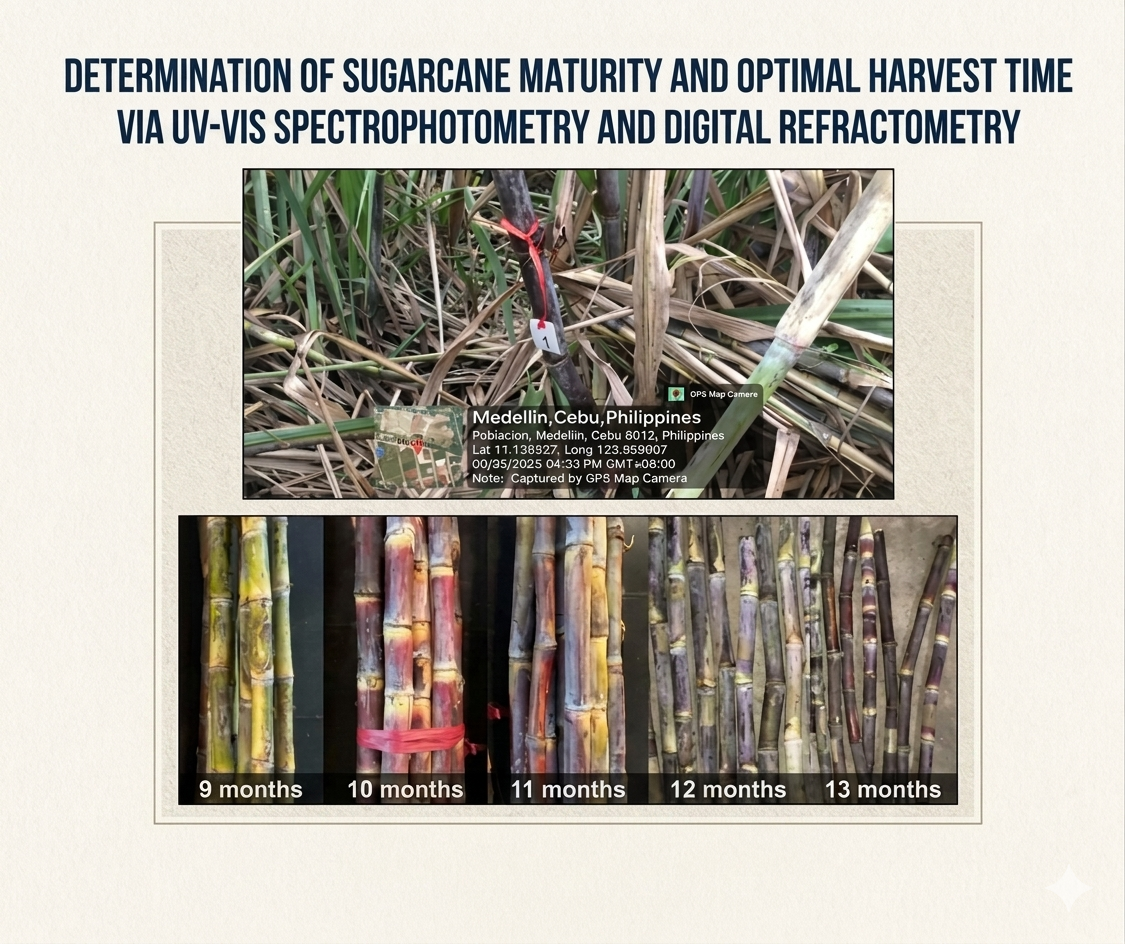
Accurate determination of sugarcane maturity is critical for maximizing sucrose yield and optimizing harvest efficiency; however, field-level assessment in smallholder systems remains largely subjective. This study determined the optimal harvest time for sugarcane (Saccharum officinarum L.) cultivated in Medellin, Cebu, Philippines, using systematic UV-Vis spectrophotometry and digital refractometry across five maturity stages (9-13 months after planting). Juice samples were extracted from three stalk positions (bottom, center, top) of ten randomly selected stalks per stage (n = 150 total). Total soluble solids (°Brix) and UV-Vis absorbance were measured, and data were analyzed using one-way and two-way ANOVA, Tukey’s HSD, Pearson correlation, linear discriminant analysis (LDA), and principal component analysis (PCA). The 12-month stage yielded the highest overall mean TSS (19.05 °Bx), the peak UV-Vis absorbance within the optimal range (1.1899 at 600 nm), and the lowest inter-sample variability (SD = 0.076). UV-Vis absorbance values were measured at stage-specific wavelengths (510–620 nm) as an exploratory chromophoric profiling approach; between-stage absorbance values are therefore not directly comparable on a single Beer–Lambert scale and should be interpreted as qualitative maturity indicators only. LDA correctly classified 83.33% of samples (Wilks’ λ, p < 0.05), and PCA confirmed the complementarity of the two methods. Twelve months after planting is recommended as the optimal harvest time, with a practical window of 11 to 12 months. Digital refractometry (≥18 °Bx at the bottom section) and UV-Vis spectrophotometry (absorbance 1.10–1.20 at 600 nm) together provide an accessible, scientifically validated decision-support framework for sugarcane harvest management in the Philippine context.
Article Details

This work is licensed under a Creative Commons Attribution-NonCommercial-NoDerivatives 4.0 International License.
References
Sugar Regulatory Administration. Average yield of sugarcane plantation in the Philippines from crop year 2018/19 to 2022/23. Statista 2024. https://www.statista.com/statistics/1480208 (accessed Jan 1, 2024).
Mehdi, S.; Ahmad, M. S.; Iqbal, M.; Mahmood, A. Current perspectives on the regulatory mechanisms of sucrose accumulation in sugarcane. Heliyon 2024, 10(5), e27277. https://doi.org/10.1016/j.heliyon.2024.e27277
Mubarak, M.; Niaz, M.; Zia, M. A.; Hussain, I. Post-harvest biology and recent advances of storage technologies in sugarcane. Biotechnol. Rep. 2022, 33, e00696. https://doi.org/10.1016/j.btre.2022.e00705
Rafiq, M.; Ahmed, R.; Rana, I. A.; Ahsan, M.; Ahmad, S. Expression of sucrose metabolizing enzymes in different sugarcane varieties under progressive heat stress. Front. Plant Sci. 2023, 14, 1269521. https://doi.org/10.3389/fpls.2023.1269521
Oliveira, T.; Santos, H.; Mendes, A. Climate variability and sugar accumulation in sugarcane: Implications for harvest scheduling. Agric. Syst. 2020, 185, 102950. https://doi.org/10.1016/j.agsy.2020.102950
Sukkasem, T.; Sittichok, K.; Chompuchan, C. An analysis of drought in Phetchaburi River Basin using TVDI derived from MODIS data. ASEAN J. Sci. Technol. Rep. 2020, 23(2), e240086. https://ph02.tci-thaijo.org/index.php/tsujournal/article/view/240086
Prasad, R.; Mehta, V.; Sharma, K. Application of spectrophotometry in sugarcane sucrose purity analysis. J. Sugarcane Res. 2020, 10(2), 76–84.
Rani, S.; Meena, K. UV–Vis spectroscopy for sugarcane maturity determination. Int. J. Plant Sci. 2023, 18(2), 134–141.
Khawsung, T.; Utaipan, T.; Treewanjutha, W. Smartphone-based spectrophotometer for facile and fast determination of lipid peroxidation in local fried food. ASEAN J. Sci. Technol. Rep. 2024, 27(2), e252346. https://doi.org/10.55164/ajstr.v27i2.252346
Tinnam, P.; Yodpijit, N.; Junsupasen, S.; Sappakittipakorn, M.; Jongprasithporn, M. Reduction of sound pressure levels with noise barriers containing agricultural residues: Case study. ASEAN J. Sci. Technol. Rep. 2025, 28(3), e257762. https://doi.org/10.55164/ajstr.v28i3.257762
Anuradha, S.; Nair, A. Digital refractometry as a reliable tool for assessing sugarcane maturity. J. Crop Sci. Technol. 2020, 9(2), 45–52.
Silva, F.; Barbosa, L.; Souza, C. Digital refractometry in determining sugarcane maturity stages. Sugar Tech 2021, 23(3), 654–662.
Barbosa Júnior, M. R.; Moreira, B. R. A.; de Oliveira, R. P.; Shiratsuchi, L. S.; da Silva, R. P. UAV imagery data and machine learning: A driving merger for predictive analysis of qualitative yield in sugarcane. Front. Plant Sci. 2023, 14, 1101934. https://doi.org/10.3389/fpls.2023.1114852
Aparatana, K.; Naomasa, Y.; Sano, M.; Watanabe, K.; Mitsuoka, M.; Ueno, M.; Kawamitsu, Y.; Taira, E. Predicting sugarcane quality using a portable visible near infrared spectrometer and a benchtop near infrared spectrometer. J. Near Infrared Spectrosc. 2023, 31(1), 14–23. https://doi.org/10.1255/jnirs.1145
Cabral, M. R.; Belon, A. R.; da Silva, S. A. Influence of phenolic compounds on color formation at different stages of the VHP sugar manufacturing process. Sci. Rep. 2022, 12, 19922. https://doi.org/10.1038/s41598-022-24455-4
Khan, M. S.; Mahmood, A.; Ashraf, M.; Rashid, M.; Iqbal, J.; Awan, S. I.; Ali, A. Morphological, agronomical, physiological and molecular characterization of a high sugar mutant of sugarcane. PLOS ONE 2022, 17(3), e0264990.
Subramanian, S.; Krishnan, R.; Ramesh, B. Affordable maturity assessment techniques for smallholder sugarcane farmers. Indian J. Agric. Sci. 2024, 94(1), 12–20.
Kumar, S.; Patel, R.; Joshi, D. Integrated use of spectrophotometry and refractometry for sugarcane maturity analysis. Agric. Eng. Today 2023, 47(3), 45–54.
Zhang, Y.; Li, H.; Zhao, Q. Combining refractometry and spectroscopy for improved sugarcane maturity prediction. Sensors 2022, 22(8), 3156.
Singh, H.; Meena, R. S.; Kumar, S.; Meena, V. S. Effect of harvesting ages on yield and yield components of sugar cane varieties cultivated at Finchaa Sugar Factory. Adv. Agric. 2021, Article 9936195.
Yusoff, M. N. H.; Zulkifli, N. W. M.; Sukiman, N. L.; Chyuan, O. H.; Hassan, M. H.; Hasnul, M. H.; Mamat, R. Physicochemical properties of sugarcane juice in relation to maturity. J. Phys. Sci. 2020, 31(2), 1–18. https://doi.org/10.21315/jps2020.31.2.1
Heenkenda, S.; Romero, D. A. Estimating sugarcane maturity using high spatial resolution remote sensing images. Drones 2024, 4(3), 24. https://doi.org/10.3390/drones4030024
Cohen, J. Statistical Power Analysis for the Behavioral Sciences, 2nd ed.; Lawrence Erlbaum Associates: Hillsdale, NJ, USA, 1988.
Chandra, P.; Yadav, R.; Mishra, A. Evaluating sugarcane harvest timing using digital refractometry. Int. J. Agric. Res. 2023, 18(1), 112–120.
Gómez, M. A.; Ruiz, J. L.; Torres, F. Sugarcane maturity assessment under variable climates in Latin America. Agronomy 2022, 12(5), 1123. https://doi.org/10.3390/agronomy12051123
