
การตรวจวัดอัตราการปลดปล่อยเรดอนจากหมอนยางพาราที่สุ่มตัวอย่างจากตลาดออนไลน์ในประเทศไทย
Article Sidebar
Main Article Content
บทคัดย่อ
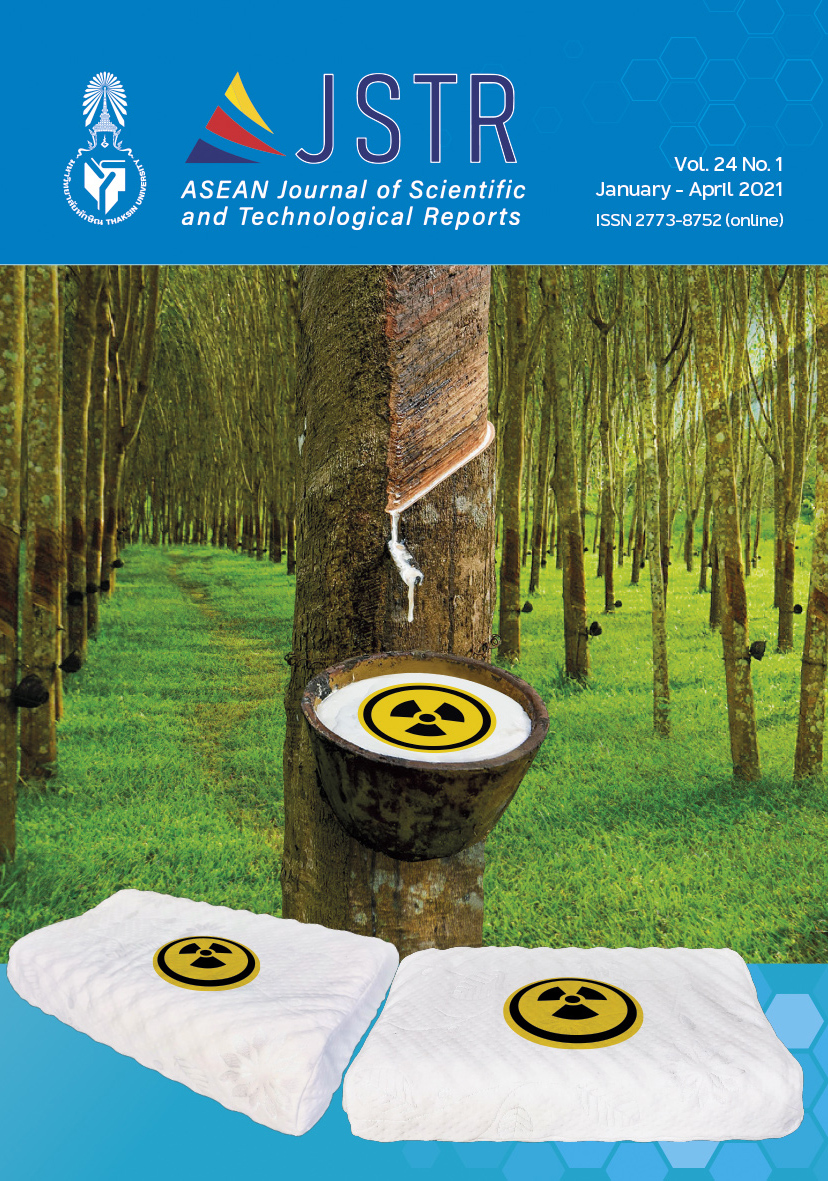
เรดอนเป็นก๊าซกัมมันตรังสีที่มีอยู่ตามธรรมชาติและเป็นที่สนใจทั่วโลกเพราะมีผลกระทบต่อสุขภาพ และเพิ่มโอกาสการป่ วยเป็นโรคมะเร็งปอดหลังจากได้รับในปริมาณความเข้มข้นสูงเป็นระยะเวลาที่ยาวนาน การศึกษาครั้งนี้เพื่อวัดปริมาณความเข้มข้นของก๊าซเรดอน ปริมาณอัตราการปลดปล่อยและประเมินปริมาณรังสียังผลรายปี ที่ได้รับอันเนื่องจากปริมาณก๊าซเรดอน เพื่อนำไปสู่การกำหนดค่ามาตรฐานควบคุมการปนเปื้อน ก๊าซเรดอนในผลิตภัณฑ์จากยางพาราในประเทศไทย ตัวอย่างหมอนยางพาราที่สุ่มซื้อจากตลาดออนไลน์ ในประเทศไทยถูกเก็บในถังวัดแบบปิดสนิทที่ต่อเข้ากับเครื่อง ATMOS 12 DPX ผลการตรวจวัด พบว่า ปริมาณความเข้มข้น สมมูลของก๊าซเรดอนมีค่าระหว่าง 11 ± 2 และ 43 ± 5 Bq m–3 และมีค่าเฉลี่ย 17 ± 9 Bq m–3 ซึ่งค่าที่วัดได้มีค่าต่ำกว่าค่าสูงสุดที่สามารถปนเปื้อนได้ในอากาศที่ 148 และ 300 Bq m–3 ตามมาตรฐาน USEPA และ ICRP ตามลำดับ อัตราการปลดปล่อยก๊าซเรดอนจากหมอนยางพารามีค่าระหว่าง 12 ± 3 และ 60 ± 7 mBq m–2 h–1 และมีค่าเฉลี่ย 25.7 ± 14.4 mBq m–2 h–1 นอกจากนี้การประเมินปริมาณรังสียังผลรายปีที่ได้รับ พบว่ามีค่าอยู่ระหว่าง 0.12 ± 0.03 และ 0.43 ± 0.05 mSv y–1 ซึ่งยังต่ำกว่าค่าขีดจำกัดของการรับรังสียังผลรายปี สำหรับประชาชนทั่วไป (1.0 mSv y–1) ตามมาตรฐานของ ICRP
Article Details

อนุญาตภายใต้เงื่อนไข Creative Commons Attribution-NonCommercial-NoDerivatives 4.0 International License.
เอกสารอ้างอิง
World Health Organization (WHO). (2009). Handbook on Indoor Radon: A Public Health Perspective. Geneva: WHO Press.
International Commission on Radiological Protection (ICRP). (1993). Protection Against Radon-222 at Home and at Work. ICRP Publication 65. Annuals of the ICRP 23(2). Oxford: Pergamon Press.
Fior, L., Corrêa, J. N., Paschuk, S. A., Denyak, V. V, Schelin, H. R., Soreanu Pecequilo, B. R., & Kappke, J. (2012). Activity measurements of radon from construction materials. AppliedRadiation and Isotopes, 70(7), 1407–1410. DOI:10.1016/j.apradiso.2011. 11.036.
Maged, A. F., Ismail, L. Z., & Moussa, N. L. A. (2012). Environmental risk assessment of radon from ceramic tiles. Radioprotection, 47(3), 403–411. DOI:10.1051/radiopro/ 2012011.
Perna, A. F. N., Paschuk, S. A., Corrêa, J. N., Narloch, D. C., Barreto, R. C., Claro, F. D., & Denyak, V. (2018). Exhalation rate of radon-222 from concrete and cement mortar. Nukleonika, 63(3), 65–72. DOI:10.2478/nuka-2018-0008.
Sarrou, I., & Pashalidis, I. (2017). Radon exhalation from granite countertops and expected indoor radon levels. Journal of Radioanalytical and Nuclear Chemistry, 311(1), 913–916. DOI: 10.1007/s10967-016-5108-7.
Stajic, J. M., & Nikezic, D. (2015). Measurement of radon exhalation rates from some building materials used in Serbian construction. Journal of Radioanalytical and Nuclear Chemistry, 303(3), 1943–1947. DOI:10.1007/s10967-014-3726-5.
Srisuwan, T., Wanabonges, P., & Tantasavasdi, C. (2012). The influence of finishing materials on radon exhalation from concrete with phosphogypsum additives. The Journal of Architectural /Planning Research and Studies, 9(2), 105–112.
Sola, P., Srinuttrakul, W., Laoharojanaphand, S., & Suwankot, N. (2014). Estimation of indoor radon and the annual effective dose from building materials by ionization chamber measurement. Journal of Radioanalytical and Nuclear Chemistry, 302(3), 1531–1535. DOI: 10.1007/s10967-014-3716-7.
Kaewtubtim, P., Sola, P., & Kongpakdee, T. (2019). Radon concentration and radon exhalation rate from rock samples used for construction at northern part of Yala province. Rajamangala University of Technology Krungthep Research Journal, 13(2), 187–197.
The Korea Times. (2018). Tourists exposed to harmful latex in Thailand (Online). Retrieved 20 March 2020, from http://www.koreatimes.co.kr/www/news/nation/2018/06/356_250111. html.
The Korea Bizwire. (2018). Radon Detected in 80% of Latex Products (Online). Retrieved 20 March 2020, from http://koreabizwire.com/radon-detected-in-80-of-latex-products/121374.
Kovler, K. (2007). Measurements of radon exhalation rate for monitoring cement hydration. Materials and Structures, 40(4), 419–430. DOI:10.1617/s11527-006-9149-1.
Hassan, N. M., Hosoda, M., Ishikawa, T., Sorimachi, A., Sahoo, S. K., Tokonami, S., & Fukushi, M. (2009). Radon migration process and its influence factors: review. Japanese Journal of Health Physics, 44(2), 218–231. DOI:10.5453/jhps.44.218.
Krisiuk, E. M. (1980). Airborne radioactivity in buildings. Health Physics, 38(2), 199–202.
Kovler, K., Perevalov, A., Steiner, V., & Metzger, L.A. (2005). Radon exhalation of cementitious materials made with coal fly ash: Part 1 – scientific background and testing of the cement and fly ash emanation. Journal of Environmental Radioactivity, 82(3), 321–334. DOI: 10.1016/j.jenvrad.2005.02.004.
United Nations Scientific Committee on the Effects of Atomic Radiation (UNSCEAR). (2000). Sources and Effects of Ionizing Radiation, Annex B. I. UNSCEAR Report to the United Nations General Assembly. New York: United Nations Publication.
International Commission on Radiological Protection (ICRP). (1991). 1990 Recommendations of the International Commission on Radiological Protection. ICRP Publication 60. Annual of the ICRP 21 (1-3). Oxford: Pergamon Press.
International Commission on Radiological Protection (ICRP).(2007). The 2007 Recommendations of the International Commission on Radiological Protection. ICRP Publication 103. Annual of the ICRP 37 (2–4). Oxford: Elsevier Ltd.
Bala, P., Kumar, V., & Mehra, R. (2017). Measurement of radon exhalation rate in various building materials and soil samples. Journal of Earth System Science, 126(2), 31. DOI: 10.1007/s12040-017-0797-z.
International Commission on Radiological Protection (ICRP). (2014). Radiological Protection against Radon Exposure. ICRP Publication 126. Annual of the ICRP 43(3). London: Sage Publications Ltd.
