A Comparative Hedonic Analysis of Condominium Asking Rents in Bangkok, Phuket, and Pattaya
DOI:
https://doi.org/10.56261/built.v24.266592Keywords:
hedonic price model, condominium rental market, asking rents, online listings, Bangkok, Phuket, PattayaAbstract
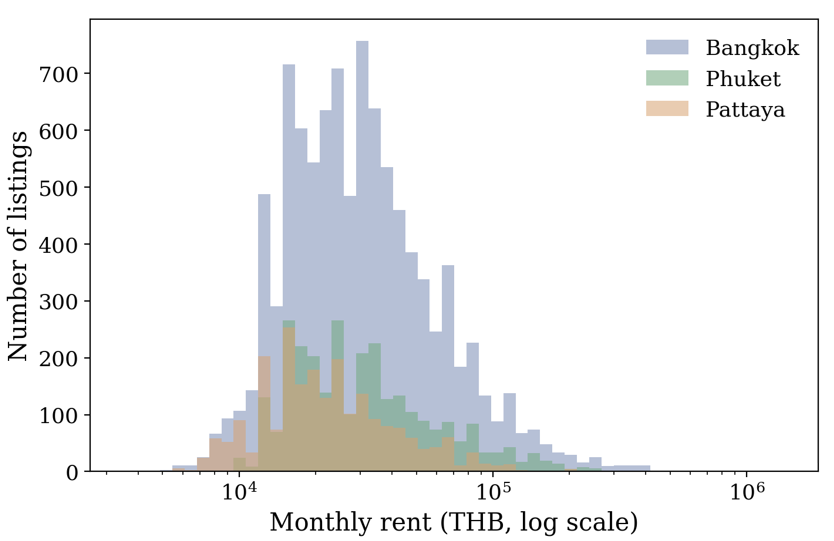
This study estimates condominium rental price differentials from online listings across Thailand’s three major tourist cities, using Bangkok as the benchmark for Phuket and Pattaya while controlling for observable unit characteristics. Intercity differentials are measured with a hedonic regression in which the dependent variable is the natural logarithm of monthly rent (in Thai baht). Model 1 controls for the number of bedrooms, while Model 2 adds unit size through log(size_sqm), allowing the effect of unit composition on estimated city effects to be assessed. Confidence intervals at 95% are based on heteroskedasticity-robust (HC1) standard errors. The main finding is the magnitude and persistence of city-level effects relative to Bangkok. In Model 1, Pattaya has a monthly rent 11.5% lower (95% CI -13.3% to -9.6%) and Phuket 23.8% higher (95% CI 21.4% to 26.3%). When apartment size is included in Model 2, the monthly rent in Pattaya is 16.8% lower (95% CI -18.3% to -15.2%) and in Phuket 14.3% higher (95% CI 12.5% to 16.2%), and the model fit improves as the adjusted R-squared rises from 0.491 to 0.663. These results indicate that factors beyond apartment size drive rental differences across cities, since the gaps remain statistically significant after adjusting for size. The study offers robust, transparent estimates of rental levels in Thailand’s major tourist cities that can support comparison and benchmarking.
Downloads
References
Anenberg, E., Kuang, C., & Kung, E. (2022). Social learning and local consumption amenities: Evidence from Yelp. The Journal of Industrial Economics, 70(2), 294–322.
Anenberg, E., & Kung, E. (2020). Can more housing supply solve the affordability crisis? Evidence from a neighborhood choice model. Regional Science and Urban Economics, 80, 103363.
Bajat, B., Kilibarda, M., Pejović, M., & Petrović, M. S. (2017). Spatial hedonic modeling of housing prices using auxiliary maps. In Spatial analysis and location modeling in urban and regional systems (pp. 97–122). Springer.
Baum-Snow, N., & Han, L. (2024). The microgeography of housing supply. Journal of Political Economy, 132(6), 1897–1946.
Boeing, G., & Waddell, P. (2017). New insights into rental housing markets across the United States: Web scraping and analyzing Craigslist rental listings. Journal of Planning Education and Research, 37(4), 457–476.
Buranasiri, J., & Laokulrach, M. (2025). Appropriate rental price prediction for condominiums in Pattaya, Thailand using artificial neural network approach. Journal of Social Economics Research, 12(3), 161–175.
Day, B. (2003). Submarket identification in property markets: A hedonic housing price model for Glasgow (CSERGE Working Paper EDM No. 03-09). University of East Anglia, Centre for Social and Economic Research on the Global Environment.
Deboosere, R., Kerrigan, D. J., Wachsmuth, D., & El-Geneidy, A. (2019). Location, location and professionalization: A multilevel hedonic analysis of Airbnb listing prices and revenue. Regional Studies, Regional Science, 6(1), 143–156.
Dendoung, T., Tochaiwat, K., Rinchumphu, D., & Dodgson, J. L. (2020). Technology for identifying determinants of condominiums responsible property investing in Thailand. International Journal of Building, Urban, Interior and Landscape Technology, 15, 45–64.
Franklin, J. P., & Waddell, P. (2003). A hedonic regression of home prices in King County, Washington, using activity-specific accessibility measures. In Proceedings of the Transportation Research Board 82nd Annual Meeting.
Genesove, D. (2003). The nominal rigidity of apartment rents. Review of Economics and Statistics, 85(4), 844–853.
Glaeser, E. L., Gyourko, J., & Saiz, A. (2008). Housing supply and housing bubbles. Journal of Urban Economics, 64(2), 198–217.
Gröbel, S., & Thomschke, L. (2018). Hedonic pricing and the spatial structure of housing data – An application to Berlin. Journal of Property Research, 35(3), 185–208.
Helbich, M., Brunauer, W., Hagenauer, J., & Leitner, M. (2013). Data-driven regionalization of housing markets. Annals of the Association of American Geographers, 103(4), 871–889.
Ismail, S. (2005). Hedonic modelling of housing markets using geographical information system (GIS) and spatial statistic: A case study of Glasgow, Scotland (Doctoral dissertation, University of Aberdeen).
Lisi, G. (2013). On the functional form of the hedonic price function: A matching-theoretic model and empirical evidence. International Real Estate Review, 16(2), 189–207.
Lorenz, F., Willwersch, J., Cajias, M., & Fuerst, F. (2023). Interpretable machine learning for real estate market analysis. Real Estate Economics, 51(5), 1178–1208.
Malpezzi, S. (2003). Hedonic pricing models: A selective and applied review. Housing Economics and Public Policy, 1, 67–89.
Mason, C., & Quigley, J. M. (1996). Non-parametric hedonic housing prices. Housing Studies, 11(3), 373–385.
Metzner, S., & Kindt, A. (2017). Automated hedonic valuation models: A variety of projects in research and industry. In ERES Annual Conference.
Miura, T., & Asami, Y. (2012). Hedonic analysis for the estimation of condominium rent utilizing web information. Environment and Planning B: Planning and Design, 39(6), 1049–1068.
Osland, L. (2010). An application of spatial econometrics in relation to hedonic house price modeling. Journal of Real Estate Research, 32(3), 289–320.
Ottensmann, J. R., Payton, S., & Man, J. (2008). Urban location and housing prices within a hedonic model. Journal of Regional Analysis & Policy, 38(1), 19–35.
Roback, J. (1982). Wages, rents, and the quality of life. Journal of Political Economy, 90(6), 1257–1278.
Rosen, S. (1974). Hedonic prices and implicit markets: Product differentiation in pure competition. Journal of Political Economy, 82(1), 34–55.
Sirmans, S., Macpherson, D., & Zietz, E. (2005). The composition of hedonic pricing models. Journal of Real Estate Literature, 13, 1–44.
Solovev, K., & Pröllochs, N. (2021). Integrating floor plans into hedonic models for rent price appraisal. arXiv. https://arxiv.org/abs/2102.08162
Tochaiwat, K., Rinchumphu, D., Dendoung, T., & Khumpaisal, S. (2023). Applying linear hedonic price model to measure impact of responsible property investment factors on Thai condominium projects. Engineered Science, 24, 924.
Tsai, I.-C. (2023). Overheated behaviours and spread effects: An analysis of London's housing market. International Journal of Urban Sciences, 27(1), 65–92.
Tsai, I.-C. (2025). Willingness to pay for green buildings post COVID-19 pandemic outbreak: Differences between high- and low-income areas and high- and low-price settlements. The Annals of Regional Science, 74(1), 23.
Wang, W.-K., & Tsai, I.-C. (2022). House age and housing prices: A viewpoint of the optimal time for land redevelopment. International Journal of Strategic Property Management, 26(3), 172–187.
Downloads
Published
How to Cite
Issue
Section
License
Copyright (c) 2026 International Journal of Building, Urban, Interior and Landscape Technology

This work is licensed under a Creative Commons Attribution-NonCommercial-NoDerivatives 4.0 International License.