
การเปรียบเทียบประสิทธิภาพของโครงข่ายประสาทเทียมในการจำแนกโรคใบข้าว
บทคัดย่อ
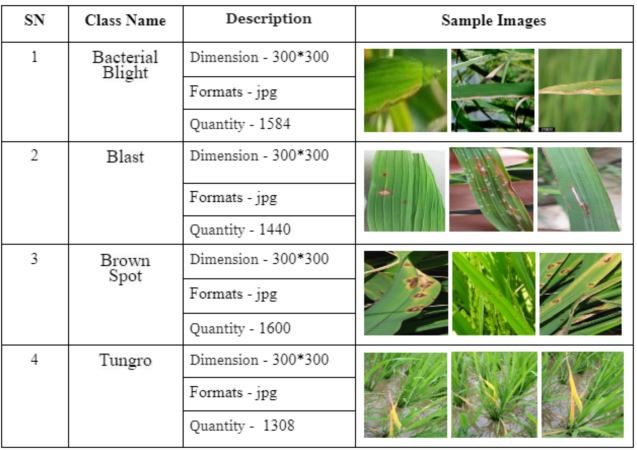
การวิจัยครั้งนี้มีวัตถุประสงค์เพื่อ 1) พัฒนาโมเดลและเปรียบเทียบประสิทธิภาพโครงข่ายประสาทเทียมในการจำแนกโรคใบข้าวแบบไม่มีการเสริมข้อมูล และ 2) พัฒนาโมเดลและเปรียบเทียบประสิทธิภาพโครงข่ายประสาทเทียมในการจำแนกโรคใบข้าวแบบมีการเสริมข้อมูล จากชุดข้อมูล RiceLeafBD Datasets ประกอบด้วยภาพทั้งหมด จำนวน 1,555 ภาพ แบ่งเป็น 4 ประเภทโรค ได้แก่ โรคใบไหม้จากแบคทีเรีย โรคใบไหม้จากเชื้อรา โรคใบจุดสีน้ำตาล และโรคไวรัสทังโกร ซึ่งเป็นชุดข้อมูลออนไลน์สาธารณะในแพลตฟอร์ม Kaggle Dataset ทดลองด้วย 3 โครงข่ายประสาทเทียม ได้แก่ 1) InceptionNet-V2 2)MobileNet-V2 และ 3) EfficientNet-V2 ที่มีการปรับปรุงด้วยการเพิ่มองค์ประกอบอย่าง Squeeze-and-Excitation (SE) blocks เพื่อเรียนรู้ความสำคัญของแต่ละ Channel ให้ดีขึ้น โดยทั้ง 3 โครงข่ายได้ทดลองกับทั้ง 2 ชุดข้อมูล คือ ชุดข้อมูลพื้นฐานและชุดข้อมูลที่มีการเสริมข้อมูล ซึ่งการทดลอง Train และ Test โมเดล จำนวน 20 epoch และ 50 epoch สถิติที่ใช้ในการวิเคราะห์ข้อมูลได้แก่ Accuracy Precision Recall และ F1-score
ผลการพัฒนาโมเดลและเปรียบเทียบประสิทธิภาพโครงข่ายประสาทเทียมในการจำแนกโรคใบข้าวทั้งแบบไม่มีและมีการเสริมข้อมูล พบว่า โมเดลที่พัฒนาสามารถทำนายโรคใบข้าวได้ดีกว่าโมเดลพื้นฐาน (Base Model) ทั้ง 3 โครงข่าย โดยโครงข่ายประสาทเทียมที่ให้ค่าความถูกต้องสูงสุด ได้แก่ EfficientNet-V2 ในการทดลองแบบไม่มีการเสริมข้อมูล ได้ค่า Accuracy, Precision, Recall และ F1-score ตามลำดับ ดังนี้ 92.60%, 92.75%, 92.50% และ 92.25% และโมเดลที่มีการเสริมข้อมูล (EfficientNet-V2 + DA) ให้ค่าความถูกต้องในการจำแนกโรคใบข้าว ได้ค่า Accuracy, Precision, Recall และ F1-score ตามลำดับ ดังนี้ 95.50%, 95.75%, 95.75% และ 95.75% ซึ่งผลการทดลองในครั้งนี้ถือว่าโมเดลที่พัฒนามีประสิทธิภาพดีกว่าโมเดลพื้นฐานทุกกรณี
เอกสารอ้างอิง
กัญญารัตน์ สมเพ็ชร, พัชรวิภา ใจจักรคำ, และอรอุมา เพียซ้าย. (2563). การจัดจำแนกชนิด และการใช้สารเคมีควบคุมเชื้อราRhizoctonia species สาเหตุโรคกาบใบแห้งของข้าว. วารสารวิทยาศาสตร์และนวัตกรรมการเกษตร, 51(2), 122-138.
จุฬาลักษณ์ มุ่งมาตร, ดุสิต อธินุวัฒน์, และวิลาวรรณ์ เชื้อบุญ. (2567). การยับยั้งเชื้อสาเหตุโรคใบไหม้และส่งเสริมการเจริญเติบโตของข้าวต่างพันธุ์ด้วยแบคทีเรีย. วารสารมหาวิทยาลัยราชภัฏร้อยเอ็ด: วิทยาศาสตร์และเทคโนโลยี, 5(2), 58-72.
Ahmad, R., Ansari, M. H., Thakur, M. B., Anwer, A., Singh, S. N., Kunal, G., Singh, P., Minnatullah, M. (2024). A review on emerging insights into bacterial leaf blight of rice: diagnostics, climate dynamics, and economic impact. Agricultural Mechanization in Asia, Africa and Latin America, 55(10), 19025-19044.
Bre, F., Gimenez, J. M., and Fachinotti, V. D. (2018). Prediction of wind pressure coefficients on building surfaces using artificial neural networks. Energy and Buildings, 158, 1429–1441.
Chen, M., Bai, Y., Lee, J. D., Zhao, T., Wang, H., Xiong, C., and Socher, R. (2020). Towards Understanding Hierarchical Learning: Benefits of Neural Representations. In the 34th Conference on Neural Information Processing Systems (NeurIPS) (pp.3114–3124). Vancouver: Canada.
Cubuk, E. D., Zoph, B., Shlens, J., and Le, Q. V. (2020). RandAugment: Practical automated data augmentation with a reduced search space. In Proceedings of the IEEE/CVF Conference on Computer Vision and Pattern Recognition Workshops (pp.702–703). Vancouver: Canada.
Dai, W., and Berleant, D. (2019). Benchmarking Contemporary Deep Learning Hardware and Frameworks: A Survey of Qualitative Metrics. In 2019 IEEE First International Conference on Cognitive Machine Intelligence (CogMI) (pp.148-155). Los Angeles, CA: USA.
Dutta, M., Sujan, R.I., Mojumdar, M. U., Chakraborty, N. R., Marouf, A. A., Rokne, J. G., and Alhajj, R. (2024). Rice Leaf Disease Classification A Comparative Approach Using Convolutional Neural Network (CNN), Cascading Autoencoder with Attention Residual U-Net (CAAR-U-Net), and MobileNet-V2 Architecture. Technologies 2024, 12(11), 1-15. doi: 10.3390/technologies12110214
Fawaiq, M. N., Utami, E., and Ariatmanto, D. (2023). Rice Plant Disease Detection with Data Augmentation Using Transfer Learning. International Journal of Research Publication and Reviews, 4(4), 2195-2199.
Haque, Md. E., Rahman, A., Junaeid, I. and Hoque, S. U. (2022). Rice Leaf Desease Classification and Detection Using YOLOV5. In International Conference on Digital Image Computing: Techniques and Applications (DICTA) (pp.516-522). Sydney, New South Wales: Australia.
Hossain, S.M.M., Deb, K., Dhar, P.K., and Koshiba, T. (2021). Plant Leaf Disease Recognition Using DepthWisSeparable Convolution-Based Models. Symmetry 2021, 13, 511. Retrieved from https://www.mdpi.com/2073-8994/13/3/511. doi.org/10.3390/sym13030511
Hou, Q., Zhou, D., and Feng, J. (2021). Coordinate Attention for Efficient Mobile Network Design. In IEEE/CVF Conference on Computer Vision and Pattern Recognition (CVPR), 13708-13717. Online. Retrieved from https://ieeexplore.ieee.org/xpl/conhome/9577055/proceeding?sortType=vol-onlyseq&isnumber=9577056&searchWithin=Coordinate%20Attention%20for%20Efficient%20 doi.org/10.1109/CVPR46437.2021.01350
Howard, A. G., Zhu, M., Chen, B., Kalenichenko, D., Wang, W., Weyand, T., ... Adam, H. (2017). MobileNets:
Efficient Convolutional Neural Networks for Mobile Vision Applications. Retrieved from https://www.researchgate.net/publication/316184205_MobileNets_Efficient_Convolutional_Neural_Networks_for_Mobile_Vision_Applications. doi.org/10.48550/arXiv.1704.04861
Howard, A., Sandler, M., Chu, G., Chen, L. C., Chen, B., Tan, M., ... Adam, H. (2019). Searching for MobileNetV3. In Proceedings of the IEEE/CVF International Conference on Computer Vision (ICCV) (pp.1314-1324). Seoul: South Korea.
Hu, J., Shen, L., Albanie, S., Sun, G., and Wu, E. (2018). Squeeze-and-Excitation Networks. In IEEE/CVF Conference on Computer Vision and Pattern Recognition (CVPR) (pp.7132-7141). Salt Lake City, Utah: USA.
Kanjanamaneesathian, M., Chumthong, A., Pengnoo, A., and Wiwattanapatapee, R. (2009). Bacillus megaterium Suppresses Major Thailand Rice Diseases. Asian Journal of Food and Agro-Industry, Special Issue, S154-S159.
Minaee, S., Boykov, Y., Porikli, F., Plaza, A., Kehtarnavaz, N., and Terzopoulos, D. (2023). A Comprehensive Survey of Image Augmentation Techniques for Deep Learning. Pattern Recognition, 137, 109347. Retrieved from https://www.sciencedirect.com/science/article/pii/S0031320323000481.
doi.org/10.1016/j.patcog.2023.109347
Mumuni, A., and Mumuni, F. (2022). Data augmentation: A comprehensive survey of modern approaches. Array, 16, 1-27. doi: 10.1016/j.array.2022.100258
Rimi, S. A., Chowdhury, J. U., Abdullah, R., Ahmed, I., Mim, M. A., and Rahman, M. S. (2025). Empowering Agricultural Insights: RiceLeafBD - A Novel Dataset and Optimal Model Selection for Rice Leaf Disease Diagnosis through Transfer Learning Technique, 1-24. doi: 10.48550/arXiv.2501.08912
Sandler, M., Howard, A., Zhu, M., Zhmoginov, A., and Chen, L. C. (2018). MobileNetV2: Inverted Residuals
and Linear Bottlenecks. In IEEE/CVF Conference on Computer Vision and Pattern Recognition
(CVPR) (pp.4510-4520). Salt Lake City, Utah: USA.
Spadaro, D., Agustí, N., Ortega, S. F., and Hurtado Ruiz, M. A. (2020). Diagnostics and Identification of Diseases,
Insects and Mites. In Integrated Pest and Disease Management in Greenhouse Crops (pp.231–258). Cham: Switzerland.
Szegedy, C., Vanhoucke, V., Ioffe, S., Shlens, J., and Wojna, Z. (2015). Rethinking the Inception Architecture
for Computer Vision. In 2016 IEEE Conference on Computer Vision and Pattern Recognition (CVPR) (pp.2818-2826). Las Vegas, NV: USA.
Tan, M., and Le, Q. V. (2019). EfficientNet: Rethinking Model Scaling for Convolutional Neural Networks.
In Proceedings of the 36th International Conference on Machine Learning (ICML) (pp.6105-6114). Long Beach: California.
Worasit, T., Phatrapornnant, T., Toojinda, T., Sinthupinyo, W., Kiratiratanapruk, K., Temniranrat, P., and Patarapuwadol, S. (2022). Rice bacterial blight and blast diseases recognition using deep learning techniques. Khon Kaen Agriculture Journal, 50(1), 216-228.
Xu, M., Park, J.-E., Lee, J., Yang, J., and Yoon, S. (2024). Plant disease recognition datasets in the age of deep learning: Challenges and opportunities. Frontiers in Plant Science, 15, 1-13. doi: 10.3389/fpls.2024.1452551
Yang, S., Liu, X., Dong, X., and Fu, B. (2024). Mini-DA: Improving Your Model Performance through Minimal Data Augmentation using LLM. In Proceedings of the Fifth Workshop on Data Science with Human- in-the-Loop (Language Advances) (pp.25–30). Mexico City: Mexico.
ดาวน์โหลด
เผยแพร่แล้ว
ฉบับ
ประเภทบทความ
สัญญาอนุญาต
ลิขสิทธิ์ (c) 2025 Loei Rajabhat University

อนุญาตภายใต้เงื่อนไข Creative Commons Attribution-NonCommercial-NoDerivatives 4.0 International License.
บทความที่ได้รับการตีพิมพ์



