
การเปรียบเทียบแบบจำลองการกรองข้อมูลสำหรับระบบแนะนำหลักสูตร ระดับปริญญาตรีภายใต้ข้อจำกัดความเบาบางของข้อมูล
บทคัดย่อ
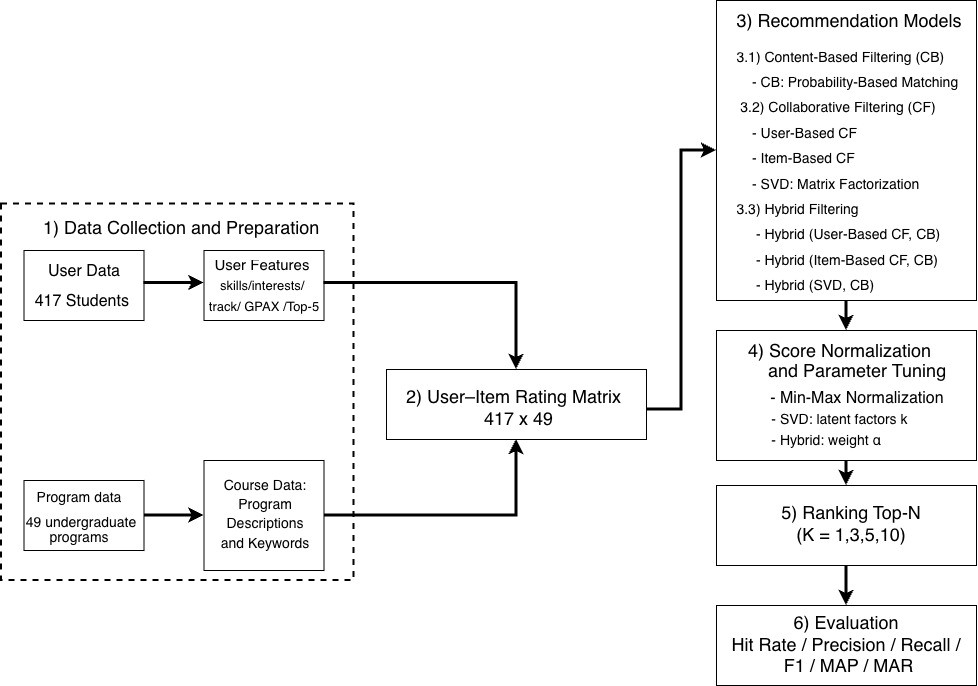
งานวิจัยนี้มีวัตถุประสงค์เพื่อเปรียบเทียบประสิทธิภาพของแบบจำลองการกรองข้อมูลสำหรับระบบแนะนำหลักสูตรระดับปริญญาตรี ภายใต้ข้อจำกัดความเบาบางของข้อมูล โดยเปรียบเทียบแบบจำลองระบบแนะนำจำนวน 7 แบบจำลอง ซึ่งจัดเป็น 3 วิธีหลัก ได้แก่ 1) Content-Based Filtering ประกอบด้วย Content-Based Filtering ด้วยแนวทาง Probability-Based Matching 2) Collaborative Filtering ประกอบด้วย User-Based Collaborative Filtering, Item-Based Collaborative Filtering และ Singular Value Decomposition (SVD) และ 3) Hybrid Filtering ประกอบด้วย Hybrid (User-Based CF, CB), Hybrid (Item-Based CF, CB) และ Hybrid (SVD, CB) กลุ่มตัวอย่าง คือ นักเรียนระดับมัธยมศึกษาตอนปลาย จำนวน 417 คน โดยคัดเลือกแบบเจาะจงและให้เลือกหลักสูตรที่สนใจจริง 5 อันดับ จากหลักสูตรระดับปริญญาตรี 49 หลักสูตร จากนั้นแปลงอันดับเป็นคะแนนเพื่อสร้างเมทริกซ์ผู้ใช้–หลักสูตรขนาด 417 × 49 ซึ่งมีความเบาบางของข้อมูลประมาณร้อยละ 89.8 การประเมินผลใช้แนวทาง Top-N Recommendation ที่ค่า K= 1, 3, 5 และ 10 ด้วยตัวชี้วัด Hit Rate, Precision, Recall, F1-score, MAP และ MAR ผลการวิจัยพบว่า Hybrid (SVD, CB) ที่ค่า = 0.80 ให้ผลดีที่สุดในภาพรวม โดยเฉพาะที่ K=5 มีค่า Hit Rate@5 = 1.0000, Precision@5 = 0.8590, Recall@5 = 0.9153, F1@5 = 0.8863, MAP@5 = 0.9089 และ MAR@5 = 0.5367 ผลการวิจัยชี้ให้เห็นว่าการผสมผสาน ระหว่าง Model – Based Collaborative Filtering แบบ SVD Model และ Content-Based Filtering สามารถเพิ่มประสิทธิภาพของระบบแนะนำหลักสูตรได้ภายใต้ความเบาบางของชุดข้อมูล
เอกสารอ้างอิง
ภัทร สูตรสุวรรณ, เดือนเพ็ญ ธีรวรรณวิวัฒน์, และพาชิตชนัต ศิริพานิช. (2564). การศึกษาระบบแนะนำสถานที่ท่องเที่ยวในกรุงเทพฯ และปริมณฑลสำหรับนักท่องเที่ยวต่างชาติ. วารสารสมาคมนักวิจัย, 26(3), 121–139.
สมเพ็ชร จุลลาบุดดี. (2562). การสำรวจงานวิจัยระบบแนะนำในประเทศไทย พ.ศ. 2550–2560. วารสารสารสนเทศศาสตร์, 37(3), 95–122.
วรนุช ศรีพลัง, และวงกต ศรีอุไร. (2560). การพัฒนาระบบแนะนำข้อมูลสำหรับห้องสมุดออนไลน์โดยใช้วิธีการกรองข้อมูลแบบพึ่งพาผู้ใช้ร่วมและข้อมูลส่วนบุคคล. วารสารมหาวิทยาลัยศรีนครินทรวิโรฒ สาขาวิทยาศาสตร์และเทคโนโลยี, 9(18), 150–164.
Adomavicius, G., and Tuzhilin, A. (2005). Toward the next generation of recommender systems: A survey of the state-of-the-art and possible extensions. IEEE Transactions on Knowledge and Data Engineering, 17(6), 734–749. doi: 10.1109/TKDE.2005.99
Aggarwal, C. C. (2016). Recommender Systems: The Textbook. Cham, Switzerland: Springer. doi: 10.1007/978-3-319-29659-3
Burke, R. (2002). Hybrid recommender systems: Survey and experiments. User Modeling and User-Adapted Interaction, 12(4), 331–370. doi: 10.1023/A:1021240730564
Gunathilaka, T. M. A. U., Manage, P. D., Zhang, J., Li, Y., and Kelly, W. (2025). Addressing sparse data challenges in recommendation systems: A systematic review of rating estimation using sparse rating data and profile enrichment techniques. Intelligent Systems with Applications, 25, 200474. doi: 10.1016/j.iswa.2024.200474
Herlocker, J. L., Konstan, J. A., Terveen, L. G., and Riedl, J. T. (2004). Evaluating collaborative filtering recommender systems. ACM Transactions on Information Systems, 22(1), 5–53. doi: 10.1145/963770.963772
Herrera, R. J. E. (2020). A hybrid recommender system to enrollment for elective subjects in engineering students using classification algorithms. International Journal of Advanced Computer Science and Applications, 11(7), 400–406. doi: 10.14569/IJACSA.2020.0110752
Isinkaye, F. O., Folajimi, Y. O., and Ojokoh, B. A. (2015). Recommendation systems: Principles, methods and evaluation. Egyptian Informatics Journal, 16(3), 261–273. doi: 10.1016/j.eij.2015.06.005
Koren, Y., Bell, R., and Volinsky, C. (2009). Matrix factorization techniques for recommender systems. Computer, 42(8), 30–37. doi: 10.1109/MC.2009.263
Lahoud, C., Moussa, S., Obeid, C., El Khoury, H., and Champin, P.-A. (2023). A comparative analysis of different recommender systems for university major and career domain guidance. Education and Information Technologies, 28, 8733–8759. doi: 10.1007/s10639-022-11541-3
Lops, P., de Gemmis, M., and Semeraro, G. (2011). Content-based recommender systems: State of the art and trends. In F. Ricci, L. Rokach, B. Shapira, and P. B. Kantor (Eds.), Recommender Systems Handbook (pp. 73–105). New York, NY: Springer. doi: 10.1007/978-0-387-85820-3_3
Sabiri, B., Khtira, A., El Asri, B., and Rhanoui, M. (2025). Hybrid quality-based recommender systems: A systematic literature review. Journal of Imaging, 11(1), 12. doi: 10.3390/jimaging11010012
Sakboonyarat, S., and Tantatsanawong, P. (2022). Applied big data technique and deep learning for massive open online courses (MOOCs) recommendation system. ECTI-CIT Transactions, 16(4), 436–447. doi: 10.37936/ecti-cit.2022164.245873
Zhu, L., and Wang, B. (2022). Course selection recommendation based on hybrid recommendation algorithms. In Proceedings of the International Conference on Modern Education and Information Management (pp. 476–482). doi: 10.2991/978-94-6463-044-2_60
ดาวน์โหลด
เผยแพร่แล้ว
ฉบับ
ประเภทบทความ
สัญญาอนุญาต
ลิขสิทธิ์ (c) 2026 Loei Rajabhat University

อนุญาตภายใต้เงื่อนไข Creative Commons Attribution-NonCommercial-NoDerivatives 4.0 International License.
บทความที่ได้รับการตีพิมพ์



