A Comparison of Data Filtering Models for Undergraduate Program Recommendation under Data Sparsity Constraints
Abstract
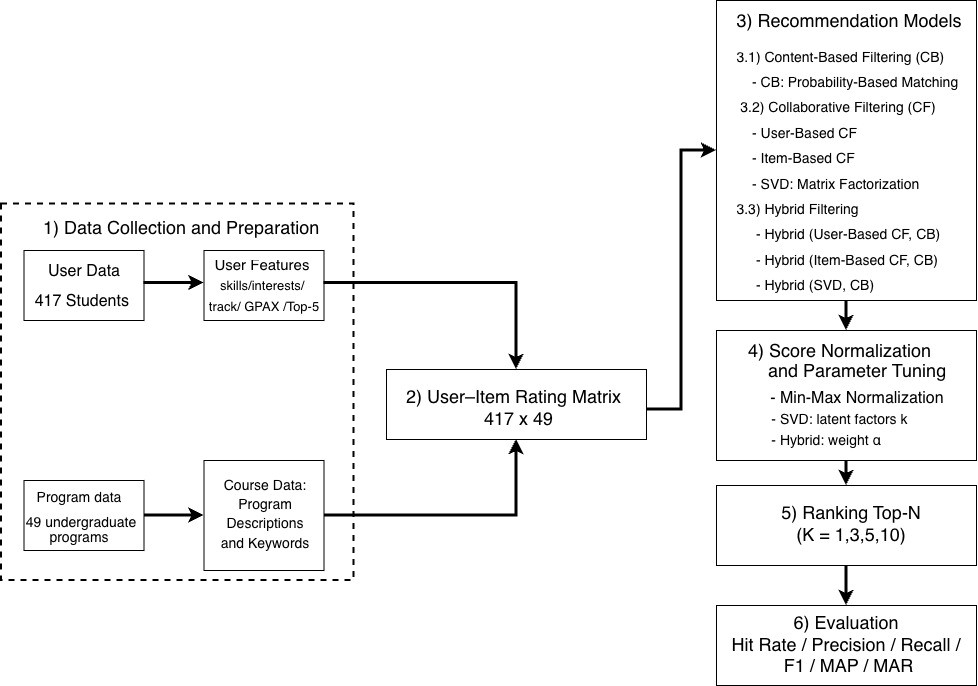
This study aimed to compare the performance of data filtering models for an undergraduate program recommender system under data sparsity constraints. Seven recommendation models were compared and categorized into three main approaches: 1) Content-Based Filtering, consisting of Content-Based Filtering using the Probability-Based Matching approach; 2) Collaborative Filtering, consisting of User-Based Collaborative Filtering, Item-Based Collaborative Filtering, and Singular Value Decomposition (SVD); and 3) Hybrid Filtering, consisting of Hybrid (User-Based CF, CB), Hybrid (Item-Based CF, CB), and Hybrid (SVD, CB). The sample consisted of 417 high school students selected through purposive sampling. Participants were asked to choose their top five genuinely preferred undergraduate programs from a total of 49 programs. The ranked preferences were then transformed into scores to establish a 417 × 49 user–program matrix with approximately 89.8% data sparsity. The evaluation utilized the Top-N Recommendation approach at K= 1, 3, 5, and 10 using Hit Rate, Precision, Recall, F1-score, Mean Average Precision (MAP), and Mean Average Recall (MAR) as performance metrics. The results indicated that the Hybrid (SVD, CB) model with =0.80 achieved the best overall performance. In particular, at K=5, the model obtained Hit Rate@5 = 1.0000, Precision@5 = 0.8590, Recall@5 = 0.9153, F1@5 = 0.8863, MAP@5 = 0.9089, and MAR@5 = 0.5367. The findings suggest that integrating the SVD-based Model-Based Collaborative Filtering model with Content-Based Filtering can significantly improve the performance of undergraduate program recommender systems under sparse data constraints.
References
ภัทร สูตรสุวรรณ, เดือนเพ็ญ ธีรวรรณวิวัฒน์, และพาชิตชนัต ศิริพานิช. (2564). การศึกษาระบบแนะนำสถานที่ท่องเที่ยวในกรุงเทพฯ และปริมณฑลสำหรับนักท่องเที่ยวต่างชาติ. วารสารสมาคมนักวิจัย, 26(3), 121–139.
สมเพ็ชร จุลลาบุดดี. (2562). การสำรวจงานวิจัยระบบแนะนำในประเทศไทย พ.ศ. 2550–2560. วารสารสารสนเทศศาสตร์, 37(3), 95–122.
วรนุช ศรีพลัง, และวงกต ศรีอุไร. (2560). การพัฒนาระบบแนะนำข้อมูลสำหรับห้องสมุดออนไลน์โดยใช้วิธีการกรองข้อมูลแบบพึ่งพาผู้ใช้ร่วมและข้อมูลส่วนบุคคล. วารสารมหาวิทยาลัยศรีนครินทรวิโรฒ สาขาวิทยาศาสตร์และเทคโนโลยี, 9(18), 150–164.
Adomavicius, G., and Tuzhilin, A. (2005). Toward the next generation of recommender systems: A survey of the state-of-the-art and possible extensions. IEEE Transactions on Knowledge and Data Engineering, 17(6), 734–749. doi: 10.1109/TKDE.2005.99
Aggarwal, C. C. (2016). Recommender Systems: The Textbook. Cham, Switzerland: Springer. doi: 10.1007/978-3-319-29659-3
Burke, R. (2002). Hybrid recommender systems: Survey and experiments. User Modeling and User-Adapted Interaction, 12(4), 331–370. doi: 10.1023/A:1021240730564
Gunathilaka, T. M. A. U., Manage, P. D., Zhang, J., Li, Y., and Kelly, W. (2025). Addressing sparse data challenges in recommendation systems: A systematic review of rating estimation using sparse rating data and profile enrichment techniques. Intelligent Systems with Applications, 25, 200474. doi: 10.1016/j.iswa.2024.200474
Herlocker, J. L., Konstan, J. A., Terveen, L. G., and Riedl, J. T. (2004). Evaluating collaborative filtering recommender systems. ACM Transactions on Information Systems, 22(1), 5–53. doi: 10.1145/963770.963772
Herrera, R. J. E. (2020). A hybrid recommender system to enrollment for elective subjects in engineering students using classification algorithms. International Journal of Advanced Computer Science and Applications, 11(7), 400–406. doi: 10.14569/IJACSA.2020.0110752
Isinkaye, F. O., Folajimi, Y. O., and Ojokoh, B. A. (2015). Recommendation systems: Principles, methods and evaluation. Egyptian Informatics Journal, 16(3), 261–273. doi: 10.1016/j.eij.2015.06.005
Koren, Y., Bell, R., and Volinsky, C. (2009). Matrix factorization techniques for recommender systems. Computer, 42(8), 30–37. doi: 10.1109/MC.2009.263
Lahoud, C., Moussa, S., Obeid, C., El Khoury, H., and Champin, P.-A. (2023). A comparative analysis of different recommender systems for university major and career domain guidance. Education and Information Technologies, 28, 8733–8759. doi: 10.1007/s10639-022-11541-3
Lops, P., de Gemmis, M., and Semeraro, G. (2011). Content-based recommender systems: State of the art and trends. In F. Ricci, L. Rokach, B. Shapira, and P. B. Kantor (Eds.), Recommender Systems Handbook (pp. 73–105). New York, NY: Springer. doi: 10.1007/978-0-387-85820-3_3
Sabiri, B., Khtira, A., El Asri, B., and Rhanoui, M. (2025). Hybrid quality-based recommender systems: A systematic literature review. Journal of Imaging, 11(1), 12. doi: 10.3390/jimaging11010012
Sakboonyarat, S., and Tantatsanawong, P. (2022). Applied big data technique and deep learning for massive open online courses (MOOCs) recommendation system. ECTI-CIT Transactions, 16(4), 436–447. doi: 10.37936/ecti-cit.2022164.245873
Zhu, L., and Wang, B. (2022). Course selection recommendation based on hybrid recommendation algorithms. In Proceedings of the International Conference on Modern Education and Information Management (pp. 476–482). doi: 10.2991/978-94-6463-044-2_60
Downloads
Published
Issue
Section
License
Copyright (c) 2026 Loei Rajabhat University

This work is licensed under a Creative Commons Attribution-NonCommercial-NoDerivatives 4.0 International License.
บทความที่ได้รับการตีพิมพ์