Effects of Different Drying Methods on Resveratrol Content of Mulberry Fruits Determined by High-Performance Liquid Chromatography Technique
Abstract
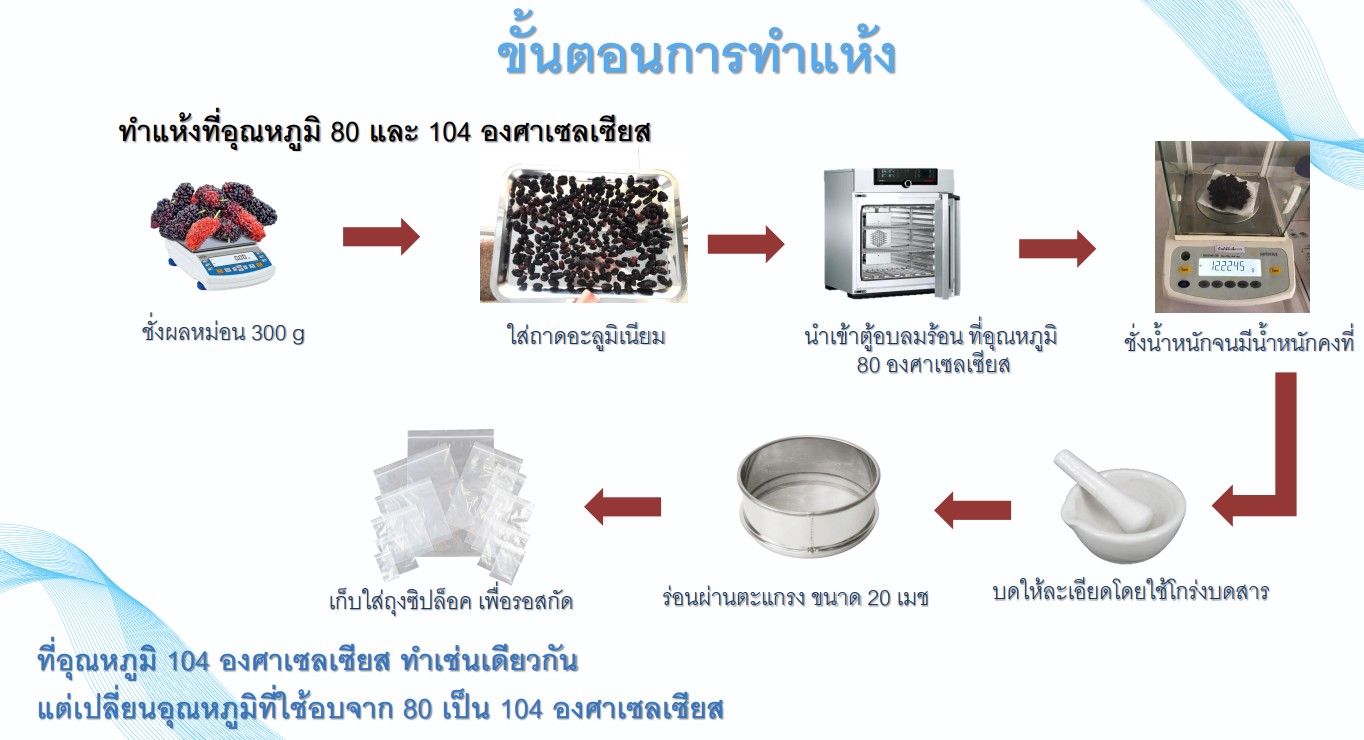
Mulberries are fruits rich in many essential compounds, one of which is resveratrol. This compound is highly sensitive to temperature; exposure to either excessively low or high temperatures can cause it to degrade. Therefore, the drying process of mulberries has an impact on the retention of resveratrol. The objective of this study was to determine the amount of resveratrol extracted from the fruit of the Mulberry cultivar Buriram 60, which was sampling from Phu Luang District, Loei Province. The samples were dried using five methods: hot air drying at 80°C, hot air drying at 104°C, sun drying, freeze drying, and drying by reducing relative humidity. These dried mulberry fruits were ground finely and sieved through 100 mesh to achieve uniform particle size. They were then extracted with a 60%v/v methanol solution, utilizing ultrasonic assistance for 40 minutes. The solids were removed, and the clear extract was filtered through a 0.45-micron membrane filter prior to the analysis of resveratrol content using high-performance liquid chromatography (HPLC) at a detection wavelength of 306 nanometers.
The quantitative analysis results indicated that different drying methods led to varying amounts of resveratrol. Exposure to the hot air oven caused significant degradation of resveratrol, resulting in its undetectability. Only the sun-drying method, freeze-drying method, and drying by reducing relative humidity still yielded detectable levels of resveratrol, with values of 10.73±0.61 mg/100g DW, 12.29±0.30 mg/100g DW, and 18.19±0.10 mg/100g DW, respectively. Therefore, this study concludes that the most suitable method for drying mulberry fruit while preserving the resveratrol content is the drying method that reduces relative humidity.
References
กันยวิชญ์ กันจินะ และสมชาย จอมดวง. (2556). การเปรียบเทียบการผลิตหม่อนผงโดยใช้เครื่องอบแห้งแบบถาดและ เครื่องอบแห้งแบบสุญญากาศที่ใช้อินฟราเรด.วารสารอุตสาหกรรมเกษตรมหาวิทยาลัยเชียงใหม่, 4(1): 1-8.
กรมหม่อนไหม. (2552). ข้อมูลพันธุ์หม่อน-พันธุ์ไหมอนุรักษ์. ค้นจากhttps://qsds.go.th/monmaiseed.
นันท์นภัส เติมวงศ์. (2551). ปริมาณรวมของสารต้านอนุมูลอิสระสารประกอบฟีโนลิกส์ และวิตามินซีในผักและ สมุนไพร.วารสารก้าวทันโลกวิทยาศาสตร์, 8(1), 1-45.
บริษัท หาญ เอ็นจิเนียริ่ง โซลูชั่นส์ จำกัด (มหาชน). (2568). ทำความรู้จักกับการทำแห้งแบบ แช่เยือกแข็ง (Freeze Dry) ค้นจาก https://www.harn.co.th/articles/getting-to-know-freeze-dry
ศิริพันธ์ มุรธาธัญลักษณ์. (2557). การอบแห้งผลหม่อนด้วยเครื่องอบแห้งอุณหภูมิต่ำ. คณะวิศวกรรมศาสตร์ สถาบันเทคโนโลยีพระจอมเกล้าเจ้าคุณทหารลาดกระบัง: กรุงเทพฯ.
Amin, G. S. M., Marouf, B. H., Namiq, H. S., and Salih, J. M. (2024). Impact of resveratrol and pharmaceutical care on type 2 diabetes mellitus and its neuropathic complication: A randomized placebo controlled clinical trial. Journal of Clinical Pharmacy and Therapeutics, 2024(1), 7739710. doi: 10.1155/2024/7739710
Amri, A., Chaumeil, J. C., Sfar, S., and Charrueau, C. (2012). Administration of resveratrol: What formulation solutions to bioavailability limitations?. Journal of Controlled Release, 158(2), 182–193. doi: 10.1016/j.jconrel.2011.09.083
Anekonda, T. S. (2006). Resveratrol—A boon for treating Alzheimer’s disease?. Brain Research Reviews, 52(2), 316–326. doi: 10.1016/j.brainresrev.2006.04.004
Brown, K., Theofanous, D., Britton, R. G., Aburido, G., Pepper, C., Sri Undru, S., and Howells, L. (2024). Resveratrol for the management of human health: How far have we come? A systematic review of resveratrol clinical trials to highlight gaps and opportunities. International Journal of Molecular Sciences, 25(2), 747. doi: 10.3390/ijms25020747
Gambini, J., Inglés, M., Olaso, G., Lopez-Grueso, R., Bonet-Costa, V., Gimeno-Mallench, L., … Borras, C. (2015). Properties of resveratrol: In vitro and In vivo studies about metabolism, bioavailability, and biological effects in animal models and humans. Oxidative Medicine and Cellular Longevity, 2015, 1–13. doi: 10.1155/2015/837042
Janjarasskul, T., and Suppakul, P. (2018). Active and intelligent packaging: The indication of quality and safety. Critical Reviews in Food Science and Nutrition, 58(5), 808–831. doi: 10.1080/10408398.2016.1225278
Kwon, S. H., Choi, H. R., Kang, Y. A., and Park, K. C. (2017). Depigmenting effect of resveratrol is dependent on FOXO3a activation without SIRT1 activation. International Journal of Molecular Sciences, 18(6), 1213. doi: 10.3390/ijms18061213
Ren, Z., Zheng, S., Sun, Z., Luo, Y., Wang, Y., Yi, P., … Xiao, W. (2025). Resveratrol: molecular mechanisms, health benefits, and potential adverse effects. Medicine communications, 6(6), e70252. doi: 10.1002/mco2.70252
Yam, K. L. (Ed.). (2009). The Wiley encyclopedia of packaging technology. (3rded). Hoboken, NJ: John Wiley & Sons.
Yu, X., Jia, Y., and Ren, F. (2024). Multidimensional biological activities of resveratrol and its prospects and challenges in the health field. Frontiers in Nutrition, 11, 1408651. doi: 10.3389/fnut.2024.1408651
Zhu, P., Jin, Y., Sun, J., and Zhou, X. (2025). The efficacy of resveratrol supplementation on inflammation and oxidative stress in type-2 diabetes mellitus patients: Randomized double-blind placebo meta-analysis. Frontiers in Endocrinology, 15, 1463027. doi: 10.3389/fendo.2024.1463027
Zupančič, Š., Lavrič, Z., and Kristl, J. (2015). Stability and solubility of trans-resveratrol are strongly influenced by pH and temperature. European Journal of Pharmaceutics and Biopharmaceutics, 93, 196–204. doi: 10.1016/j.ejpb.2015.04.002
Downloads
Published
Issue
Section
License
Copyright (c) 2026 Loei Rajabhat University

This work is licensed under a Creative Commons Attribution-NonCommercial-NoDerivatives 4.0 International License.
บทความที่ได้รับการตีพิมพ์