Development of an Interactive AR Application for the Applied Traditional Thai Boxing Dance “Ram Ploen Dern Bor Lom”
Abstract
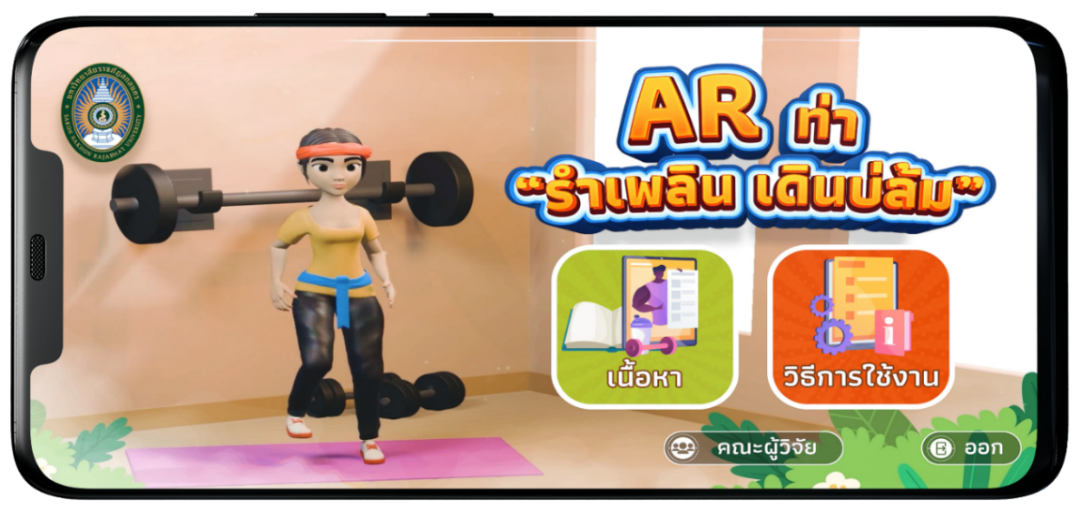
The objectives of this research were 1) to develop an Interactive AR application for the Applied Traditional Thai Boxing Dance, 2) to evaluate the effectiveness of AR application, and 3) to evaluate satisfaction with the use of AR application. Develop based on the SDLC process in conjunction with the 3P process using C#, model with Unity and Blender. The tools used were performance assessments from 5 experts and satisfaction assessments from a sample of 30 people using purposive and accidental sampling selection methods. The statistics used are the mean and standard deviation. The results show that the Interactive AR Application for the Applied Traditional Thai Boxing Dance under the title “AR-Ram Ploen Dern Bor Lom” successfully presented six traditional dance postures: 1) Arm Swing, 2) The plow dance, 3) The plow dance, 4) Lap Mokkhasak pose, 5) Elephant Curling Its Trunk, and 6) Kai Liap Coop which. The character model was categorized into three types: (1) the traditional boxing dance model, (2) the traditional boxing dance muscle model, and (3) the applied boxing dance model with realistic aesthetics, and implemented through an Android smartphone application. The overall performance of the application was evaluated at the highest level (=4.84, S.D.=0.20), and user satisfaction was also rated at the highest level (
=4.52, S.D.=0.68). It can therefore be concluded that the developed AR application represents an innovation capable of effectively transferring knowledge of ancient boxing dance. This innovation has the potential to be accessible to people of all ages, particularly health enthusiasts and caregivers of the elderly.
References
กมลรัตน์ กิจรุ่งไพศาล. (2567). ความต้องการใช้เทคโนโลยีการสื่อสารความเป็นจริงเสมือนของผู้สูงวัยไทยและข้อเสนอแนะในการใช้งาน. วารสารนิเทศศาสตร์, 42(3), 19-40.
กฤษดากร บันลือ. (2563). สารานุกรมศิลปะการแสดงพื้นถิ่นสกลนคร “มวยโบราณสกลนคร”. สกลนคร: พิพิธภัณฑ์เมืองสกลนคร.ชัยยงค์ พรหมวงศ์. (2556). การทดสอบประสิทธิภาพสื่อหรือชุดการสอน. วารสารศิลปากรศึกษาศาสตร์วิจัย, 5(1), 7-20.
ดนัยพร ลดากุล, และปุญญรัตน์ ปุญญา. (2560). การพัฒนาการ์ตูนแอนิเมชัน 3 มิติ เพื่อส่งเสริมคุณธรรมด้านความซื่อสัตย์สำหรับนักเรียนช่วงชั้นที่ 2. วารสารวิทยาการสารสนเทศ และเทคโนโลยีประยุกต์, 1(1), 64-71.
ดิเรก อัคฮาด. (2563). การใช้เทคโนโลยีเสมือนจริงสำหรับการจัดการเรียนการสอนในยุค Thailand 4.0. วารสารครุศาสตร์สาร : Journal of Educational Studies, 14(1), 239-252.
ทรงสิริ วิชิรานนท์, รุ่งอรุณ พรเจริญ, สุนารี จุลพันธ, และฉันทนา ปาปัดถา. (2562). การพัฒนาสื่อประชาสัมพันธ์เทคโนโลยีเสมือนจริงส่งเสริมการท่องเที่ยววิถีชุมชนคูบัว จังหวัดราชบุรี. ใน รายงานสืบเนื่องจากการประชุมวิชาการระดับชาติด้านการท่องเที่ยวกับมนุษยศาสตร์ ครั้งที่ 1, (หน้า 733-746). ภาควิชาการท่องเที่ยว คณะมนุษยศาสตร์ มหาวิทยาลัยเชียงใหม่: เชียงใหม่.
พระมหาวีรธัช ธมฺมวชิโร. (2560). การใช้สื่อเสมือนจริงในการจัดการเรียนการสอน. วารสารศึกษาศาสตร์ปริทัศน์, 32(2), 85-93.
พรทิพย์ กลมดี, และรุจโรจน์ แก้วอุไร. (2563). การพัฒนาแอปพลิเคชันความเป็นจริงเสริม เรื่อง ระบบสุริยจักรวาล สำหรับนักเรียนชั้นประถมศึกษาปีที่ 1. วารสารกลุ่มมนุษย์ศาสตร์-สังคมศาสตร์, 3(2), 27-35.
ภาภรณ์ เหล่าพิลัย, ทินกร โพธิโสภา, และกิตติศักดิ์ สร้อยสันเทศ. (2566). การพัฒนาสื่อเชิงโต้ตอบแนะนําอุปกรณ์ออกกําลังกายด้วยเทคโนโลยีทัวร์เสมือนจริง 360 องศา. วารสารวิชาการ การจัดการเทคโนโลยี มหาวิทยาลัยราชภัฏมหาสารคาม, 11(1), 85–95.
วิวัฒน์ มีสุวรรณ์. (2554). การเรียนรู้ด้วยการสร้างโลกเสมือนผสานโลกจริง. วารสารศึกษาศาสตร์ มหาวิทยาลัยนเรศวร, 13(2), 119-127.
ศรัญญา ตรีทศ, และทัสนันทน์ ตรีนันทรัตน์. (2562). แอปพลิเคชันส่งเสริมการท่องเที่ยว 7 เมนูอาหารที่ต้องชิมในจังหวัดเพชรบูรณ์ ด้วยเทคโนโลยีเสมือนจริง. วารสารวิทยาการและเทคโนโลยีสารสนเทศ, 9(1), 9-17.
โสภณ โกวิทพิบูลย์. (2559). แอปพลิเคชันแบบอินเทอร์แอคทีฟเพื่อการเรียนรู้. วารสารวิชาการเทคโนโลยีสารสนเทศ, 8(1), 15-22.
Al-Ansi, A. M., Jaboob, M., Garad, A., and Al-Ansi, A. (2023). Analyzing augmented reality (AR) and virtual reality (VR) recent development in education. Social Sciences & Humanities Open. 1(8). 1-10. doi: 10.1016/j.ssaho.2023.100532
Chanamarn, N., Uypatchawong, S., and Suwannapan, K. (2024). Mobile application with augmented reality technology for digestive system learning of upper-primary school students. Journal of Applied Informatics and Technology, 7(1), 57–72.
Chatsiopoulou, A., and Michailidis, P.D. (2025). Augmented reality in cultural heritage: A narrative review of design, development and evaluation approaches. Heritage, 8(10). 1-33. doi: 10.3390/heritage8100421
Li, G., Luo, H., Chen, D., Wang, P., Yin, X., and Zhang, J. (2025). Augmented reality in higher education: A systematic reviewand meta-analysis of the literature from 2000 to 2023. Education Sciences, 15(6), 1-24. doi: 10.3390/educsci15060678
Sampaothon T., and Sanchana W. (2023). The development application promote agritourism of pakdee farm with augmented reality technology. Journal of Applied Informatics and Technology, 5(1). 71-85.
Singh, S., Kaur, A., and Gulzar, Y. (2024). The impact of augmented reality on education: a bibliometric exploration. Frontiers in Education, 2024(9), 1-23. doi: 10.3389/feduc.2024.1458695
Weerapan, D. (2018). Management information system for instructional via web applications. Journal of Innovation Technology Management, 5(1). 145-154.
Downloads
Published
Issue
Section
License
Copyright (c) 2025 Loei Rajabhat University

This work is licensed under a Creative Commons Attribution-NonCommercial-NoDerivatives 4.0 International License.
บทความที่ได้รับการตีพิมพ์