
การพัฒนาเครื่องอบแห้งสับปะรดท่าอุเทนด้วยพลังงานแสงอาทิตย์ร่วมกับรังสีอินฟราเรดที่ควบคุมอุณหภูมิและความชื้นสัมพัทธ์ด้วยระบบอินเทอร์เน็ตของสรรพสิ่ง
คำสำคัญ:
การอบแห้งด้วยแสงอาทิตย์ การอบแห้งด้วยอินฟราเรด อินเตอร์เน็ตของทุกสรรพสิ่งบทคัดย่อ
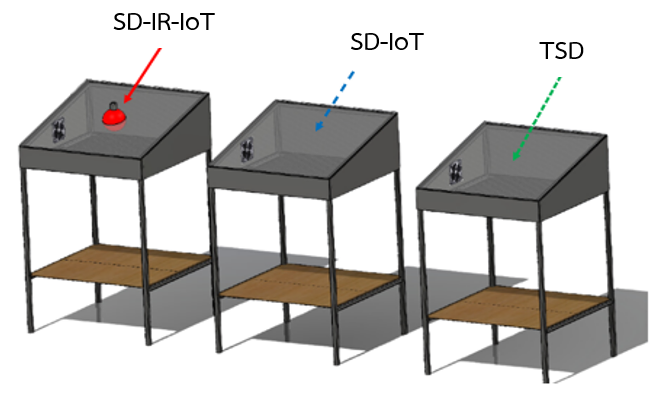
งานวิจัยนี้ได้ประเมินสมรรถนะของเครื่องอบแห้งสับปะรดท่าอุเทนแบบผสมผสานพลังงานแสงอาทิตย์ร่วมกับรังสีอินฟราเรดที่ควบคุมอุณหภูมิและความชื้นสัมพัทธ์ด้วยระบบอินเทอร์เน็ตของสรรพสิ่ง (SD-IR-IoT) และเปรียบเทียบกับ ระบบ SD-IoT และเครื่องอบแห้งแบบดั้งเดิม(TSD) การทดลองดำเนินการภายใต้สภาวะแวดล้อมเดียวกันระหว่างเวลา 09:00–17:00 น. โดยใช้หลอดอินฟราเรดกำลัง 200 วัตต์ ควบคุมอุณหภูมิในช่วง 50–70°C และควบคุมพัดลมระบายอากาศให้อยู่ในช่วงความชื้นสัมพัทธ์ 30–50% ผลการทดลองแสดงให้เห็นว่า SD-IR-IoT สามารถรักษาอุณหภูมิภายในห้องอบแห้งสูงกว่าระบบอื่น 5–45% และลดความชื้นสัมพัทธ์เฉลี่ยลงได้ 10–30% ส่งผลให้ค่าสัดส่วนความชื้นลดลงจาก 1.0 เหลือประมาณ 0.15 ภายใน 8 ชั่วโมง ขณะที่ SD-IoT และ TSD ลดลง 0.35 และ 0.50 ตามลำดับ อัตราการอบแห้งของ SD-IR-IoT อยู่ในช่วง 0.4–0.8 กรัม/นาที ซึ่งสูงกว่าและมีความสม่ำเสมอกว่าระบบอื่นอย่างชัดเจน การวิเคราะห์เชิงเศรษฐศาสตร์พบว่าระบบมีระยะเวลาคืนทุนเพียง 0.36 ปี ผลการศึกษาชี้ให้เห็นว่าการบูรณาการพลังงานแสงอาทิตย์รังสีอินฟราเรด และการควบคุมแบบเรียลไทม์ด้วย IoT สามารถเพิ่มเสถียรภาพอุณหภูมิ เร่งอัตราการอบแห้ง และมีความคุ้มค่าทางเศรษฐศาสตร์ เหมาะสำหรับการประยุกต์ใช้ในระดับชุมชนและเกษตรกรรายย่อย
เอกสารอ้างอิง
กลุ่มยุทธศาสตร์พัฒนาการเกษตร สำนักงานเกษตรและสหกรณ์จังหวัดนครพนม. (2566). แผนพัฒนาการเกษตรและสหกรณ์ของจังหวัดนครพนม พ.ศ. 2566 - 2570. นครพนม: สำนักงานเกษตรและสหกรณ์จังหวัดนครพนม.
Alfiya, P., Jayashree, E., and Theertha, K. (2025). Conventional sun drying and infrared convective drying of spices: A comparative evaluation on kinetics and quality. Solar Energy, 291, 113396. doi: 10.1016/j.solener.2025.113396
Alkahdery, L. A. (2023). Automated temperature and humidity control and monitoring system for improving the performance in drying system. Eurasian Physical Technical Journal, 20(2), 32–40. doi: 10.31489/2023No2/32-40
AOAC. (2019). Official methods of analysis of AOAC International (21sted.). Gaithersburg, MD: AOAC International.
Archvadze, K., Chachava, I., Liparteliani, R., Khotenashvili, N., Chubinishvili, Z., and Tabukashvili, Z. (2022). On the issue of creating solar drying plants for the purpose of obtaining dried agricultural products. World Science, 4, 76. doi: 10.31435/rsglobal_ws/30062022/7836
Arslan, E. (2023). Experimental performance analysis of infrared assisted solar air heater for continuous applications of drying. Energy Sources, Part A: Recovery, Utilization, and Environmental Effects, 45(1), 1168–1185. doi: 10.1080/15567036.2023.2176572
Behera, D. D., Mohanty, A. M., and Mohanty, R. C. (2022). Recent advances in solar drying technologies: A comprehensive review. Journal of Energy Systems, 6(4), 503–519. doi: 10.30521/jes.1050814
Chen, Y., Zheng, L., and Peng, H. (2023). Assessing pineapple maturity in complex scenarios using an improved RetinaNet algorithm. Engenharia Agrícola, 43(2). doi: 10.1590/1809-4430-eng.agric.v43n2e20220180/2023
Delfiya, D. S. A., Prashob, K., Murali, S., Alfiya, P. V., Samuel, M. P., and Pandiselvam, R. (2022). Drying kinetics of food materials in infrared radiation drying: A review. Journal of Food Process Engineering, 45(6), e13810. doi: 10.1111/jfpe.13810
ElGamal, R., Song, C., Rayan, A. M., Liu, C., Al-Rejaie, S., and ElMasry, G. (2023). Thermal degradation of bioactive compounds during drying process of horticultural and agronomic products: A comprehensive overview. Agronomy, 13(6). doi: 10.3390/agronomy13061580
Fernandes, L., Fernandes, J. R., and Tavares, P. B. (2022). Design of a friendly solar food dryer for domestic over-production. Solar, 2(4), 495–508. doi: 10.3390/solar2040029
Fernandes, L., and Tavares, P. B. (2024). A review on solar drying devices: Heat transfer, air movement and type of chambers. Solar, 4(1), 15–42. doi: 10.3390/solar4010002
Ghafar, H., W. R., I., S. A. N., Mohd Yamin, A. F., and Yusoff, H. (2025). Implementation of an Internet of Things-based monitoring system to evaluate solar dryer performance on mullet fish. Food Research, 9(1). doi: 10.26656/fr.2017.9(S1).026
Ghasemi, G., Moradi, M., Zare, D., Golbakhshi, H., and Namjoo, M. (2023). Energy and exergy-based threshold setting for the auxiliary heating source of a hybrid solar/IR drying system. Sustainable Energy Technologies and Assessments, 59, 103400. doi: 10.1016/j.seta.2023.103400
Gilago, M. C., and Chandramohan, V. P. (2023). Study of drying parameters of pineapple and performance of indirect solar dryer supported with thermal energy storage: Comparing passive and active modes. Journal of Energy Storage, 61, 106810. doi: 10.1016/j.est.2023.106810
Hadibi, T., Boubekri, A., Mennouche, D., Benhamza, A., Youcef-Ali, S., Boualit, H., and Benatiallah, A. (2023). Drying characteristic, sustainability, and 4E (energy, exergy, and enviro-economic) analysis of dried date fruits using indirect solar-electric dryer: An experimental investigation. Renewable Energy, 218, 119291. doi: 10.1016/j.renene.2023.119291
Hidalgo, L. F., Candido, M. N., Nishioka, K., Freire, J. T., and Vieira, G. N. A. (2021). Natural and forced air convection operation in a direct solar dryer assisted by photovoltaic module for drying of green onion. Solar Energy, 220, 24–34. doi: 10.1016/j.solener.2021.02.061
Ibrahim, A., Cattaneo, T. M. P., Amer, A., & Helyes, L. (2023). Drying technology evolution and global concerns related to food security and sustainability. In J. S. Tumuluru (Ed.), Food processing and packaging technologies: Recent advances (1st ed., pp. 135–182). London, UK: IntechOpen.
Jin, Y., Yin, J., Xie, H., and Zhang, Z. (2023). Investigation of a precise control scheme for rice quality. Applied Sciences, 13(13), 7532. doi: 10.3390/app13137532
Khan, S. A., Dwivedi, M., Dar, A. H., Singh, S. K., Sultan, U., and Haroon, A. (2026). Thermodynamic analysis of heat and mass transfer of strawberry slices in an IoT-based solar–infrared hybrid dryer. Journal of Thermal Analysis and Calorimetry. doi: 10.1007/s10973-025-15150-3
Komanee, K., Namkhat, A., Pumchumpol, S., and Teeboonma, U. (2025a). Effect of temperature and air velocity on kinetics and energy efficiency of fish fillets drying. Journal of Advanced Research in Fluid Mechanics and Thermal Sciences, 132(2), 1–17. doi: 10.37934/arfmts.132.2.117
Komanee, K., Namkhat, A., and Teeboonma, U. (2025b). Integrating Internet of Things for performance enhancement of hot air dryer. EUREKA: Physics and Engineering, 5, 105–116. doi: 10.21303/2461-4262.2025.003896
Komanee, K., Pumchumpol, S., Namkhat, A., Chaiyot, K., Patikanang, R., and Teeboonma, U. (2025c). Enhancing energy and exergy efficiency in hot air drying system using IoT-controlled adaptive air recirculation. Journal of Advanced Research in Experimental Fluid Mechanics and Heat Transfer, 21(1), 165–181. doi: 10.37934/arefmht.21.1.165181
Krabch, H., Tadili, R., and Bargach, M. (2022). Indirect solar dryer with a single compartment for food drying. Application to the drying of the pear. Solar Energy, 240, 131–139. doi: 10.1016/j.solener.2022.05.025
Malakar, S., Arora, V. K., Nema, P. K., and Yadav, D. K. (2023). Development of infrared-assisted hybrid solar dryer for drying pineapple slices: Investigation of drying characteristics, mass transfer parameters, and quality attributes. Innovative Food Science & Emerging Technologies, 88, 103437. doi: 10.1016/j.ifset.2023.103437
Mehdipour, R., and Ghaffari, A. (2021). Solar dryer performance simulation: Experimental and numerical study. Journal of Food Process Engineering, 44(11), e13875. doi: 10.1111/jfpe.13875
Mishra, L., Hauchhum, L., Gurung, J., and Gupta, R. (2025). Environmental impact and performance comparison of solar and grid-powered dryers. Energy Sources, 47(1), 61–73. doi: 10.1080/15567036.2024.2441417
Pérez-González, E., Severiano-Pérez, P., Aviña-Jiménez, H. M., and Velázquez-Madrazo, O. D. C. (2023). Geothermal food dehydrator system, operation and sensory analysis, and dehydrated pineapple quality. Food Science and Nutrition, 11(11), 6711–6727.
doi: 10.1002/fsn3.3249
Philip, N., Duraipandi, S., and Sreekumar, A. (2022). Techno-economic analysis of greenhouse solar dryer for drying agricultural produce. Renewable Energy, 199, 613–627. doi: 10.1016/j.renene.2022.08.148
Rahman, M. Z., and Hasanuzzaman, M. (2022). Solar drying system. In M. Z. Rahman & M. Hasanuzzaman (Eds.), Technologies for solar thermal energy (1st ed., pp. 237–266). Cambridge, MA: Academic Press.
Ragasudha, R., Karthickumar, P., Murali, S., Pradeep, R., Rathnakumar, K., Mercy Amrita, C., … Manimehalai, N. (2023). Design and performance analysis of a PV-powered solar-infrared hybrid dryer for anchovy fish drying. Biomass Conversion and Biorefinery, 14(15), 17555–17566. doi: 10.1007/s13399-023-03944-0
Rani, P., and Tripathy, P. P. (2022). Investigating shrinkage corrected drying characteristics, rehydration, color profile and microstructural evolution during solar drying of pineapple slices. Journal of Food Process Engineering, 45(8), e14036.
doi: 10.1111/jfpe.14036
Sharma, B. B., Gupta, G., Vaidya, P., Basheer, S., Memon, F. H., and Thakur, R. N. (2022). Internet of Things-based crop classification model using deep learning for indirect solar drying. Wireless Communications and Mobile Computing, 2022, 1–11.
doi: 10.1155/2022/1455216
Sharma, B. B., Vaidya, P., Kumar, N., Tiwari, A., Bansal, S., Faruque, M. R. I., and Al-Mugren, K. S. (2025). Enhancing post-harvest sustainability in temperate crops through smart IoT-integrated indirect solar dryer. Scientific Reports, 15(1), 28608. doi: 10.1038/s41598-025-13499-x
Zhu, G., Raghavan, G. S. V., and Li, Z. (2023). Predicting the moisture ratio of a Hami melon drying process using image processing technology. Foods, 12(3), 672. doi: 10.3390/foods12030672
ดาวน์โหลด
เผยแพร่แล้ว
ฉบับ
ประเภทบทความ
สัญญาอนุญาต
ลิขสิทธิ์ (c) 2026 Loei Rajabhat University

อนุญาตภายใต้เงื่อนไข Creative Commons Attribution-NonCommercial-NoDerivatives 4.0 International License.
บทความที่ได้รับการตีพิมพ์



