Clustering and Analysis of Circular Economy Indicators by Economic Sector and Waste Type Using Machine Learning
Keywords:
Circular Economy, Circular Economy Indicator, Data Clustering, Machine Learning, Unsupervised Learning, Principal Component AnalysisAbstract
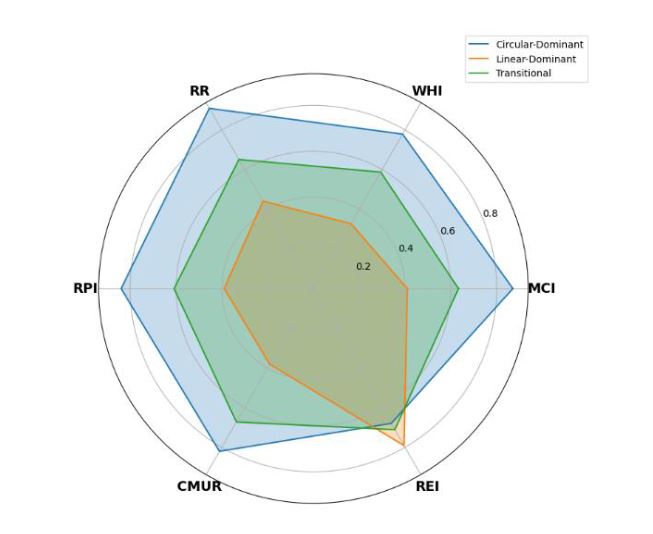
This study aims to analyze and classify patterns of circular economy systems across different economic sectors. It integrates secondary data analysis with machine learning techniques. To date, no prior study has systematically linked circular economy (CE) indicators with both economic sectors and types of waste. The research utilizes secondary data from 877 research articles indexed in the Scopus database published between 2010 and 2024. Six key CE indicators are examined, including the material circularity indicator (MCI), waste hierarchy index (WHI), recycling rate (RR), reuse potential index (RPI), resource efficiency indicator (REI), and circular material use rate (CMUR). Principal Component Analysis (PCA) and K-Means Clustering are applied to identify distinct patterns within the dataset. The findings reveal that the agriculture and food industries are strongly represented in the "circular-dominant" cluster, while the construction and metallurgy sectors are primarily associated with the "linear-dominant" cluster, which exhibits limitations in circular performance. However, the analysis faced certain limitations, including data imbalance across sectors and inconsistencies in indicator definitions. These insights can support the design of sector-specific circular economy policies and contribute to the development of recommendation systems for selecting appropriate indicators based on waste types and industrial contexts. The results serve as a foundation for accelerating the practical transition toward a circular economy.
References
M. Azizuddin, A. Shamsuzzoha, and S. Piya, “Influence of circular economy phenomenon to fulfil global sustainable development goal: Perspective from Bangladesh,” Sustainability, vol. 13, no. 20, Oct. 2021, Art. No. 11455, doi: 10.3390/su132011455.
A. de Pascale et al., “The circular economy implementation at the European Union level. Past, present and future,” Journal of Cleaner Production, vol. 423, Oct. 2023, Art. no. 138658, doi: 10.1016/j.jclepro.2023.138658.
ฐิติกร หมายมั่น, ชำนาญ ทองมาก, บัณฑิต รัตนไตร, และ ฐานิสร โรจนดิลก. "โมเดลเศรษฐกิจ BCG เพื่อการพัฒนาที่สมดุลและยั่งยืน" วารสารวิชาการมหาวิทยาลัยอีสเทิร์นเอเชีย (สังคมศาสตร์และมนุษยศาสตร์), ปีที่ 13, ฉบับที่ 2, หน้า 14–27, พ.ค.–ส.ค. 2566 [ออนไลน์]. เข้าถึงได้: https://so01.tci-thaijo.org/index.php/EAUHJSocSci/article/download/265111/173729/1016066
B. Corona, L. Shen, D. Reike, J. R. Carreón, and E. Worrell, “Towards sustainable development through the circular economy—A review and critical assessment on current circularity metrics,” Resources, Conservation and Recycling, vol. 151, Dec. 2019, Art. no. 104498, doi: 10.1016/j.resconrec.2019.104498.
Z. Kowalski, J. Kulczycka, M. Banach, and A. Makara, “A complex circular-economy quality indicator for assessing production systems at the micro level,” Sustainability, vol. 15, no. 18, Sep. 2023, Art. no. 13495, doi: 10.3390/su151813495.
G. Moraga et al., “Circular economy indicators: What do they measure?,” Resources, Conservation and Recycling, vol. 146, pp. 452–461, Jul. 2019, doi: 10.1016/j.resconrec.2019.03.045.
A. Pires and G. Martinho, “Waste hierarchy index for circular economy in waste management,” Waste Management, vol. 95, pp. 298–305, Jul. 2019, doi: 10.1016/j.wasman.2019.06.014.
M. Haupt, C. Vadenbo, and S. Hellweg, “Do we have the right performance indicators for the circular economy?: Insight into the swiss waste management system,” Journal of Industrial Ecology, vol. 21, no. 3, pp. 615–627, Oct. 2016, doi: 10.1111/jiec.12506.
J. Y. Park and M. R. Chertow, “Establishing and testing the ‘reuse potential’ indicator for managing wastes as resources,” Journal of Environmental Management, vol. 137, pp. 45–53, May. 2014, doi: 10.1016/j.jenvman.2013.11.053.
G. Moraga, S. Huysveld, S. De Meester, and J. Dewulf, “Resource efficiency indicators to assess circular economy strategies: A case study on four materials in laptops,” Resources, Conservation and Recycling, vol. 178, Feb. 2022, Art. no. 106099, doi: 10.1016/j.resconrec.2021.106099.
CE Monitor, “Circular Material Use Rate (CMURR).” Circular Flanders. Accessed: May. 1, 2025. [Online]. Available: https://cemonitor.be/en/indicator/circularity/r-strategies/circular-material-use-rate-cmur/
Z. Farshadfar, T. Mucha, and K. Tanskanen, “Leveraging machine learning for advancing circular supply chains: A systematic literature review,” Logistics, vol. 8, no. 4, Oct. 2024, Art. no. 108, doi: 10.3390/logistics8040108.
S. L. Nañez Alonso, R. F. Reier Forradellas, O. Pi Morell, and J. Jorge-Vazquez, “Digitalization, circular economy and environmental sustainability: The application of artificial intelligence in the efficient self-management of waste,” Sustainability, vol. 13, no. 4, Feb. 2021, Art. no. 2092, doi: 10.3390/su13042092.
H. H. Chin, P. S. Varbanov, F. You, F. Sher, and J. J. Klemeš, “Plastic circular economy framework using hybrid machine learning and pinch analysis,” Resources, Conservation and Recycling, vol.184, Sep. 2022, Art. no. 106387, doi: 1016/j.resconrec.2022.106387.
G. Liu, J. Yang, Y. Hao, and Y. Zhang, “Big data-informed energy efficiency assessment of China industry sectors based on K-means clustering,” Journal of Cleaner Production, vol. 183, pp. 304–314, May. 2018, doi: 10.1016/j.jclepro.2018.02.129.
M. Chaudhry, I. Shafi, M. Mahnoor, D. L. R. Vargas, E. B. Thompson, and I. Ashraf, “A systematic literature review on identifying patterns using unsupervised clustering algorithms: A data mining perspective,” Symmetry, vol. 15, no. 9, Aug. 2023, Art. no. 1679, doi.10.3390/sym15091679.
S. Licen, A. Astel, and S. Tsakovski, “Self-organizing map algorithm for assessing spatial and temporal patterns of pollutants in environmental compartments: A review,” Science of The Total Environment, vol. 878, Jun. 2023, Art. no. 163084, doi: 10.1016/j.scitotenv.2023.163084.
เจนจิรา สุภาใส และ นิภาพร ชนะมาร, “การจัดกลุ่มข้อมูลเศรษฐกิจครัวเรือนด้วยการประยุกต์ใช้เทคนิคการจัดกลุ่มแบบ K-Means Clustering Clustering,” วารสารวิทยาศาสตร์ วิศวกรรมศาสตร์ และเทคโนโลยี, ปีที่ 3, ฉบับที่ 1, หน้า 1–12, ม.ค.–มิ.ย., 2566. [ออนไลน์]. เข้าถึงได้: https://ph02.tci-thaijo.org/index.php/JSET/article/view/247693
K. Gomonov, S. Ratner, I. Lazanyuk, and S. Revinova, “Clustering of EU countries by the level of circular economy: An object-oriented approach,” Sustainability, vol. 13, no. 13, Jun. 2021, Art. no. 7158, doi: 10.3390/su13137158.
F. Kamalov, H. Sulieman, A. Alzaatreh, M. Emarly, H. Chamlal, and M. Safaraliev, “Mathematical methods in feature selection: A review,” Mathematics, vol. 13, no. 6, Mar. 2025, Art. no. 996, doi: 10.3390/math13060996.
L. R. Kaufman and P. Rousseeuw, Finding Groups in Data: An Introduction to Cluster Analysis. Hoboken, NY: John Wiley & Sons Inc., 2005.
UCLA Statistical Consulting Group, Exploratory factor analysis (EFA) with SPSS [Online]. Available: https://stats.oarc.ucla.edu/wp-content/uploads/2020/05/pca-efa-V12.pdf
I. Marjanović, J. J. Stanković, J. Östh, M. Marković, and M. Stanojević, “Insight into territorial efficiency of circular economy through data envelopment analysis,” Frontiers in Environmental Science, vol. 13, Apr. 2025, Art. no. 1494184, doi: 10.3389/fenvs.2025.1494184.
S. Krämer and S. Engell, Improving Resource Efficiency in Process Plants: Monitoring and Improvement. Wiley-VCH Verlag GmbH & Co. KGaA, Weinheim, 2017.
X. Tong, T. Wang, J. Li, and X. Wang, “Extended producer responsibility to reconstruct the circular value chain,” Circular Economy, vol. 3, no. 1, Feb. 2024, Art. no. 100076, doi: 10.1016/j.cec.2024.100076.
อดิศร์ อิศรางกูล ณ อยุธยา, ปริญญารัตน์ เลี้ยงเจริญ, เกศินี ธารีสังข์, กาญจนา ย่าเสน, และ ทิพวัลย์ แก้วมีศรี, “นโยบายการเกษตรเพื่อรองรับ BCG,” สถาบันวิจัยเพื่อการพัฒนาประเทศไทย (TDRI). เข้าถึงเมื่อ: 13 มิถุนายน 2568. [ออนไลน์]. เข้าถึงได้: https://tdri.or.th/2023/03/bio-circular-green/
มูลนิธิสถาบันสิ่งแวดล้อมไทย, “การขับเคลื่อนการดำเนินงาน BCG Implementation เรื่อง การพัฒนาตัวชี้วัดและฐานข้อมูลด้าน CO2, CE, SDG เพื่อการค้าและความยั่งยืน,” มูลนิธิสถาบันสิ่งแวดล้อมไทย. เข้าถึงเมื่อ: 13 มิถุนายน 2568. [ออนไลน์]. เข้าถึงได้: https://www.tei.or.th/th/environment_news_detail.php?eid=2901
Downloads
Published
How to Cite
Issue
Section
Categories
License
Copyright (c) 2025 NKRAFA JOURNAL OF SCIENCE AND TECHNOLOGY

This work is licensed under a Creative Commons Attribution-NonCommercial-NoDerivatives 4.0 International License.
- Content and information in articles published in NKRAFA Journal of Science and Technology are comment and responsibility of authors of articles directly. Journal editorial do no need to agree or share any responsibility.
- NKRAFA Journal of Science and Technology Articles holds the copyright of the content, pictures, images etc. which published in it. If any person or agency require to reuse all or some part of articles, the permission must be obtained from the NKRAFA Journal of Science and Technology.