Development of Mathematical Models to Analyze the Impact of Geometric Small-Scale Building Designs on Energy Efficiency: A Case Study at Navaminda Kasatriyadhiraj Royal Air Force Academy, Muak Lek
Keywords:
Mathematical Model, Finite Element Method, Geometric BuildingAbstract
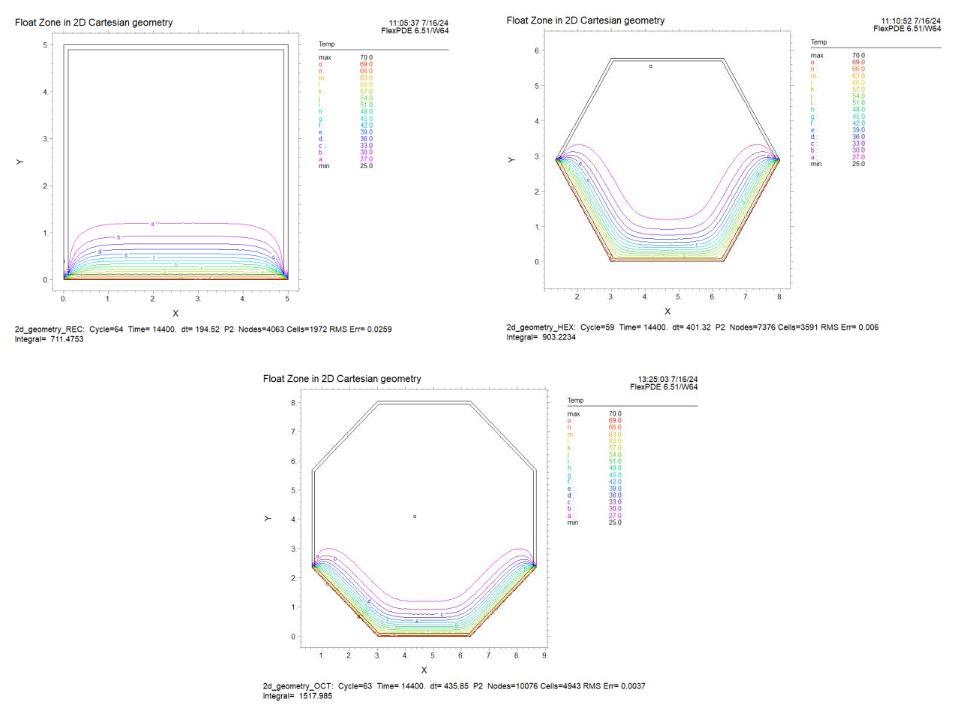
This research presents a mathematical model for evaluating the internal temperature of buildings with symmetrical geometric cross-sections, including rectangles, hexagons, and octagons. It examines scenarios where the cross-sectional areas or perimeters are equal. The study focuses on the transfer of heat from the outside to the inside, with walls and indoor air as the mediums. Results are presented as contour plots that depict heat diffusion levels within the building, along with temperature distribution graphs values based on reference points. The results suggest that the internal temperature is more significantly affected by the direction of sunlight than by the type of building.
References
วิศรุต คล้ายแจ้ง และ นพรัตน์ โพธิ์ชัย, “การจำลองแบบเชิงคณิตศาสตร์ของการถ่ายเทความร้อนจากผนังภายนอกสู่ผนังภายในอาคารโดยใช้วัสดุคอนกรีตมวลเบาคอนกรีตมอญและคอนกรีตบล็อก,” วารสารวิทยาศาสตร์และเทคโนโลยีนายเรืออากาศ, ฉบับที่ 15, หน้า 9-18, 2562.
วิศรุต คล้ายแจ้ง, นพรัตน์ โพธิ์ชัย และ สมภูมิ มีชาวนา, “การจำลองแบบเชิงคณิตศาสตร์ของการถ่ายเทความร้อนจากผนังภายนอกสู่ผนังภายในอาคารโดยใช้วัสดุคอนกรีตมวลเบาคอนกรีตมอญและคอนกรีตบล็อก,” วารสารวิทยาศาสตร์และเทคโนโลยีนายเรืออากาศ, ฉบับที่ 18, 2563.
วรากรณ์ พูลจันทร์, เทียนสิริ เหลืองวิไล, วีระพล วิลามาศ, สมภูมิ มีชาวนา, สุภาวดี ลีลายุทธ และ สามารถ หมุดและ, “การวิเคราะห์พฤติกรรมการถ่ายเทความร้อนผ่านผนังอาคารเมื่อใช้วัสดุปิดผิวที่ต่างกันโดยใช้ระเบียบวิธีของแถว,” วารสารวิทยาศาสตร์และเทคโนโลยีนายเรืออากาศ, ฉบับที่ 17, หน้า 1-10, 2564.
S. T. Tulus, S. Suwaluddin, and T.J. Marpaung, “Optimization temperature in the Room using air conditioner with finite element methods,” in The 3rd Annual Applied Science and Engineering Conference (AASEC 2018), 2018.
Z. Hongxia, F. Ake, and O. Thomas, An Explicit Finite Element Method for Thermal Simulations Buildings with Phase Change Materials, Energies. 2021.
ปราโมทย์ เตชะอำไพ, ไฟไนเอลิเมนต์ในงานวิศวกรรม. พิมพ์ครั้งที่ 2. กรุงเทพมหานคร: สำนักพิมพ์จุฬาลงกรณ์มหาวิทยาลัย, 2542.
K. Kant, A Shukla and Sharma, “Heat transfer studies of building brick containing phase change materials,” Solar Energy, vol. 155, pp. 1233-1242, October 2017.
Downloads
Published
How to Cite
Issue
Section
Categories
License
Copyright (c) 2025 NKRAFA JOURNAL OF SCIENCE AND TECHNOLOGY

This work is licensed under a Creative Commons Attribution-NonCommercial-NoDerivatives 4.0 International License.
- Content and information in articles published in NKRAFA Journal of Science and Technology are comment and responsibility of authors of articles directly. Journal editorial do no need to agree or share any responsibility.
- NKRAFA Journal of Science and Technology Articles holds the copyright of the content, pictures, images etc. which published in it. If any person or agency require to reuse all or some part of articles, the permission must be obtained from the NKRAFA Journal of Science and Technology.