Improving the Production Process of Curry Puff Products to Enhance the Sustainable Potential of Mae Baan Tapon Noi Community Enterprise, Khlung District, Chanthaburi Province
Keywords:
Production Process, Curry Puff Product, Community Enterprise, ECRSAbstract
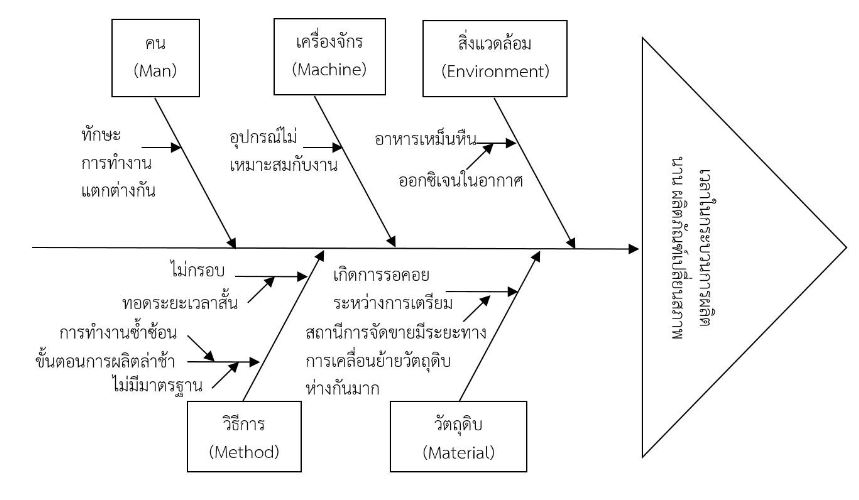
The analysis of the curry puff production process of Mae Baan Tapon Noi Community Enterprise, Khlung District, Chanthaburi Province, using a fishbone diagram found that the main causes were that when the curry puffs were sold, the products were not crispy and there was an excessive waiting time. Therefore, the objective of this research was to study and improve the curry puff production process. From the study and analysis of the production process using a process flow diagram, it was found that it took a total of 14 hours and 15 minutes to produce 30 pieces. Improvements were made based on the ECRS principle, focusing particularly on the filling preparation stage. As a result, the time required for this stage was reduced by 72.30% of the original duration. The production process was revised and divided into two steps: 1) the twice-frying process and 2) the baking process. These two methods were evaluated through sensory quality evaluation method. The results showed that the twice-frying process received the highest overall preference, with an average score of 7.15. The moisture values of the traditional, twice-frying, and baked processes were 13.97, 13.10, and 12.70, respectively. The water activity values of the traditional, twice-frying, and baked processes were 0.787, 0.811, and 0.775, respectively. Therefore, the twice-frying process was selected for the curry puff product manufacturing process.
References
สุพัตรา เลิศวณิชย์วัฒนา, เพ็ญขวัญ ชมปรีดา, วิชัย หฤทัยธนาสันติ์ และกล้าณรงค์ ศรีรอต, การพัฒนาผลิตภัณฑ์กะหรี่ปั๊บจากแป้งสาลีผสมแป้งข้าวหอมมะลิ. ใน การประชุมทางวิชาการมหาวิทยาลัยเกษตรศาสตร์ ครั้งที่ 41, สำนักงานกองทุนสนับสนุนการวิจัย, กรุงเทพมหานคร, 3-7 กุมภาพันธ์, 2546, น. 323-330.
วิจิตรา เหลียวตระกูล และวชิรญา เหลียวตระกูล, “การพัฒนาผลิตภัณฑ์ปลาสลิดแดดเดียวทอดอบกรอบโดยใช้ตู้อบลมร้อน,” วารสารวิทยาศาสตร์และเทคโนโลยี มหาวิทยาลัยราชภัฏอุดรธานี. ปีที่ 9, ฉบับที่ 2, หน้า 35-47, 2564.
มินดา สุวรรณ, ทิพวรรณ วรรณะ, วันชัย สมบัติทอง, สุวิจักขณ์ เส้งสุข และฐิติมาพร ศรีรักษ์, “ผลของชนิดน้ำตาลและการควบคุมคุณภาพการผลิตต่อการยอมรับขนมเจาะหู,” วารสารเทคโนโลยีคหกรรมศาสตร์ มหาวิทยาลัยเทคโนโลยีราชมงคลพระนคร, ปีที่ 5, ฉบับที่ 1, หน้า 47-58, มกราคม-มิถุนายน, 2566.
วิชญา จันทนา และวัชรพจน์ ทรัพย์สงวนบุญ, “การปรับปรุงประสิทธิภาพกระบวนการผลิตเซรามิค: กรณีศึกษา โรงงานในจังหวัดสมุทรปราการ,” วารสารวิทยาการจัดการ มหาวิทยาลัยสงขลานครินทร์, ปีที่ 37, ฉบับที่ 2, หน้า 58-83, กรกฎาคม–ธันวาคม, 2563.
วันรัตน์ จันทกิจ, 17 เครื่องมือนักคิด. พิมพ์ครั้งที่ 8. กรุงเทพมหานคร: สถาบันเพิ่มผลผลิตแห่งชาติ, 2553.
ปรียามาศ มณีวรรณ, “การประยุกต์ใช้ระบบอัตโนมัติในกระบวนการบรรจุผลิตภัณฑ์ กรณีศึกษาโรงงานผลิตแผงวงจรไฟฟ้าแบบยืดหยุ่น,” วิทยานิพนธ์มหาบัณฑิต, มหาวิทยาลัยธรรมศาสตร์, กรุงเทพมหานคร, 2560.
มินดา สุวรรณ, ทิพวรรณ วรรณะ, วันชัย สมบัติทอง, สุวิจักขณ์ เส้งสุข และฐิติมาพร ศรีรักษ์, “ผลของชนิดน้ำตาลและสภาวะการทอดต่อการยอมรับขนมเจาะหู,” วารสารเทคโนโลยีคหกรรมศาสตร์ มหาวิทยาลัยเทคโนโลยีราชมงคล, ปีที่ 5, ฉบับที่ 1, หน้า 47-58, มกราคม-มิถุนายน, 2566.
ศูนย์วิจัยและพัฒนานวัตกรรมสินค้าเกษตรและอาหารภาคตะวันออก, “การทดสอบทางประสาทสัมผัส ค่าความชื้น และค่าวอเตอร์แอคติวิตี้,” [ออนไลน์]. Available: http://www.classforecast.rbru.ac.th. (เข้าถึงเมื่อ: 19 กันยายน 2567).
P. P. Lewicki, “Water as the determinant of food engineering properties” A review Journal of Food Engineering, vol. 61, no. 4, pp. 483-495, March 2004.
J. M. Kim, J. H. Choi, Y. S. Choi and D. J. Han, “Effects of frying time and temperature on formation of acrylamide and sensory evaluation in french fries” Korean Journal of Food Science and Technology, vol. 41, no. 4, pp. 471-475. January 2009.
S. Sahin and S. G. Sumnu, Advances in deep-fat frying of foods, 1st ed, Ireland: CRC press, 2009, 10-16.
Downloads
Published
How to Cite
Issue
Section
License
Copyright (c) 2025 NKRAFA JOURNAL OF SCIENCE AND TECHNOLOGY

This work is licensed under a Creative Commons Attribution-NonCommercial-NoDerivatives 4.0 International License.
- Content and information in articles published in NKRAFA Journal of Science and Technology are comment and responsibility of authors of articles directly. Journal editorial do no need to agree or share any responsibility.
- NKRAFA Journal of Science and Technology Articles holds the copyright of the content, pictures, images etc. which published in it. If any person or agency require to reuse all or some part of articles, the permission must be obtained from the NKRAFA Journal of Science and Technology.