Kinder Bot for Early Childhood Learning
Keywords:
Teaching robot, teaching, Educational Technology, Early Childhood DevelopmentAbstract
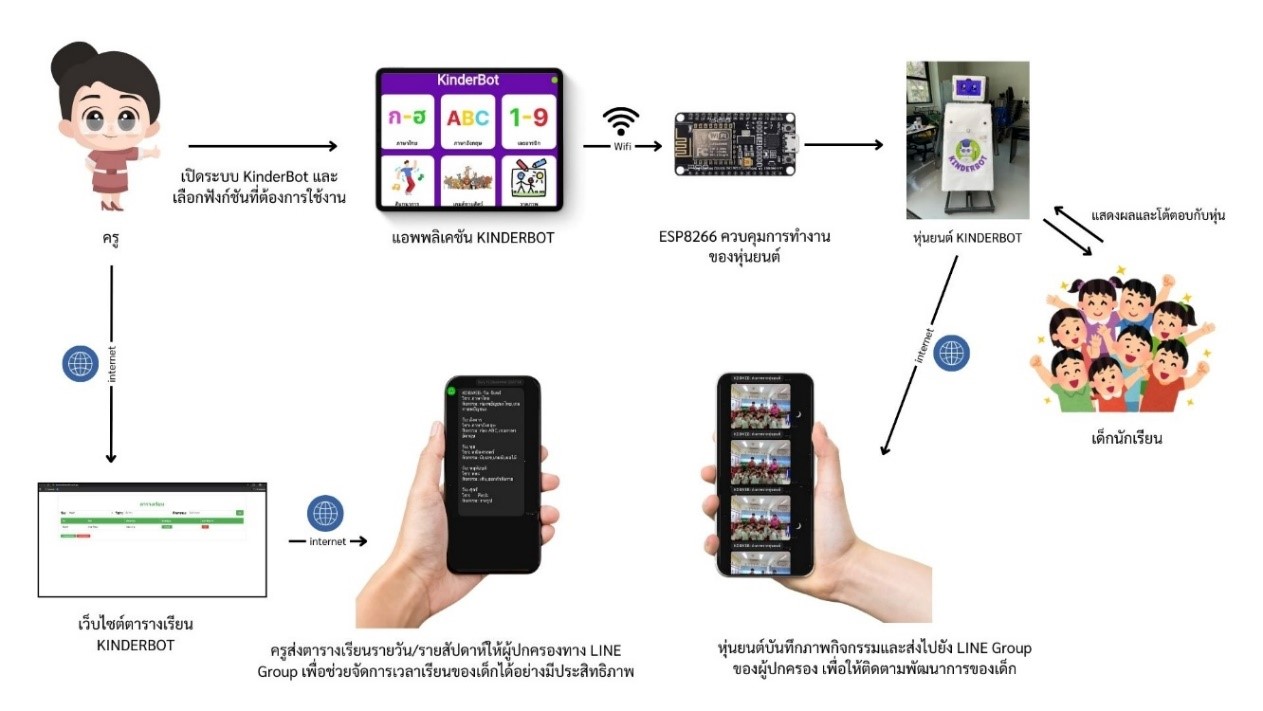
This research aimed to develop Kinder Bot, an educational robot designed for early childhood learners. The study involved 10 second-level kindergarten students and three teachers from Tessaban 4 Chalong Rat School in Nong Khai Province. Participants were selected through purposive sampling and voluntarily participated in using the Kinder Bot. The research instruments included a robot prototype, performance tests for each of its functions, and a quantitative user satisfaction questionnaire. Data were analyzed using mean and standard deviation. Results showed that: 1) Kinder Bot comprises three key components: (1) a central control unit responsible for managing the robot's internal mechanisms; (2) an application used as a teaching material and for controlling the robot’s arm and body movement, which is an approach commonly adopted to enhance control and accessibility; and (3) the robot operation integrated with the Internet to enable remote operation. 2) The performance evaluation, based on its core functionalities, including movement control of both arms, sensor-based detection during operation, touchscreen usability, photo capture and transmission via LINE, and sending class schedules to
parents via LINE, demonstrated 100% accuracy. 3) The user satisfaction survey on the Kinder Bot was rated at the highest level.
References
จุรีพร มุลนี. (2565). ประสิทธิภาพการจัดการเรียนการสอนของครูในศตวรรษที่ 21 ของสำนักงานเขตพื้นที่การศึกษาประถมศึกษาชลบุรี เขต 1. ค้นจาก https://art.krirk.ac.th/wp-content/uploads/sites/6/2022/06/2.pdf
ชธีรพันธุ์เมธี ป. (2565). การพัฒนาสื่อการเรียนการสอนโดยใช้เทคโนโลยีเสมือนจริงเพื่อเพิ่มประสิทธิภาพการเรียนรู้ของนักเรียน. วารสารศิลปศาสตร์และวิทยาการจัดการ มหาวิทยาลัยราชภัฏบ้านสมเด็จเจ้าพระยา, 19(1), 45–56.
ศูนย์เทคโนโลยีการศึกษา มหาวิทยาลัยสุโขทัยธรรมาธิราช. (2565). การใช้สื่อเทคโนโลยีสารสนเทศในการจัดการเรียนการสอน. ค้นจาก https://ir.stou.ac.th/bitstream/123456789/12072/1/FULLTEXT.pdf
Brown, C. P., et al. (2023). First-year teachers’ challenges with implementing developmentally appropriate practices in their public school classrooms. Journal of Research in Childhood Education, 38(1), 104–122. doi:10.1080/02568543.2023.2190787
EF Education First. (2018). EF English Proficiency Index. Retrieved from https://www.ef.co.th/epi/regions/asia/thailand/
Fisher-Price. (2021). The Future of Learning Through Play: Embracing Digital Tools for Early Education. Retrieved from https://www.fisher-price.com
Grosch, M. (2017). Educational robotics: Opportunities for the future of education. International Journal of Advanced Computer Science and Applications, 8(11), 1–6.
Houtman, E. (2012). Robots in early childhood education: Preparing children for a changing world. Journal of Early Childhood Research, 10(1), 3–14. doi:10.1177/1476718X11407993
Kewalramani, S., Havu-Nuutinen, S., and Rintakorpi, K. (2020). Enhancing creativity through robotics in early years learning: A study in STEAM education. Early Child Development and Care, 190(15), 2369–2380. doi:10.1080/03004430.2019.1574777
Lee, J., Kim, H., and Park, S. (2018). Development of a robot-based learning system to enhance problem-solving skills in children. International Journal of Social Robotics, 10(3), 345–356. doi: 1007/s12369-018-0476-5
National Association for the Education of Young Children. (2022). Developmentally appropriate practice in early childhood programs serving children from birth through age 8 (4th ed.). NAEYC. Retrieved from https://www.naeyc.org/resources/pubs/books/dap-fourth-edition?utm_source
Patil, S. B., and Kale, A. (2017). Application of robotics in education. International Journal of Research in Advent Technology, 5(6), 60–63.
VEX Robotics. (2024). STEM education with VEX Robotics. Retrieved from https://www.vexrobotics.com/
Downloads
Published
Issue
Section
License
Copyright (c) 2025 Loei Rajabhat University

This work is licensed under a Creative Commons Attribution-NonCommercial-NoDerivatives 4.0 International License.
บทความที่ได้รับการตีพิมพ์